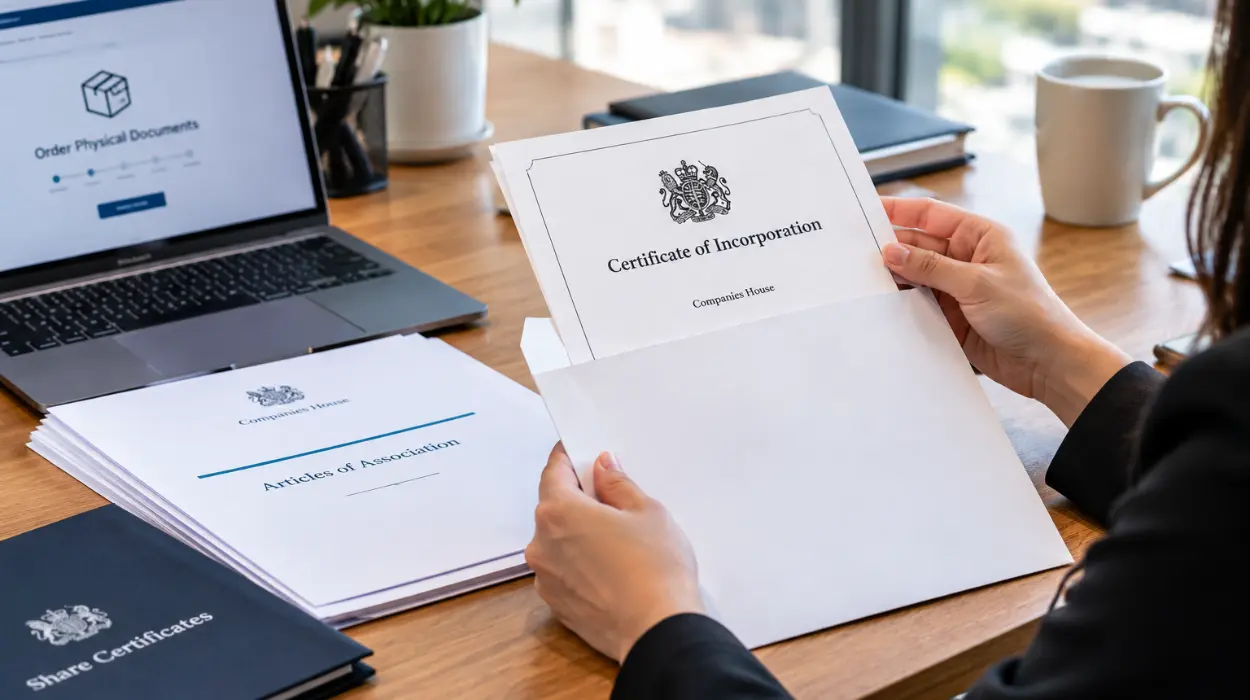
Register a UK private limited company online with Companies House, appoint directors, provide a registered UK address, and submit the Articles of Association.
Register the company using Form IN01 or Companies House online incorporation. Appoint at least one director and one person with significant control (PSC). Provide a UK service address or use a registered office provider. File the Articles of Association and state the share capital and shareholder details. Pay the incorporation fee and obtain a Companies House registration number.
Explain corporate identity, tax registration, and official records. Once incorporated, register for Corporation Tax with HMRC within three months of starting the business. Keep statutory registers for directors, shareholders, and PSCs. Maintain annual Confirmation Statements and file Annual Accounts with Companies House on schedule. Use professional company formation services to ensure correct document formats and timely filings.
What identification and verification do UK banks require?
Provide certified passport scans, two proof-of-address documents, an international source-of-funds statement, and company documents verified under UK KYC rules.
UK banks require identity verification for each director and beneficial owner. Typical documents include a valid passport, a national ID if applicable, and two recent proofs of address (utility bill, bank statement, or government letter dated within three months). Banks request certified copies or verification through regulated agents. They also require a recent biography or CV for directors in some cases.
Banks also validate the company registration and shareholder structure using Companies House data. Provide the certificate of incorporation, Articles of Association, and a Company Register extract. Prepare a source-of-funds statement showing business revenue, contracts, or capital origins. Expect enhanced due diligence for higher-risk jurisdictions like Djibouti, including bank reference letters and transaction history for personal accounts.
Read our articles, How Djibouti Residents Can Navigate Banking and Compliance When Opening a UK Company and UK Company Banking and Compliance Guide for Djibouti Entrepreneurs.
How do you open a UK business bank account from Djibouti?
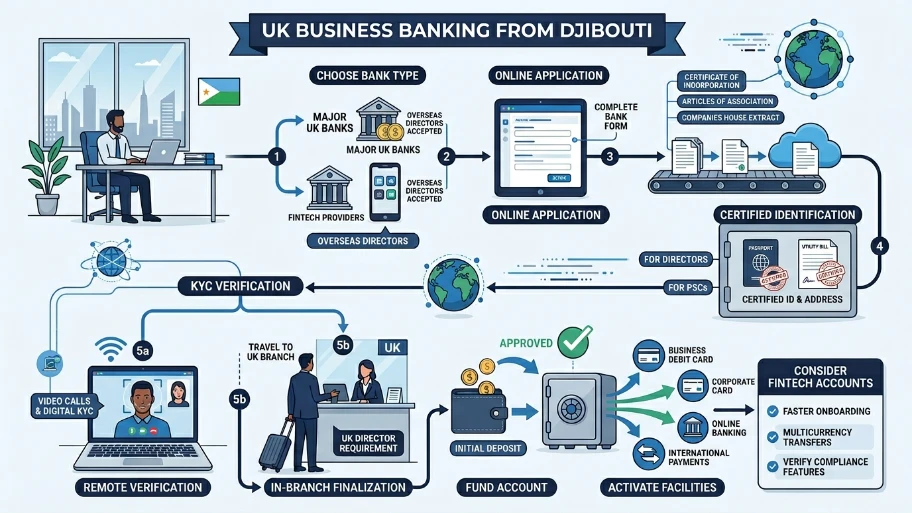
Submit company incorporation documents, certified ID, proof of address, and a completed bank account application; complete remote or in-branch KYC and fund the account to activate services.
Choose a bank offering non-resident business accounts. Major UK banks and fintech providers accept overseas directors but vary in process. Start by completing the bank’s commercial account application online. Upload the certificate of incorporation, Articles, and a Companies House extract. Provide certified identity and address documents for directors and PSCs.
Expect either remote verification via video calls or travel to a UK branch for face-to-face KYC. Some banks mandate a UK-based director or director visits for final verification. Fund the account with an initial deposit once approved. Request business debit and corporate card facilities, online banking, and international payment capabilities. Consider fintech accounts for faster onboarding and multicurrency transfers; verify limits and compliance features before choosing.
Which UK banks and fintechs support non-UK resident company owners?
Select banks with explicit non-resident business account policies or licensed fintech providers offering remote onboarding and multicurrency support.
High-street banks with international business teams accept non-resident owners selectively: Barclays International, HSBC UK, and NatWest have established international client services. Each bank applies bespoke KYC policies and may ask for additional checks. Fintech providers such as Revolut Business, Tide, and Wise Business offer faster remote onboarding and multicurrency accounts, but they enforce transaction monitoring and KYC limits.
Compare fees, international transfer costs, FX spreads, and integration with accounting software. Prioritise providers that support CHAPS, SWIFT, and direct debit if you need UK payment rails. Confirm whether the provider offers GBP merchant services and multi-user access for accountants. Verify provider eligibility for Djibouti residents before applying.
What compliance and tax obligations arise after formation?
Register for Corporation Tax with HMRC, file annual accounts and Confirmation Statements, and comply with UK AML and VAT obligations as applicable.
Register the company for Corporation Tax within three months of commencing business. Prepare statutory annual accounts and file them with Companies House. Submit a Confirmation Statement yearly to confirm director and shareholder details. Appoint an accountant to calculate tax liabilities and submit a Company Tax Return.
Comply with UK anti-money-laundering (AML) rules: maintain client due diligence records and report suspicious activity to the National Crime Agency when required. If taxable turnover exceeds the VAT threshold (currently £85,000), register for VAT and file regular VAT returns. Keep payroll records and register for PAYE if hiring UK employees. Retain all corporate records for at least six years.
How do you handle international payments and currency management?
Set up multicurrency accounts, use FX hedging for large payments, and enable GBP payment rails (CHAPS, Faster Payments, SWIFT) for reliable transfers.
Open a multicurrency account or use a UK bank plus a specialist FX provider. Use GBP accounts to receive UK payments and reduce conversion friction. For regular cross-border receipts, enable SWIFT and provide beneficiaries with IBAN or sort code/account number as needed. Use FX forward contracts to fix rates for future invoices when you expect large currency exposure.
Monitor transaction fees and FX spreads. Use payment APIs for automated reconciliation with accounting systems. Implement two-step authentication for online banking and restrict user access by role to reduce fraud.
What risks and restrictions should Djibouti residents expect?
Anticipate enhanced due diligence, longer onboarding timelines, and occasional refusal based on perceived country risk or incomplete documentation.
UK banks apply enhanced due diligence for clients from higher-risk jurisdictions. Expect detailed source-of-funds checks, bank reference letters, and evidence of ongoing business activity. Remote onboarding can take 2–8 weeks, depending on document certification and additional checks. Some banks refuse accounts if they assess an unacceptable risk level.
Mitigate risk by preparing complete, certified documentation, maintaining transparent corporate structures, and using regulated intermediaries for document certification. Engage a UK-registered director or corporate services provider to reduce friction. Retain clear transaction records and professional contracts to substantiate business activities.
Explore our Chinese guide,
Start Your UK Company from China with Form My Company
How does Form My Company support Djibouti entrepreneurs?
Form My Company handles UK incorporation, registered address provision, compliance filing, and banking introductions to suitable UK providers.
Form My Company registers the company with Companies House and supplies a UK-registered office address. The service prepares incorporation documents and statutory registers. It coordinates compliance filings like Confirmation Statements and Annual Accounts. For banking, Form My Company introduces clients to UK banks and fintechs experienced with non-resident directors and guides KYC packaging.
Form My Company also advises on tax registration and AML documentation. The service streamlines onboarding to reduce delays and improve acceptance rates at banks. Use the service to centralise formation, compliance, and bank introduction tasks for a faster route to live UK banking.
Opening a UK company from Djibouti with full banking support requires correct incorporation, certified KYC for directors and beneficial owners, and clear source-of-funds documentation. Use formation and compliance services to streamline filings and improve bank acceptance. Form My Company provides incorporation, registered office, compliance filings, and tailored bank introductions to help Djibouti entrepreneurs activate UK banking services efficiently.
Frequently Asked Questions
Can I open a UK company from Djibouti as a non-resident?
Yes, non-residents from Djibouti can open a UK private limited company by registering with Companies House, appointing at least one director, and providing a UK registered address. From My Company streamlines this process and ensures all incorporation documents meet UK compliance requirements for Djibouti entrepreneurs.
What banking options are available to UK companies owned by Djibouti residents?
UK companies owned by Djibouti residents can open business accounts with major UK banks or fintech providers like Revolut Business, Tide, or Wise that support non-resident directors. From My Company provides banking introductions to suitable UK providers and helps package KYC documentation for Djibouti-based applicants.
What documents do UK banks require for Djibouti company directors?
UK banks require certified passport copies, two recent proof-of-address documents, a source-of-funds statement, and company documents such as the certificate of incorporation and Articles of Association. From My Company assists Djibouti directors in preparing compliant KYC packages that meet UK anti-money-laundering and identity verification standards.
How long does it take to open a UK company and bank account from Djibouti?
UK company incorporation typically takes 24–48 hours via Companies House, while business bank account onboarding for Djibouti residents usually takes 2–8 weeks due to enhanced due diligence. From My Company accelerates both steps by pre-validating documents and connecting Djibouti entrepreneurs with banks experienced in non-resident onboarding.
Do I need to visit the UK to register a company or open a bank account from Djibouti?
You do not need to visit the UK to register a company, as incorporation is fully remote via Companies House. However, some UK banks may require in-person KYC verification or a director visit for final account approval, though many fintechs offer complete remote onboarding for Djibouti residents. From My Company guides clients through remote options and prepares documentation to minimize travel requirements.