
Bank holidays shift payment dates and clearances, requiring payroll runs earlier to ensure on-time pay and HMRC reporting.
Payroll processing depends on bank clearing cycles. UK bank transfers commonly clear on the next banking business day. If a normal pay date falls on a bank holiday, employers must pay earlier or arrange cleared funds beforehand. Employers must also ensure Real Time Information (RTI) submissions to HMRC align with adjusted pay dates to avoid penalties. Set payroll cut-off at least two working days earlier when using BACS; use same-day faster payments when available but confirm provider cut-off times.
Payroll teams must validate pay runs for 1) salaried staff with fixed pay, 2) hourly staff with variable hours, and 3) contingent workers with irregular pay. For hourly and irregular workers, recalculate holiday pay using statutory formulas based on the previous 52 weeks or an agreed method in the contract. Example: calculate an irregular worker’s holiday pay using the 52-week average, excluding weeks with zero pay per HMRC guidance.
How do bank holidays affect statutory pay calculations?
Bank holidays count as leave if the contract specifies them; statutory pay averages must include pay for bank holiday weeks when relevant.
Statutory payments such as Statutory Sick Pay (SSP), Statutory Maternity Pay (SMP), and statutory holiday pay use earnings and leave records. If a contract grants bank holidays as paid leave, include those days in the employee’s leave entitlement and pay. For workers without contractual bank holiday entitlement, treat the days as unpaid unless staff take annual leave.
For holiday pay for irregular hours, apply the 52-week average asbestos: compute total pay over 52 weeks divided by 52. Exclude weeks with zero pay only when the worker did not work due to maternity, statutory leave, or other specified absences. Record the calculation and retain documentation for three years to meet HMRC audit standards.
Read our articles, UK Bank Holidays 2026: Business Planning Guide and Start and Plan Your UK Business Around 2026 Bank Holidays.
How should employers schedule payroll around bank holidays?
Employers must set and communicate a revised pay schedule at least one payroll cycle before the holiday, process pay runs earlier, and confirm bank cut-off times.
Create a payroll calendar covering all 2026 bank holidays and incorporate processing buffer days. Communicate the adjusted pay dates to staff two to four weeks in advance. Coordinate with banks or payroll providers to understand BACS and Faster Payments cut-off times. For BACS payments, process two working days before the intended payment; for CHAPS or Faster Payments, confirm same-day availability and fees.
Automate payroll where possible and implement a holiday-led checklist: freeze wage changes 48 hours before pay run; confirm timesheets 72 hours before; run exception reports 48 hours before. Maintain contingency funds to cover advances if staff request earlier pay due to the holiday.
How do bank holidays affect operational staffing and rostering?
Bank holidays increase staffing demand for retail, hospitality, and logistics, so employers must publish rosters early, offer premium pay or time off, and comply with working time rules.
Certain sectors experience 20–60% higher demand on bank holidays; plan rosters based on historical sales and footfall data. Publish rotas at least 14 days before the holiday to comply with best practice and reduce churn. Offer opt-in shifts, overtime pay rates, or time-off-in-lieu according to contract terms and the Working Time Regulations.
Ensure rest breaks and weekly rest periods still meet legal minimums. For night workers or those approaching 48-hour weekly average limits, adjust hours across the payroll period to remain compliant. Track accrued holiday and TOIL precisely, and document employee agreement for substituted days or enhanced pay rates.
How should businesses handle overtime and premium rates for bank holidays?
Employers must follow contractual terms: apply agreed premium rates or compensate with time off; update payroll rules to pay premiums and tax/NIC correctly.
Check employment contracts and collective agreements for bank holiday pay entitlements. If contracts grant time-and-a-half, double time, or fixed premiums, implement those rules in payroll software. Record premium pay separately in payroll codes to ensure accurate National Insurance (NI) and pension contributions. For auto-enrolment pension calculations, include qualifying earnings per the pension scheme rules.
If the employer provides time off instead of premium pay, track TOIL balances and schedule compensatory leave within the agreed period. Ensure payroll reversals or adjustments occur within the same pay period to keep RTI accuracy.
How do bank holidays affect payroll taxes, HMRC reporting, and pensions?
Bank holidays change payment timing but not tax rules; RTI submissions must align to actual pay dates, and pension calculations must include bank-holiday earnings where qualifying.
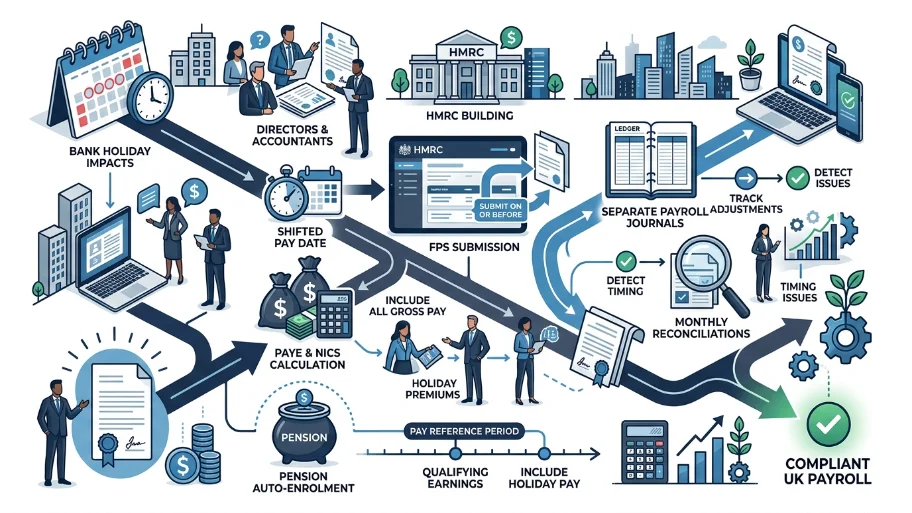
Submit Full Payment Submission (FPS) to HMRC on or before each employee’s pay date. If the pay date moves forward, send the FPS for that earlier date. For National Insurance and PAYE, compute contributions based on gross pay, including premiums. For pension auto-enrolment, include qualifying earnings within the relevant pay reference period; bank-holiday premiums count when they fall within the period.
Maintain separate payroll journals for bank holiday adjustments to simplify reconciliations and HMRC reviews. Reconcile PAYE and NICs monthly to detect timing issues caused by earlier payments.
How should employers manage payroll for contractors and zero-hours staff during holidays?
Treat contractors as self-employed unless employment status tests indicate otherwise; for zero-hours workers, calculate holiday pay using statutory averages and document acceptance.
Contractors paid via invoices remain responsible for their own holiday arrangements. For zero-hours workers designated as workers (not self-employed), apply the 52-week average to calculate holiday pay. Provide written notice of any substitution of bank holidays with other days. Keep records of hours worked and payments for at least three years to support calculations and respond to tribunal claims.
When offering work on bank holidays, obtain written acceptance for ad-hoc shifts to avoid implied contractual changes.
How can payroll systems and processes be optimised for bank holidays?
Automate pay codes for bank-holiday premiums, set calendar alerts, and run test payrolls one week before the holiday to verify totals and tax calculations.
Configure payroll software to flag pay dates that fall on bank holidays. Create pay codes for bank-holiday premium rates, time off in lieu, and holiday pay recalculations. Run a test pay run seven days before the actual pay date. Reconcile test outputs against expected gross-to-net totals. Keep a bank-holiday checklist covering cut-off confirmations, timesheet finalisation, RTI submission, and contingency funding.
Train at least two staff members on emergency payroll processing to cover absences during holiday periods.
Explore our Company Services guide,
UK vs Offshore: Tax Exposure, Credibility, and Banking Access Compared
How do bank holidays influence cash flow and financial planning?
Bank holidays accelerate cash outflows; adjust cash forecasts to account for earlier salary payments and maintain a two-to-four-day reserve for payroll-related liquidity.
Forecast payroll cash needs by listing each declared holiday and its adjusted pay date. Move supplier payments where possible to after the holiday to preserve liquidity. Keep a minimum reserve equal to two payroll cycles or 5–10% of monthly payroll, whichever is higher. Notify banks of large transfers ahead of time to avoid delays. Use short-term facilities or overdraft arrangements for planned liquidity gaps.
Bank holidays affect payroll timing, statutory pay calculations, rostering, tax reporting, pensions, and cash flow. Employers must schedule payroll earlier when required, maintain documented calculations for irregular workers, and publish rotas early for operational continuity. From My Company’s Company Services provides compliance-aligned payroll setup, automated pay-code configuration, and bank-holiday payroll planning to ensure accurate pay, timely HMRC reporting, and stable cash flow during holiday periods.
Frequently Asked Questions
What company services does From My Company offer for UK business setup?
From My Company’s Company Services provides end-to-end UK company formation, including registered office address, director secretarial support, and compliance documentation. The service handles CIN registration, VAT registration setup, and statutory record filing with Companies House.
How quickly can I register a UK company using From My Company’s Company Services?
From My Company’s Company Services, it typically registers a UK company within 24 hours when applications are submitted before the Companies House cut-off. The process includes instant CIN issuance and automatic email delivery of incorporation documents.
What included features come with From My Company’s Company Services for new businesses?
From My Company’s Company Services include a free registered office address in the UK, director service email, and annual confirmation statement preparation. Additional benefits cover statutory minute templates, share certificate generation, and compliance alerts for filing deadlines.
Does From My Company’s Company Services help with VAT and payroll registration for UK companies?
Yes, From My Company’s Company Services assist with VAT registration applications and payroll (HMRC) setup for newly formed UK companies. The team coordinates with HMRC to secure VAT numbers and configure employer references for automatic enrolment.
Are From My Company’s Company Services suitable for non-UK residents starting a business in the UK?
From My Company’s Company Services are designed for non-UK residents, providing a UK registered office, director support, and compliance filings without requiring local residency. The service includes remote identity verification and digital document delivery for international entrepreneurs.