
The Economic Crime Act 2023 requires enhanced identity verification, beneficial ownership validation, and updated AML controls for director appointments, increasing documentation, verification steps, and reporting responsibilities for UK companies.
What specific verification steps are required for appointing a director under the Economic Crime Act 2023?
Companies must verify identity, confirm residential address, and validate beneficial ownership using reliable, independent sources before appointment.
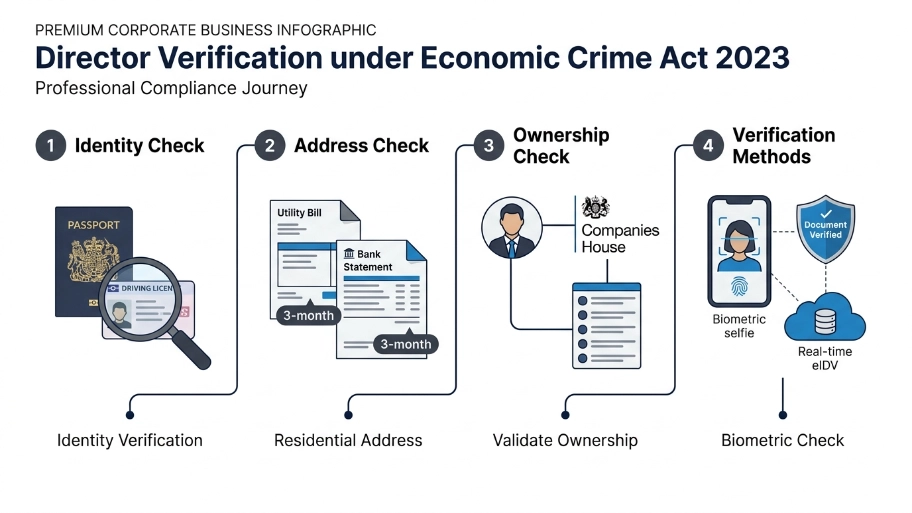
Companies must verify identity using government-issued ID such as a passport or driving licence. Companies must confirm residential address with recent utility bills or bank statements dated within three months. Companies must validate beneficial ownership records against Companies House, international registries, and sanctioned-person lists. These three checks prevent false identities and hidden ownership structures used in fraud and money laundering.
Most corporate service providers implement biometric checks, document authentication, and electronic identity verification (eIDV). Biometric checks authenticate a live person through a selfie or video, reducing impersonation risk. Document authentication confirms the document’s security features and issue date. eIDV compares supplied data with credit bureau or government data in real time. Use multiple sources for higher assurance when a director controls over 25% of shares or voting rights.
Read our articles, Compliance Changes Affecting UK Company Directors and Economic Crime Act 2023: What Businesses Must Know.
How does the Act change responsibilities for company officers during director appointment?
Directors and company officers must implement AML systems, maintain records, and report suspicious information before and after appointment.
Officers must adopt written AML policies tailored to director appointment processes. Policies must define verification steps, retention periods, and escalation paths. Officers must keep verification records for at least five years after a director leaves. Companies must report suspicious information to the National Crime Agency (NCA) when there is knowledge or reasonable suspicion of money laundering or sanctions breaches. The Act assigns explicit personal accountability to officers who fail to apply required checks, increasing regulatory risk for negligent handling.
Companies must run sanctions and PEP (politically exposed person) checks for new directors and linked beneficial owners. If a potential director is on a sanctions list or flagged as high risk, companies must freeze the appointment process and notify the NCA. Use automated screening integrated into onboarding workflows to ensure consistent checks and immediate alerts.
What documentation should companies collect when appointing a director post-Act?
Collect certified identity documents, proof of address, declaration of beneficial interests, and a source-of-funds statement when applicable.
Identity documents include passport or UK driving licence certified by a regulated professional. Proof of address includes a utility bill, council tax bill, or bank statement dated within three months. Companies must obtain a signed declaration listing direct and indirect beneficial interests and any trustee or nominee arrangements. Where transactions or previous activity are high value or complex, companies must request a source-of-funds statement describing fund origin, transaction dates, and supporting documents such as bank statements or contracts.
Maintain digital copies and secure logs showing who verified each document and when. Timestamped evidence supports compliance during audits and regulatory inquiries. Use secure encryption for storage to comply with data protection rules and prevent unauthorized access.
How should companies update corporate processes to comply with the Economic Crime Act 2023?
Redesign onboarding workflows to include layered verification, automated screening, record retention, and staff training tied to clear escalation paths.
Map current onboarding to identify gaps: missing biometric checks, absent sanctions screening, or insufficient storage retention. Integrate automated eIDV and sanctions screening with manual document authentication for high-risk cases. Formalise escalation paths to compliance officers and trustees where verification flags appear. Retain records in tamper-evident systems for at least five years and export audit trails quarterly.
Train staff on new legal obligations and red flags such as inconsistent personal details, beneficial ownership discrepancies, or complex ownership through trusts and shell companies. Assign a named compliance officer for director appointments. Conduct annual internal audits to verify process adherence and remediate detected weaknesses within 30 days.
What penalties and enforcement actions does the Economic Crime Act introduce for non-compliance?
Regulators can impose fines, restrict filings, and pursue criminal charges for deliberate or reckless breaches of verification and reporting duties.
Civil fines vary by severity and breach duration. Companies that fail to prevent or report suspicious activity risk monetary penalties and orders restricting business operations. The Act increases criminal exposure for officers who knowingly omit required checks or falsify records. Courts can disqualify directors found complicit in economic crime. Enforcement focuses on deterrence; regulators publish enforcement outcomes and require remediation plans.
Companies face reputational damage when enforcement actions are public. Reputation loss can result in lost contracts, banking relationships, and investor confidence. Implement prevention controls to reduce the probability of penalties and to demonstrate proactive compliance in regulatory reviews.
When is a source-of-funds check required during appointment?
Require source-of-funds checks when a director holds significant economic influence, is connected to high-value transactions, or triggers risk-based thresholds set in policy.
Examples: require checks for directors with 25%+ shareholding; directors involved in property transactions over £100,000; or when the director originates funds from high-risk jurisdictions. Source-of-funds documents include bank statements covering six months, sale agreements, or inheritance documentation. Verify transaction flows by matching incoming funds to declared sources and corroborating with third-party records.
Use a risk matrix to set thresholds and automate triggers. When a trigger activates, escalate to senior compliance for approval or further investigation. Document remediation steps and final decisions to support regulatory scrutiny.
How does the Economic Crime Act affect beneficial ownership reporting?
Companies must validate beneficial ownership declarations and reconcile them with Companies House data before finalising director appointments.
Companies must compare provided beneficial ownership information against Companies House PSC (persons with significant control) records. Reconcile discrepancies immediately and request clarifications or supplemental documents. If a beneficial owner is a legal entity, verify that entity’s ownership chain to identify natural persons behind it. For ownership chains crossing multiple jurisdictions, request certified corporate documents and conduct jurisdiction-specific checks.
Update Companies House records promptly after appointment completion. Accurate reporting reduces the risk of sanctions for false filings. Use documented reconciliation steps to demonstrate due diligence during audits.
How can Director Appointment services help companies meet Act requirements?
Director Appointment services provide identity verification, sanctions screening, beneficial ownership validation, and secure record-keeping aligned with UK compliance frameworks.
Professional services authenticate identities using passport checks, biometric verification, and eIDV. They screen against domestic and international sanctions lists and PEP databases. They validate beneficial ownership by tracing ownership chains and checking Companies House records. They also maintain tamper-evident records and generate compliance reports for audits. For companies with limited compliance resources, outsourcing ensures consistent application of verification steps and reduces regulatory exposure.
From My Company provides Director Appointment services that integrate these checks into onboarding workflows. Their service automates screenings, stores certified documents, and produces compliance-ready reports for filings and audits.
Explore our Director Appointment guides,
Tax Threshold Strategies for Directors and Shareholders
Hire Our Company Secretarial Experts for Your Next Official Director Appointment Filing
What immediate actions should companies take today to comply with the Act?
Update appointment policies, integrate automated verification, retrain staff, and review existing director records for gaps.
Update written appointment and AML policies to reflect the Economic Crime Act requirements and retention timelines. Integrate automated eIDV, sanctions screening, and Companies House reconciliation into digital onboarding. Retrain staff on new verification steps, documentation standards, and escalation rules within 30 days. Audit all current directors to identify missing verification records and remediate within 90 days.
If a company lacks internal capability, engage a specialist Director Appointment service to implement verification and record-keeping quickly. Outsourcing reduces time to compliance and provides documented evidence for regulators.
The Economic Crime Act 2023 raises verification, reporting, and record-keeping standards for director appointments. Companies must verify identity, confirm addresses, validate beneficial ownership, and perform sanctions and source-of-funds checks based on risk. Implement layered verification, automated screening, and robust record retention to reduce regulatory and criminal exposure. From My Company delivers Director Appointment services that perform these checks, maintain secure records, and produce compliance documentation to support filings and audits.
Frequently Asked Questions
What is included in a Director Appointment service?
A Director Appointment service handles identity verification, sanctions screening, beneficial ownership validation, and submission of director details to Companies House. From My Company provides end-to-end Director Appointment support that ensures compliance with UK economic crime and AML requirements.
How long does it take to appoint a new director in the UK?
Most Director Appointment processes complete within 24–48 hours once verified documents and consent forms are received. From My Company accelerates Director Appointment by using automated eIDV and instant Companies House filing to reduce processing time.
What documents are needed to appoint a director under the Economic Crime Act 2023?
You need a certified passport or UK driving licence, proof of address dated within three months, a signed beneficial ownership declaration, and consent to act as director. From My Company’s Director Appointment service collects and verifies all required documents to meet Economic Crime Act 2023 standards.
Can I appoint a director who lives outside the UK?
Yes, non-UK residents can be appointed as directors if they pass identity verification, sanctions screening, and address validation using reliable independent sources. From My Company supports international Director Appointment cases by applying global eIDV and cross-border compliance checks.
What happens if a director appointment fails compliance verification?
Failed verification stops the appointment process, requires remediation of missing or inconsistent data, and may trigger a suspicious activity report if fraud or sanctions risks are detected. From My Company’s Director Appointment team investigates verification failures, resolves data gaps, and ensures compliant re-submission to Companies House.