
The VAT Flat Rate Scheme saves more money for small businesses with low operating expenses and minimal capital purchases, whereas standard VAT registration saves more for businesses with heavy supply chain costs and high reclaimable expenses.
The choice between standard VAT registration and the Flat Rate Scheme directly dictates a company’s net tax liability in the United Kingdom. Standard VAT registration requires businesses to collect VAT from customers at standard rates—currently 20%—and pay that full amount to HM Revenue and Customs, minus any VAT incurred on purchases. Conversely, the Flat Rate Scheme allows eligible small businesses to charge standard VAT to clients while paying HMRC a fixed, reduced percentage of their gross turnover. The financial benefit depends entirely on your cost structure and the volume of VAT-taxable expenses your business incurs each quarter.
Determining the most cost-effective VAT structure requires analyzing profit margins and purchasing patterns. Service-based businesses with low overhead costs often retain a larger portion of collected tax under the flat rate model. Trading companies with significant raw material purchases usually lower their total tax bill through standard registration. Business directors must evaluate their annual turnover, supply chain dynamics, and client base before making a final selection.
How Does Standard VAT Registration Work for UK Businesses?
Standard VAT registration requires businesses to charge 20% VAT on taxable sales, offset this against VAT paid on business expenses, and pay the net difference to HMRC through quarterly VAT returns.
Standard VAT registration acts as an intermediary collection mechanism for the UK tax authority. When a business completes registration, it receives a unique VAT number and must apply the appropriate VAT rate to all eligible goods and services sold. The standard rate applies to most commercial transactions across England, Scotland, Wales, and Northern Ireland. The business collects this tax on behalf of the government, holding the funds until quarterly reporting deadlines require settlement with HMRC.
The primary advantage of the standard VAT scheme is the ability to reclaim input VAT. Input VAT refers to the sales tax paid on business purchases, such as inventory, office software, transport costs, and professional advice. When completing a quarterly return, the business calculates total sales VAT collected (output tax) and subtracts total expense VAT paid (input tax). If input tax exceeds output tax, HMRC refunds the difference directly to the business bank account.
Calculating VAT on standard terms demands precise record-keeping and clear documentation for every transaction. Businesses must retain valid VAT invoices for all claimed purchases to survive compliance audits. Failure to produce valid invoices results in disallowed reclaims, interest charges, and financial penalties. Modern accounting systems automate much of this tracking, but managing input tax recovery remains an ongoing operational requirement for registered entities.
Standard registration becomes compulsory when a business crosses specific operational benchmarks. If your taxable turnover exceeds the statutory threshold within any rolling twelve-month period, mandatory registration applies immediately. Businesses can also choose voluntary registration before reaching this threshold. Voluntary registration benefits companies that trade primarily with other VAT-registered businesses or those anticipating heavy early-stage capital expenditure.
When managing corporate expansion or hosting client negotiations regarding tax strategy, using dedicated facilities like a professional conference room venue for client meetings provides a compliant environment to review accounting structures and operational budgets.
What Is the VAT Flat Rate Scheme and How Is It Calculated?
The Flat Rate Scheme simplifies tax accounting by allowing businesses with turnover up to £150,000 to pay HMRC a fixed percentage of total gross turnover rather than tracking individual input tax.
HMRC established the Flat Rate Scheme to lower the administrative burden on small businesses and sole traders. Instead of calculating input VAT on every single receipt and expense, participating businesses apply a predetermined percentage directly to their total gross turnover, which includes VAT-inclusive sales. The business continues to charge customers standard 20% VAT on invoices, but it pays HMRC at a lower, sector-specific rate, retaining the remaining difference as additional operational revenue.
Flat rate percentages vary across industries based on typical trade expense ratios. Sectors with low operational expenses, such as IT consultancy or legal services, receive higher flat rate percentages. Sectors with heavy material costs, such as catering or manufacturing, receive lower flat rate percentages. During the first year of flat rate registration, HMRC grants an additional 1% discount, further reducing the effective tax rate for new joiners.
Limited Cost Traders represent an exception to typical sector rates within the Flat Rate Scheme. HMRC defines a limited cost trader as a business that spends less than 2% of its turnover, or less than £1,000 per year, on physical goods. Businesses falling into this category must use a flat rate percentage of 16.5%, regardless of their underlying sector classification. This rule prevents service companies with virtually zero physical overhead from retaining disproportionate tax margins through the scheme.
Input VAT cannot be reclaimed on everyday operational expenses under the flat rate structure. The fixed flat rate percentage already accounts for standard business expenditure assumptions. However, HMRC permits a single exception for capital assets costing £2,000 or more, including VAT. If a business purchases a single piece of capital equipment meeting this financial threshold, it can reclaim the full input VAT on that specific invoice through its standard quarterly submission.
Which VAT Scheme Saves More Money for Your Business Type?
Standard VAT registration saves more money for businesses with heavy supply overheads, whereas the Flat Rate Scheme saves more money for labor-intensive, service-focused companies with low operational costs.
The financial outcome between standard VAT and flat rate depends on your business cost model. Consider an IT consultant generating £100,000 in turnover with only £2,000 in annual purchases. Under standard VAT, the consultant charges £20,000 in output VAT and reclaims £400 in input VAT, paying £19,600 to HMRC. Under the flat rate scheme at 14.5% (assuming non-limited cost status), the consultant charges £120,000 gross, pays 14.5% of that gross total (£17,400) to HMRC, and retains £2,600 as profit.
Conversely, consider a retail business generating £100,000 in sales with £60,000 spent on inventory purchases. Under standard VAT, the business collects £20,000 in output VAT and reclaims £12,000 in input VAT on inventory, resulting in a net payment to HMRC of £8,000. Under a flat rate percentage of 7.5%, the business pays 7.5% on £120,000 gross sales, resulting in a £9,000 payment to HMRC. In this inventory-heavy scenario, standard registration saves the business £1,000 annually.
| Business Attribute | Standard VAT Registration | Flat Rate Scheme |
| Max Eligibility Turnover | Unlimited | £150,000 or less |
| Input Tax Reclaim | All valid business expenses | Capital assets over £2,000 only |
| Record-Keeping Complexity | High (track all receipts) | Low (track gross sales only) |
| Best Suited For | High-overhead & retail businesses | Low-overhead service providers |
Businesses evaluating their growth trajectory must monitor turnover projections carefully. If your business expansion causes annual taxable turnover to exceed £230,000, you must exit the Flat Rate Scheme immediately. Understanding how business turnover thresholds affect VAT registration requirements helps directors select the correct scheme at each growth stage without incurring unexpected tax liabilities or compliance penalties.
What Are the Key Eligibility Rules and Limits for the Flat Rate Scheme?
Businesses qualify for the Flat Rate Scheme if estimated VAT-exclusive turnover remains under £150,000 annually, provided they are not associated with another business or using specialized VAT margin schemes.
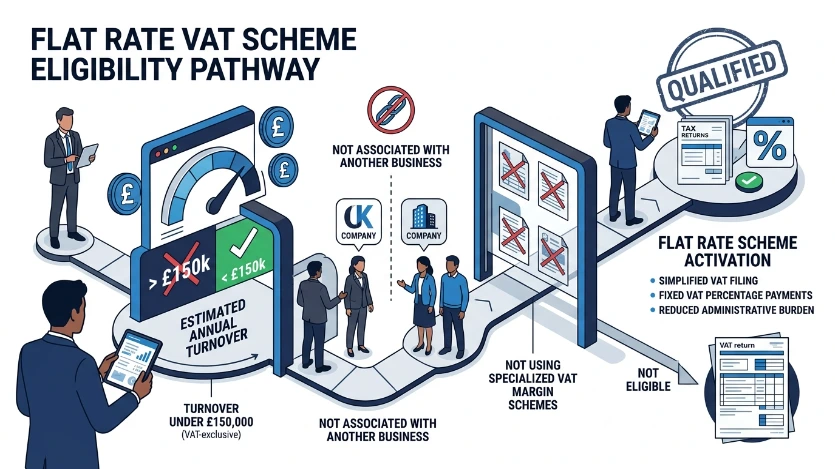
Eligibility for the Flat Rate Scheme relies primarily on annual revenue projections. When applying to HMRC, a business must reasonably expect its taxable turnover to stay below £150,000 in the next twelve months. Taxable turnover includes all sales subject to standard, reduced, or zero-rated VAT, but excludes exempt income and capital asset sales. Once joined, a business can remain in the scheme until its total gross turnover exceeds the exit threshold of £230,000.
HMRC enforces strict exclusion criteria to prevent scheme abuse by corporate groups. A business cannot join the Flat Rate Scheme if it has been registered for VAT as part of a corporate group within the past twenty-four months. Furthermore, businesses closely linked to other entities through common ownership, financial ties, or shared management structures face automatic disqualification from flat rate participation.
Specific industry activities and accounting methods also trigger flat rate restrictions. Businesses using margin schemes for second-hand goods, art, or antiques cannot apply flat rates to those revenue streams. Similarly, entities using the Tour Operators Margin Scheme must use standard VAT reporting. Businesses guilty of VAT offences or penalty assessments within the preceding twelve-month period are barred from flat rate entry.
When seeking professional guidance on structuring corporate tax compliance, obtaining expert VAT registration assistance from Form My Company ensures your application aligns with HMRC guidelines while avoiding costly classification errors.
How Do Administrative Burden and Compliance Compare Between Schemes?
The Flat Rate Scheme reduces record-keeping work by eliminating input tax calculations, whereas standard VAT registration requires meticulous receipt tracking and invoice reconciliation.
Administrative complexity remains a primary consideration for small business owners choosing a VAT structure. Standard VAT compliance demands detailed tracking of every incoming invoice and outgoing receipt. Businesses must categorize every purchase, verify vendor VAT numbers, and separate 20% standard rate items from reduced or zero-rated items. This operational burden requires dedicated accounting software, regular bookkeeping hours, and meticulous document storage to satisfy HMRC compliance standards.
The Flat Rate Scheme eliminates the need to track VAT on individual business purchases. Because input VAT is not reclaimed under flat rate rules, businesses do not need to record the sales tax component of daily expenses like stationery, fuel, broadband, or office supplies. Bookkeepers simply record total gross income from outgoing invoices, apply the flat rate percentage, and generate the payment figure. This streamlined workflow reduces time spent on quarterly administration.
Compliance risk varies significantly between the two frameworks. Under standard registration, HMRC audits focus heavily on input VAT claims, verifying whether claimed items represent genuine business expenses with valid VAT documentation. Under the Flat Rate Scheme, HMRC audits focus on whether the business applied the correct sector percentage and whether the business qualifies as a limited cost trader.
Both schemes require strict adherence to Making Tax Digital regulations. All VAT-registered businesses in the UK, regardless of turnover or scheme type, must store digital records and submit quarterly returns using MTD-compatible software. The Flat Rate Scheme simplifies the data points submitted, but it does not exempt a business from digital record-keeping mandates.
How Do You Switch Between VAT Schemes as Your Business Grows?
Businesses switch VAT schemes by submitting a written request or online application to HMRC, adjusting accounting software settings on the first day of the new accounting period.
Transitioning between VAT schemes becomes necessary when business cost structures or turnover volumes change. A company starting as a low-overhead service provider may benefit initially from the Flat Rate Scheme. If that company later expands into physical product distribution, input VAT expenses increase, making standard VAT registration more advantageous. Alternatively, crossing the £230,000 flat rate exit threshold forces an automatic return to standard VAT rules.
To leave the Flat Rate Scheme voluntarily, a director must notify HMRC in writing or through their online tax account. The notification must specify the requested exit date, which normally aligns with the start of the next quarterly VAT period. Once a business leaves the Flat Rate Scheme voluntarily, HMRC prevents it from rejoining the scheme for at least twelve months, ensuring businesses cannot switch back and forth purely to exploit seasonal purchasing spikes.
Accounting adjustments must occur precisely on the transition date to avoid double counting or missed tax liabilities. On the day of the switch, the business stops applying the flat rate percentage to gross income and begins calculating output VAT and input VAT on every line item. Invoices raised prior to the switch date follow flat rate rules, while invoices raised on or after the switch date follow standard VAT accounting.
Stock and asset adjustments require special attention during a transition back to standard VAT. If a business leaves the Flat Rate Scheme, it cannot reclaim input VAT on stock purchased while participating in the scheme. However, capital assets purchased prior to joining or assets over £2,000 reclaimed during the scheme retain their original tax treatment. Aligning transition timing with accounting year-ends simplifies audit trails and keeps reporting accurate.
Form My Company assists businesses throughout their operational lifecycle, providing structured corporate services, administrative support, and tax registration guidance tailored to UK business compliance requirements.
Explore our Conference Room guide,
Voluntary vs. Forced Director Resignation: What You Should Know
Bundle Filing vs. Separate Filings: Saving Time and Money
Frequently Asked Questions
What is included when booking a conference room with Form My Company?
Booking a conference room with Form My Company includes high-speed Wi-Fi, modern audio-visual presentation technology, variable seating configurations, and on-site administrative support. Facilities also offer professional reception greeting services and complimentary refreshments for attendees. These meeting room amenities ensure a fully equipped, professional environment for corporate client meetings and team workshops.
How do professional meeting room rentals support business compliance and privacy?
Professional conference rooms provide secure, soundproof environments required for sensitive corporate discussions, financial audits, and board meetings. Renting dedicated meeting spaces through Form My Company ensures confidential client negotiations occur in a fully compliant, distraction-free environment rather than informal public locations. This privacy helps directors maintain regulatory standards and safeguard confidential business data.
Can I book a conference room for a few hours or a full day?
Yes, conference room bookings offer flexible reservation options including hourly, half-day, and full-day rentals to match your specific event schedule. Form My Company provides customizable booking durations so businesses only pay for the exact time required for client presentations or strategic planning sessions. Online scheduling allows for immediate booking adjustments and seamless meeting management.
Why should small businesses use off-site conference rooms instead of remote meetings?
Off-site conference rooms offer neutral, professional environments that facilitate face-to-face collaboration, improve client deal closure rates, and eliminate remote communication barriers. Utilizing a professional meeting space provided by Form My Company establishes corporate credibility without the overhead costs of long-term commercial lease agreements. Physical meeting venues also provide advanced AV tech essential for high-stakes hybrid presentations.
How do I choose the right conference room size for my business meeting?
Selecting the ideal conference room depends on your attendee headcount, required seating layout, and the nature of your meeting activities. Boardroom setups suit formal executive discussions, while classroom or theater layouts accommodate larger training seminars and company presentations. Form My Company offers scalable meeting spaces equipped with flexible furniture arrangements to suit diverse business event requirements.