
PSC identity verification under the Economic Crime and Corporate Transparency Act 2023 is a mandatory UK legal requirement for Persons with Significant Control. It requires individuals to prove their identity through government-issued documents to Companies House to ensure corporate transparency and prevent economic fraud.
What Is the ECCTA 2023 Framework for UK Companies?
The Economic Crime and Corporate Transparency Act 2023 introduces reform powers to Companies House to increase corporate transparency and fight financial fraud across the UK business register.
The Economic Crime and Corporate Transparency Act 2023 transforms Companies House from a passive registrar into an active gatekeeper. The legislation grants official powers to verify corporate information, query suspicious filings, and exchange data with UK law enforcement agencies. These statutory changes aim to prevent criminal entities from abusing UK corporate structures, money laundering networks, and shell company setups.
UK legislation mandates identity checks for all registered company directors and Persons with Significant Control (PSCs). Companies House requires verified identities before registering new corporate entities or accepting routine annual filings. The legal framework establishes penalties for non-compliance, including director disqualifications, financial fines, and restrictions on company activities.
Who Qualifies as a Person with Significant Control?
A Person with Significant Control is an individual owning over 25% of company shares, holding over 25% of voting rights, or exercising significant influence over management.
Companies House defines a PSC based on specific legal ownership criteria and organizational influence metrics. An individual qualifies if they hold more than 25% of the total issued shares in a UK company. Shareholding percentages directly dictate voting power in statutory corporate decisions and board appointments.
An individual also qualifies if they hold more than 25% of the total voting rights attached to corporate shares. Rights to appoint or remove a majority of the board of directors establish PSC status regardless of equity ownership percentages. Individuals who exercise significant influence or control over trust operations or partnership structures fall under the same legal definition.
Certain corporate entities qualify as Relevant Legal Entities (RLEs) instead of individual PSCs. An RLE must hold its own registered interest in the target company and maintain compliance with statutory reporting standards. Companies must record all identified PSCs and RLEs within their official company records.
What Are the Key Requirements of PSC Identity Verification?
PSC identity verification requires eligible individuals to validate their identity using official passports, biometric scans, or address evidence before submission to Companies House.
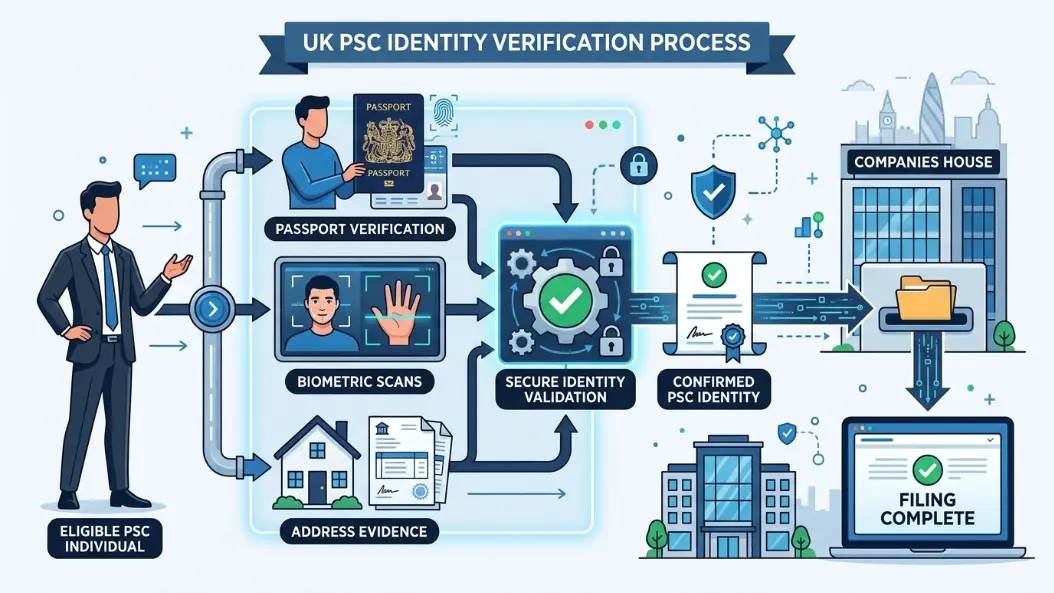
The verification process validates personal identity data against trusted government database records. Verification occurs directly through Companies House digital portals or through authorized corporate service providers. Three acceptable identification documents include valid passports, biometric national identity cards, and official driving licenses.
Verification requires biometric matching to prevent identity theft and fraudulent filings. Individuals submit high-resolution photo scans alongside digital face matches via smartphone cameras. Verification systems analyze document security features, security threads, and facial geometry parameters.
Successful completion yields a unique identity code linked to the individual’s central record. The individual uses this code across every UK company directorship or PSC role they maintain. Failure to complete verification within designated legal timelines invalidates corporate submissions and triggers regulatory warnings.
Why Did Companies House Introduce Mandatory Verification?
Companies House introduced mandatory identity checks to eliminate anonymous company ownership, prevent money laundering, and protect the UK financial ecosystem from fraudulent activity.
Historical registration rules allowed individuals to incorporate UK entities using false names and unverified residential details. Fraudsters utilized unverified companies to hide illicit funds, evade international tax obligations, and orchestrate fraud schemes. The UK government lost an estimated £15 billion annually to economic crime prior to the structural legislative changes.
Mandatory verification creates absolute transparency across public registers. Law enforcement officers, financial regulators, and commercial organizations inspect verified records to evaluate corporate risk. Public access to verified PSC data rebuilds trust in UK corporate governance and cross-border commercial partnerships.
Verified registries discourage organized criminal networks from incorporating shell companies within the jurisdiction. The system links physical human identities directly to legal entities, creating clear legal accountability for financial misconduct. Legal compliance protects legitimate business owners from corporate identity hijacking.
When Must Companies Complete PSC Verification Checks?
Existing PSCs must verify identity within specified transitional periods, while new PSCs and directors must complete verification before company incorporation or appointment.
New companies must submit verified identity codes for all proposed directors and PSCs during initial incorporation filings. Companies House rejects incorporation applications that lack fully verified personal credentials. Newly appointed directors or PSCs must complete verification prior to formal notification filings.
Existing PSCs receive a structured transition window following full implementation of the statutory rules. The compliance schedule aligns with the company’s mandatory annual confirmation statement deadline. Directors must confirm that all listed PSCs hold active verification status when submitting confirmation statements.
Failure to verify within statutory deadlines constitutes a criminal offense for both the individual and the company. Companies House issues compliance notices, levies monetary fines, and applies civil penalties for unverified roles. Prolonged non-compliance results in compulsory striking-off proceedings from the official register.
How Does the PSC Verification Process Work Step by Step?
The process involves submitting biometric identity documents, matching live photographic data, validating residential addresses, and receiving a unique Companies House verification code.
Identity verification follows a strict digital validation sequence. Individuals initiate the process through verified government online portals or accredited third-party identity service providers. To complete the requirement efficiently, review How to Complete PSC Identity Verification Step by Step for detailed operational guidance.
Capture valid identity documents using smartphone applications or desktop scanner software.
Upload high-resolution images of document biographical pages and embedded security chips.
Complete a real-time biometric facial scan to verify physical presence and match document photos.
Input proof of residential address using bank statements or official utility records.
Submit completed data packages for automated algorithmic checks and manual agent authentication.
Receive a permanent personal identification code upon successful validation by the registry software.
Third-party providers cross-reference submitted details against international criminal databases, politically exposed person (PEP) lists, and sanction rosters. The verification network issues immediate digital receipts once verification checks confirm true identity match.
What Documents Are Accepted for PSC Identity Verification?
Companies House accepts biometric passports, photo driving licenses, national identity cards, and official utility bills or bank statements for address verification.
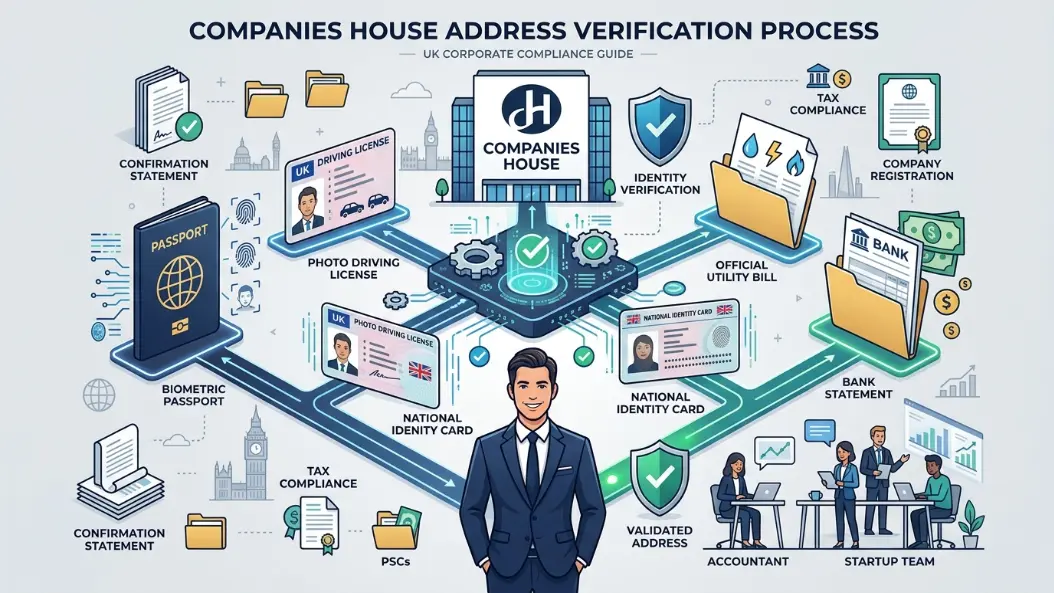
Document processing rules require current, unexpired identification issued by recognized national governments. Primary photo identification documents demonstrate full name, date of birth, nationality, and clear facial images. Three primary accepted photo documents include international biometric passports, photocard driving licenses, and official national identity cards.
Secondary address proof documents confirm current residential address details. Address documentation must match the name on primary identification records exactly. Three acceptable address documents include utility bills dated within 3 months, official bank statements, and government council tax notifications.
Non-English documents require official certified translations provided by accredited translation services. Verification systems verify translation seals, notary signatures, and translator credentials before accepting submitted records. Unclear, damaged, or expired documents trigger automatic verification rejections.
What Are the Penalties for Non-Compliance with ECCTA 2023?
Non-compliance results in criminal prosecution, financial fines up to statutory limits, civil penalties, director disqualifications, and compulsory company dissolution.
The Economic Crime and Corporate Transparency Act establishes strict criminal and civil liability frameworks. Operating an unverified company role constitutes an offense punishable by unlimited fine structures. Company directors face personal liability for allowing unverified PSCs to remain on corporate registers.
Companies House applies administrative restrictions to non-compliant organizations. The registry blocks confirmation statements, director changes, and registered address updates for non-compliant entities. Unverified status prevents companies from securing corporate bank accounts, commercial credit facilities, and business loans.
Persistent failure to satisfy verification rules triggers strike-off proceedings. Companies House removes non-compliant entities from the register, causing corporate assets to revert to the Crown as bona vacantia. Disqualified individuals cannot manage, form, or direct UK corporate entities for up to 15 years.
How Do Professional Business Services Support Verification Compliance?
Professional corporate service providers streamline identity verification by validating documents, managing PSC registries, submitting filings, and guaranteeing statutory compliance.
Maintaining internal corporate compliance requires continuous regulatory tracking, precise documentation, and technical submission management. Professional providers utilize authorized API connections to Companies House to verify data accuracy prior to official submissions. Outsourcing identity administration reduces error rates and prevents costly regulatory rejection notices.
Business owners maintain full statutory compliance using tailored management services. You can establish your statutory records using a professional PSC Register service to track ownership changes and verification statuses. Professional support ensures corporate structures remain compliant with evolving UK corporate laws.
Service providers assist foreign directors and complex corporate structures with multi-jurisdictional verification requirements. Third-party experts verify international identity documents, secure legal translations, and resolve validation queries raised by registry examiners. Ongoing record monitoring protects businesses against accidental deadline omissions.
How Can Businesses Prepare for Statutory Verification Updates?
Businesses prepare by reviewing shareholding structures, gathering updated PSC identity documentation, auditing register records, and establishing compliance protocols.
Preparation begins with an internal audit of corporate registers and ownership arrangements. Management must verify that current filings accurately reflect true share ownership and voting control rights. Identifying potential PSCs early prevents administrative delays during mandatory verification windows.
Companies must establish internal communication protocols with all identified PSCs. Requesting updated copies of passports, proof of address, and personal details ensures quick document submission. Organizations must maintain secure data storage policies aligned with UK GDPR standards when handling personal identity data.
Integrating third-party compliance management simplifies ongoing verification tracking. Business owners should explore how to Complete PSC Identity Verification With Form My Company to ensure total corporate compliance under the ECCTA statutory framework. Early preparation protects business operations from legal disruptions.
Explore our PSC Register guide,
Director Resignation: A Simple Guide to Maintaining Compliance
The Essential Director Bundle: Managing Appointments and Resignations Together
Frequently Asked Questions
What Is a PSC Register in the UK?
A PSC Register (Register of Persons with Significant Control) is an official corporate record that identifies the individuals or legal entities holding ultimate ownership or operational control over a UK company. Following reforms under the Economic Crime and Corporate Transparency Act (ECCTA), central PSC data is maintained directly on the public registry at Companies House. Form My Company assists businesses in correctly identifying, filing, and managing statutory PSC Register submissions to maintain regulatory compliance.
Who Needs to Complete PSC Identity Verification Under the ECCTA?
All individuals designated as Persons with Significant Control (PSCs), company directors, and Limited Liability Partnership (LLP) members must complete identity verification with Companies House. This requirement applies to both existing corporate officers and newly appointed individuals following the mandatory implementation of the ECCTA framework. Form My Company helps company officers fulfill these verification mandates alongside maintaining an up-to-date PSC Register.
What Documents Are Required to Verify a Person with Significant Control?
Verification requires a valid, unexpired photographic identification document—such as a biometric passport, national identity card, or photo driving license—combined with a real-time biometric facial scan. Secondary residential address documentation, such as a recent utility bill or bank statement, may also be required to validate personal details. Form My Company guides clients through assembling these compliant documents for smooth PSC Register integration.
What Happens If a Company Fails to Submit PSC Verification Details?
Failing to verify a PSC or submit required identity details to Companies House within statutory deadlines is a criminal offense that results in financial fines and potential prosecution. Companies House will reject corporate filings—including confirmation statements—for non-compliant entities, potentially leading to compulsory company dissolution. Utilizing Form My Company for PSC Register management ensures all statutory deadlines are tracked and penalties are avoided.
Do UK Companies Still Need to Keep an Internal Physical PSC Register?
Under ECCTA reforms, the legal requirement for private UK companies to maintain their own internal statutory PSC Register at their registered office has been replaced by direct filing with Companies House. The central register at Companies House now acts as the authoritative public record of beneficial ownership. Form My Company provides professional corporate secretarial support to ensure all statutory information is promptly transmitted and validated on the central register.