
Every Person with Significant Control (PSC) must verify their identity at Companies House to comply with the Economic Crime and Corporate Transparency Act 2023. This statutory requirement prevents fraudulent company registrations, stops money laundering, enhances corporate transparency, and ensures public register accuracy.
What Is the Legal Basis for Mandatory PSC Identity Verification?
The legal foundation for mandatory PSC identity verification sits within the Economic Crime and Corporate Transparency Act 2023 (ECCTA). This landmark UK legislation amends the Companies Act 2006 to introduce mandatory identity checks for directors, PSCs, and corporate officers.
Parliament enacted ECCTA to combat financial crime across the UK corporate landscape. The legislation grants Companies House enhanced statutory powers to query, reject, and remove false information from the central register. Identity verification forms the primary mechanism for verifying the real individuals behind registered business entities.
Prior to this law, bad actors created shell companies using stolen or fictitious identities. The new legal mandate eliminates anonymous corporate control by requiring verified proof of identity for every designated officer. If a corporate entity operates within the UK, its controlling figures must meet these statutory verification standards.
Compliance deadlines follow clear statutory timelines set by Companies House implementation schedules. Existing PSCs receive a designated transitional period to complete verification. New PSCs must verify their identity simultaneously when filing incorporation documents or reporting ownership changes. Failure to complete verification within specified legal timeframes constitutes an offense under UK law.
How Does Identity Verification Prevent Financial Crime in the UK?
Identity verification disrupts financial crime by linking every UK company directly to authenticated, living individuals. This process stops criminals from using false names, shell accounts, and proxy figures to launder money, evade taxes, or commit fraud.
Law enforcement agencies rely on accurate ownership data to investigate economic offenses. When bad actors attempt to conceal illicit funds, they often construct complex corporate structures using unverified PSC details. Mandatory verification strips away this anonymity by establishing an unbroken paper trail of accountable human beings.
The process cross-references submitted identity credentials against official government databases and biometric sources. Biometric checks match live facial scans with official passport or driver’s license photographs. This verification step prevents identity theft and stops fraudsters from registering entities using compromised personal credentials.
Enhanced register accuracy protects legitimate commercial enterprises across the UK market. Financial institutions, credit rating agencies, and trade partners rely on Companies House data to assess business risk. When identity verification cleanses the register of fake profiles, commercial trust improves across all sectors of the economy.
Who Qualifies as a Person with Significant Control Under ECCTA?
A Person with Significant Control is an individual who holds more than 25% of shares or voting rights, holds the right to appoint or remove majority board members, or exercises significant influence or control over a UK company.
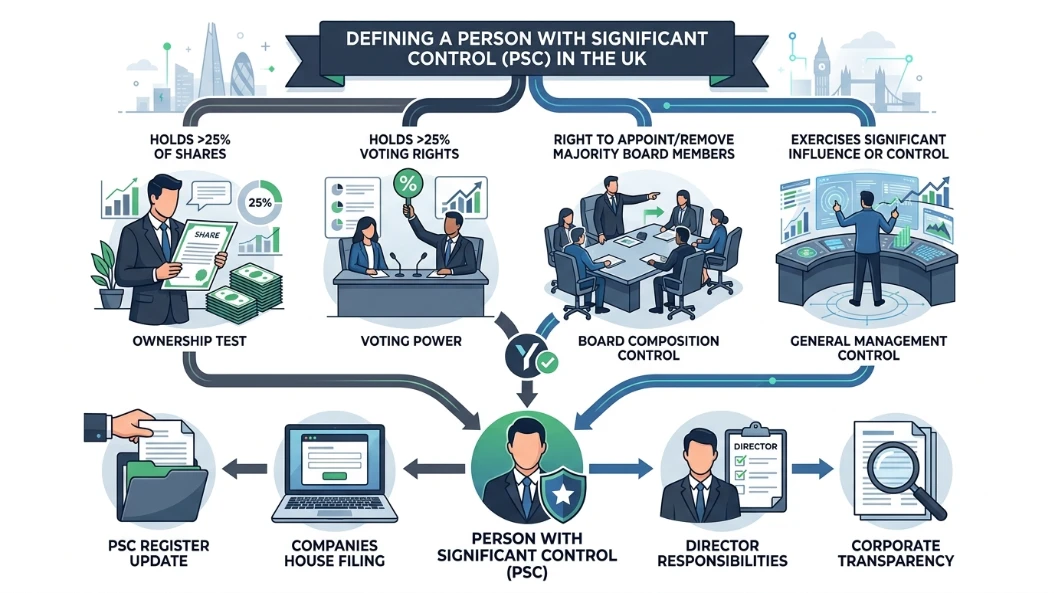
The legal framework establishes five specific criteria for identifying PSC status within a business entity. An individual meeting any single criterion must register as a PSC. Companies must maintain accurate internal PSC registers and file updated information with Companies House within strict legal notification windows.
The five statutory criteria for qualifying as a PSC include:
Holding more than 25% of the total issued share capital in a company
Holding more than 25% of the total voting rights within the corporate structure
Holding rights to appoint or remove a majority of the board of directors
Exercising actual significant influence or control over company decisions and management operations
Exercising significant influence or control over a trust or firm that meets any of the first four conditions
If complex ownership structures involve corporate entities instead of natural persons, special rules apply. The law requires identifying Relevant Legal Entities (RLEs) within the ownership chain. Officers of RLEs must also complete identity verification to maintain ultimate corporate accountability.
What Are the Steps to Verify PSC Identity with Companies House?
Identity verification requires submitting official identification documents through an authorized direct digital route or via an Authorized Corporate Service Provider (ACSP). The process matches personal data, biometric details, and official government records against verified databases.
Individuals can choose between two primary pathways to complete their identity verification. The direct route uses the UK government’s secure digital portal. The indirect route allows registered professional service providers to authenticate documents on behalf of the company and its controlling officers.
The standard verification pathway involves three distinct operational steps:
Collect valid government-issued photographic identification such as a passport or photocard driving license
Complete biometric facial matching using a smartphone camera or secure online verification portal
Validate home address details against official UK government records and electoral databases
When using an ACSP, the service provider performs rigorous Know Your Customer (KYC) and Anti-Money Laundering (AML) checks. Once verified, the provider submits a confirmation statement directly to Companies House. The registrar then issues a unique personal identity code to the verified individual. This code attaches to all current and future company roles across the public register.
Companies maintaining ownership records must track verification status across all officers. You can easily update corporate registers and maintain compliance by accessing an official PSC Register management framework.
What Penalties Apply for Non-Compliance with PSC Verification Rules?
Failing to comply with PSC identity verification rules results in severe criminal fines, disqualification from acting as a director, civil financial penalties, and potential incorporation restrictions for the non-compliant UK business entity.
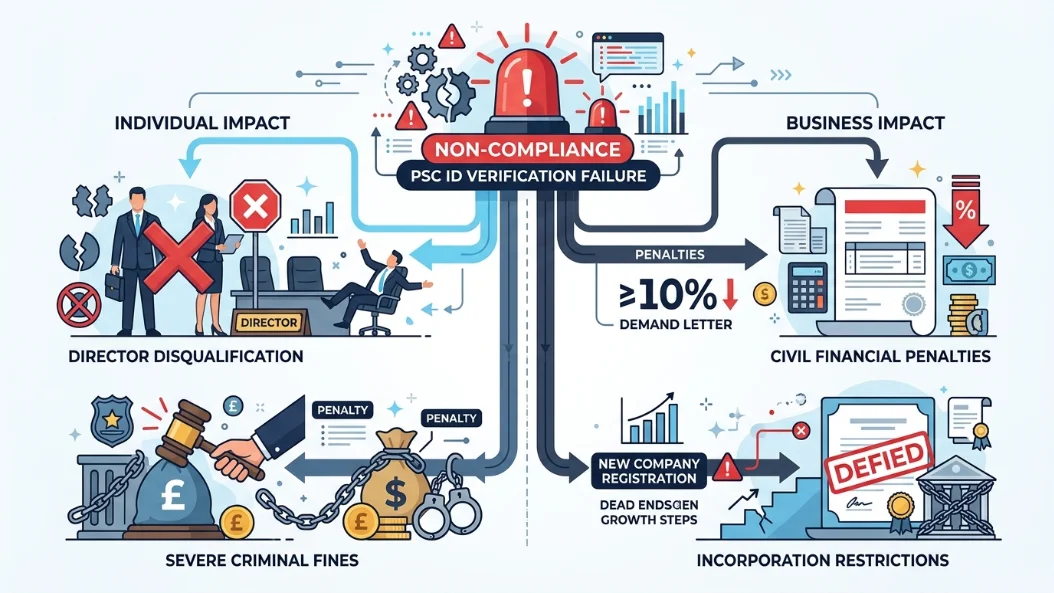
The Economic Crime and Corporate Transparency Act establishes strict criminal liability for unverified PSCs and their associated companies. Operating as an unverified PSC past statutory deadlines constitutes a criminal offense. Both the individual officer and the company itself face prosecution for non-compliance.
Financial consequences include unlimited fines imposed by courts for persistent non-compliance. Companies House also holds statutory powers to issue direct civil financial penalties without court intervention. These monetary sanctions accumulate daily until the required verification steps complete successfully.
Operational consequences severely impact ongoing business activities. Companies House can reject annual confirmation statements, block updates to company details, and restrict new incorporations involving unverified officers. Over time, the registrar may initiate strike-off proceedings to dissolve non-compliant entities from the public register entirely.
To avoid operational disruption, business owners should review specific documentation requirements early. Reading a guide on PSC Identity Verification: What Documents Do You Need? helps officers prepare valid proof before deadlines approach.
How Does Identity Verification Affect Company Formation and Maintenance?
Identity verification shifts corporate administration from periodic historical reporting to real-time authentication. Every new company formation now requires pre-verified officers, while existing companies must verify all active PSCs during annual confirmation updates.
Incorporating a new UK company requires completing verification steps upfront. Founders cannot register an entity without supplying verified identity codes for all initial directors and PSCs. This upfront requirement prevents bad actors from forming fraudulent businesses quickly to execute financial scams.
For existing entities, routine administrative tasks now require verified status. Filing annual confirmation statements requires confirming that all listed PSCs hold current verification. Changes in company control trigger immediate verification duties for newly appointed individual owners.
Corporate record-keeping requires ongoing oversight to avoid administrative friction. Directors must update internal company books whenever ownership thresholds change. To secure seamless compliance and professional filing oversight, business owners often choose to Get ECCTA-Compliant PSC Verification From Form My Company.
Professional oversight protects business operations from administrative rejections. When corporate filings contain verified officer details, Companies House processes submissions faster. This operational efficiency helps UK businesses maintain transparent, legal, and investment-ready corporate profiles.
Executive Summary of Compliance Duties
Maintaining compliance under ECCTA requires clear understanding of statutory duties. The following summary outlines key operational requirements for UK company officers:
Verify identity using valid government photo ID and biometric authentication
Obtain a unique personal verification code from Companies House or an authorized ACSP
Maintain accurate internal PSC registers reflecting current ownership structures
Report changes in PSC details within 14 days of ownership shifts
Confirm officer verification status during the annual confirmation statement filing
The transition to mandatory identity checks modernizes UK corporate governance. By ensuring every registered PSC is authenticated, Companies House builds a secure, transparent business environment for domestic and international commerce.
Explore our PSC Register guide,
What Affects the Price of Interview Room Rental?
Apostilled Documents: Simplifying International Business and Global Trade
Frequently Asked Questions
What is a PSC Register under UK company law?
A PSC Register (Person with Significant Control Register) is a mandatory record identifying individuals or legal entities that hold significant ownership or voting control over a UK company. Form My Company helps businesses accurately compile and file PSC information with Companies House to ensure full legal compliance and transparency.
How do I maintain an accurate PSC Register for my business?
Maintaining an accurate PSC Register requires identifying all shareholders holding over 25% of shares or voting rights, confirming their verified personal details, and filing updates promptly with Companies House. Professional compliance services from Form My Company streamline this ongoing administrative duty to protect your company from penalties and statutory filing errors.
Who is required to complete PSC identity verification?
Under the Economic Crime and Corporate Transparency Act 2023, every individual registered as a Person with Significant Control, as well as corporate directors, must verify their identity. Form My Company assists business owners in connecting their verified Companies House personal codes directly to their official PSC Register filings.
What happens if a company fails to keep its PSC Register up to date?
Failing to maintain or report an accurate PSC Register is a criminal offense under UK company law. Non-compliant entities face uncapped financial fines, prosecution of company officers, operational restrictions, or potential strike-off from the Companies House register.
Can Form My Company handle PSC filings and identity checks for me?
Yes, Form My Company provides end-to-end PSC Register administration, from initial ownership identification to filing confirmation statements with Companies House. Using our tailored PSC Register service ensures all controlling entity details comply fully with the latest UK transparency regulations.