
Apostilled documents are legal certificates issued under the 1961 Hague Convention that authenticate public records, corporate filings, and legal agreements for cross-border recognition. They remove multi-tiered embassy legalisation steps, allowing companies to execute contracts, register overseas entities, and conduct international trade without legal delays.
What Is an Apostille Certificate in International Trade?
An apostille certificate is an official government-issued seal that authenticates the origin of a public or corporate document for legal recognition in foreign countries. It verifies seal integrity, document issuer authority, and signature authenticity without requiring additional foreign embassy or consular certification.
International business operations require valid legal documentation to establish foreign subsidiaries, open offshore bank accounts, and complete cross-border mergers. The Hague Legalisation Convention of 1961 created the apostille process to replace cumbersome, multi-step diplomatic authentication protocols. Government-designated competent authorities attach standard physical or electronic certificates directly to official filings. When foreign regulators receive an apostilled document, they recognize its legal validity instantly across all 126 member nations.
Corporate documents frequently requiring this international validation include certificate of incorporation records, memorandum and articles of association, director passports, and board resolutions. Authentication confirms that the issuing official held legal authority at the exact moment of signing. Cross-border trade partners accept these verified certificates because standard national legal frameworks enforce mutual recognition protocols. Removing secondary diplomatic layers accelerates legal compliance schedules and lowers administrative friction for expanding corporate entities.
How Does Document Legalisation Protect Cross-Border Transactions?
Document legalisation protects cross-border transactions by verifying corporate credentials, preventing international identity fraud, and establishing legal accountability between foreign entities. It ensures foreign judicial courts, tax authorities, and commercial banks recognize contractual obligations without challenging corporate legal standing.
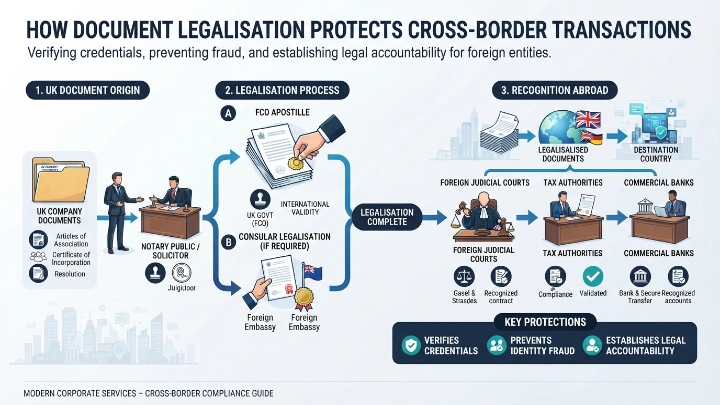
International commerce depends entirely upon enforceable agreements between parties operating under distinct legal jurisdictions. When foreign entities enter joint ventures or supply agreements, standard corporate registries require non-local corporate documents to carry verified government authentication seals. Legalisation deters fraudulent commercial filings by ensuring independent state agencies validate the identity and legal status of corporate signatories.
Financial institutions implement strict anti-money laundering frameworks that require foreign corporate clients to provide validated documentation. Bank compliance teams examine apostilled corporate registries, officer appointments, and legal ownership charts to establish ultimate beneficial ownership. Validated public records ensure that foreign courts enforce commercial arbitration awards, operational contracts, and debt recovery claims if commercial disputes arise. Legal legalisation acts as an essential safeguard for risk management in global trade networks.
What Is the Step-by-Step Process for Obtaining an Apostille?
Obtaining an apostille involves authenticating original documents, completing statutory notary certifications, submitting records to official government legalisation offices, paying administrative fees, and receiving stamped certificates. This standardized sequence transforms domestic paperwork into legally binding international instruments.
The legalisation journey begins when corporate officers prepare original public certificates or private business documents. Private contracts, power of attorney filings, and corporate minutes require notary public verification before official submission. The certified notary confirms signatory identity using official passport checks, biometric verification, and legal authority checks before applying a formal seal. Standard government-issued records like company registration certificates skip local notarization and move directly to official state registries.
Next, applicants submit the notarized or public records to designated national competent authorities, such as the UK Foreign, Commonwealth & Development Office. Government examiners inspect the physical document, cross-reference notary signatures against official state databases, and verify legal seal authenticity. Once validated, officers affix a numbered apostille certificate directly to the original document package using secure ribbons, embossed seals, or digital cryptographic signatures. Processing timelines range between 24 hours for expedited services and 10 business days for standard postal applications.
Why Do Companies Need Conference Facilities During Global Expansion?
Expanding companies require specialized conference facilities to execute international contracts, present notarized documents to foreign delegations, hold board meetings, and satisfy statutory governance standards. Professional meeting environments establish operational credibility, ensure data privacy, and maintain compliance during complex cross-border negotiations.
Corporate expansion overseas requires more than administrative document authentication; it demands dedicated operational infrastructure. When executive teams finalize foreign joint ventures, they require secure environments to execute legal documentation, present verified filings to international partners, and coordinate cross-border legal counsel. Organizations booking a Conference Room secure specialized enterprise technology, high-speed encrypted internet networks, and professional support staff necessary to execute high-stakes corporate transactions efficiently.
Regulatory frameworks often mandate physical corporate gatherings within specific jurisdictions to maintain tax residency and corporate governance standards. Executive board members hold formal meetings in equipped business centers to pass binding corporate resolutions authorizing global trade activities. Remote board members join via secure video conferencing systems to review apostilled corporate records and sign digital authorizations. Accessing professional meeting infrastructure helps international businesses maintain administrative momentum, impress institutional investors, and fulfill complex jurisdictional requirements.
How Does the Hague Convention Simplify Global Commercial Operations?
The Hague Convention simplifies global commercial operations by establishing a uniform, single-certificate authentication model recognized across 126 member countries. It eliminates redundant consular legalisation, reduces administrative processing expenses, and standardizes international legal documentation standards for expanding enterprises.
Before the adoption of the 1961 Hague Convention, international trade legalisation required multi-tiered diplomatic authentication. Companies submitted corporate filings to local notaries, national foreign offices, and individual destination country embassies. This manual chain of authentication added months to international transaction schedules and multiplied administrative costs across every target market.
The simplified convention replaces consular legalization chains with a single standardized certificate containing ten mandatory text fields. Foreign government agencies accept apostilled corporate filings immediately without requiring secondary validation from their local diplomatic missions. Standardized verification speeds up cross-border business setup, lowers legal fees, and creates predictable timelines for global business growth.
What Are the Differences Between Apostille and Legalization Protocols?
Apostille protocols provide streamlined document authentication exclusively between Hague Convention member nations using a standardized state certificate. Non-Hague legalisation requires complex multi-tiered authentication, including state department verification and individual destination embassy legalisation seals.
Understanding legal authentication requirements requires distinguishing between Hague member nations and non-member jurisdictions. When trading between member countries, organizations complete a single-tier apostille process through local competent authorities. Foreign registries accept this standardized certificate immediately upon receipt without requiring further embassy engagement.
Verify country membership status within the official Hague Conference database
Submit non-member documents to destination country consular offices for secondary legalisation
Obtain embassy seals following initial national foreign office verification steps
Non-Hague countries require traditional multi-step legalisation chains. Documents move from local notaries to national authorities, ending with legalisation by destination country embassies. Operating across non-member jurisdictions increases administrative costs, requires longer processing times, and demands careful tracking of embassy rules. Strategic planners evaluate destination rules early to budget time correctly for legal authentication.
For a comprehensive comparison of non-Hague legalisation procedures, review our guide on Apostille vs. Notarization: Navigating International Document Legalisation.
What Documents Are Mandatory for Establishing an Overseas Subsidiary?
Establishing an overseas subsidiary mandates apostilled corporate incorporation certificates, memorandum and articles of association, director identity records, legal powers of attorney, and certified board resolutions. Foreign corporate registries demand these authenticated documents to establish corporate legitimacy and tax compliance.
Setting up an overseas business subsidiary requires submitting corporate filings to foreign business registries. Local regulatory bodies inspect parent company credentials to verify legal standing, active registration status, and corporate authority. Providing unauthenticated records leads to immediate application rejections and delays business entry into new markets.
Corporate authorities examine foreign director identity documents to satisfy strict local compliance laws. Managing officers submit apostilled passport copies, address verification records, and clean criminal background certificates. Power of attorney documents allow local legal teams to submit corporate paperwork, sign commercial leases, and manage regulatory filings for the parent company. Collecting and certifying these core business documents early helps ensure smooth corporate expansion.
How Do Processing Delays Impact Cross-Border Business Deals?
Processing delays in document legalisation disrupt international contract execution, postpone corporate bank account approvals, delay asset acquisitions, and create financial penalties. Administrative friction halts foreign business expansion and risks exposing firms to volatile market shifts.
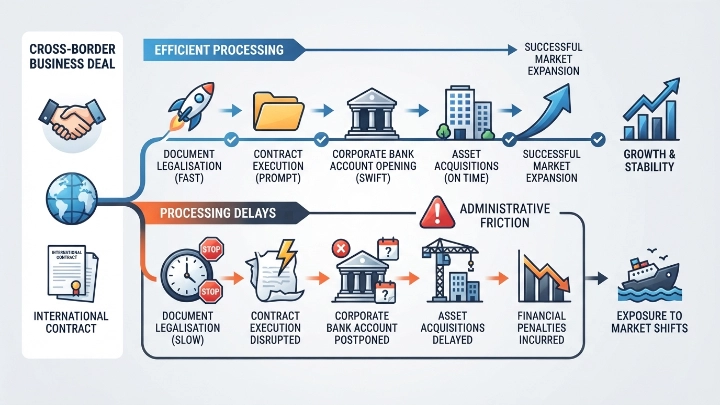
When corporate legalisation timelines stretch unexpectedly, international commercial agreements face severe operational risk. Overseas sellers can cancel property acquisitions, asset purchases, or joint venture negotiations if buyers miss strict closing dates. Foreign banking institutions freeze corporate account applications when presented with expired or unauthenticated officer verification documents.
Missing critical legalisation deadlines stalls operational execution across foreign business units. Technical teams cannot secure local operating licenses, hire foreign staff, or import commercial equipment without validated parent company registrations. Delaying market launch burns working capital on idle office leases and remote overhead without generating sales revenue. Utilizing an Expedited Apostilled Document Service: Your Global Trade Partner helps growing businesses eliminate administrative bottlenecks, maintain deal momentum, and secure international assets quickly.
How Do Digital Apostilles Modernize International Trade Frameworks?
Digital apostilles (e-Apostilles) modernize international trade frameworks by utilizing cryptographic signatures, online verification registries, and secure PDF distribution systems. Electronic legalisation cuts administrative delivery times from weeks to seconds while eliminating physical document forgery risks.
The introduction of electronic apostille frameworks marks a major shift in international document authentication. Digital legalisation systems allow competent authorities to issue cryptographically signed PDF certificates that link directly to electronic business registries. Foreign officials verify legal document authenticity instantly by entering digital certificate numbers into public online databases.
Upload digital corporate records to official state portal systems
Verify electronic notary signatures using public key infrastructure cryptography
Issue secure e-Apostilles containing verifiable cryptographic seals
Access digital certificates via secure online validation registries
Digital authentication removes shipping costs, postal delays, and physical loss risks during international transit. Global supply chains process digital legal paperwork quickly, accelerating customs clearance, vendor onboarding, and international contract execution. As more Hague member nations adopt electronic registries, e-Apostille technology will become the baseline standard for global commercial authentication.
Establishing a global business presence requires navigating complex regulatory landscapes, securing official document authentication, and building strong operational infrastructure. Form My Company provides complete business incorporation support, administrative document legalisation services, and professional corporate facilities to help expanding enterprises succeed in foreign markets.
Frequently Asked Questions
How do I book a professional conference room for an international business meeting?
Booking a professional conference room through Form My Company involves selecting your preferred date, location, and meeting duration via our online platform. Our modern conference facilities come equipped with high-speed encrypted internet, hybrid presentation technology, and video conferencing tools necessary for secure cross-border negotiations. You can customize room configurations and request administrative support services to match your specific corporate requirements.
What amenities are included with corporate meeting room rentals?
Form My Company conference room rentals include enterprise-grade Wi-Fi, audio-visual display systems, digital whiteboards, and ergonomic seating setups. Clients also gain access to reception services, climate-controlled environments, soundproofing, and optional secretarial assistance for document handling. These specialized meeting spaces ensure seamless execution during executive board meetings, legal signings, and investor presentations.
Why do expanding companies need dedicated meeting facilities for foreign compliance?
Regulatory frameworks and foreign registries often require international businesses to hold formal corporate gatherings, sign apostilled documents, or conduct director meetings within specific jurisdictions to maintain legal compliance. Form My Company provides professional conference facilities that give expanding enterprises a verified, fully equipped physical environment for official proceedings. Utilizing standard corporate meeting venues supports governance protocols and establishes operational credibility with foreign partners and regulatory bodies.
Can I host hybrid or remote video conference meetings in a rented boardroom?
Yes, Form My Company boardrooms feature high-definition video conferencing hardware and secure network infrastructure designed for seamless hybrid meetings. These technical features allow local executives to present physical legal filings or corporate agreements while remote board members and overseas legal counsel participate in real time. Reliable audio-visual integration prevents technical downtime and maintains data privacy during sensitive international trade discussions.
How far in advance should I reserve a business conference space for legal document execution?
It is best to reserve a business conference space at least 3 to 5 business days before executing apostilled documents or legal agreements to guarantee room availability and technical support. Advance booking allows Form My Company to tailor room layouts, set up specialized presentation software, and coordinate secretarial support for incoming international delegations. Early planning prevents administrative bottlenecks and ensures all necessary operational infrastructure is ready for your meeting.