
Notarization certifies the authenticity of signatures and identity on a legal document by a qualified public notary. An apostille provides official state-level authentication by the Foreign, Commonwealth & Development Office, validating the notary’s seal for overseas legal recognition under international treaty frameworks.
International document authentication requires specific legal procedures. Businesses operating across national boundaries routinely encounter legalisation protocols. Document verification guarantees acceptance by foreign governments, banks, and regulatory bodies. The Hague Convention of 1961 established a standardized mechanism to streamline document validation globally.
Understanding legalisation pathways prevents operational delays during international expansion. Corporate entities must distinguish between notary certifications and state-issued apostilles. Both processes validate document authenticity, yet each operates at a different jurisdictional level. Foreign authorities reject documents that lack appropriate authentication protocols. Proper execution ensures seamless cross-border corporate governance, contract execution, and regulatory compliance.
What is Document Notarization in International Business?
Document notarization is an official process where a licensed notary public verifies signatory identity, witnesses signature execution, and applies a legal seal. This process establishes legal authenticity and deters fraud for domestic and cross-border commercial transactions.
Notaries Public act as impartial legal officers appointed by statutory bodies. In the United Kingdom, the Faculty Office of the Archbishop of Canterbury regulates notary appointments. Notaries verify the legal capacity and identity of individuals signing documents. They verify corporate status through Companies House records before attesting corporate instruments.
Notarization serves as the initial verification tier for cross-border documentation. The notary attaches a formal certificate, known as a notarial act, directly to the primary document. This certificate confirms that the signatories appeared in person and executed the agreement voluntarily.
Notaries apply a unique embossed seal and personal signature to prevent document tampering. Foreign courts rely on notarial seals to verify the legal validity of private agreements.
Executing legal agreements overseas requires secure administrative facilities. Directors frequently require private environments to finalize high-value cross-border contracts. Utilizing professional Conference Rooms provides the necessary infrastructure, secure connection, and privacy required for executing notarized documents alongside legal counsel.
What is an Apostille Stamp Under International Law?
An apostille is a standardized certificate issued by a competent government authority that authenticates the signature, capacity, and seal of a notary or public official. It simplifies international document validation among signatories of the 1961 Hague Apostille Convention.
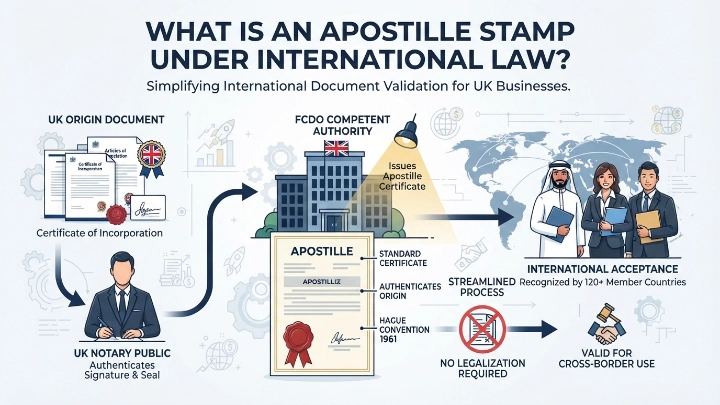
The Foreign, Commonwealth & Development Office (FCDO) functions as the sole issuing authority for apostilles in the United Kingdom. The apostille is a printed certificate containing ten standard data fields prescribed by international treaty. The FCDO attaches this certificate permanently to the underlying public or notarized document.
An apostille validates the public official who certified the document rather than the underlying substantive content. The FCDO matches the notary’s signature against its central register of authorized UK public officials. Once verified, the state applies an official embossed stamp and security ribbon.
Hague Convention signatories accept apostilled documents without additional embassy attestation. Over 120 member states recognize this streamlined legalisation framework. Non-member nations require further consular legalization through their respective London embassies.
Proper document preparation prevents administrative rejection by foreign government agencies. Reviewing a comprehensive guide on Apostilled Documents: Simplifying International Business and Global Trade allows corporate managers to establish efficient legalisation workflows before launching global trade operations.
When Do Overseas Authorities Require Notarization Versus Apostille?
Overseas authorities require notarization for private contracts, power of attorney documents, and corporate resolutions. They demand an apostille when private or public documents must be submitted to foreign government registries, tax authorities, or judicial bodies.
Determining the required legalisation tier depends on document type and target jurisdiction. Private agreements executed between commercial entities typically mandate initial notarization. Foreign state agencies require secondary validation through an official apostille certificate.
Different document classes require specific legalisation pathways to achieve foreign validity:
Verify legal capacity for corporate power of attorney documents through initial notarization followed by an FCDO apostille.
Submit original UK birth, marriage, or death certificates directly to the FCDO for apostille legalisation without prior notarization.
Authenticate company incorporation certificates, memorandum of association, and articles of association via notary verification before state apostille issuance.
Validate commercial invoices and certificates of origin through regional Chambers of Commerce prior to consular processing.
Failure to follow the correct sequential protocol invalidates the legal documentation. Foreign registries reject filings that skip required verification tiers. Processing documents incorrectly leads to project delays and unexpected administrative costs.
How Does the Step-by-Step International Document Legalisation Process Work?
The legalisation process involves drafting compliant documents, verifying signatory identity before a licensed notary public, submitting notarized paperwork to the Foreign, Commonwealth & Development Office for apostille attachment, and obtaining final embassy attestation if required.
Document legalisation follows a strict sequential hierarchy established by international law. Skipping individual stages invalidates the entire chain of authentication. Executing each phase accurately ensures compliance with foreign regulatory authorities.
Follow these sequential steps to legalise commercial documents for global deployment:
Draft the required commercial instrument in full compliance with host country legal standards.
Present government-issued identification to a registered public notary for identity verification and signature attestation.
Secure the notary public seal, signature, and formal notarial certificate onto the original document.
Submit the notarized paperwork to the FCDO Legalisation Office via secure postal service or registered courier.
Validate the FCDO apostille certificate upon receipt, verifying that all ten treaty fields contain accurate information.
Forward the apostilled document to the target foreign embassy if the recipient country operates outside the Hague Convention.
Managing this multi-stage workflow demands significant administrative time and regulatory expertise. Businesses often require an Expedited Apostilled Document Service: Your Global Trade Partner to accelerate processing timelines and guarantee official acceptance across foreign jurisdictions.
What Are the Most Common Document Legalisation Errors in Global Trade?
Common legalisation errors include submitting copied documents instead of certified originals, using unverified local notaries, omitting required embassy attestations for non-Hague nations, and presenting translations completed by non-certified translators prior to state authentication.
Administrative mistakes cause severe operational delays for UK companies expanding abroad. The FCDO rejects incomplete submissions, requiring businesses to restart the application process. Understanding compliance failures protects corporate expansion timelines and preserves capital.
Submit certified original public documents or verified notary copies to avoid direct FCDO rejection.
Confirm that the target nation belongs to the 1961 Hague Apostille Convention before submitting documentation.
Complete sworn translations after securing the apostille to ensure the translation covers both the primary text and state stamp.
Verify that the notary’s signature is currently registered on the FCDO official database prior to document execution.
Cross-border legal compliance requires meticulous administrative precision. Form My Company assists commercial entities in structuring corporate documentation correctly from the outset.
When corporate officers execute legal filings correctly, overseas expansion proceeds without regulatory friction. Form My Company provides corporate governance support to simplify international document preparation for UK entities.
How Do Digital Apostilles and e-Notarization Impact International Legalisation?
Digital apostilles (e-Apostilles) and e-notarization enable secure electronic document verification using cryptographic signatures. These digital standards streamline global trade by reducing document processing times from weeks to minutes across participating jurisdictions.
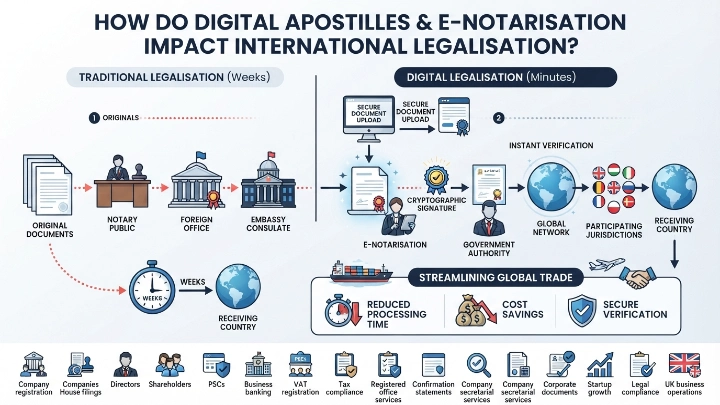
Digital transformation has modernized cross-border document authentication frameworks globally. The FCDO launched the UK e-Apostille service to process digitally signed PDF documents. Electronic verification protocols eliminate physical shipping delays and reduce administrative costs.
e-Notarization allows signatories to complete legal attestations via secure video conferencing platforms. Qualified public notaries apply cryptographic digital signatures containing public key infrastructure (PKI) certificates. Cryptographic hashing algorithms detect any unauthorized alterations made to the document post-execution.
The Hague Conference on Private International Law actively promotes the electronic Apostille Program (e-APP). Participating member states maintain online registers to verify e-Apostille authenticity instantly.
Foreign regulatory bodies check digital certificate serial numbers against central state databases. Form My Company monitors evolving digital compliance requirements to help businesses adopt efficient cross-border authentication workflows. Modernizing document legalisation infrastructure ensures rapid operational deployment in global markets.
Explore our Conference Room guide,
Internal Records vs. Companies House Filings: Avoiding Discrepancies
Document Standardisation: Why Your Company Pack Should be Consistent
Frequently Asked Questions
What amenities are included with Form My Company conference room hire?
Form My Company conference rooms come equipped with high-speed fibre Wi-Fi, large presentation screens or projectors, and flipcharts with markers. Each booking also includes a dedicated reception welcome service for guests and access to a complimentary tea and coffee station.
How do I book a conference room through Form My Company?
You can reserve a fully equipped venue by submitting a booking request directly on the Form My Company website or by contacting their support team via phone or email. Reservations are highly customizable, offering flexible hourly, half-day, and full-day access options tailored to your schedule.
What room configurations are available for Form My Company conference rooms?
Form My Company conference rooms support multiple versatile layouts, including boardroom style for up to 10 participants, collaborative roundtables, and theatre-style presentation setups. The flexible room layouts accommodate various corporate events, such as strategic board sessions, workshops, and client presentations.
Can Form My Company conference rooms support hybrid and virtual meetings?
Yes, Form My Company meeting spaces feature state-of-the-art audiovisual connectivity designed for seamless hybrid collaboration. Presenters can easily connect their own devices to large displays or projectors to host remote participants via video conferencing platforms.
Where are Form My Company conference rooms located in the UK?
Form My Company offers professional conference room hire in prime UK business locations, including key commercial hubs in Bolton, Manchester, and Liverpool. These centrally positioned venues provide convenient transport links and professional administrative support for on-site corporate proceedings.