An expedited apostilled document service speeds up global trade by authenticating legal documents through official government channels within 24 to 48 hours. This process ensures international authorities recognise corporate filings, power of attorney forms, and commercial contracts instantly without legal friction.
Why Do Businesses Require an Expedited Apostilled Document Service for International Operations?
Businesses require an expedited apostilled document service to meet strict foreign regulatory deadlines, secure international contracts, and open overseas bank accounts without delay. Fast authentication prevents costly deal cancellations, regulatory penalties, and administrative hold-ups in foreign jurisdictions.
Global expansion requires fast validation of legal paperwork across borders. Companies operating in foreign markets must prove their legal status to foreign governments, financial institutions, and business partners. Standard apostille processing by government agencies often takes four to six weeks. This delay stalls commercial operations and disrupts cross-border investments.
An expedited service bypasses standard public queues by utilising dedicated legal agents and direct registry access. Authorised specialists submit original records straight to official issuing offices, such as the UK Foreign, Commonwealth & Development Office (FCDO). They handle document preparation, notary coordination, and embassy legalization within compressed timeframes.
Cross-border mergers, foreign branch registrations, and international intellectual property filings require immediate legal recognition. Delaying these filings creates financial loss and operational stagnation. Fast-track apostille processing allows commercial entities to maintain momentum and comply with foreign legal systems efficiently.
How Does the Hague Apostille Convention Facilitate Cross-Border Commercial Transactions?
The Hague Apostille Convention streamlines international trade by replacing complex, multi-tiered document legalization with a single, universally recognized certificate. Member nations accept an apostille as full proof of authenticity for public and corporate documents without extra embassy verification.
Drafted in 1961, the Hague Apostille Convention established a standardized system for validating documents between participating countries. Before this treaty, foreign document legalisation required multiple layers of diplomatic certification. Organizations had to clear local public authorities, foreign ministries, and the destination country’s embassy.
The apostille certificate attaches directly to the official document. It features ten standardized data fields, including the country of origin, signing official, authority seal, certificate number, and issuing agency signature. Foreign courts and government bodies accept this standardized seal as direct evidence of validity.
More than 120 member states participate in this international framework. This widespread adoption simplifies global commerce, trade agreements, and cross-border corporate governance. Companies operating in member nations save time and resources by avoiding complex legalisation chains.
Which Corporate Documents Require Rapid Legalisation for Global Commerce?
Corporate documents requiring fast legalisation include Certificates of Incorporation, Memorandum and Articles of Association, board resolutions, and powers of attorney. Financial statements, Certificate of Good Standing filings, and commercial invoices also require rapid apostille processing to maintain foreign operations.
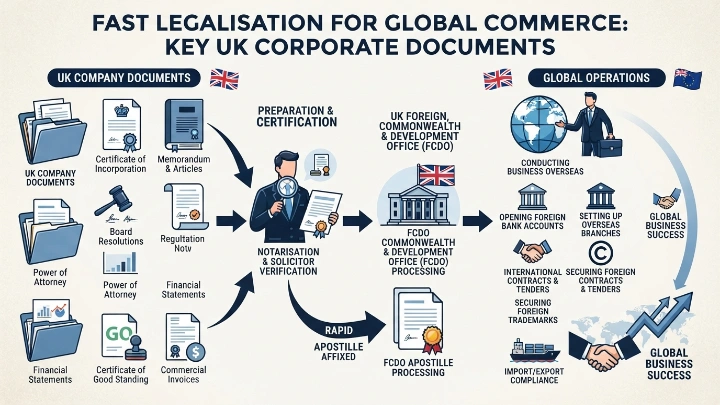
Companies must legalise structural corporate records when establishing foreign subsidiaries or opening offshore accounts. Foreign corporate registries demand authenticated proof that a parent company exists legally in its home jurisdiction.
Four major categories of commercial records regularly require apostille certification:
Corporate Formation Files: Certificates of Incorporation, Memorandum of Association, Articles of Association, and Shareholder Certificates.
Governance and Power Records: Board Resolutions, Power of Attorney authorizations, Director Certificates, and Secretary Statements.
Financial and Tax Filings: Certificate of Good Standing declarations, audited financial statements, tax residency certificates, and bank reference letters.
Commercial and Intellectual Contracts: Export certificates, trademark registrations, patent assignments, and supply chain distribution agreements.
When international deals require physical locations for negotiations, executive teams book an executive Conference Room to execute contracts and finalize apostille submissions. Having verified records ready during high-stakes meetings prevents operational delays.
How Does the Step-by-Step Expedited Apostille Process Work?
The expedited apostille process verifies document signatures, secures required public notary certifications, submits files to government legalisation offices, and issues the official apostille seal within 24 to 48 hours.
Authenticating international business records follows a precise administrative sequence. Skipping a single step leads to immediate rejection by foreign government authorities.
Professional agents eliminate common errors like improper notarisation, missing signatures, or incorrect document formats. Their direct oversight speeds up processing and guarantees compliance with international legal frameworks.
What Is the Difference Between Apostille and Legalisation for Non-Hague Nations?
An apostille provides standard verification for Hague Convention member nations, whereas embassy legalisation requires additional authentication steps from the foreign country’s embassy for non-Hague member states.
Not all nations belong to the 1961 Hague Apostille Convention. When trading with non-signatory countries—such as the UAE, Qatar, or Vietnam—a standard apostille certificate is insufficient. Businesses must navigate a longer, multi-tiered legalisation path.
To understand the operational and procedural differences, consult our detailed analysis on Apostille vs. Notarization: Navigating International Document Legalisation. Understanding these legal pathways ensures compliance across all international territories.
Non-Hague document verification requires double certification. First, the home country’s central government authority certifies the notary’s seal. Second, the destination country’s embassy or consulate inspects, stamps, and signs the document.
Embassy legalisation takes longer and costs more than a standard apostille. Embassies enforce specific translation rules, jurisdictional boundaries, and fee structures. Expedited service providers manage these complex requirements to prevent costly delays in non-member states.
How Do Legalisation Delays Impact Cross-Border Business Expansion?
Legalisation delays disrupt cross-border business expansion by stalling trade agreements, freezing international bank account setups, and causing missed regulatory compliance deadlines in foreign jurisdictions.
Timelines govern modern international business. Missing a registration deadline in a target market can derail product launches and cancel multi-million-pound investments.
Delays in document authentication trigger negative commercial ripple effects:
Frozen Banking Setup: Foreign commercial banks refuse to open corporate accounts without fully apostilled formation certificates and director IDs.
Stalled Trade Deals: Foreign buyers cancel procurement contracts when supply chain documents lack proper authentication.
Regulatory Penalties: Foreign corporate registries impose financial penalties or revoke operational licenses when compliance documents miss statutory deadlines.
Lost Tender Opportunities: International public procurement bids require certified corporate credentials upon submission, disqualifying late applicants.
Working with an experienced business services provider protects companies from administrative bottlenecks. Fast, reliable authentication keeps international business plans on track.
How Does Form My Company Streamline Expedited Legalisation for Businesses?
Form My Company streamlines expedited legalisation by reviewing corporate documents, coordinating solicitor notarisation, and handling direct submissions to issuing government agencies for rapid 24-hour turnaround times.
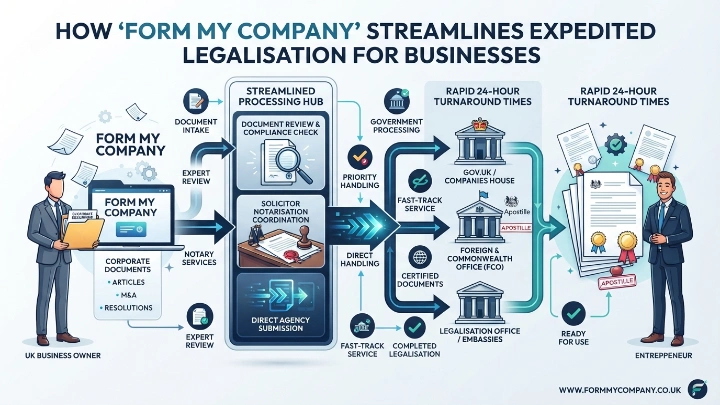
Navigating international legal requirements demands precision and speed. Form My Company provides complete administrative support for UK businesses expanding overseas. Experienced corporate agents handle every step of the apostille process, ensuring zero errors and immediate compliance.
When preparing corporate governance files, executives use an executive Conference Room to execute board resolutions, notarise documents, and finalize corporate filings. Combining professional venue services with document legalisation speeds up international expansions.
Form My Company simplifies cross-border management through expert handling:
Inspecting corporate records against current foreign registry requirements before submission.
Coordinating directly with accredited solicitors and public notaries for rapid document certification.
Submitting files via priority channels to secure same-day or 24-hour apostille turnarounds.
Managing full embassy legalisation for non-Hague target markets worldwide.
Outsourcing document authentication allows leadership teams to focus on core operations. Form My Company ensures global trade activities remain fully compliant and operational.
To build a complete cross-border expansion plan, read our comprehensive guide on Apostilled Documents: Simplifying International Business and Global Trade. Implementing structured legal strategies protects commercial assets in every global market.
Explore our Conference Guide,
Order Your Certificate of Good Standing via Form My Company
Appoint Your New Director with Form My Company Today
Frequently Asked Questions
How much does it cost to book a conference room in the UK?
The cost of booking a conference room in the UK typically ranges from £30 to £150 per hour, depending on the venue location, room capacity, and technical amenities included. Premium meeting venues in major business districts usually charge higher hourly or daily rates for fully equipped corporate facilities. Form My Company provides access to professional conference room spaces tailored to specific business meeting requirements and budgets.
What amenities are included with professional conference room rentals?
Professional conference room rentals generally include high-speed Wi-Fi, audiovisual equipment for video conferencing, digital presentation displays, and ergonomic seating. Many business centers also provide administrative support, meeting reception services, flipcharts, and complimentary hot beverages. Facilities booked through Form My Company ensure business teams have access to fully equipped meeting environments for board meetings and client presentations.
Can I rent a conference room for an hour or half a day?
Yes, most corporate meeting facilities offer flexible booking models including hourly, half-day, and full-day rental options. Flexible conference room rentals allow startups and remote companies to access professional meeting spaces only when needed without long-term commercial leases. Form My Company enables businesses to reserve state-of-the-art conference rooms for flexible time slots to conduct interviews, board discussions, or legal document signings.
How do I choose the right conference room size for a business meeting?
Choosing the right conference room size depends on the number of attendees, the format of the meeting, and necessary physical distancing or breakout requirements. Small boardroom setups suit intimate client negotiations with 4 to 8 participants, while workshop style layouts accommodate larger corporate training sessions. Form My Company offers various configurable conference room spaces designed to host everything from executive director meetings to larger corporate team sessions.
Why should remote companies use professional conference rooms for meetings?
Remote and hybrid businesses use professional conference rooms to host formal client presentations, team strategy sessions, and official corporate governance meetings in a secure environment. A dedicated meeting facility establishes corporate credibility, ensures data privacy during sensitive discussions, and provides reliable technology for hybrid video calls. Through Form My Company, virtual businesses gain instant access to professional conference room locations across key commercial hubs.