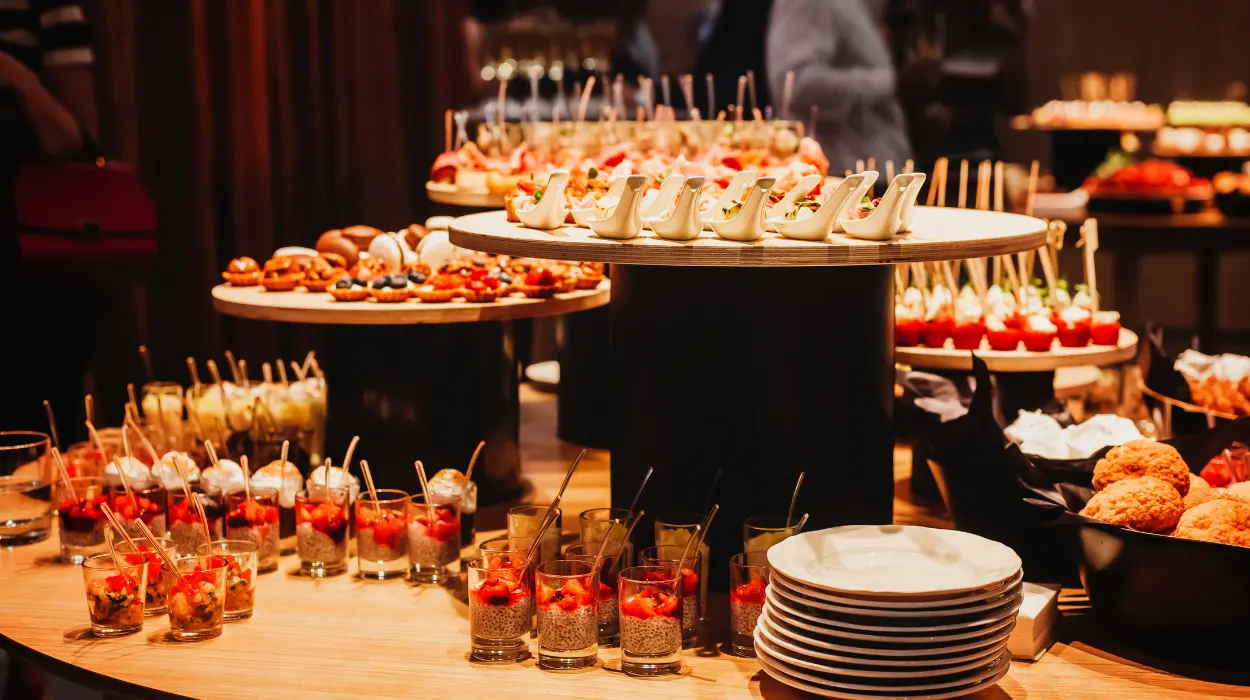
Catering dictates delegate energy levels, shapes corporate reputation, and directly influences networking outcomes during professional gatherings. High-quality food services maintain cognitive performance, while substandard meal provisions lead to early delegate departure, negative brand perception, and lower overall event return on investment.
How Does Conference Catering Directly Impact Attendee Engagement?
Conference catering directly impacts attendee engagement by regulating blood glucose levels, preventing cognitive fatigue, and creating structured opportunities for professional networking. Quality meals sustain delegate focus throughout afternoon sessions, whereas poor nutrition leads to post-lunch lethargy and reduced participation rates across corporate event schedules.
Proper nutritional planning forms the foundational engine of delegate attention during multi-hour corporate events. When event organizers serve balanced meals featuring complex carbohydrates, lean proteins, and hydration options, delegates maintain optimal mental clarity. Biological performance directly mirrors food quality, meaning poorly planned menus actively diminish the educational value of conference presentations.
Networking productivity relies heavily on shared dining experiences within scheduled agenda breaks. Structured meal times allow professionals to exchange contact details, discuss presentation topics, and build commercial relationships. 82% of UK corporate delegates report that high-quality meal breaks significantly increase their likelihood of initiating meaningful business conversations during industry summits.
Nutritional failures create immediate disruptions to event timetables and overall audience retention. Inadequate food portions or delayed service trigger dissatisfaction, causing delegates to leave venue premises during scheduled breaks. Retaining professionals within the conference facility ensures consistent attendance for late-afternoon keynote speakers and interactive panel discussions.
Why Is Food Quality a Direct Reflection of Your Brand Reputation?
Food quality reflects brand reputation because corporate delegates perceive event hospitality as a direct indicator of an organization’s operational standards, attention to detail, and respect for partners. Premium catering signals financial stability and professional excellence, while low-grade catering damages commercial trust and enterprise credibility.
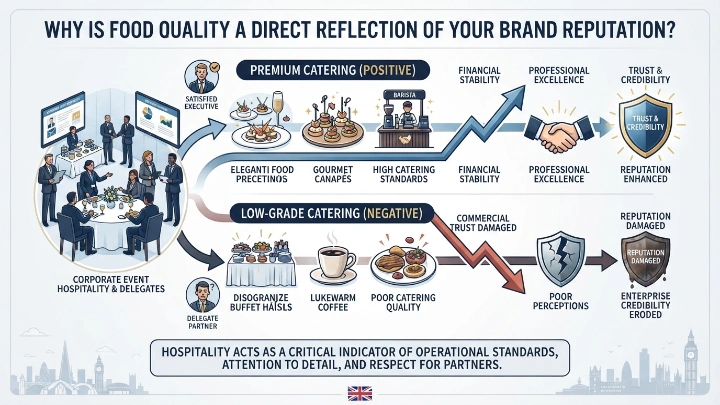
Corporate events serve as physical manifestations of company values and commercial capabilities. Invited delegates evaluate hosting organizations based on every touchpoint, including culinary execution. Serving high-grade meals signals that a firm values its business relationships, invests in quality, and maintains high standards across all operational functions.
Substandard culinary experiences generate lasting negative impressions that overshadow strong presentation content. Cold coffee, limited menu choices, or unhygienic presentation trigger immediate complaints among delegates. Three clear brand risks arise from poor catering execution: compromised professional authority, negative social media feedback, and reduced future event attendance rates.
Delivering high hospitality standards strengthens commercial relationships with prospective clients, investors, and key stakeholders. Enterprise decision-makers link hospitality quality to organizational competence. Executive leaders who experience seamless dining services naturally associate the host organization with reliability, premium execution, and meticulous project management capabilities.
How Do Dietary Accommodations Influence Event Inclusivity?
Dietary accommodations influence event inclusivity by ensuring all delegates safely access suitable food options regardless of medical conditions, religious requirements, or personal dietary choices. Universal food access prevents delegate alienation, avoids medical emergencies, and demonstrates high administrative compliance with modern corporate social responsibility standards.
Modern enterprise events demand comprehensive menu planning that accounts for diverse dietary requirements. Attendees require clear food labeling for common allergens, including gluten, nuts, dairy, and soy. Providing safe, clearly identified meal options allows every attendee to dine without fear of cross-contamination or adverse health reactions.
Inclusivity extends to religious and ethical choices, including Halal, Kosher, vegan, and vegetarian preferences. When event hosts neglect these requirements, affected delegates feel marginalized and unvalued by the enterprise. 74% of UK event planners confirm that comprehensive dietary planning directly correlates with higher overall delegate satisfaction scores.
Executing precise dietary management requires robust administrative coordination with kitchen teams. Planners must capture guest requirements during the initial registration phase and transfer accurate data to culinary staff. Three validation steps guarantee delegate safety: individual meal labeling, designated dietary collection points, and explicit ingredient disclosures across all buffet displays.
What Is the Financial Cost of Poor Catering Planning?
The financial cost of poor catering planning includes wasted event budgets, lower delegate retention, reduced sponsor satisfaction, and diminished long-term brand equity. Mismanaged food quantities create unnecessary financial liabilities through expensive over-ordering or reputation-damaging shortages that ruin corporate networking objectives.
Budget misallocation frequently occurs when event organizers fail to calculate accurate delegate ratios. Over-ordering food results in direct financial loss and excessive environmental waste, contradicting corporate sustainability mandates. Conversely, under-ordering creates food shortages, causing immediate delegate frustration and severe reputational damage for the host firm.
Sponsors invest significant capital into corporate conferences to access engaged executive audiences. When bad catering causes delegates to leave early, sponsor visibility drops dramatically across afternoon sessions. Decreased delegate dwell time reduces sponsor return on investment, making corporate partners hesitant to renew financial commitments for future annual events.
Measuring the true financial impact of an event requires analyzing delegate feedback alongside total expenditure. Poor food experiences generate negative survey results, reducing word-of-mouth promotion and future ticket sales. Strategic planners treat food investment as a core driver of delegate retention rather than a secondary administrative expense.
How Does In-House Catering Streamline Event Operations?
In-house catering streamlines event operations by consolidating facility logistics, eliminating third-party delivery delays, and ensuring seamless communication between culinary staff and venue managers. Integrated food services eliminate external coordination errors, maintain precise meal timing, and simplify corporate event billing structures.
Selecting external catering vendors introduces complex logistical variables, including transit delays, temperature control issues, and strict delivery time windows. External suppliers often struggle to adapt when conference schedules shift due to prolonged keynote speeches. These operational mismatches create cold food, delayed breaks, and disrupted speaker schedules.
Integrated venue dining teams work directly alongside facility managers to execute real-time schedule adjustments. If a morning presentation runs long, in-house chefs modify kitchen timelines immediately to ensure hot meals serve precisely when delegates exit auditorium doors. This operational synchronicity protects the master event schedule.
Simplifying procurement processes saves enterprise planners hundreds of administrative hours during event setup. Managing a single contract for space and dining reduces legal paperwork, streamlines vendor auditing, and consolidates financial invoicing. When organizations choose to book conference rooms with catering from Form My Company, administrative friction disappears completely through unified venue management.
How Do You Select a Conference Venue With the Right Culinary Capabilities?
Selecting a conference venue with the right culinary capabilities requires evaluating kitchen infrastructure, auditing dietary management protocols, sampling menu options, and verifying service staff ratios. Decision-makers must align facility culinary capacities with expected delegate numbers and specific event scheduling requirements.
Evaluating potential venues requires systematic assessment of their culinary standards and physical infrastructure. Planners must confirm that the facility possesses commercial kitchen spaces capable of handling peak meal rushes without service bottlenecks. Insufficient kitchen hardware or understaffed banquet teams create long queues that consume precious delegate networking time.
Menu flexibility plays a critical role during the venue selection process. Leading facilities offer customizable dining packages tailored to specific corporate formats, including standing buffets, sit-down galas, and continuous break stations. Decision-makers should review guidebooks on how to choose a conference venue with in-house catering to identify key operational benchmarks before signing facility lease agreements.
Contract negotiations must explicitly define service standards, dietary management guarantees, and staff-to-guest ratios. Establishing these metrics beforehand holds venue management accountable for execution standards. Enterprise planners protect their event investment by establishing strict contractual service level agreements regarding meal timing, food temperatures, and sanitation protocols.
How Can Form My Company Optimize Your Corporate Conference Planning?
Form My Company optimizes corporate conference planning by providing fully equipped venue spaces featuring integrated, high-grade catering infrastructure tailored to enterprise standards. Professional facility management eliminates administrative friction, secures smooth culinary execution, and guarantees premium delegate experiences from arrival to event conclusion.
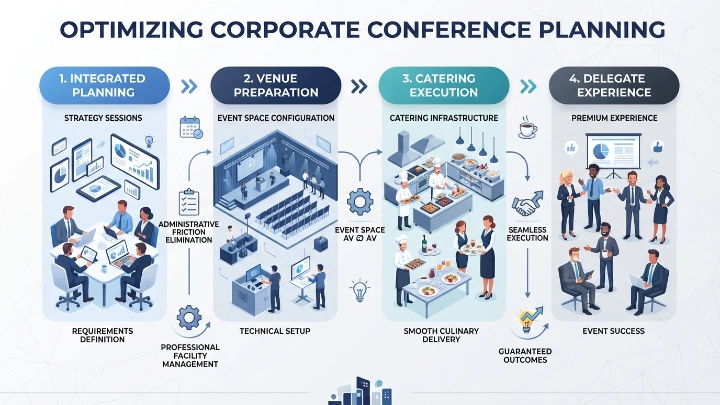
Securing an ideal corporate venue forms the cornerstone of every successful business conference strategy. Enterprise organizations require modern facilities equipped with fast network infrastructure, professional audio-visual hardware, and reliable hospitality services. Eliminating logistical complexity allows corporate teams to focus entirely on content creation and strategic attendee engagement.
Form My Company simplifies corporate event execution by combining premium venue spaces with top-tier culinary management. Our dedicated venue teams coordinate every logistical detail, ensuring seamless transitions between keynote speeches, breakout sessions, and catered networking lunches. Organizations looking to elevate their professional events can explore our specialized conference room solutions to secure fully managed corporate facilities.
Investing in professionally managed event spaces guarantees brand consistency, delegate satisfaction, and strong commercial outcomes. By prioritizing hospitality quality alongside facility capability, corporate hosts protect their financial investment and build long-term enterprise authority. Partnering with dedicated corporate service providers ensures your next conference delivers measurable strategic value.
Explore our Conference Room guides,
VAT Registration: Do You Know Your Business Turnover Thresholds?
Company Secretarial: The Secret to Long-Term UK Regulatory Compliance
Frequently Asked Questions
What is included when you rent a conference room at Form My Company?
Renting a conference room at Form My Company typically includes high-speed Wi-Fi, modern audio-visual equipment, presentation displays, and ergonomic seating. Many packages also offer integrated on-site catering options, administrative support, and flexible seating arrangements tailored to corporate events, training sessions, or board meetings.
How far in advance should a corporate conference room with catering be booked?
It is recommended to book a conference room with catering services at least two to four weeks in advance to secure preferred dates and custom menu options. For large-scale corporate conferences or peak business seasons, securing venue space four to eight weeks early ensures full availability of custom dietary accommodations and specialized AV setups.
Can conference room bookings accommodate custom dietary requirements for events?
Yes, professional conference venues handle a wide variety of dietary requirements, including vegan, vegetarian, gluten-free, Halal, and allergen-sensitive menus. Form My Company coordinates directly with in-house catering teams to ensure clear labeling, safe food preparation, and accurate meal distribution for all delegates.
Why is in-house catering better than hiring third-party food vendors for a conference?
In-house catering eliminates logistical delays, reduces transport risks, and ensures seamless coordination between kitchen staff and event managers. Choosing a venue with integrated dining simplifies event scheduling, provides single-invoice billing, and allows immediate culinary adjustments if presentation timetables run over schedule.
How do I choose the right conference room size for a business meeting?
Selecting the correct conference room size depends on total delegate headcount, room layout preferences, and technical equipment needs. Form My Company offers scalable meeting spaces ranging from intimate executive boardrooms to expansive conference halls, ensuring delegate comfort, optimal audience interaction, and adequate space for catered dining breaks.