To choose a conference venue with in-house catering, evaluate dietary customisation capabilities, room layout flexibility, peak-hour service capacity, and integrated package pricing. Select facilities with certified kitchen operations, dedicated banquet staff, and clear service-level agreements to prevent delays, cost overruns, and logistical bottlenecks during your corporate event.
How Does In-House Catering Influence Venue Selection?
In-House catering influences venue selection by streamlining event logistics, reducing vendor coordination risks, and fixing overall operational costs. Venues with direct culinary management deliver consistent meal schedules, adhere to strict dietary requirements, and optimize floor space for seamlessly managed break periods.
Corporate event planners manage complex schedules. Third-party caterers introduce logistical friction. External vendors require loading dock access, temporary kitchen setups, and separate insurance policies. Venues with internal culinary teams remove these operational hurdles. Dedicated food prep areas allow staff to adjust meal service to real-time event changes.
Event productivity relies heavily on timing. Delays in food delivery disrupt presentation schedules and lower attendee engagement. Internal culinary services coordinate directly with venue site managers. This alignment ensures that coffee breaks, buffets, and plated meals occur precisely during planned agenda gaps.
Budget management is another key factor. External caterers often charge delivery, setup, and off-site staffing fees. Internal catering combines room hire, audiovisual equipment, and food service into single packages. This consolidated pricing simplifies accounts payable processes and improves budget forecasting.
Food safety standards also require strict oversight. Venues operating certified on-site kitchens adhere to local environmental health regulations. Internal chefs manage allergen control and food temperature logs directly. This central oversight reduces liability risks for corporate event organizers.
Which Dietary and Menu Options Must a Venue Provide?
A corporate conference venue must provide inclusive menu options covering vegetarian, vegan, gluten-free, halal, and allergen-sensitive diets. Top facilities offer customisable meal plans, clear ingredient labeling, and transparent sourcing to ensure all delegate health needs and preferences are met safely.
Modern corporate events demand diverse dietary provisions. Standardized menus no longer satisfy broad delegate demographics. Venues must demonstrate clear protocols for handling severe food allergies. Kitchen teams must prevent cross-contamination during preparation, plating, and service stages.
Menu flexibility directly affects delegate satisfaction. Review sample menus before signing facility contracts. Ensure the venue offers balanced choices, including high-protein options, complex carbohydrates, and low-sugar break items. Proper nutrition prevents afternoon energy drops among delegates.
Sourcing transparency is equally critical. Premium venues partner with regional suppliers to deliver fresh ingredients. Local sourcing improves meal quality and aligns with corporate sustainability objectives. Ask venue coordinators for proof of sustainable ingredient procurement.
Tasting sessions validate culinary capabilities. Schedule a formal tasting event prior to finalising venue hire contracts. Evaluate food presentation, portion sizes, temperature stability, and service speed. Direct tasting experiences verify that kitchen staff can execute large-scale catering under live conference conditions.
Organisers seeking deeper context on culinary impact should read Why Does Catering Make or Break a Corporate Conference? to understand how food quality influences delegate retention.
How Do You Assess Room Capacity and Service Workflows?
Assess room capacity and service workflows by calculating square footage per delegate, reviewing traffic pathways, and evaluating buffet setup layouts. Facilities require dedicated staging zones and separate service entrances to move delegates efficiently without causing corridors to congest during high-volume breaks.
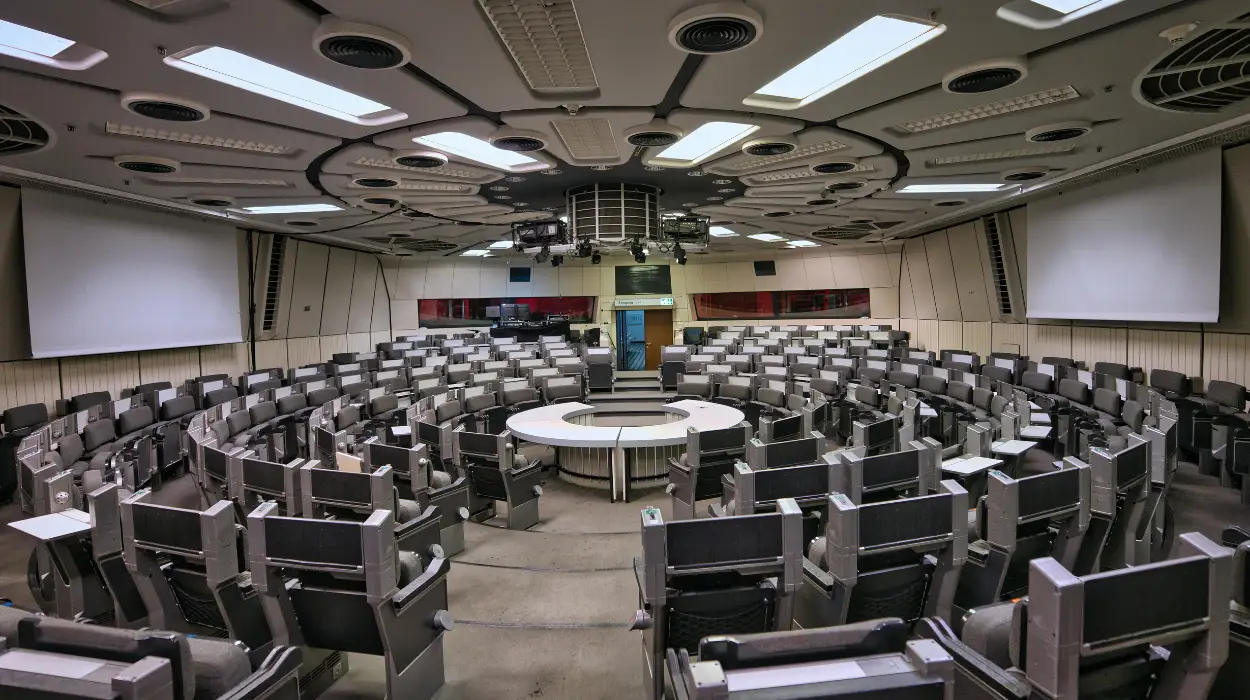
Room capacity extends beyond seating arrangements. Catering setups require substantial floor area. A venue must accommodate dining tables, buffet lines, and beverage stations without crowding presentation zones. Allow at least 15 to 20 square feet per attendee in multi-purpose dining spaces.
Traffic flow determines service speed. Congested food lines delay conference agendas. Inspect the physical layout of break rooms and dining halls. Ensure the venue provides dual-sided buffets or multiple beverage distribution points. This structural redundancy reduces queue wait times during peak 30-minute breaks.
Service staff access must remain separate from main attendee corridors. Kitchen staff require discrete entry points to replenish food stations and clear dirty dishes. Visible trash accumulation and noisy dish clearing disrupt professional environments. Dedicated service routes preserve a refined corporate atmosphere.
Acoustics in combined dining and conference spaces affect communication quality. High ceiling heights, hard flooring, and glass walls generate excessive reverberation. Select rooms featuring acoustic wall panels, carpeted floors, and sound-dampening drapery. Balanced acoustics permit productive networking during meal periods.
Spatial flexibility accommodates dynamic event schedules. Look for venues featuring movable partition walls. Convertible spaces allow rapid transitions from general assembly rooms to private dining areas. Facilities with adaptable layouts optimize total floor space usage.
What Pricing Models Apply to Venues With In-House Catering?
Pricing models for venues with in-house catering include Day Delegate Rates (DDR), itemised room hire plus consumption charges, and minimum food and beverage spend thresholds. Review package inclusions carefully to identify hidden service fees, overtime rates, and equipment charges before signing contracts.
Day Delegate Rates represent the most common commercial agreement. DDR packages combine main room hire, standard audiovisual equipment, morning tea, lunch, and afternoon refreshments into a fixed per-person fee. This model offers predictable costs for budget planning.
Itemised billing suits complex or multi-day corporate events. Venues charge separately for room rental, specific menu selections, dedicated service staff, and technical support. Itemised models require careful tracking but grant organizers granular control over individual expenditure line items.
Minimum spend contracts waive venue rental fees if food and beverage charges hit an agreed threshold. Calculate expected attendee counts accurately when negotiating these terms. If attendance falls short, your organisation remains responsible for paying the unearned balance.
Watch for hidden service fees. Standard venue proposals may omit mandatory service charges, gratuities, staff overtime, and local sales taxes. Require venue sales managers to provide fully inclusive quotes detailing all anticipated fees.
Review cancellation and attrition terms thoroughly. Corporate schedules change unexpectedly. Ensure contract clauses allow reasonable adjustments to delegate counts up to 14 days prior to the event without triggering severe financial penalties.
How Do You Audit Venue Technology and Catering Coordination?
Audit venue technology and catering coordination by verifying on-site technical support, assessing AV power accessibility near break zones, and testing real-time communication between floor managers and kitchen staff. Seamless digital infrastructure ensures presentations continue smoothly alongside food service transitions.
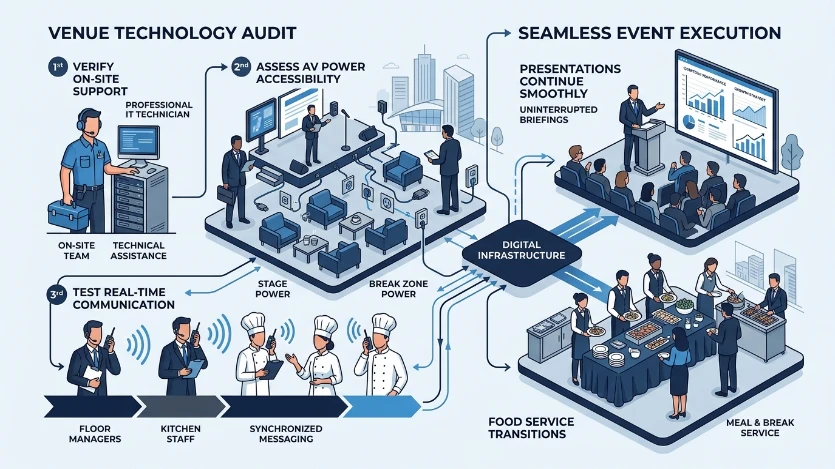
Technology infrastructure underpins modern corporate events. High-speed Wi-Fi, digital displays, and reliable sound systems are essential. Catering operations must not compromise technical setups. Ensure kitchen power demands do not overload electrical circuits dedicated to AV systems.
Digital signage improves delegate navigation. Premier venues feature electronic displays outside room doors and catering areas. These screens display updated agendas, sponsor logos, and directional guidance. Clear digital signage prevents confused delegates from roaming into wrong spaces.
On-site technical support must remain available throughout the day. Dedicated AV technicians resolve microphone feedback, projection errors, and hybrid streaming issues immediately. Confirm that technical staff are present on the floor, not just on call.
Communication between event coordinators, AV teams, and kitchen staff must be continuous. Floor managers should use two-way radios or mobile headsets. When a keynote presentation runs over time, event managers must instantly alert the kitchen to hold hot meal service.
To secure a fully equipped space that integrates high-end media infrastructure with culinary services, reserve high-specification Conference Rooms designed specifically for seamless business meetings.
Why Choose Form My Company for Your Next Event Venue?
Form My Company delivers fully equipped corporate event spaces featuring professional in-house culinary services, advanced audiovisual infrastructure, and flexible room configurations. Our venues eliminate vendor management stress, providing transparent package pricing and dedicated event coordinators to ensure flawless conference execution.
Choosing the right facility requires balancing logistics, culinary quality, and technology. Form My Company streamlines this process by providing fully managed event spaces tailored to corporate standards. Our internal culinary teams craft nutritious, adaptable menus that accommodate all dietary requirements without inflating event costs.
Our facilities feature high-speed optical fiber connectivity, acoustic isolation panels, and adaptable room configurations. Whether hosting an intimate board meeting or a full-scale corporate conference, our floor layouts adjust to your exact spatial needs. Dedicated floor managers oversee both technical systems and meal distribution to ensure your schedule runs precisely on time.
Businesses looking to streamline event logistics can Book Conference Rooms With Catering From Form My Company to guarantee fixed package rates, professional staffing, and high-quality culinary delivery for every delegate.
Explore our Conference Room guide,
Voluntary vs. Forced Director Resignation: What You Should Know
Bundle Filing vs. Separate Filings: Saving Time and Money
Frequently Asked Questions
What is included when renting a conference room with Form My Company?
Renting a conference room with Form My Company includes high-speed Wi-Fi, modern audiovisual equipment, adaptable seating configurations, and access to professional in-house catering services. Every booking provides on-site technical support and dedicated floor management to ensure seamless meeting execution. Flexible booking packages cover both half-day and full-day corporate event requirements.
How far in advance should corporate conference rooms be booked?
Corporate conference rooms should ideally be booked 4 to 8 weeks in advance to secure preferred dates, spatial layouts, and custom catering menus. Larger corporate events with complex audiovisual needs or high attendee volumes benefit from early scheduling to allow adequate coordination with venue managers. Form My Company also accommodates short-notice reservations based on real-time room availability.
Can catering menus be customized for dietary requirements at Form My Company venues?
Yes, in-house culinary teams at Form My Company offer fully customizable catering packages to accommodate dietary requirements, including vegan, vegetarian, gluten-free, halal, and allergen-sensitive diets. Organizers can request sample menus and arrange pre-event tastings to verify meal quality and service workflows. Clear ingredient labeling and dedicated food prep protocols prevent cross-contamination during event breaks.
How does in-house catering simplify conference room venue hire?
In-house catering consolidates room hire, food service, and audiovisual support into a single contract, eliminating the need to coordinate third-party food vendors. This integrated approach ensures meal breaks align precisely with conference agendas and reduces overall administrative overhead. It also guarantees compliance with on-site health standards while controlling event expenditure through transparent package pricing.
What factors determine the cost of booking a conference room with catering?
Conference room booking costs are determined by delegate headcounts, event duration, chosen menu options, and specific technical infrastructure requirements. Most facilities offer Day Delegate Rates (DDR) that combine facility hire, audiovisual setup, and scheduled meal breaks into a fixed per-person cost. Form My Company provides transparent, itemized quotes to ensure corporate clients avoid hidden service charges or unexpected overtime fees.