
Form My Company provides complete ECCTA-compliant PSC verification by managing the end-to-end identity validation process directly with Companies House. UK corporate entities obtain fully authenticated Persons with Significant Control records through encrypted biometric identity checks, verified address documentation, and automated filing workflows.
The Economic Crime and Corporate Transparency Act 2023 introduces mandatory identity verification requirements for all corporate directors and Persons with Significant Control. Failure to comply with these statutory obligations results in severe operational restrictions, financial penalties, and potential prosecution. Understanding the compliance framework ensures your enterprise maintains uninterrupted corporate standing while satisfying UK registry mandates.
What Is ECCTA PSC Verification for UK Companies?
ECCTA PSC verification is a legal mandate under the Economic Crime and Corporate Transparency Act requiring UK companies to validate the identity of every Person with Significant Control. This process links verified individuals to public registry profiles using government-issued documentation and biometric data.
The UK government enacted the Economic Crime and Corporate Transparency Act to prevent fraudulent company formations and improve corporate registry transparency. Under this legal framework, Companies House requires every Person with Significant Control to authenticate their identity before maintaining corporate standing. This statutory requirement applies to all UK limited companies, limited liability partnerships, and registered foreign entities operating within the jurisdiction.
Identity validation requires individual PSCs to match their biometric records against valid government documents. This process verifies full legal names, residential addresses, dates of birth, and nationality parameters before submission to Companies House. Unverified individuals face restrictions, preventing them from filing statutory documents or registering new business structures. Engaging a trusted corporate agent like Form My Company ensures your filings remain compliant with evolving regulatory standards.
Companies must complete identity validation within strict statutory windows following incorporation or operational changes. New entities must verify PSC identities during initial setup, while existing companies must complete compliance checks during their annual confirmation statement cycle. Retaining an updated PSC Register prevents statutory defaults and shields directors from legal liability.
Why Must Every PSC Verify Their Identity at Companies House?
Every PSC must verify their identity to prevent corporate fraud, ensure registry accuracy, and avoid severe legal penalties under UK company law. Failure to verify invalidates corporate filings, exposes directors to financial fines, and leads to mandatory strike-off proceedings.
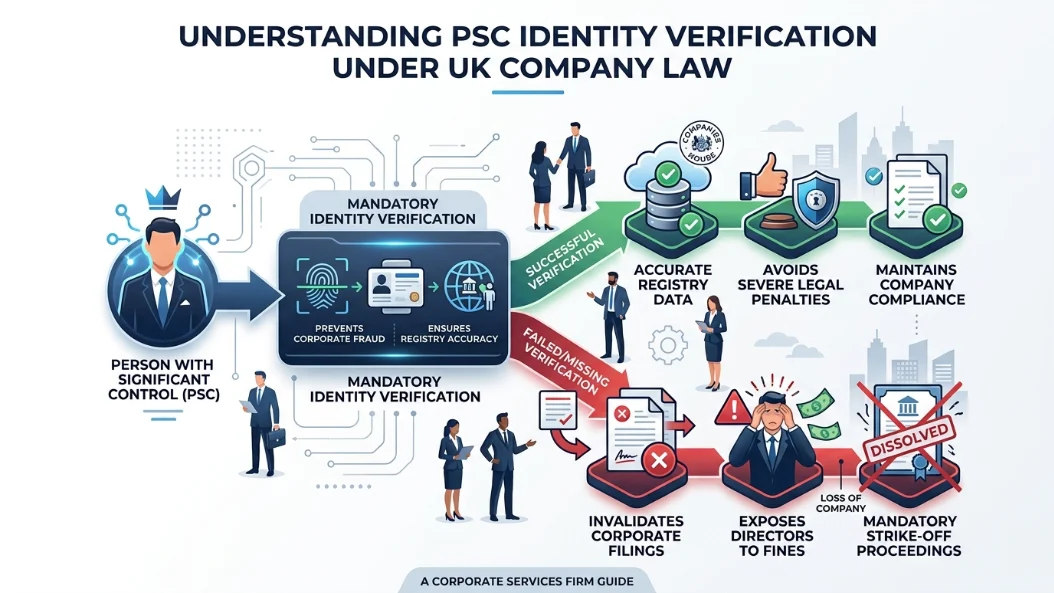
Companies House enforces identity verification to eliminate anonymous ownership structures within UK corporate entities. Anonymous ownership facilitates financial crime, money laundering, and illicit corporate control. The mandatory verification framework ensures that every individual exerting substantial influence over a UK business entity exists as an authenticated legal person.
Failing to satisfy identity verification obligations carries direct legal consequences for both the company and the individual. Directors face personal fines up to £10,000 alongside statutory restrictions preventing them from acting as company officers. Companies House actively restricts unverified enterprises from filing annual accounts, changing registered office details, or updating officer appointments.
Unverified status also triggers automatic fraud warnings on the public register, damaging business credibility with banking partners, insurers, and prospective clients. You can review our detailed analysis on why must every PSC now verify their identity at Companies House to understand the full regulatory scope and statutory risks associated with non-compliance.
What Documents Do You Need for PSC Identity Verification?
PSC identity verification requires a valid primary government photo ID paired with a approved secondary proof of residential address. Primary documents include valid passports, national identity cards, or photocard driving licenses, while secondary proof requires recent utility bills or bank statements.
Submitting accurate documentation accelerates the identity authentication process and prevents registry rejections. The primary identification document must contain a clear photographic image, full legal name, and unexpired validity date. Biometric passports represent the preferred primary credential due to integrated digital security chips that enable rapid automated validation.
Submit an unexpired passport featuring an embedded biometric chip
Provide a current photocard driving license issued by the UK or EU
Supply a national identity card displaying full biometric metadata
Upload a bank statement issued within the preceding 90 days
Present a council tax bill covering the current assessment year
Secondary address documentation must match the residential address declared on statutory filing forms. Utility bills, government tax notifications, and financial statements serve as valid residential proof when issued within designated timeframe limits. Discrepancies between official identity documents and registration entries cause immediate verification failure. For a complete document guide, read our resource on PSC identity verification: what documents do you need? to prepare your compliance materials efficiently.
How Does Form My Company Manage Your PSC Verification Process?
Form My Company manages PSC verification by collecting required identity credentials, conducting automated biometric authentication, and submitting certified verification packages to Companies House. This end-to-end service guarantees full ECCTA compliance while eliminating administrative filing delays for business owners.
Our structured verification methodology streamlines complex legal compliance requirements into a simple digital workflow. Corporate officers submit digital scans of identity documents through secure, encrypted data channels. Advanced identity verification software cross-references facial geometry against government-issued credentials, detecting fraudulent entries instantly.
Secure sensitive personal data using enterprise-level 256-bit encryption
Validate primary photographic credentials against international security databases
Match facial biometrics using automated digital verification algorithms
Confirm residential addresses against official credit and electoral databases
Submit certified compliance notifications directly to Companies House records
Once biometric verification confirms identity metrics, our regulatory specialists compile the official compliance documentation. We format statutory notifications to align precisely with Companies House submission protocols, eliminating manual data entry errors. Form My Company maintains full audit trails for every client, providing verifiable proof of legal compliance during regulatory inspections.
Outsourcing corporate compliance tasks allows company directors to focus on core commercial growth while maintaining pristine public records. Our automated platform monitors ongoing statutory deadlines, sending proactive notifications whenever confirmation updates become due. Relying on professional corporate services mitigates compliance risks and keeps your enterprise aligned with statutory obligations.
Who Needs ECCTA-Compliant PSC Identity Verification?
ECCTA-compliant PSC verification applies to every individual who holds more than 25% of company shares, controls over 25% of voting rights, or exercises significant influence over a UK registered entity. This rule encompasses UK residents, foreign nationals, corporate directors, and relevant legal entities.
Determining who qualifies as a Person with Significant Control requires evaluating corporate equity structures, voting rights allocations, and operational influence dynamics. Statutory thresholds define five primary criteria that establish PSC status under UK corporate legislation.
| Verification Criteria | Threshold Percentage | Required Verification Action |
| Share Ownership | Exceeds 25% of voting shares | Full biometric ID validation |
| Voting Rights | Exceeds 25% of total votes | Full biometric ID validation |
| Board Appointment | Right to appoint/remove majority board | Direct legal person verification |
| Significant Influence | Direct operational control | Direct legal person verification |
| Trust/Firm Control | Control over non-corporate entities | Trustee/Partner identity checks |
Foreign nationals who serve as PSCs for UK entities must complete identical verification checks as domestic residents. Overseas individuals submit certified international passports alongside translated proof of residential address. Form My Company processes international identification documents, ensuring foreign investors fulfill UK legal standards effortlessly.
Corporate entities serving as PSCs must identify their Relevant Legal Entity (RLE) and designate an authenticated natural person to act as compliance representative. This requirement prevents corporate layering from concealing underlying beneficial ownership. Identifying all qualified individuals within your corporate hierarchy ensures complete registry accuracy.
When Must Companies Complete Their PSC Identity Verification?
Companies must complete PSC identity verification immediately upon initial incorporation or within specified statutory windows during routine annual filings. Existing entities must complete verification before submitting their next annual confirmation statement to Companies House.
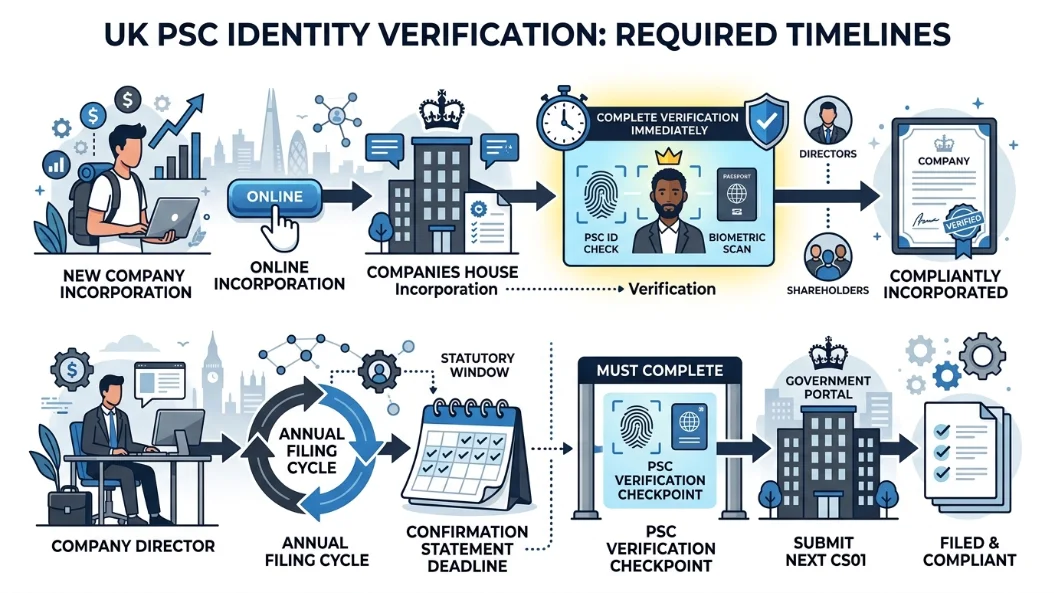
Timing represents a critical compliance metric under current UK company law. New incorporations cannot proceed past initial application stages without submitting verified identity records for all declared PSCs. Founders must gather identity credentials before initiating formation procedures to avoid operational delays.
Existing UK companies operate under transitional compliance deadlines aligned with their annual confirmation statement schedules. The compliance window opens automatically when an entity reaches its standard filing anniversary. Attempting to file annual confirmation statements without verified PSC records results in immediate registry rejection.
Changes in company ownership or beneficial control trigger immediate updating obligations under ECCTA legislation. When a new shareholder acquires more than 25% of corporate equity, the company must verify their identity within 14 calendar days. Updating statutory registers promptly maintains corporate transparency and prevents statutory default notices.
What Are the Penalties for Non-Compliance With ECCTA PSC Rules?
Non-compliance with ECCTA PSC rules results in statutory financial fines, prosecution of company directors, and administrative strike-off of the corporate entity. Unverified companies face immediate operational freezes, preventing document updates, banking operations, and legal transactions.
Companies House exercises expanded enforcement powers under the Economic Crime and Corporate Transparency Act. Regulators actively monitor statutory filings for missing or unverified identity credentials, issuing compliance default notices automatically upon deadline expiration. Continued non-compliance escalates administrative penalties to formal prosecution.
Corporate officers incur personal criminal liability for failing to satisfy identity verification mandates. Statutory fines accrue on a daily basis for ongoing non-compliance offences, creating substantial financial liabilities for negligent directors. Furthermore, persistent non-compliance leads to formal director disqualification orders lasting up to 15 years.
Financial penalties accruing daily up to statutory maximum limits
Personal criminal prosecution of negligent corporate directors and officers
Immediate rejection of statutory corporate filings and account submissions
Automatic strike-off proceedings terminating legal company existence
Disqualification orders preventing individuals from managing UK companies
Beyond government enforcement, non-compliance severely impacts everyday business operations. Commercial banks suspend financial accounts associated with unverified entities to meet anti-money laundering regulations. Institutional investors, vendors, and clients regularly audit public records, refusing contracts with non-compliant businesses.
How Can Form My Company Secure Your PSC Compliance Today?
Form My Company secures your PSC compliance by delivering automated, fully managed identity verification solutions tailored to UK statutory standards. Contact our compliance experts today to authenticate your PSC records and protect your company standing.
Navigating regulatory updates requires technical compliance expertise and efficient operational execution. Form My Company provides comprehensive corporate administration services designed to maintain perfect statutory alignment with UK registries. Our secure platform processes document validation rapidly, removing compliance friction for business owners.
Securing professional PSC verification services prevents administrative errors, protects corporate officers from liability, and maintains flawless public records. Our dedicated account team guides your officers through every verification stage, ensuring fast approval from Companies House. Request complete compliance support today to secure your corporate structure against regulatory enforcement.
Explore our PSC Register guide,
Reliable Company Secretarial Services for Growing UK Firms
Fast-Track Your Dormant Company Filing with Our Expert Team
Frequently Asked Questions
What is a PSC Register for a UK company?
A Persons with Significant Control (PSC) Register is an official corporate record that details individuals who own or control more than 25% of a UK company’s shares or voting rights. Under UK company law, every corporate entity must maintain an accurate register and submit updated details to Companies House. Form My Company assists businesses in establishing and maintaining an ECCTA-compliant PSC Register to ensure continuous statutory alignment.
Is keeping a PSC Register mandatory for UK entities?
Yes, maintaining a PSC Register is a statutory requirement under the Companies Act 2006 and the Economic Crime and Corporate Transparency Act. Failure to keep updated beneficial ownership records or submit changes to Companies House can lead to daily financial fines and criminal liability for company officers. Form My Company offers professional management of your PSC Register to mitigate non-compliance risks and legal penalties.
How often must a company update its PSC Register?
A company must update its internal PSC Register within 14 days of receiving confirmed changes regarding beneficial ownership or control. The updated information must then be reported to Companies House within a further 14 days or during the annual confirmation statement cycle. Utilizing the PSC Register service from Form My Company ensures your company filings and beneficial ownership records are updated promptly within legal deadlines.
What details are required in a PSC Register entry?
A PSC Register entry must record the individual’s full legal name, residential address, service address, date of birth, nationality, and the specific nature of their corporate control. For corporate entities acting as a PSC, registered office details and corporate registration numbers must be included. Form My Company validates these required identity metrics to ensure your PSC Register meets strict statutory standards.
Can the public access information stored in a PSC Register?
While the main PSC details are publicly accessible on the Companies House register to promote corporate transparency, sensitive information like residential addresses and full birth dates are kept strictly confidential. The public register displays only the service address and the month and year of birth for privacy protection. Form My Company manages your PSC Register submissions to ensure compliance while safeguarding confidential personal data.