
Persons with Significant Control verify their identity using official photo identification through the GOV.UK One Login system or via an Authorised Corporate Service Provider. Successful verification generates a unique Companies House personal code. You must link this code to your register entry before your statutory 14-day deadline.
Understanding regulatory changes protects corporate entities from statutory enforcement actions. The Economic Crime and Corporate Transparency Act mandates identity verification for every UK company officer. Organizations must adapt internal compliance routines immediately to align with federal standards.
What Is the Companies House PSC Verification Requirement?
The Companies House requirement forces every Person with Significant Control to validate their legal identity using verified digital infrastructure. The mandate creates a transparent corporate register while reducing financial fraud across UK business structures.
The Economic Crime and Corporate Transparency Act transforms UK company maintenance rules. Corporate registers now require explicit proof of identity for individuals controlling over 25% of company shares or voting rights. Unverified entries face immediate rejection during statutory filing submissions.
Companies House assigns a permanent personal code to each individual completing validation. This single personal code links every directorship or beneficial ownership entry to one validated human profile. Failing to maintain validated records leaves officers vulnerable to personal criminal liability.
For a broader evaluation of regulatory frameworks, read our analysis on How Has the Economic Crime Act Changed PSC Requirements?.
When Is the Mandatory PSC Identity Verification Deadline?
Existing PSCs must complete verification within 12 months of the November 18, 2025 rollout. The exact deadline depends on whether the individual also serves as a company director.
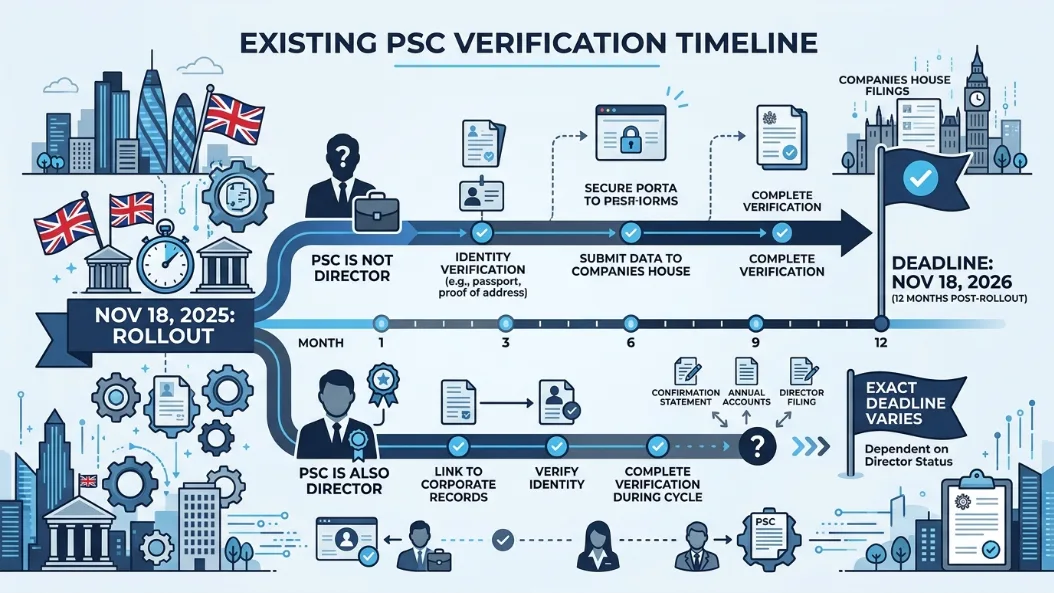
Deadlines operate on specific legal triggers rather than a single universal date for all businesses. Directors who are also PSCs must submit their personal code within 14 days of filing their next confirmation statement. Standalone PSCs must complete validation during the first 14 days of their birth month during the transition year.
Missing these statutory windows stops Companies House from processing routine updates. When officers miss filing obligations, corporate entities face public enforcement notifications and immediate financial penalties.
How Do You Verify a PSC’s Identity Step-by-Step?
Identity verification requires submitting valid photo ID and biometric data through the GOV.UK ID Checking app or an accredited agent. The process takes less than five minutes when using direct digital tools.
Preparing documentation beforehand speeds up compliance workflows significantly. Individuals need a biometric passport or a UK photocard driving licence to verify online.
Gather a valid biometric passport or national identity card
Download the official GOV.UK ID Checking application onto a mobile device
Scan the identity document chip using smartphone field communication tools
Complete the dynamic face scan to match live features against document photos
Record the unique Companies House personal code provided upon successful completion
Individuals without biometric documentation must verify identity via an accredited corporate service provider. Professional compliance specialists cross-reference official identity sources to issue valid submission codes on behalf of company officers.
What Are the Acceptable Verification Methods for PSCs?
PSCs complete verification through direct GOV.UK digital accounts or via Authorised Corporate Service Providers. Both methods generate identical statutory personal codes recognised by UK law.
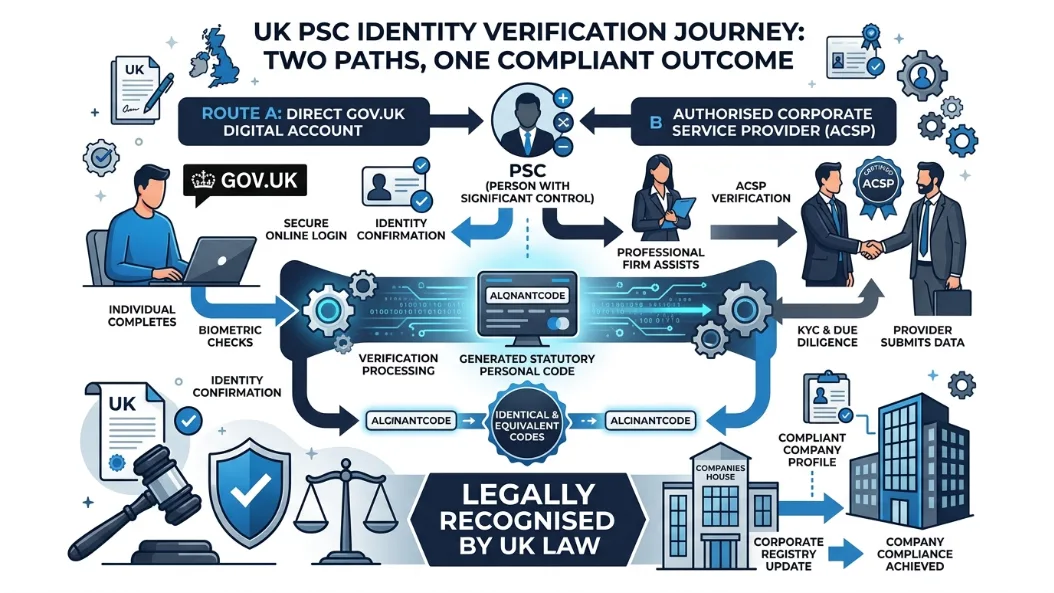
Direct verification relies on automated document verification algorithms managed by civil registry services. Users scan physical credentials, perform liveness checks, and receive instantaneous confirmation. Three core documents qualify: biometric passports, UK driving licences, and European identity cards.
Third-party verification offers tailored support for complex corporate ownership structures. Authorised agents run comprehensive anti-money laundering checks, verifying international papers that automated apps cannot process.
To protect your entity’s standing, implement structured management using a professional [PSC Register] service.
What Happens If a PSC Fails to Verify on Time?
Failing to verify a PSC’s identity within statutory windows constitutes a criminal offence resulting in civil fines and prosecution. Companies House blocks unverified businesses from making formal filings.
Regulatory systems enforce strict operational consequences for late compliance submissions. When a company submits an unverified confirmation statement, Companies House rejects the entire document package. Overdue annual filings attract automatic late filing penalties while damaging public credit ratings.
Persistent non-compliance threatens the legal status of the enterprise. Directors who permit unverified PSCs to retain control face director disqualification orders lasting up to 15 years.
Securing swift validation avoids compliance bottlenecks. Business owners can Verify Your PSC Identity Fast With Form My Company to resolve statutory identity obligations smoothly.
Explore our PSC Register guide,
Physical vs Digital Statutory Registers: Which Should You Choose?
How to Choose a Venue Equipped for Hybrid Conferences
Frequently Asked Questions
What is a PSC Register and why does a UK company need one?
An official PSC Register tracks all Persons with Significant Control who own or exercise direct authority over a limited company. UK legislation mandates maintaining this register to enhance corporate transparency, prevent financial crime, and ensure full statutory compliance with Companies House. Business service providers like Form My Company help organizations accurately prepare, update, and manage their PSC Register details.
Who qualifies as a Person with Significant Control (PSC)?
A PSC is an individual holding over 25% of a company’s shares or voting rights, or someone possessing the power to appoint or remove the majority of board directors. Individuals exercising significant influence or control over company management or underlying business trusts also qualify as PSCs.
How do I complete identity verification for a PSC Register entry?
Identity verification requires validating official photo ID through GOV.UK One Login or an Authorised Corporate Service Provider (ACSP). Upon successful validation, the individual receives a unique Companies House personal code to link their identity across official corporate filings. Services from Form My Company streamline this process by submitting identity records directly via the official PSC Register management system.
What happens if a company fails to maintain an updated PSC Register?
Failing to identify PSCs or maintain accurate records constitutes a criminal offence resulting in severe financial penalties or prosecution for company officers. Companies House may also reject routine confirmation statements or restrict corporate actions until compliance issues are resolved.
How quickly must changes to the PSC Register be reported to Companies House?
Companies must update their internal PSC Register within 14 days of confirming any corporate ownership or control changes. The updated information must then be officially submitted to Companies House within a further 14-day statutory period. Utilizing corporate maintenance tools from Form My Company ensures these filings meet all legal deadlines smoothly.