Businesses budget for recruitment space costs by calculating room requirements, estimating hire volumes, analyzing hourly leasing models, and accounting for candidate throughput. Companies evaluate fixed office leases against flexible pay-as-you-go space rentals to project quarterly interview facility expenses and eliminate unnecessary overhead.
Why Do Recruitment Space Costs Impact Hiring Budgets?
Recruitment space costs directly impact overall hiring budgets by adding recurring real estate overhead to talent acquisition expenses. Unused interview rooms inflate operational costs, while inadequate space delays candidate assessments and increases overall cost-per-hire across UK organizations.
Commercial real estate leases require long-term financial commitments that do not match fluctuating recruitment schedules. Companies often pay for empty meeting rooms during hiring lulls, which inflates total operational overhead. When candidate volume increases, internal space limits force teams to delay interviews or compromise candidate privacy.
Managing physical space requirements requires balancing square footage expenses against expected hiring cycles. Fixed office space costs between £45 and £85 per square foot annually in major UK cities. Organizations that maintain permanent interview suites pay for idle space during periods without active hiring campaigns.
Adopting on-demand venues reduces property costs by turning fixed lease commitments into variable operational expenses. HR teams calculate spatial needs based on candidate volume, interview duration, and team size. Controlling facility costs keeps recruitment operations scalable without long-term commercial property risks.
How Do Companies Calculate Expected Interview Space Requirements?
Companies calculate interview space requirements by multiplying planned candidate volume by average assessment duration while adding buffer time for panel transitions. Multiplying total hours by regional hourly room rates determines the base budget for physical interview space.
Calculating spatial needs begins with analyzing the recruitment funnel metrics for each open position. Organizations evaluate candidate volume, interview stages, and panel size to determine precise square footage requirements.
| Metric Component | Standard Value | Impact on Space Budget |
| First-Round Screenings | 30 minutes per candidate | High volume, basic room setup required |
| Panel Assessments | 60–90 minutes per candidate | Medium volume, multi-seat executive suite needed |
| Transition Buffer | 15 minutes between sessions | Prevents overlap and maintains room hygiene |
| Candidate Waiting Ratio | 1 seat per scheduled candidate | Requires dedicated reception space |
A campaign targeting 20 hires typically requires 100 first-round interviews and 30 panel assessments. Standard first-round interviews last 30 minutes, while final panels take 60 minutes. Including a 15-minute buffer between sessions totals 105 hours of required venue time.
Selecting space based on room capacity avoids overpaying for unused square footage. Small two-person rooms suit initial screenings, while larger boardrooms accommodate multi-interviewer panels. Matching room sizes to specific interview formats reduces hourly rental costs by 25% to 40%.
What Are the Key Cost Drivers in Physical Interview Space Rental?
Key cost drivers in physical interview space rental include geographical location, hourly duration, room capacity, technical infrastructure, and peak-time demand surcharges. Prime business locations and specialized presentation equipment increase base venue rates.
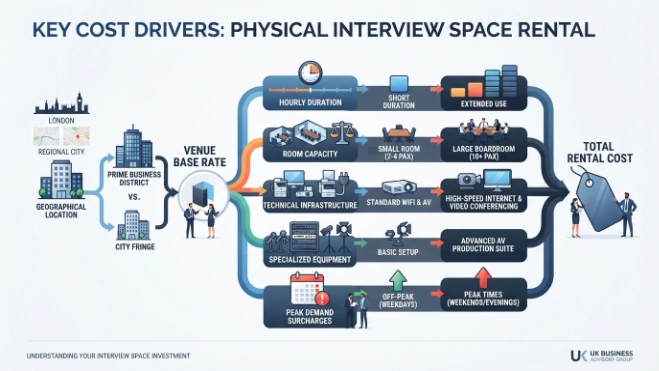
Location represents the largest variable in commercial space pricing across the United Kingdom. Central London venue rates range from £35 to £90 per hour, whereas regional hubs like Manchester or Birmingham cost between £20 and £50 per hour. Premium business districts command higher rates due to transport accessibility and prestigious branding.
Technical infrastructure directly affects total venue costs during intensive assessment centers. Interview space requires high-speed Wi-Fi, presentation screens, video conferencing systems, and soundproofing. Venues charging all-inclusive hourly rates prevent unexpected add-on costs for audiovisual equipment or guest internet access.
Booking structures also create price variations based on operational flexibility. Hourly rentals provide agility for short screening sessions, while half-day or full-day bookings lower the effective hourly rate for large-scale campaigns. Evaluating full package inclusions protects companies against hidden charges for tea, coffee, reception support, and room setup.
How Do Fixed Office Leases Compare to Flexible Interview Room Packages?
Fixed office leases involve long-term financial commitments with constant monthly overhead, whereas flexible interview room packages charge only for active usage hours. Flexible rental models reduce annual spatial costs for companies with fluctuating hiring demands.
Maintaining permanent interview facilities within a corporate lease creates predictable but inefficient expenditure. Internal meeting spaces sit vacant between hiring cycles, yet generate ongoing rent, business rates, utilities, and maintenance costs. These fixed overheads increase real estate costs per candidate hired.
On-demand room packages convert fixed property overhead into variable project expenses. Companies pay only for the exact hours needed to conduct assessments, eliminate utility maintenance, and avoid long-term property contracts. HR departments allocate these costs directly to specific recruitment project budgets.
To compare expenditure models, review how internal leases stack up against flexible bookings:
| Expense Category | Fixed Office Lease | Flexible Interview Room Package |
| Billing Model | Annual commitment (3–10 years) | Pay-as-you-go / Hourly / Daily |
| Idle Space Cost | High (paid regardless of usage) | Zero (no cost when inactive) |
| Business Rates & Utilities | Mandatory operational line item | Fully included in room rate |
| Facility Scalability | Fixed square footage | Expand or shrink space per campaign |
| Upfront Capital Outlay | High (fit-out, furniture, AV) | Zero (pre-furnished and equipped) |
Evaluating total cost per hire reveals clear savings through flexible room utilization. Growing businesses optimize cash flow by avoiding capital expenditure on dedicated corporate boardrooms. Utilizing specialized Interview Rooms allows talent acquisition teams to host candidates in professional business environments without long-term facility overhead.
What Steps Streamline the Recruitment Space Budgeting Process?
Streamlining the recruitment space budgeting process involves auditing historical hiring volume, selecting appropriate room capacities, forecasting peak recruitment months, and consolidating venue bookings under single vendors. Standardizing these steps prevents budget overruns.
Organizing recruitment space costs requires systematic financial planning across talent acquisition teams. HR managers follow structured operational frameworks to control venue expenditure before launching hiring campaigns.
1. Audit Historical Hiring Data
Review past recruitment metrics to determine average candidate volumes and interview durations. Categorize previous assessments by type, such as one-on-one screens, technical tests, or group presentations. Accurately mapping candidate volume prevents overbooking venue hours.
2. Standardize Room Capacity Requirements
Assign specific venue specifications to each stage of the assessment workflow. Book small, private consultation rooms for individual screening interviews to minimize hourly rates. Reserve larger boardrooms solely for final panel interviews or multi-candidate group tasks.
3. Forecast Seasonal Recruitment Peaks
Identify peak hiring windows throughout the financial year to reserve space early. Advance bookings secure preferred time slots and lock in baseline pricing before high-demand periods. Early scheduling avoids last-minute venue surcharges in high-density commercial centers.
4. Evaluate Package Pricing Models
Analyze venue pricing frameworks to select the most cost-effective booking structure. Compare individual hourly rates against full-day block packages for intensive multi-day assessment centers. Decision-makers often evaluate Comparing Interview Room Packages for the Best Value to align venue expenses with campaign duration.
5. Consolidate Facilities Booking Under One Provider
Streamline accounts payable by sourcing venue space through a single vendor network. Centralizing room bookings simplifies invoice processing and provides volume discount opportunities. Central management ensures consistent candidate experiences across all assessment locations.
How Does Choosing the Right Interview Venue Improve Recruitment ROI?
Choosing the right interview venue improves recruitment ROI by projecting professional brand authority, reducing candidate drop-off, and accelerating time-to-hire. Premium assessment environments increase candidate offer acceptance rates while maintaining predictable space expenditure.
First impressions heavily influence candidate perception during in-person interview rounds. Conducting assessments in poorly equipped or loud environments weakens employer branding and leads to candidate withdrawal. Professional corporate venues reinforce organizational stability, credibility, and operational standards.
Modern assessment spaces offer dedicated candidate reception areas, private holding suites, and integrated presentation technology. Soundproof walls protect candidate privacy during sensitive evaluation stages. Seamless room logistics create positive candidate experiences that directly lift job offer acceptance rates.
Offsite venues also eliminate spatial conflicts within internal corporate offices. Internal meeting rooms remain available for daily client operations, preserving normal business productivity. External interview facilities allow recruitment panels to conduct back-to-back candidate assessments without internal schedule disruptions.
Optimizing recruitment costs requires balancing spatial expenditure against hiring outcomes. Utilizing flexible booking models gives businesses high-end corporate facilities without ongoing property liabilities. Strategic talent acquisition teams Book Flexible Hourly Interview Rooms With Form My Company to maintain strict control over spatial expenditure while delivering premium candidate experiences.
How Do Businesses Control Hidden Costs in Space Rental?
Businesses control hidden costs by reviewing full venue terms, confirming inclusive amenities, establishing strict booking timeframes, and tracking room utilization metrics. Eliminating surprise add-on fees maintains budget accuracy across all hiring campaigns.
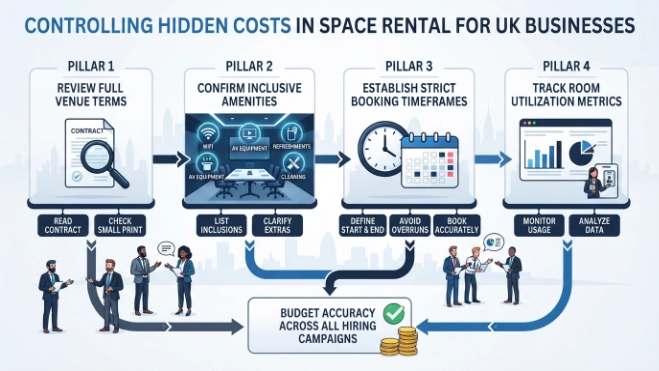
Hidden fees often distort initial room rental estimates if contracts lack pricing transparency. Standard secondary charges include separate fees for high-speed Wi-Fi access, whiteboard markers, flip charts, and AV display systems. Reviewing venue terms ensures all technical requirements are included in the baseline quote.
Catering and refreshment fees represent another source of budget variance during full-day assessment centers. Venues charging per-head fees for hot drinks can quickly inflate operational costs for large candidate pools. Securing packages with inclusive refreshments keeps candidate hospitality expenses predictable.
Overtime charges accrue quickly when interview panels run past scheduled booking windows. Setting 15-minute buffers between candidate appointments prevents schedule drift and avoids penalty rates for late room departures. Educating interview panels on strict time management protects the overall venue budget.
Tracking space utilization metrics identifies financial waste across recruitment cycles. Comparing booked hours against actual room usage helps refine future budget allocations. Data-driven space planning ensures every pound spent on recruitment venues translates directly into successful hires.
Explore our Interview Rooms guide,
What Happens if a Company Fails to Appoint a New Director Correctly?
How to Keep Your Dormant Company Ready for Potential Future Business Trading
Frequently Asked Questions
How do businesses hire Interview Rooms on an hourly basis?
Businesses reserve Interview Rooms by selecting a preferred location, choosing specific time slots, and confirming bookings online through the Form My Company platform. Employers access fully furnished spaces equipped with enterprise-grade Wi-Fi, AV systems, and reception support, paying only for active candidate evaluation hours without long-term contracts.
What amenities are included with Interview Rooms from Form My Company?
Standard Interview Rooms booked through Form My Company include acoustic soundproofing, high-speed Wi-Fi, 4K presentation displays, and ergonomic seating. On-site reception teams greet incoming candidates, manage waiting areas, and provide technical support to maintain smooth recruitment workflows.
How much does it cost to rent private Interview Rooms in the UK?
Renting private Interview Rooms in central UK locations generally ranges between £20 and £85 per hour depending on spatial capacity, location, and demand. Form My Company provides flexible pay-as-you-go billing and full-day package discounts that lower overall venue expenses by up to 30% during large-scale hiring campaigns.
Why should hiring teams use offsite Interview Rooms instead of internal offices?
Booking dedicated offsite Interview Rooms via Form My Company guarantees candidate confidentiality, eliminates workplace noise, and projects a professional corporate image. External venues also prevent schedule conflicts in busy internal meeting rooms, ensuring structured candidate assessments remain completely uninterrupted.
Can Form My Company support hybrid and video candidate assessments?
Yes, Interview Rooms provided by Form My Company feature high-definition webcams, multi-directional microphones, and integrated video conferencing equipment. These hybrid assessment setups allow remote interviewers and physical panels to evaluate candidates simultaneously without technical latency or connectivity issues.