
Failing to verify a Person with Significant Control (PSC) identity results in severe legal and financial penalties under UK law. Companies face heavy fines, restrictions on corporate actions, and potential criminal charges for directors who fail to comply with official registration mandates.
What Are the Immediate Legal Consequences for Non-Compliant PSCs?
Failure to comply with identity verification mandates leads to immediate statutory penalties under the Economic Crime and Corporate Transparency Act. Non-compliant individuals face criminal offenses, daily fine accruals, and disqualification risk from managing UK corporate entities.
Under UK law, the mandatory identity verification regime applies directly to every Person with Significant Control registered on Companies House. When an individual fails to authenticate their identity within the required timeframe, Companies House issues formal compliance notices to the entity and the relevant individual. Continued non-compliance shifts the failure from an administrative delay into an ongoing criminal offense.
Offenders face un-capped financial fines and daily default fines for each day the failure continues. Directors and officers who knowingly allow a non-compliant PSC to remain active on the statutory books share equal legal liability. Regulatory enforcement agencies treat unverified entries as deliberate corporate non-disclosure, increasing the probability of formal investigation.
Persistent failure to satisfy verification rules triggers director disqualification proceedings under the Company Directors Disqualification Act. Disqualification orders prevent individuals from acting as a director, forming a new enterprise, or controlling a UK firm for up to 15 years. Companies House also restricts the entity from completing routine corporate filings until the register shows fully authenticated personnel.
How Does Failed Identity Verification Affect Business Operations?
Unverified PSC records trigger operational freezes that halt corporate activities, block statutory filings, and terminate commercial relationships. Financial institutions automatically freeze connected accounts to satisfy strict UK Anti-Money Laundering regulatory obligations.
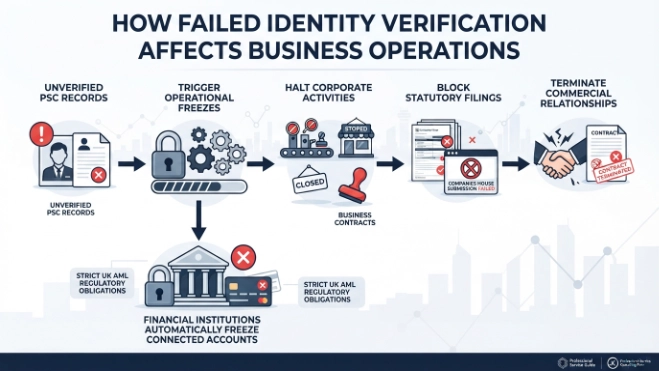
A company operating with an unverified PSC loses its ability to submit statutory updates to Companies House. The registrar rejects updates regarding director appointments, share issuances, and annual confirmation statements. This filing blackout prevents the enterprise from presenting up-to-date public records, directly damaging corporate legitimacy.
UK financial institutions run continuous automated checks against the public register to uphold Anti-Money Laundering frameworks. When an institution flags an unverified PSC, compliance protocols require the immediate restriction of corporate bank accounts. Financial entities routinely withhold lines of credit, freeze international wire transfers, and suspend payment processing systems until full statutory compliance resumes.
Commercial partners, institutional investors, and enterprise clients conduct rigorous due diligence before executing formal agreements. An unverified PSC flags the business as high-risk, leading to canceled vendor contracts and aborted equity funding rounds. Establishing clean compliance records via a dedicated PSC Register service eliminates operational disruption and protects commercial relationships.
What Financial Penalties Apply to Companies and Unverified PSCs?
Financial penalties for non-compliant PSCs include unlimited statutory fines, daily default charges, and substantial legal defense costs. Courts determine penalty amounts based on the duration of non-compliance and the size of the non-compliant entity.
The Companies House enforcement division enforces strict monetary sanctions against non-compliant entities and individuals. The base penalty structure categorizes failure to submit verification records as an offense punishable by an unlimited fine upon summary conviction. Regulatory bodies calculate daily default fines for every day the offense persists after initial notification.
| Penalty Category | Target Entity / Individual | Financial Impact Level | Legal Mechanism |
| Initial Non-Compliance Fine | Individual PSC & Enterprise | Unlimited statutory fine | Economic Crime Act enforcement |
| Daily Default Fine | Individual PSC & Enterprise | Accruing daily penalties | Statutory daily breach assessment |
| Prosecution Legal Costs | Enterprise Officers | Variable defense expenses | Magistrates’ Court proceedings |
| Banking Freeze Loss | Corporate Entity | Variable operational losses | AML compliance protocol trigger |
When enforcement reaches the judicial system, court costs and statutory interest compound the base fine. Corporate officers bear individual financial responsibility if prosecution proves they permitted the statutory breach to continue. These financial levies apply independently of any civil damages arising from breached client contracts.
Securing professional compliance assistance prevents statutory fines from compromising corporate capital reserves. Enterprise leadership must review the internal evaluation on DIY vs Assisted PSC Identity Verification: Which Is Safer? to select an optimal compliance workflow that eliminates financial penalties.
Can Companies House Strike Off a Company for PSC Non-Compliance?
Companies House holds full statutory authority to initiate compulsory strike-off procedures against entities with unverified PSC records. Striking an entity off the register dissolves the corporate entity and transfers remaining assets to the Crown.
The Registrar of Companies actively monitors statutory registers to remove delinquent or non-compliant corporate structures from the public index. When an entity ignores multiple formal warnings regarding unverified PSC entries, the registrar publishes a notice of intent to dissolve the enterprise in the London Gazette. This statutory notice provides a final 2-month window to rectify non-compliance before permanent dissolution occurs.
Compulsory dissolution permanently revokes the company’s legal status and authority to trade. Upon strike-off, all remaining corporate property, bank balances, and physical assets automatically pass to the Crown under the legal doctrine of bona vacantia. Reinstating a dissolved entity requires expensive High Court litigation or formal administrative restoration procedures.
Dissolution creates personal liabilities for corporate leadership who continue trading after the official strike-off date. Directors operating a dissolved entity assume personal responsibility for all debts and commercial liabilities incurred post-dissolution. Rectifying compliance failures before statutory notices expire remains the only way to avoid compulsory corporate liquidation.
What Are the Exact Steps to Remedy an Unverified PSC Status?
Remediating an unverified PSC status requires identity verification through government-approved channels, statutory document updates, and formal notification to Companies House. Completing these steps updates the public index and restores full operational authority.
The remediation process begins by identifying every individual who meets the legal threshold of a PSC within the corporate structure. Individuals must gather valid primary identification documents, such as a biometric passport, national identity card, or official photographic driving license. The verification system cross-references these credentials against verified government databases to confirm authenticity.
Gather official primary identification documents including biometric passports or official identity cards.
Verify identity using government-issued ID frameworks to generate a valid identity verification code.
Submit official verification codes to Companies House through secure compliance portals.
Match biometric data with official records to finalize identity confirmation.
Update internal statutory registers to reflect complete compliance status across all corporate officers.
Once the verification system confirms the individual’s identity, Companies House issues an official identity verification code. The company secretary or authorized corporate officer inputs this code into the statutory filings. Updating the public register clears regulatory flags, removes administrative freezes, and ensures total corporate alignment with UK law.
Entities seeking rapid remediation can Beat the Companies House Deadline With Form My Company by deploying streamlined verification services designed to maintain seamless statutory compliance.
How Does PSC Identity Verification Protect Corporate Governance?
PSC identity verification strengthens corporate transparency by preventing fraud, confirming true beneficial ownership, and upholding UK governance standards. Standardized verification protocols ensure public corporate registers remain accurate, reliable, and resistant to financial crime.
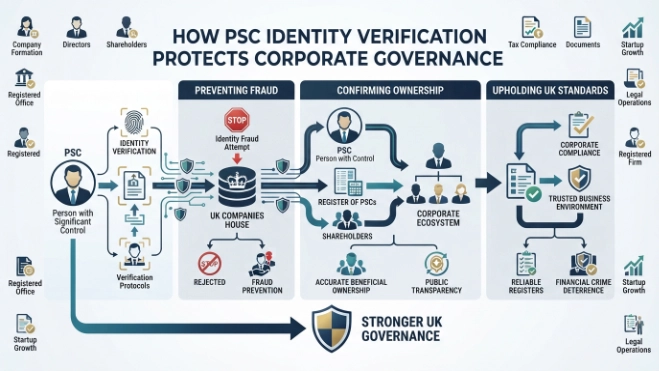
The UK corporate ecosystem relies on public transparency to maintain international commercial trust. Standardized identity checks prevent individuals from using nominee structures, shell entities, or fraudulent personal details to obscure ultimate economic control. Verifying ultimate beneficial owners exposes illegitimate corporate networks and strengthens national economic security.
Accurate public registers simplify corporate transactions, vendor onboarding, and institutional financing. When corporate ownership records remain verifiable, financial institutions process compliance checks efficiently without delays. Transparent governance reduces administrative friction across every stage of commercial expansion.
Adopting continuous verification controls safeguards the enterprise against identity theft and unauthorized corporate filings. Verified records ensure that only authorized personnel execute corporate changes, protecting corporate assets from internal misrepresentation. Maintaining accurate PSC data remains a foundational requirement for responsible corporate stewardship in the UK.
Final Wrap-Up
Failing to verify a Person with Significant Control introduces severe operational, financial, and legal risks. Unverified entries expose enterprises to unlimited court fines, director disqualifications, banking freezes, and compulsory strike-off proceedings by Companies House. Maintaining accurate, fully verified statutory registers is essential for uninterrupted business operations and regulatory compliance. Form My Company delivers comprehensive compliance solutions, providing expert administrative support to ensure your corporate registers meet all UK statutory identity verification standards seamlessly.
Explore our PSC register guide,
Why Large Enterprises Prefer Dedicated Training Centers Over Standard In House Offices
The Role of Proper Meeting Etiquette in Maintaining a Professional Corporate Image
Frequently Asked Questions
What is a PSC register and who needs to maintain one?
A PSC register is an official statutory record detailing individuals who own or control a UK company. Every limited company and Limited Liability Partnership must maintain this register to comply with UK corporate transparency regulations. Form My Company assists businesses in establishing and managing their statutory PSC register accurately.
How do you update the Persons with Significant Control register at Companies House?
Updating the PSC register requires recording any changes to significant control within 14 days and filing the updated details with Companies House within a further 14 days. Companies can complete these filings electronically through the official registry portal or utilize professional compliance services. Ensuring timely submission prevents regulatory penalties and maintains clean corporate records.
What information must be included in a UK PSC register?
A UK PSC register must record the full legal name, date of birth, service address, country of residence, and nationality of each person with significant control. It must also detail the exact nature of their control, such as holding more than 25% of shares or voting rights. This information remains open to public inspection via the Companies House database.
Who qualifies as a Person with Significant Control (PSC) in a UK company?
An individual qualifies as a PSC if they meet at least one of five specific conditions, including holding more than 25% of shares or voting rights in the enterprise. Individuals who exercise significant influence or control over the company also fall under this classification. Identifying these qualifying conditions ensures accurate statutory reporting.
How can businesses maintain compliance with PSC registration requirements?
Businesses maintain compliance by conducting regular ownership reviews, verifying individual identities, and submitting timely updates to Companies House. Failing to update the PSC register can lead to unlimited fines, daily default penalties, and director prosecution. Utilizing professional administration services from Form My Company helps streamline PSC register maintenance and avoids administrative oversights.