
PSC meaning refers to a Person with Significant Control, someone who owns or controls a UK company in a way that meets specific legal conditions. A PSC usually holds more than 25% of a company’s shares or voting rights, can appoint or remove most directors, or exercises significant influence or control. Understanding what a PSC is helps company owners identify beneficial owners, meet Companies House reporting requirements and maintain accurate corporate information.
What Does PSC Mean?
PSC stands for Person with Significant Control. The term describes an individual who meets one or more statutory conditions for owning or controlling a company. In certain circumstances, a qualifying legal entity can also be recorded as a PSC under the applicable rules.
Companies House uses PSC information to improve corporate transparency and show who ultimately owns or controls a business. A PSC may be a founder, shareholder, investor or another individual who exercises significant influence over company decisions.
For example, if one shareholder owns 60% of a limited company, that individual will generally meet the share ownership condition for PSC status. However, a person does not need to own shares to qualify. Someone with the right to appoint or remove most directors, or who exercises significant influence or control, may also qualify.
Companies must identify their PSCs, report the required information to Companies House and keep that information up to date. The official Companies House guidance on people with significant control explains the identification, reporting and identity verification requirements.
PSC Meaning: What Does PSC Stand For?
PSC stands for Person with Significant Control. It is a legal term used in UK company reporting to identify individuals who have substantial ownership or control over a business.
The term is not a job title and does not automatically mean that someone is a director. A PSC may be involved in daily management, but they may also be a passive investor or an individual who controls important company decisions through voting rights or other arrangements.
The key distinction is that PSC status depends on the nature of a person’s ownership or control, rather than their position within the organisation.
What Is a PSC Under UK Company Law?
A PSC is a person who satisfies at least one of the statutory conditions set out in the Companies Act 2006. These conditions focus on share ownership, voting rights, the power to appoint or remove directors, significant influence or control, and control exercised through certain trusts or firms.
The rules help companies identify the people behind their ownership structures. They also apply where control is exercised indirectly through other entities or arrangements.
A company should not assume that its largest shareholder is necessarily its only PSC. Different people may satisfy different conditions, and a person without a large shareholding may still qualify because of their governance rights or influence.
For detailed interpretation, companies should consult the 2026 statutory guidance on significant influence or control.
What Are the Five Conditions for PSC Status?
The PSC framework contains five conditions. A person generally qualifies if they meet at least one applicable condition.
| Condition | What it means | Example |
|---|---|---|
| More than 25% of shares | The person holds more than 25% of the company’s shares | An individual owns 40% of the issued shares |
| More than 25% of voting rights | The person controls more than 25% of the voting rights | An investor controls 35% of voting rights |
| Board appointment rights | The person has the right to appoint or remove a majority of directors | An agreement gives an individual the right to appoint most board members |
| Significant influence or control | The person has the right to exercise or actually exercises significant influence or control over the company | An individual has decisive influence over important company decisions |
| Control through a trust or firm | The person controls the activities of a trust or qualifying firm that meets relevant conditions in relation to the company | A person controls a trust that holds a controlling interest in the company |
The first three conditions use specific ownership, voting or board appointment tests. The fourth and fifth conditions require a closer assessment of the actual rights and relationships involved.
Important: The threshold is more than 25%, not exactly 25%. A person holding precisely 25% does not meet the first condition on that percentage alone, although other rights or control arrangements may still make them a PSC.
Who Counts as a PSC?
A PSC can be an individual who owns shares, controls voting rights, influences company decisions or has authority over board appointments. A company may have one PSC, several PSCs or no identifiable PSC after appropriate checks.
Common examples include:
- A founder who owns 75% of a private limited company.
- A shareholder who controls 30% of the voting rights.
- An individual with the legal right to appoint or remove most directors.
- A person who exercises significant influence or control despite holding a smaller shareholding.
- An individual who controls a relevant trust or firm connected to the company’s ownership structure.
A corporate entity may also be reportable where it meets the requirements for a Relevant Legal Entity, or RLE. Whether an entity qualifies depends on its legal status, transparency and the applicable PSC rules.
Companies should trace indirect ownership and control rather than stopping at the first company or shareholder in a structure. Where ownership involves several companies, trusts or agreements, professional advice may be appropriate.
What Is a PSC Company?
A PSC company is an informal phrase people use when referring to a company that has a Person with Significant Control or needs to report PSC information. It is not a separate type of company or a special legal structure.
A standard UK limited company can have PSCs. Its directors are responsible for taking reasonable steps to identify the relevant people and submitting the required information to Companies House.
For example, a company with three shareholders may have one PSC if only one person meets the statutory conditions. It may have multiple PSCs if several people independently meet one or more conditions.
The phrase company PSC generally refers to the person or qualifying entity recorded as having significant control over that particular company.
What Is the Difference Between a PSC and a Director?
A PSC and a director have different roles under UK company law. A director is responsible for managing the company and carrying out their legal duties. A PSC is identified because of their ownership or control.
| PSC | Director |
|---|---|
| Identified through ownership or control conditions | Appointed to manage and govern the company |
| May or may not be involved in daily operations | Usually has management and governance responsibilities |
| Can be a shareholder, investor or another qualifying person | Does not need to own shares |
| May have significant influence without being on the board | Has duties associated with the director role |
| Must comply with applicable PSC reporting and identity verification requirements | Must comply with director reporting and identity verification requirements |
One person can be both a PSC and a director. For example, a founder who owns 60% of a company and serves as its managing director will generally hold both roles.
However, a director who owns no shares and has no other qualifying control rights is not automatically a PSC. Equally, an investor who meets a PSC condition does not automatically become a director.
For more context on current director obligations, read how compliance changes affect UK company directors.
Where Do PSC Details Appear?
PSC information is reported to Companies House and can be viewed through the company’s public register entry, subject to applicable protections and restrictions. The information helps third parties understand who owns or controls a company.
Depending on the type of PSC and the information required, records can include:
- The PSC’s name or the qualifying legal entity’s name.
- The date on which the person became a PSC.
- The nature of their control, such as share ownership or voting rights.
- The applicable shareholding or voting rights band.
- Relevant service address and other prescribed information.
- Identity verification status or related reporting information where applicable.
Some personal information is handled differently from public information. Residential addresses and certain protected details are not generally displayed in the same way as public service information. Individuals who face a serious risk of violence or intimidation may be able to apply for protection under the applicable rules.
Companies should make sure the information submitted to Companies House is accurate and consistent with the company’s actual ownership and control arrangements.
How Do Companies Identify Their PSCs?
Identifying PSCs requires a review of ownership records, voting arrangements and the rights that determine who controls the company. Directors should not rely solely on a list of shareholders because control can arise through other arrangements.
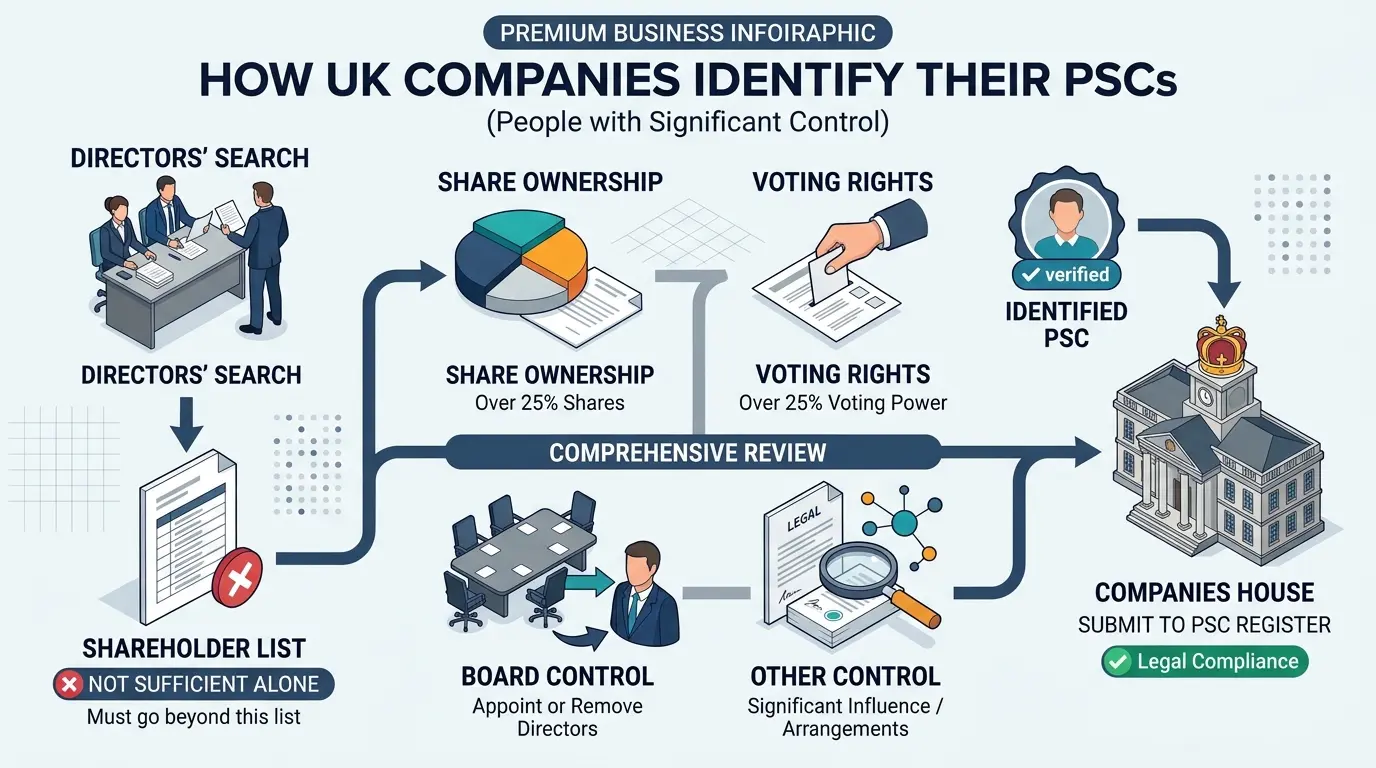
A practical identification process includes:
- Review the share structure. Check the issued shares, ownership percentages and any relevant share classes.
- Check voting rights. Review the rights attached to shares and any voting agreements.
- Examine board appointment rights. Establish whether any person can appoint or remove a majority of directors.
- Assess significant influence or control. Consider relevant agreements, decision-making rights and the practical circumstances of control.
- Trace indirect ownership. Review any holding companies, trusts or other arrangements in the ownership chain.
- Confirm the details with relevant people. Request the information needed to establish PSC status and complete reporting.
- Submit and maintain the required records. Report the information to Companies House and follow the applicable identity verification process.
Companies with complex structures should use the current statutory guidance and seek professional support when necessary. The objective is to identify the people who actually meet the legal conditions, not simply those who appear most prominent in the business.
What Information Must Be Reported About a PSC?
The information required depends on whether the PSC is an individual or a qualifying legal entity. Companies must provide the prescribed details through the appropriate Companies House process.
For an individual PSC, the required information can include their name, date of birth, nationality, country or part of the UK where they usually live, service address, the date they became a PSC and the nature of their control. Companies must follow the current requirements for residential address information and identity verification.
For a qualifying legal entity, the required details can include its legal name, registered office, legal form, governing law and relevant registration information.
Companies should not assume that completing the original incorporation documents permanently satisfies their PSC obligations. Ownership and control can change after incorporation, and the company must report relevant changes within the applicable timeframe.
What Are the PSC Reporting and Identity Verification Requirements?
Companies must identify their PSCs and report the required information to Companies House. Where a change occurs, the company must follow the current reporting deadline, which in many circumstances requires updated information to be provided within 14 days of confirmation.
PSC identity verification is also part of the current Companies House framework. A PSC must verify their identity and provide their Companies House personal code through the applicable process. The relevant 14-day period depends on factors including whether the PSC was already registered before the rules took effect and whether they are also a director of the company.
Companies should therefore check the current official guidance rather than rely on a single deadline for every situation. The latest Companies House PSC guidance explains how to identify PSCs, report changes and complete identity verification.
A practical compliance checklist includes:
- Review ownership and control when the company is incorporated.
- Identify every person or qualifying entity meeting a PSC condition.
- Submit the required PSC information through the correct Companies House process.
- Check the applicable identity verification requirements and deadlines.
- Report changes to PSC details or nature of control within the required timeframe.
- Keep supporting ownership and governance documents accurate.
- Review the company record to confirm that submitted information is correct.
What Happens If a Company Does Not Comply With PSC Rules?
Failure to comply with PSC requirements can create legal and administrative consequences for the company and the individuals involved. Depending on the circumstances, failing to provide accurate information, failing to comply with statutory notices or failing to meet applicable duties can constitute a criminal offence.
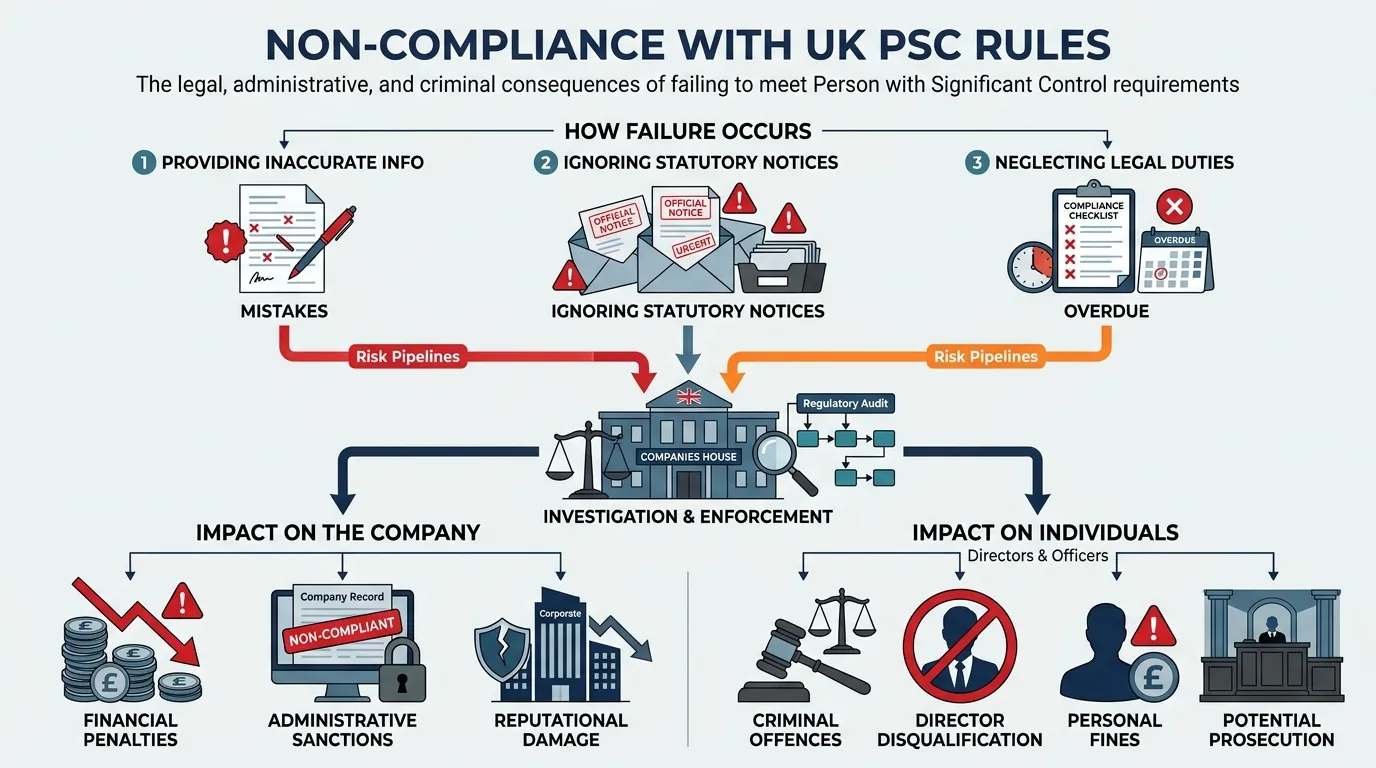
Potential consequences may include fines, imprisonment in cases covered by the legislation, restrictions affecting shares or voting rights in certain circumstances, and additional scrutiny of the company’s records.
The precise consequences depend on the specific breach and the relevant legal provisions. Companies should not assume that every error results in the same penalty or that a missed administrative step automatically leads to every possible sanction.
Directors can reduce the risk of non-compliance by maintaining accurate ownership information, responding to requests for information and checking current Companies House requirements. Where a company cannot identify a PSC or believes it has no PSC, it must follow the applicable reporting process rather than leave the position unexplained.
How Does the PSC Register Service Help Companies?
Managing PSC information requires accurate reporting, appropriate record-keeping and attention to changes in ownership or control. Companies with several shareholders, indirect ownership arrangements or limited internal administrative capacity may benefit from professional support.
Form My Company’s PSC Register service supports companies with PSC-related statutory administration. Review the service details to understand the package scope and confirm which record-management and filing tasks are included.
Before using any service, make sure the company provides complete and accurate information. Directors remain responsible for their statutory duties even when they appoint an external provider to help with administration.
Companies should also maintain suitable evidence of ownership and control decisions. Where identity documents or address information are required, use the relevant verification process and keep sensitive information secure. For additional context on address checks, see what counts as proof of address in the UK.
Explore our PSC Register guide,
Why Your Dormant Company Needs a Registered Office Address for Official Mail
How to Evaluate the ROI of Investing in Professional External Training Rooms
Frequently Asked Questions About PSC Meaning
What is a PSC?
A PSC is a Person with Significant Control. It is someone who meets one or more statutory conditions for owning or controlling a UK company, such as holding more than 25% of shares or voting rights, having relevant board appointment rights or exercising significant influence or control.
What does PSC stand for?
PSC stands for Person with Significant Control. Companies House uses the term to identify individuals and, in qualifying circumstances, legal entities that meet the relevant ownership or control conditions.
What is the full form of PSC in a company?
The full form of PSC in a company is Person with Significant Control. The term identifies who has significant ownership or control and whose details must be reported under the applicable UK company reporting rules.
What is a PSC company?
PSC company is an informal expression for a company that has a Person with Significant Control or is required to report PSC information. It does not refer to a separate legal company type.
Who qualifies as a Person with Significant Control?
A person may qualify if they hold more than 25% of the company’s shares or voting rights, have the right to appoint or remove a majority of directors, exercise significant influence or control, or meet the relevant condition involving a trust or firm.
Can a director also be a PSC?
Yes. A director can also be a PSC if they meet one or more of the statutory ownership or control conditions. However, being a director alone does not automatically make someone a PSC.
Where can I find a company’s PSC details?
PSC information is available through the company’s public record at Companies House, subject to the applicable protections and restrictions. The record identifies the reported PSCs and the nature of their control.
Does a company need to update its PSC information?
Yes. Companies must report relevant changes to PSC information within the applicable statutory timeframe and follow the current identity verification requirements. The precise deadline and process depend on the type of change and the person’s circumstances.
What happens if a company does not identify a PSC?
The company must take appropriate steps to identify its PSCs and follow the relevant Companies House reporting process if it cannot identify a PSC or believes it has none. It should not simply omit the information without following the applicable procedure.
Can a company use a professional PSC Register service?
Yes. A company can use a professional service for support with PSC-related administration and filings. Directors should check exactly what the service covers and remain aware of their own legal responsibilities.
Maintain Accurate PSC Information With Form My Company
Understanding PSC meaning helps company owners recognise who controls their business and what information must be reported. By reviewing shareholdings, voting rights, board appointment powers and other control arrangements, companies can identify the people who meet the statutory conditions.
Keep ownership information accurate, complete the applicable Companies House reporting and identity verification steps, and review changes promptly. If you need help managing PSC-related administration, explore the Form My Company PSC Register service and confirm which services are appropriate for your company’s requirements.