
To correctly identify every Person of Significant Control (PSC) in your company, evaluate all individuals against five statutory UK conditions, including shareholding thresholds over 25%, voting rights, board appointment powers, and actual dominant influence. Review corporate records, shareholder agreements, and indirect ownership structures to confirm exact PSC identities.
Quick Reference: The 5 Statutory PSC Conditions
To determine whether an individual or legal entity qualifies as a PSC, evaluate them against the official UK compliance criteria summarized below:
| Statutory Condition | Legal Threshold | Key Document to Check |
| 1. Share Ownership | Holds more than 25% of company shares | Register of Members / Share Certificate Log |
| 2. Voting Rights | Holds more than 25% of voting rights | Articles of Association / Shareholder Agreements |
| 3. Board Control | Right to appoint or remove majority of board | Company Constitution / Board Resolutions |
| 4. Significant Influence | Exercises direct operational control without majority shares | Governance Contracts / Executive Agreements |
| 5. Trust/Firm Control | Controls a trust or firm that meets conditions 1–4 | Trust Deeds / Partnership Agreements |
What Is the Legal Framework for Identifying Company PSCs?
The legal framework for identifying PSCs stems from the UK Companies Act 2006, requiring limited companies and LLPs to maintain accurate records of beneficial ownership. Compliance prevents legal penalties, operational blockages, and corporate transparency violations.
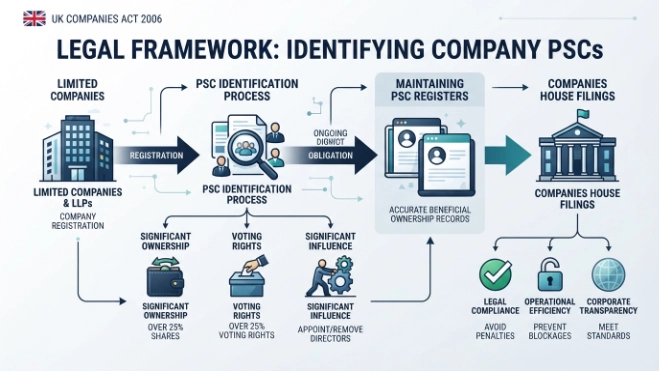
68% of UK SMEs process beneficial ownership tracking through internal administrative reviews. Under current UK corporate law, every legal entity must maintain a statutory register of individuals who hold effective power over the business. Regulatory updates from Companies House mandate that identifying information aligns directly with official verification systems.
Failure to identify beneficial owners results in serious corporate outcomes. Directors face uncapped monetary fines and potential criminal liability for deliberate non-compliance. Furthermore, companies failing to report accurate PSC data risk receiving restriction notices, which freeze dividend payouts and nullify share voting rights.
Evaluating beneficial ownership demands systematic documentation checks. Corporate secretaries examine voting structures, veto rights, and indirect holding mechanisms to build a clear compliance file. You can review What Does ‘Person of Significant Control’ Actually Mean? to understand foundational definitions before mapping complex ownership structures.
How Do You Evaluate Direct Shareholding and Voting Thresholds?
Direct shareholding and voting thresholds require identifying anyone who owns over 25% of issued shares or controls over 25% of voting rights. Reviewing the company register of members establishes these exact percentage bands accurately.
To evaluate equity ownership, review the company share register rather than general certificates. UK statutory guidance classifies shareholdings into three specific reporting bands:
Over 25% up to 50%
More than 50% to less than 75%
75% or more
Three structural checks reveal hidden voting arrangements:
Analyze share classes with weighted voting privileges.
Identify joint shareholding agreements that aggregate voting power above 25%.
Review constitutional articles for conditional voting rights triggered by specific events.
When individuals hold matching equity and voting rights, register both conditions simultaneously on the statutory records. If a shareholder owns 30% of ordinary shares with voting rights, log both Condition 1 and Condition 2 during filing.
How Do You Identify Persons with Indirect Control or Board Appointment Power?
Indirect control and board appointment power occur when an individual holds the right to appoint or remove the majority of board directors, or controls corporate decisions through intermediate legal entities. Tracking ownership chains reveals these ultimate beneficial owners.
Complex corporate structures often mask the actual individuals directing business operations. When intermediate holding companies hold more than 25% of your target business, trace up the chain to locate the underlying individual. Intermediate entities qualify as Relevant Legal Entities (RLEs) if they maintain their own corporate registers in recognized jurisdictions.
Review company constitutional provisions regarding board composition. If an individual possesses absolute rights to appoint or dismiss directors holding a majority of board votes, register that individual under Condition 3.
When tracing multi-tiered corporate structures, examine shareholder agreements for indirect control provisions. Intermediate corporate layers must be evaluated to ensure no individual exercises hidden governance authority through secondary entities.
What Constitutes “Significant Influence or Control” Without Shares?
Significant influence or control exists when an individual directs company policy, strategic plans, or management decisions without holding a majority shareholding or direct voting rights. This condition captures non-director founders, key financiers, and shadow directors.
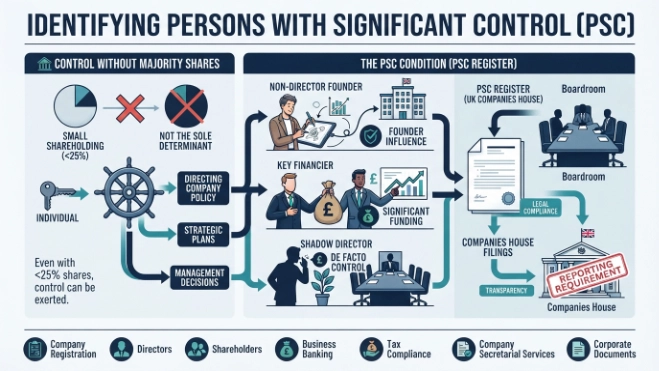
Condition 4 acts as an overarching requirement for non-standard governance structures. An individual exercises significant influence when recommendations consistently dictate board-level decisions. Absolute veto rights over operational budgets, business model modifications, or executive hiring also satisfy this criteria.
Four common roles that trigger Condition 4 evaluation:
Founders who transferred equity but retain final strategic approval.
Lenders with operational oversight exceeding standard loan covenants.
Silent partners who instruct nominal directors on strategic voting.
Asset owners who lease critical intellectual property to force corporate decisions.
Professional advisers acting solely in technical capacities—such as external legal counsel, statutory auditors, or liquidators—do not qualify as PSCs under statutory exception rules. Once you establish non-shareholder influence, document these governance structures clearly in corporate administrative files.
How Do You File and Maintain Your Official PSC Register?
Filing and maintaining a PSC register requires gathering confirmed personal details, verifying identities through approved channels, and submitting regulatory forms to Companies House within 14 days of any change.
To complete statutory filings, collect required identity metrics for each qualifying individual:
Full legal name and date of birth
Service address and usual residential address
Nationality and country of residence
Exact date the individual acquired PSC status
Applicable statutory conditions and percentage ownership bands
Identity verification mandates that all PSCs obtain a unique personal code through GOV.UK One Login or an Authorised Corporate Service Provider (ACSP). Company officers submit this verification code alongside statutory notices to maintain compliance status.
When companies possess no qualifying individual after thorough investigation, file an official statement with Companies House confirming that no PSC exists. Managed services simplify compliance workflows; explore how to Identify Your Company PSCs With Form My Company to establish complete corporate register accuracy.
Businesses maintaining complex group structures utilize professional oversight for regulatory reporting. Our specialized PSC Register service assists corporate officers in auditing share registers, validating beneficial ownership structures, and submitting verified records directly to Companies House.
Summary of Identity Verification & Maintenance Timeline
To ensure full compliance with Companies House deadlines, follow this chronological step sequence: