
Buying an officially formatted statutory register from Form My Company ensures your UK business meets all legal record-keeping requirements under the Companies Act 2006 immediately. It protects your enterprise from statutory fines, prevents costly administrative errors, and keeps director and shareholder records fully compliant for official audits.
What Is a Compliant Company Register for a UK Business?
A compliant company register is an officially structured record system that stores a legal entity’s mandatory corporate details under the UK Companies Act 2006. It documents current ownership, directorship changes, active charges, and official administrative decisions for public and legal inspection.
Every private limited company registered in the United Kingdom must maintain accurate statutory books from the exact date of incorporation. The register serves as the ultimate legal proof of legal ownership and management structure within the business. Statutory records contain five main individual registers: the register of directors, register of directors’ residential addresses, register of secretaries, register of members, and the register of people with significant control (PSC). Failure to produce these documents during an official audit results in immediate financial penalties.
A professional statutory book formats these required sections into clean, verifiable structures. When legal authorities or prospective investors examine corporate records, they check the register of members first to confirm valid equity distribution. Maintaining handwritten or loose notes creates severe compliance gaps over time. Form My Company constructs fully formatted registers that eliminate structural omissions and satisfy legal obligations under current statutory standards.
Why Do UK Companies Need to Maintain Official Statutory Registers?
UK companies must maintain official statutory registers because Section 113 of the Companies Act 2006 makes accurate record-keeping a legal duty. Failing to update these books leads to personal criminal liability for officers and corporate fines reaching £1,000 per missing entry.
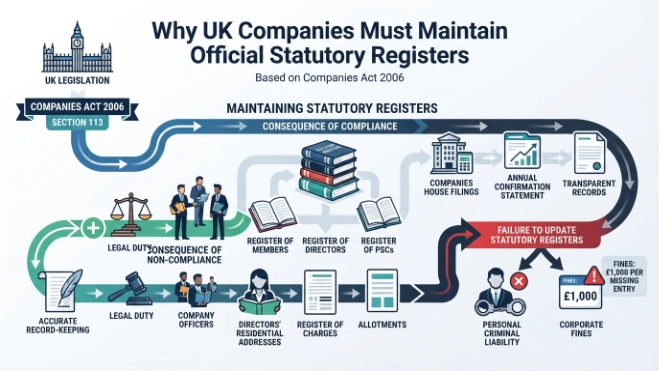
The Companies House public database does not replace a business’s internal statutory register. While Companies House records filed submissions, English law treats your internal statutory registers as the primary legal evidence of legal title. If a ownership dispute arises between equity holders, courts accept entries inside the physical or official digital register of members over third-party filings. Keeping these documents updated stops internal ownership deadlocks before they start.
Corporate transactions require fully verified books during formal due diligence checks. Buyers, mortgage lenders, and institutional investors verify historical statutory books before releasing capital funds. Three key transaction types require audited statutory registers: share sales, commercial property purchases, and bank loan approvals. Incomplete registers delay deal completions by an average of six weeks while solicitors reconstruct missing records. You can explore What Must Be Recorded in a Company’s Statutory Books? to understand every individual entry required by corporate law.
How Does a Pre-Formatted Register Simplify Statutory Compliance?
A pre-formatted register simplifies statutory compliance by providing pre-structured templates that guide officers through mandatory data entry fields. This layout prevents missed disclosures, standardizes internal documentation, and ensures immediate compliance with United Kingdom corporate legislation.
Updating corporate records manually creates formatting errors when officers omit required statutory fields. For example, registering a new shareholder requires documenting their full name, official service address, share class, quantity, currency, and the exact date of registration. Missing even one field renders the record invalid during legal reviews. Pre-formatted registers eliminate guesswork by embedding structured entry spaces directly aligned with legal requirements.
Using standardized layouts saves administration time for company secretaries and designated directors. Rather than building legal layouts from scratch, administrators enter updates into organized compliance sections. Pre-formatted books also assist corporate restructuring by holding dedicated tabs for debentures, share transfers, and mortgages. To master ongoing register maintenance, read How to Keep Your Statutory Books Compliant With the Companies Act for step-by-step regulatory guidance.
What Mandatory Records Are Included in a Form My Company Register?
A Form My Company register includes five legally required sub-registers: members, directors, directors’ residential addresses, secretaries, and persons with significant control. It also includes dedicated sections for accounting historical share transfers, official debentures, and company meeting minutes.
The register of members remains the most critical sub-register within the binder. It records exact share allocation, total paid-up capital, allotment dates, and historical share transfers across all shareholder classes. The register of persons with significant control (PSC) tracks individuals holding more than 25% of voting rights or direct operational control over management decisions. Omitting active PSC entries constitutes a criminal offense under UK company law.
The remaining sections safeguard director details and company debts. The register of directors tracks legal names, service addresses, nationalities, business occupations, and formal appointment dates. A separate residential address register keeps personal living details protected from public disclosure rules. The register of charges tracks corporate loans, secured bank mortgages, and active fixed debentures. You can order a physical or digital Company Pack to receive a complete set of fully compliant statutory registers formatted for immediate use.
How Does an Incorrect Register Impact Corporate Audits and Due Diligence?
An incorrect register impacts corporate audits and due diligence by triggering legal flags, halting share transfers, and increasing legal expenses. Auditors mark unverified ownership records as compliance failures, forcing businesses to pay costly solicitor fees for statutory reconstruction.
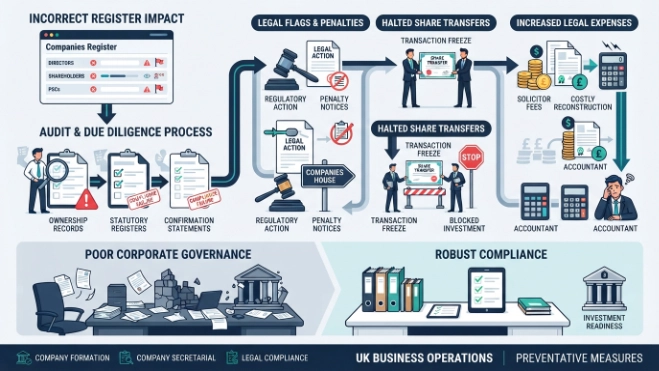
During commercial acquisitions, corporate buyers instruct solicitors to perform strict legal reviews. If the statutory books show gaps between filed share allotments and internal member registers, the buyer’s legal team halts the transaction. Discrepancies invalidate recent board resolutions, putting previous dividend payments at risk of being declared unlawful under Section 830 of the Companies Act. Rectifying these errors requires formal court applications or expensive board rectifications.
Tax reviews by HM Revenue and Customs (HMRC) also inspect statutory records to confirm equity distributions. If dividend vouchers do not match the entries inside the register of members, HMRC reclassifies those payments as taxable director salary payments. This reclassification incurs unexpected National Insurance contributions, tax penalties, and accrued interest charges. Maintaining correct registers protects your business from these expensive administrative disasters.
What Is the Process to Buy a Compliant Company Register From Form My Company?
The process to buy a compliant company register from Form My Company involves selecting your binder format, supplying basic business details, and receiving a fully populated document set. The service delivers legally compliant statutory books ready for immediate corporate use.
Select your preferred statutory register binder format on the order screen. Choose between durable hardcopy loose-leaf binders or secure digital electronic registers.
Enter your business details, including your registered company name, official registration number, and incorporation date into the secure portal.
Review the populated corporate details generated by automated validation systems to ensure accuracy across all director and shareholder fields.
Authorize the secure payment processing screen to finalize your legal document order.
Receive your completed statutory register through express physical courier delivery or instant digital dispatch.
Insert past board decisions, share certificates, and statutory meeting minutes directly into the dedicated compliance dividers.
Form My Company simplifies corporate management by supplying pre-assembled registers tailored to UK legislation. Whether establishing a new venture or updating outdated records, receiving professionally bound statutory registers ensures your business remains audit-ready every day of the year.
Explore our Company Pack guide,
Get Professional Help with Your Dormant Company Accounts and Avoid HMRC Fines
Order Our Comprehensive Dormant Account Package for Worry Free Annual Business Compliance
Frequently Asked Questions
What is included in the Company Pack from Form My Company?
The Company Pack from Form My Company includes essential statutory books, hardcopy or digital registers, and official incorporation documents required by UK company law. It provides pre-formatted registers for members, directors, and persons with significant control (PSC), alongside company seal options and share certificate templates. This bundle ensures a newly incorporated business or existing private limited company satisfies legal record-keeping obligations under the Companies Act 2006.
Why does a business need an official statutory company register?
Section 113 of the Companies Act 2006 requires every UK limited company to maintain accurate statutory registers to prove legal ownership and management structure. Internal statutory records serve as the primary legal evidence of equity distribution during corporate audits, share transfers, and bank due diligence checks. Ordering a compliant register through Form My Company prevents statutory compliance failures, administrative errors, and potential criminal fines for officers.
Can statutory registers be kept electronically in the UK?
Yes, UK legislation permits businesses to hold statutory books and company registers either in physical loose-leaf binders or in electronic digital formats. Digital registers must remain searchable, backed up, and accessible for official inspection upon lawful request. Form My Company offers both bound physical binders and secure digital versions within its Company Pack to suit modern administrative preferences.
What is the difference between Companies House filings and statutory books?
Companies House maintains a public repository of corporate filings, whereas a business’s internal statutory books serve as the ultimate legal proof of legal title and ownership. Updates submitted to Companies House do not legally replace the internal register of members, which must be updated independently following share allotments or transfers. Maintaining a dedicated Company Pack ensures internal company registers align perfectly with official registrar filings.
How do I update my company register when director or shareholder details change?
Company secretaries or directors must record any change in corporate management, residential address, or share allocation into the relevant sub-register immediately upon notice. The updated entries in the statutory book must include full names, service addresses, effective dates, and specific transaction details. Utilizing the pre-formatted templates provided by Form My Company helps administrators update company registers quickly without omitting required legal disclosure fields.