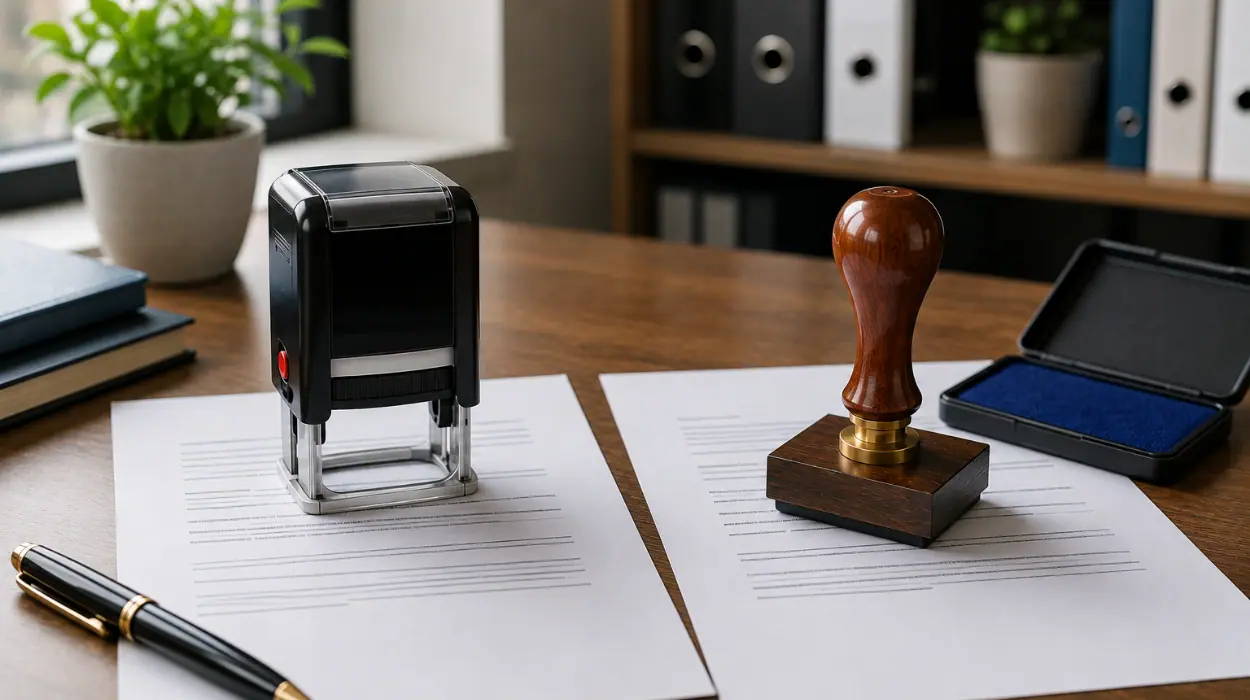
Self-inking company stamps offer superior convenience and speed for high-volume document execution, whereas traditional rubber stamps provide long-term durability and lower replacement costs for specialized sealing needs. Choosing the right option depends on your daily operational volume and document handling requirements.
What defines a self-inking company stamp?
Self-inking company stamps contain an internal ink pad that automatically flips and re-inks the die plate with every downward press. This mechanism delivers thousands of impressions without requiring a separate ink pad.
Modern UK businesses process hundreds of documents weekly. Administrative teams require fast stamping tools to maintain document velocity. The internal mechanism uses a rotating die that rests against a built-in sponge pad. When you press the handle downward, the rubber text plate rotates 180 degrees. It strikes the paper surface with crisp, uniform ink distribution. You eliminate the messy process of handling external stamp pads.
Manufacturing materials typically feature durable molded plastic casings. These housings protect the internal spring mechanism from dust and daily wear. Replacement ink pads slide out easily when dry. You swap the old cartridge within seconds without staining your fingers. Office managers prefer this clean replacement cycle. High-volume environments benefit from rapid, repetitive stamping operations.
Business administration relies on precise impression quality. The internal spring tension ensures consistent pressure across every character. Legal documents, invoices, and share certificates require legible company registration details. Self-inking models prevent smudging caused by uneven manual pad contact. Companies order these units alongside standard incorporation documents to establish immediate operational readiness.
How do traditional rubber stamps differ in design?
Traditional rubber stamps require a separate external ink pad to coat the text plate before every single impression is applied to paper. This classic two-step process offers maximum mechanical durability and supports specialized viscous inks.
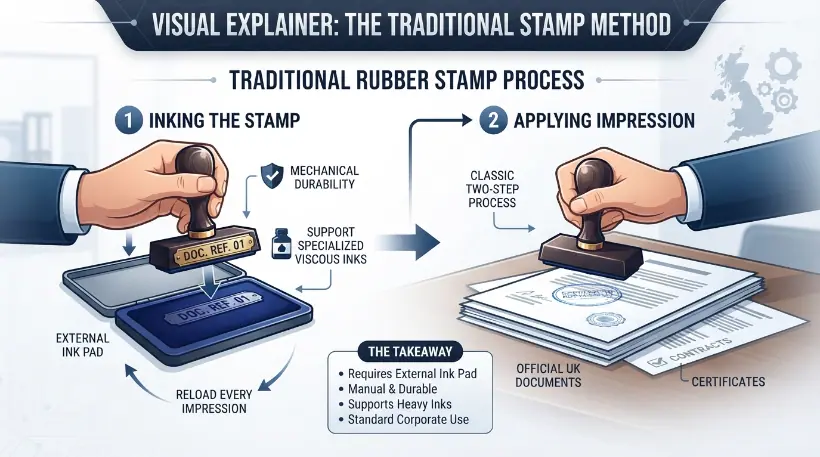
Classic rubber stamps consist of a wooden or acrylic block attached to a molded rubber die. Operating this tool requires an external ink pad soaked in pigment. You press the rubber die onto the pad manually. Then you align the inked die onto your physical paperwork. This traditional method lacks automated moving parts. Fewer mechanical components mean fewer points of failure over decades of use.
Durability remains the primary advantage of traditional models. Without internal springs or rotating axles, these stamps last for generations. Accountants and legal professionals often favor them for archival work. Specialized indelible inks or heavy pigment formulations work poorly in self-inking mechanisms. Traditional rubber dies accommodate specialized chemical inks without clogging internal components.
Storage requires a dedicated desk stand or ink pad enclosure. The exposed rubber die collects dust if left uncovered on a desk. You must clean the rubber surface periodically using specialized conditioning solutions. This maintenance prevents ink buildup from obscuring fine text details. Organizations handling specialized compliance paperwork appreciate this tactile, traditional approach.
Which option delivers better operational efficiency?
Self-inking models accelerate daily document processing speeds by eliminating the manual pad-inking step required by traditional stamps. Automated rotation saves administrative hours across large document batches.
Time efficiency drives modern office productivity metrics. Stamping fifty invoices manually with an external pad takes significant operational minutes. Self-inking units reduce that workflow duration by half. The continuous motion lets staff execute rapid sequences of clean impressions. Administrative teams finish batch paperwork before courier collection deadlines.
Error reduction is another major operational benefit. External pads often deposit excess ink on the edges of rubber dies. This overflow creates smudged borders on official company certificates. Self-inking designs meter the exact volume of liquid transferred to the paper. Every impression remains sharp, legible, and compliant with corporate governance standards.
Workspace organization improves when using self-inking units. Desks remain free of messy ink pads and stained surfaces. Offices handling high volumes of formal paperwork streamline their stations effectively. When setting up a new corporate identity, founders often review resources like Why Do Businesses Still Use a Company Stamp Today? to understand ongoing administrative requirements.
What are the long-term cost implications?
Traditional rubber stamps offer lower initial purchasing costs and near-zero mechanical maintenance expenses over decades of continuous service. Self-inking variants require periodic replacement ink pads but minimize consumable waste.
Financial budgeting for office supplies requires evaluating both upfront and replacement costs. Traditional wooden stamps feature minimal manufacturing expenses. They rarely break, meaning replacement cycles span decades. However, you must purchase replacement external ink pads and bottled refill ink regularly.
Self-inking devices carry a slightly higher initial purchase price due to internal engineering. The plastic housing and internal springs require precision manufacturing. When the internal pad eventually dries out after thousands of impressions, you buy a replacement cartridge rather than a new stamp. This modular replacement design balances long-term operational expenditures effectively.
Corporate structuring costs extend beyond digital filings and state fees. New directors evaluating corporate setup expenses often review a comprehensive Company Pack to understand all required operational assets, including statutory registers and authentication tools. Factoring these physical tools into your initial startup budget ensures seamless day-one operations.
How do you select the correct stamp for your business?
Select self-inking models for fast-paced administrative environments that process high volumes of daily paperwork. Choose traditional stamps if you require archival permanence, specialized inks, or rare physical usage.
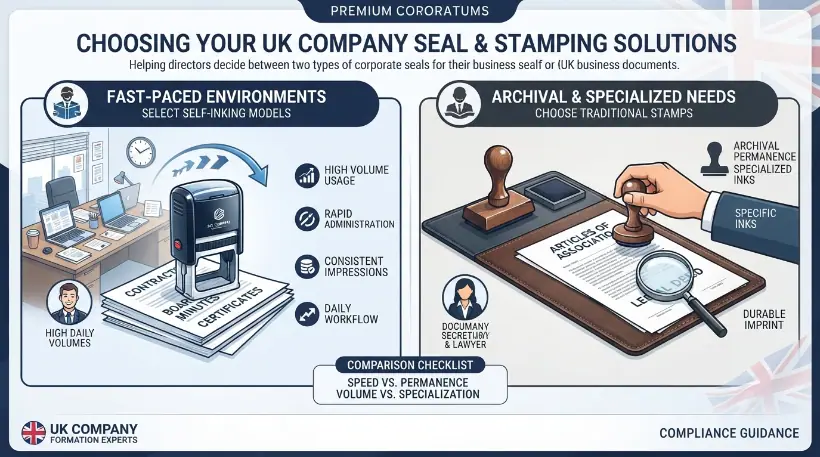
Matching office tools to daily workflows prevents unnecessary expenditure. Law firms processing hundreds of property deeds daily require speed. Their staff benefits immensely from automated ink distribution. Conversely, a boutique consultancy stamping three ledger books per month gains little from automated mechanisms. They thrive using a durable, classic wooden block.
Impression clarity also influences your final selection. High-resolution company seals containing intricate logos demand precise pressure control. Self-inking devices deliver uniform pressure across complex graphic layouts. Traditional stamps require steady human hand pressure to achieve identical visual fidelity.
Procuring these essential corporate items requires straightforward customization channels. Business owners ready to finalize their physical authentication tools can explore How Can You Get a Self-Inking Company Stamp With Form My Company? for direct fulfillment options. Form My Company delivers precision-engineered stamps designed to meet strict UK corporate standards and executive daily workflows.
Explore our Company Pack guide,
Standard vs Same-Day Apostille: Is the Extra Cost Worth It?
How to Choose a Sustainable Conference Venue for Your Business?
Frequently Asked Questions
What is included in a standard company pack for UK businesses?
A standard company pack from Form My Company typically contains essential corporate documents like the certificate of incorporation, memorandum and articles of association, and share certificates. These bundled corporate kits provide newly registered UK businesses with the legal foundation required for day-one operational compliance.
Do I legally need a company stamp for my UK registered business?
UK company law does not mandate the use of a physical company stamp or corporate seal for standard operational transactions. However, many financial institutions, international partners, and legal documents still require official seals to authenticate corporate paperwork effectively.
How do I order a company pack during business registration?
You can order a comprehensive company pack directly through Form My Company during the online incorporation process or as a standalone upgrade via the company pack service page. The fulfillment process packages all necessary physical and digital statutory registers for immediate business use.
What is the difference between a self-inking and traditional company stamp?
Self-inking stamps feature an internal mechanism that automatically re-inks the die plate for rapid, high-volume document execution. Traditional rubber stamps require a separate external ink pad but offer exceptional archival permanence for specialized corporate sealing requirements.
How long does it take to receive a physical company pack?
Physical company packs and custom corporate stamps are typically processed and dispatched within a few business days following successful company incorporation. Delivery timelines depend on your chosen postal option, ensuring your statutory documents arrive promptly for business banking setup.