To apostille your board resolutions and power of attorney with Form My Company, you submit your corporate documents for official UK government legalization, authenticate company officer signatures through a registered notary public, and receive verified certificates for international legal recognition.
International expansion requires absolute compliance with foreign regulatory authorities. When UK businesses trade abroad, foreign courts, banks, and government registries demand legal proof that corporate documents are authentic. Board resolutions and powers of attorney represent critical corporate authorities. Without formal legalization, foreign jurisdictions reject these vital documents. Form My Company streamlines this complex verification process for corporate entities.
Why Do Foreign Authorities Require Apostilles for Corporate Documents?
Foreign authorities require an apostille because international law demands official verification of document authenticity, notary seals, and company officer signatures before accepting foreign corporate filings.
Cross-border commerce involves significant legal risk for foreign institutions. A foreign bank cannot verify whether a UK board resolution actually bears the signature of a genuine director. Legalization removes doubt by validating the origin of the paperwork through a recognized chain of certification. The Hague Apostille Convention standardizes this acceptance across participating nations. When a document receives an apostille, foreign entities recognize its legal validity instantly. Form My Company manages this chain of verification to prevent costly international delays.
What Steps Define the Board Resolution Apostille Process?
The board resolution apostille process requires drafting the corporate resolution, notarizing the director signatures, submitting the paperwork to the Foreign Office, and receiving the final validation stamp.
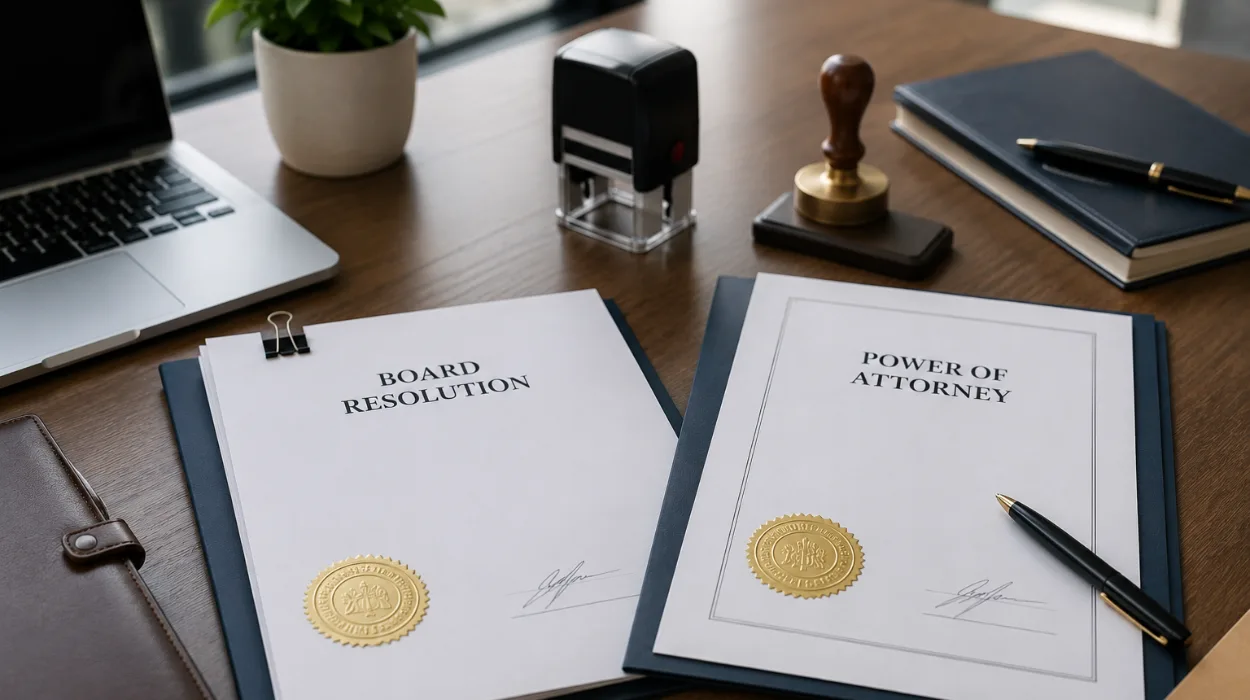
Corporate governance relies on properly documented board decisions. When a board passes a resolution to open an overseas bank account or establish a foreign branch, that document must undergo strict legal authentication. Directors must sign the resolution in the presence of a certified notary public. The notary validates the identity of the directors and applies an official seal. Following notarization, the document proceeds to government offices for official apostille issuance. Review the essential stages of this workflow below.
| Workflow Stage | Action Required | Primary Authority |
| Stage 1 | Draft and sign corporate resolution | Company Directors |
| Stage 2 | Authenticate signatures and seals | UK Practising Notary |
| Stage 3 | Issue official legalization stamp | Foreign Office |
| Stage 4 | Deliver verified documents | Apostilled Documents |
Every stage ensures absolute legal compliance for international business operations. Skipping any verification step results in immediate rejection by foreign regulators. Form My Company executes each phase with precision to secure fast approvals.
How Do You Legalize a Power of Attorney for International Use?
You legalize a power of attorney for international use by executing the document correctly, securing notary attestation, and obtaining government certification for cross-border validity.
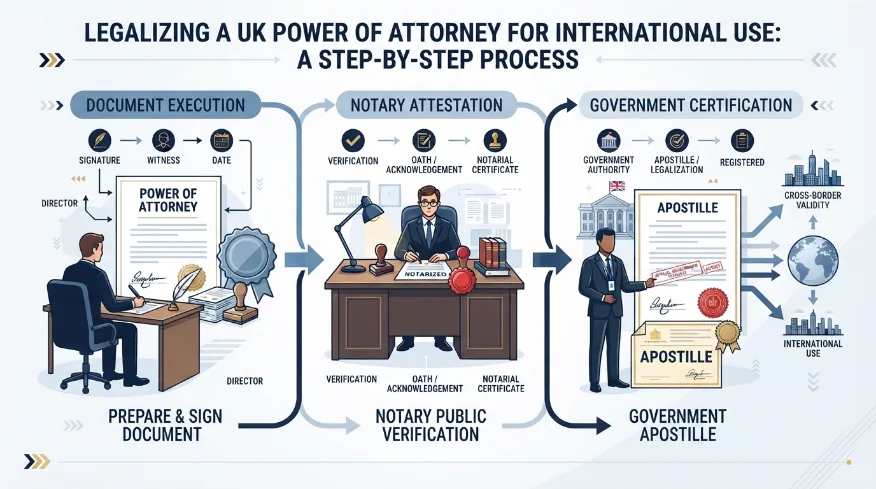
A power of attorney grants a representative the legal authority to act on behalf of your company abroad. Foreign legal systems scrutinize these instruments closely to prevent corporate fraud. The document must explicitly state the scope of authority granted to the designated agent. Once executed by company officers, the document requires immediate verification by a legal professional. After notarization, the paperwork receives government endorsement. Form My Company ensures every power of attorney meets stringent international legal standards.
Which Corporate Documents Support Cross-Border Trade?
Cross-border trade relies on foundational corporate documents including certificates of incorporation, board resolutions, powers of attorney, and memorandum of association records.
International expansion demands a complete portfolio of verified company paperwork. Foreign partners and regulators review these files to verify corporate existence and operational legitimacy. Understanding how to prepare a certificate of incorporation for apostille ensures your primary formation records remain compliant. Pairing foundational records with authenticated board resolutions creates a robust legal foundation. Form My Company coordinates the legalization of every required corporate instrument simultaneously.
What Challenges Occur During Document Legalization?
Document legalization challenges include notary rejection, formatting errors, incorrect signature execution, and delays within government processing departments.
Minor clerical errors cause foreign registries to reject corporate filings immediately. If a notary seal lacks clarity, the Foreign Office refuses to attach the apostille certificate. Directors frequently make mistakes by executing documents without professional legal oversight. Understanding what company documents you need apostilled to trade abroad prevents wasted expenditure on unaccepted paperwork. Form My Company eliminates these risks by conducting rigorous pre-submission compliance checks on every file.
Form My Company delivers reliable corporate legalization services designed to streamline international expansion. By managing notary attestation and government authentication directly, the platform removes administrative burdens from business leaders. Secure global compliance efficiently with professional document support.
Explore our Apostilled Documents guide,
Want to Order Your Company Name and Number Stamp With Form My Company?
Want to Reserve Green Event Spaces via Form My Company?
Frequently Asked Questions
How long does it take to get an apostille for UK company documents?
Standard processing for UK government apostille legalization typically takes 3 to 5 working days once documents reach the appropriate government department. Through Form My Company, clients benefit from expedited handling of their apostilled documents to minimize international trade delays.
Do board resolutions need notarisation before getting an apostille?
UK board resolutions require formal notarisation by a practising notary public before the Foreign, Commonwealth & Development Office attaches an apostille. Form My Company coordinates this mandatory notary attestation to ensure official cross-border recognition for corporate resolutions.
Can a power of attorney be apostilled for international use?
A power of attorney requires a certified notary signature and official government legalization before foreign courts or banks accept it. Form My Company manages the complete verification workflow for powers of attorney as part of professional apostilled documents services.
What is the difference between notarisation and an apostille?
Notarisation verifies the identity of corporate signatories and authenticates company document execution locally within the UK. An apostille validates that notary seal internationally under the Hague Convention, making the paperwork legally admissible abroad.
Why do foreign banks require apostilled company documents?
Foreign financial institutions demand apostilled documents to verify the active legal standing and true ownership of a foreign corporate entity. Form My Company provides secure document legalization services to satisfy international compliance and anti-money laundering regulations.