
Your bank asks for proof that your company can use its registered office address, and suddenly a simple account application stalls. What Is a Registered Office Authorisation Letter? It is written confirmation that your company has permission to use a particular address as its registered office. The purpose is straightforward, but it can be confusing to know when you need one and who should provide it.
Since 4 March 2024, UK companies have had to maintain an appropriate registered office address. Being able to show that you are authorised to use the address can help answer checks from banks and other organisations. The letter does not replace Companies House requirements, but it can provide useful evidence of your right to use the address.
This guide explains what the letter should confirm, when you may be asked to present it and how to obtain one. If you use a home address and want more privacy, we also explain how Form My Company’s Registered Office Address Service or Privacy Package may fit your needs.
Key Takeaways
- What Is a Registered Office Authorisation Letter? It is written permission to use an address as your company’s registered office and may help demonstrate your right to use it.
- Check what proof a bank, HMRC or another organisation needs before submitting your company details.
- Make sure the letter clearly identifies the company, the address and the person or organisation granting permission.
- If you use a commercial property, check whether your title documents or lease support using it as your registered office.
- Form My Company’s Registered Office Address Service includes an authorisation letter. The Privacy Package may suit directors who want to keep their home address private.
Defining the Registered Office Authorisation Letter and Its Core Purpose
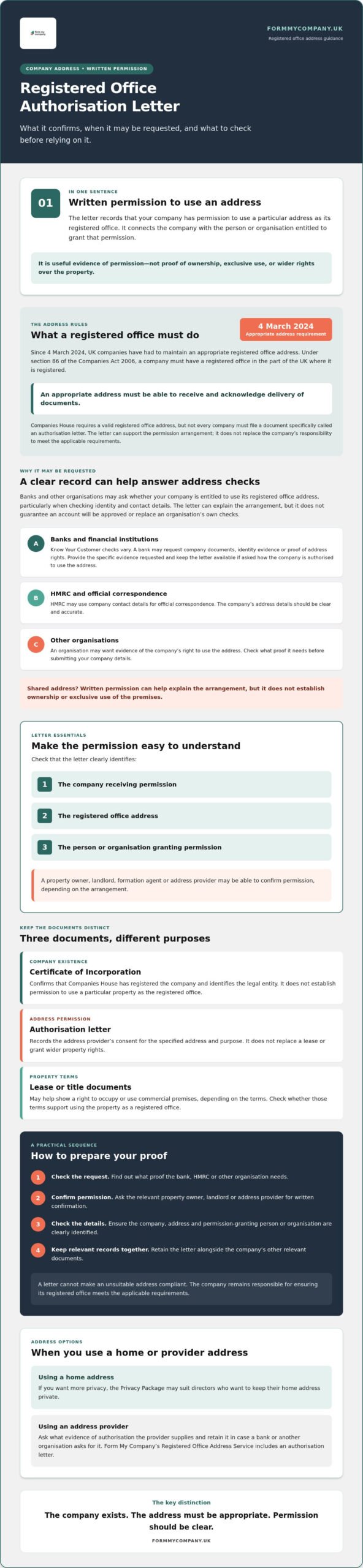
What Is a Registered Office Authorisation Letter? It is a written record confirming that a company has permission to use a particular address as its registered office. The letter links the company using the address with the person or organisation entitled to grant permission, such as a property owner, landlord or address provider.
A registered office is the company’s official address for formal correspondence. Under section 86 of the Companies Act 2006, a company must have a registered office in the part of the UK where it is registered. The address must also be appropriate for receiving and acknowledging delivery of documents. A registered office has a specific legal purpose, so it should not be treated as just a convenient mailing address.
The Legal Framework Behind Address Permission
Companies House requires a valid registered office address, but that does not mean every company must file a document called an authorisation letter. The letter is practical evidence of permission. It can show that the company has a legitimate connection to the address and is entitled to use it. A landlord may provide confirmation for a rented property, while a formation agent or address provider may issue it when supplying an address service.
Keep the distinction clear: the letter supports the permission arrangement, while the company remains responsible for ensuring that its registered office meets the applicable requirements. A letter cannot make an unsuitable address compliant.
Authorisation vs. Incorporation: Knowing the Difference
Your Certificate of Incorporation confirms that Companies House has registered the company. It identifies the legal entity, but it does not establish that you have permission to use a particular property as its registered office. An authorisation letter addresses that separate question.
The documents have different purposes: the certificate proves that the company exists, while the authorisation letter records the address provider’s consent. A lease may also demonstrate a right to occupy or use premises, depending on its terms. An authorisation letter is usually narrower. It confirms permission for the specified address and purpose, but does not replace a lease or grant wider rights over the property.
Keep relevant documents together during setup. If you need additional company records, see Form My Company’s supplementary company documents. If you use a professional registered office address provider, ask what evidence of authorisation it supplies and retain it in case a bank or another organisation asks for it.
Why Your Business Requires a Formal Address Authorisation
A registered office address is more than a line on your incorporation paperwork. Banks and other organisations may ask you to show that your company is entitled to use it, particularly when checking a new business’s identity and contact details. An authorisation letter can help answer that question, but it does not guarantee that an account will be approved or replace an organisation’s own checks.
For example, a bank reviewing an application may want to understand the connection between a newly formed company and an address used by several businesses. Written permission from the address provider helps explain the arrangement. It can be especially useful for a company with an online-only presence and no shopfront or office lease to show. The letter establishes consent, not ownership or exclusive use of the premises.
Banking and Financial Checks
Know Your Customer checks vary between financial institutions. A bank might ask for company documents, identity evidence or proof of address rights as part of its review. A digital presence is not a problem in itself, but it may prompt questions about where the company is officially based and how it receives formal correspondence. Provide the specific evidence requested, and keep the letter available in case the bank asks how your company is authorised to use the address.
Clear permission can also help distinguish a legitimate shared address arrangement from unauthorised use, sometimes described as “address squatting”. That phrase is not a formal compliance test. The practical point is to avoid ambiguity. GOV.UK guidance says a company must have permission to use the address it gives as its registered office.
HMRC, Address Records and Identity Checks
HMRC may use company contact details for official correspondence. Businesses applying for VAT registration should ensure that the information they provide is accurate and consistent. An authorisation letter can support your records if an organisation asks you to demonstrate your right to use an address. It is not a universal substitute for HMRC’s application requirements, so check what evidence is needed for your circumstances.
Keep address permission separate from identity verification. Companies House identity checks concern the identity of directors and people with significant control (PSCs); they do not establish the company’s right to use its registered office. PSC information has its own reporting requirements, so keep those records accurate rather than assuming the authorisation letter updates them. Form My Company provides an identity verification service for directors or PSCs, which is separate from confirming address permission.
Using an address without consent can lead to disputes or difficulty responding to official queries, and may put your registered office arrangements under scrutiny. If you need a documented address arrangement, consider Form My Company’s Registered Office Address Service, which includes authorisation letters.
Essential Components of a Valid Authorisation Letter
What Is a Registered Office Authorisation Letter? It is written evidence that a company has permission to use a particular address for its registered office. There is no single format for every situation, so make the permission clear, specific and easy to verify. Section 86 of the Companies Act 2006 requires a company to have a registered office, while the letter records the agreement between the address provider and the company.
The Anatomy of a Professional Authorisation
Letterhead can help identify the person or organisation granting permission, but the key is clear, verifiable information. Check that the document includes:
- The parties’ full legal names: Name the company exactly as registered and identify the property owner, landlord, agent or address provider granting permission.
- The complete address: Include the full UK address and postcode. Match the format used in the company’s official records and check it against the address provider’s details.
- An explicit statement of permission: State that the company is authorised to use the specified premises as its registered office. General wording about receiving post may not make the intended use clear.
- The period covered: Give a start date and, if relevant, an end date. If permission continues until withdrawn, say so rather than leaving the duration unclear.
- Company details and sign-off: Add the Company Registration Number (CRN) once issued. The grantor should sign and date the letter, giving their name, role and contact details so the recipient can verify who approved it.
The person signing should have authority to grant permission on behalf of the property owner or address provider. If an agent signs, their role should be clear. Ask the provider to confirm who is authorised to approve the arrangement rather than assuming any employee can sign.
Common Mistakes That Can Cause Delays
Small discrepancies can prompt extra questions. Compare the company name and address on the letter with Companies House records and the details supplied to the bank or other organisation requesting proof. Do not rely on a document that only permits mail delivery if it does not expressly cover use as a registered office.
Check that the letter is current, signed and dated, and includes a way to contact the grantor. An old letter may not reflect a change of provider or permission period. Before submitting it, confirm that the recipient accepts this type of evidence and whether it needs any additional documents.
How to Secure Your Proof of Registered Office Address
What Is a Registered Office Authorisation Letter? It is evidence that you have permission to use an address for your company’s registered office. How you obtain that evidence depends on who controls the premises and what the organisation requesting it will accept.
Choose the Right Route for Your Address
- Your own commercial property: Check the title documents and any lease for terms relevant to using the premises as a registered office. If the company does not own the property, do not assume that occupying it automatically gives the company permission. Ask the owner or landlord to confirm consent in writing.
- A professional address provider: A Registered Office Address Service is an option when you need an address and supporting authorisation. Form My Company provides authorisation letters with its Registered Office Address and Virtual Office services. Confirm what the letter covers and whether the organisation asking for proof needs anything else.
- Your residential address: You may be able to use a home address if it meets the relevant requirements and you have the right to use it. Consider privacy, as a registered office is publicly available company information. If you rent, check your agreement and obtain the necessary permission rather than relying on an assumption.
There is no single turnaround time for every provider or arrangement. Ask how and when the letter will be issued, and allow time to check its details before submitting it. If a bank or another organisation has requested proof, ask whether it has a required format or will accept a digital copy.
Extra Checks for Non-UK Residents
If you are forming a UK company from abroad, arrange written permission from the UK address provider and keep the letter with your incorporation records. A bank outside the UK may have its own due diligence process, so ask whether it needs an original, a certified copy or a translation. Do not assume an apostille is required. Confirm this with the organisation receiving the document first. For further information, see apostilled documents.
Update the Evidence When Your Address Changes
If your company moves its registered office, the previous letter relates to the former address. Obtain fresh written permission for the new one, then update the company’s records with Companies House using the appropriate process. A confirmation statement is not a substitute for notifying Companies House of an address change. Check the filing steps before making the move. You can read about filing a confirmation statement separately.
Plan the handover carefully. Confirm when permission for the old address ends and when the new arrangement begins, and check how official post will be handled during the transition. To arrange an address with supporting authorisation, explore Form My Company’s registered office address service.
Streamlining Your Compliance with Form My Company
A clear address arrangement makes company administration easier to organise. Form My Company’s Virtual Office services include authorisation letters, helping you document permission to use the address. The letter supports your records, but it does not guarantee that a bank or another organisation will accept it as its only evidence. Check what the organisation requires and keep your company name and address consistent across submitted documents.
If you are comparing options, review the details of the Virtual Office services and confirm what is included in the address arrangement and supporting paperwork. This helps you understand what evidence you can request before you need to respond to a bank, HMRC or another organisation.
Choose Support That Fits Your Business
Directors who do not want to use their home address can consider the Privacy Package. Check the package details and which addresses appear on public company records before choosing.
Address proof is only one part of setting up a company. Form My Company also offers a VAT Registration Service. Keep the responsibilities distinct: address authorisation confirms permission to use an address, while a VAT registration application has its own information and requirements. A formation or address provider can help organise relevant documents, but cannot promise that a bank will approve an account or that every organisation will accept the same evidence.
Virtual office services can contribute to a professional business presence, but do not assume that a mailing address or authorisation letter also includes call answering or room access. Check each service separately if you need those facilities. Also check whether the letter names your company, identifies the authorised address and clearly states the permission, so you can present the appropriate document when requested.
Get Started with the Right Package
Start by identifying what you need: company formation, an authorised registered office address, or both. Then compare the formation packages and relevant address options. If you are registering a company, prepare the proposed company details and check that the address arrangement suits your circumstances. Form My Company offers UK company formation services for residents and foreign nationals, with options to review based on your needs.
Compare the available Company Formation Packages with the address services you may need, and check what each option includes before deciding.
Put Your Registered Office Arrangements in Place
What Is a Registered Office Authorisation Letter? It is written evidence that your company has permission to use its registered office address. Keep the letter accurate, make sure it clearly covers registered office use, and check what supporting evidence a bank or another organisation requires. If you use a professional address, choose a service that provides authorisation documentation alongside it.
Form My Company’s Registered Office Address Service includes authorisation letters. It can be a practical option if you want to keep your home address private or need help organising address paperwork. Each bank makes its own decisions about the evidence it accepts, so confirm its requirements before applying.
To arrange your company’s registered office address and authorisation letter, contact Form My Company. Check the service details and the evidence requested by any bank or organisation you need to satisfy.
Frequently Asked Questions
Can I write my own registered office authorisation letter?
Yes, you can draft one if you have authority to grant permission for the address. Clearly identify the company and the person or organisation granting consent, give the full address, state that it may be used as the registered office, and include the permission period and a dated signature. If a bank or another organisation requested the letter, check its requirements first. What Is a Registered Office Authorisation Letter? It is evidence of permission, not a prescribed universal form.
Is a registered office authorisation letter the same as a lease?
No. A lease sets out rights and obligations concerning occupation or use of premises, according to its terms. An authorisation letter is narrower: it records permission to use a specified address as a company’s registered office. It does not replace a lease or grant broader rights to occupy the property. Depending on the circumstances, a lease may help evidence permission, but check that it allows the intended use and whether the organisation requesting proof accepts it.
Do I need to send this letter to Companies House when I register?
Companies House requires a valid registered office address, but an authorisation letter is not routinely submitted as a standard incorporation document. Keep it with your company records and provide it if a bank, authority or other organisation asks for evidence of permission. The address must meet the applicable requirements whether or not a letter is filed. Check current Companies House guidance and the specific evidence requested for your situation.
Will a bank accept a digital copy of the authorisation letter?
That depends on the bank’s checks and document policy. Some may accept a clear electronic copy, while others could request an original or additional evidence. Before submitting it, ask whether the bank accepts digital documents, whether the letter needs a particular format, and whether it requires a signature or supporting records. Ensure the copy is complete and legible, and that the company name and address match the details on your application.
What happens if I use an address without an authorisation letter?
The key issue is whether you have permission to use the address, not simply whether you hold a particular letter. Without written evidence, it may be harder to demonstrate consent if a bank or another organisation asks. Using an address without permission can lead to disputes and may raise questions about whether the registered office is appropriate. Obtain consent from the owner or provider and keep a record of it.
Does the letter expire if I renew my address service annually?
There is no universal expiry period for every authorisation letter. Check the wording: it may specify an end date, remain valid until permission is withdrawn, or refer to the term of an address service. On renewal, confirm that the service and permission continue and ask the provider whether it issues updated evidence. If the address, company details or permission terms change, request a revised letter and keep the current version on file.
Can a virtual office provider refuse to give me this letter?
A provider’s obligations depend on its service terms and the address arrangement. Ask before signing up whether authorisation is included, what the letter confirms and when it will be supplied. Form My Company’s Virtual Office and Registered Office Address services include authorisation letters. If a provider cannot confirm permission for registered office use, do not assume its mailing address is suitable for that purpose. Clarify the arrangement before using the address on company records.
Is an authorisation letter required for a Director Service Address too?
A director’s service address and a company’s registered office are separate address details, so permission for one should not automatically be treated as permission for the other. If you use a third-party address for a director’s service address, check with the provider that your arrangement covers that specific use and request written confirmation. Keep the company’s registered office evidence distinct, and ensure each address is used and reported for the correct purpose.