Your company’s bank asks for proof that you’re allowed to use its registered office address. The address provider, property owner or another party could be the right person to contact, depending on your arrangement. How to Obtain a Registered Office Authorisation Letter starts with identifying who has authority to approve use of the address.
It’s understandable to be unsure what the letter needs to say. Requirements depend on both the organisation requesting it and your arrangement with the address provider. A missing company name, address or clear statement of permission could mean delays while you arrange a corrected document.
This guide explains how to identify the right person or organisation to ask, what details to confirm and how to check the letter before submitting it. You’ll also learn when an address service provider may be the appropriate contact, so you can make a precise request and send the document with confidence.
Key Takeaways
- How to Obtain a Registered Office Authorisation Letter starts with checking exactly what the requesting organisation needs.
- Contact the party responsible for the address, which may be an address service provider or the property owner.
- Use a checklist for the company name, address and intended use, but include details only as requested.
- Confirm the recipient’s preferred format and submission method, then review the letter before sending it.
- If you need to arrange a company address, consider whether a registered office address service suits your requirements.
How to Obtain a Registered Office Authorisation Letter: Start with the Request
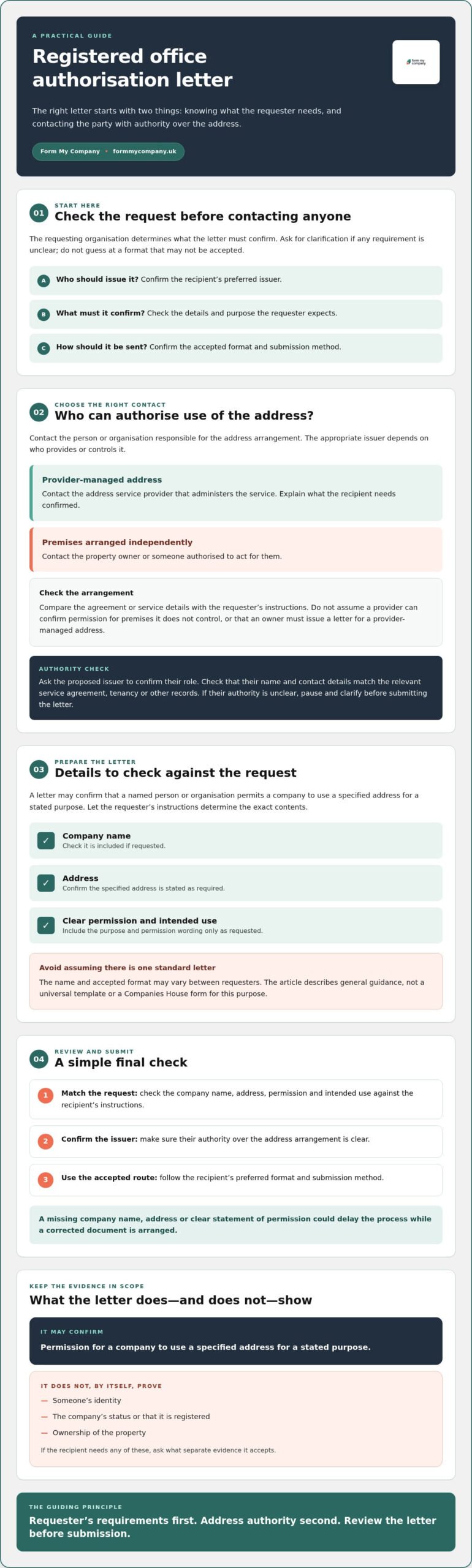
A request for an authorisation letter can be hard to interpret, particularly if the organisation asking for it hasn’t supplied a template. Before contacting anyone, check what the document needs to confirm, who should issue it and how it should be submitted. Ask the requester to clarify any point that is unclear. This gives you a practical starting point without guessing at a format that may not be accepted.
Where the purpose is to show that a company has permission to use an address, the letter is written confirmation of that permission. It may identify the address and intended use, but the requester’s instructions should determine its exact contents. The term “registered office” refers to an official address for a legal entity, used for formal correspondence; see this overview of a registered office. A letter confirming permission to use an address is not, by itself, proof of someone’s identity, the company’s status or ownership of the property.
Don’t assume there’s a single standard authorisation letter or a Companies House form for this purpose. The document’s name and accepted format may vary between requesters. Treat the guidance below as general information, and follow the instructions of the organisation asking for the evidence.
What does a registered office authorisation letter confirm?
It may confirm that a named person or organisation permits a company to use a specified address for a stated purpose. Permission to use an address doesn’t establish who owns it, verify a director’s identity or confirm that a company is registered. If the recipient needs any of those things, ask what separate evidence it accepts.
Who might ask for the letter?
The organisation requesting the document determines what it needs to confirm. An address service provider may be asked to confirm permission to use an address it provides. If the company uses premises arranged independently, the property owner may be the relevant person to contact. A bank or another organisation reviewing company details might also request evidence, but its requirements may differ. Check who should issue the letter, what it must cover and whether a particular format or submission method is required.
Check the requester’s requirements first: the right issuer and acceptable evidence depend on why the letter is needed. If you’re unsure, ask for clarification before requesting or drafting anything. This helps you approach the authorised contact with a precise request and reduces the risk of sending a document that doesn’t meet the recipient’s needs.
Who can issue a registered office authorisation letter for your address?
The right issuer depends on who provides or controls the address. If you use an address service, the organisation administering it may be able to confirm your permission to use the address. If you arranged premises independently, the property owner or someone authorised to act for them may be the appropriate contact. Don’t assume a property owner must issue a letter for a provider-managed address, or that a provider can confirm permission for premises it doesn’t control.
For a UK company, the registered office must meet the relevant requirements set out in the Companies Act 2006. However, this doesn’t mean any particular person can confirm your right to use a specific address. Focus on the person or organisation with authority over the address arrangement, not simply the most convenient contact.
When should you contact an address provider or property owner?
Start with the agreement or service details for the address, then compare them with the requester’s instructions. If a provider manages the address, send your request to that organisation and explain what the recipient needs confirmed. If you arranged the premises yourself, ask the owner or an authorised representative. Check whether the recipient has specified who must issue the letter before making your request.
A provider’s confirmation relates to the service and permissions it administers. A property owner’s letter may confirm permission for a company to use premises they control. Don’t treat one as a substitute for the other unless the organisation requesting evidence agrees.
How can you confirm the issuer is authorised?
Ask the proposed issuer to confirm their role in managing the address or approving its use. Check that their name and contact details match the relevant service agreement, tenancy or other records. An assurance from someone whose authority is unclear may not satisfy the recipient.
If the agreement names a different contact, or the person responding can’t confirm their authority, pause before submitting the letter. Ask the requester whether they’ll accept evidence from that issuer. If the arrangement remains unclear, seek advice from a suitably qualified adviser.
If you’re arranging a company address, review Form My Company’s registered office address service and confirm directly whether it can provide the evidence your recipient requests. Don’t assume a particular authorisation letter is included.
What should a registered office authorisation letter include?
There isn’t one universal checklist for every registered office authorisation letter. Let the recipient’s instructions determine what appears in the document. Use the details below as a prompt for questions, and confirm each item before asking for the letter. A concise, accurate confirmation is more useful than information the recipient hasn’t requested.
Ask the requester what the letter needs to confirm and whether it has a preferred template. Use this table to organise your questions, not as a legal template to copy without checking.
| Detail to consider | What to confirm first |
|---|---|
| Company name | Should the full registered name appear, and does it need a company number or another identifier? |
| Address | Which address should be stated, and how should it be written? |
| Purpose of permission | Does the recipient need confirmation that the address can be used as the company’s registered office, or for another specific purpose? |
| Date and signatory | Is a date required, and must the issuer’s name, position or signature be included? |
| Supporting evidence | Does the recipient require an agreement, proof of address or another attachment? |
Which company and address details should you check?
Match the company name and address to the requester’s records and instructions. Check spelling and punctuation against reliable company records rather than relying on memory or an old draft. Confirm whether the address needs specific details, such as a unit or floor, and reproduce them as requested.
Keep the letter focused. Don’t add personal or sensitive information unless the recipient requests it and it’s necessary for the stated purpose. If the company name or address differs between records, resolve the discrepancy with the requester before the letter is issued.
Does the letter need a signature or supporting documents?
Ask whether the recipient expects a signature, the issuer’s position or a company stamp. Requirements can vary, so don’t assume that a particular signatory or attachment is mandatory. Check which supporting documents are wanted, what format they’ll accept and whether those documents should be sent with the letter or separately.
Before submitting, compare the finished letter with the requester’s instructions. Confirm that the company, address and purpose are correct, and that any requested date, signatory details or attachments are present. This final check helps you spot omissions without adding unnecessary information.
How to request, review and submit the letter step by step
A clear process helps you request the right confirmation, check it before sending and keep a record. Follow these steps, using the recipient’s instructions as your guide throughout.
- Step 1: Check the request. Identify what the recipient wants the letter to confirm, who should issue it and whether it has supplied a template. Ask about the preferred format and submission method before drafting or requesting the document.
- Step 2: Prepare a precise request. State the company name, relevant address and purpose of the letter. Include a deadline only if the requester has given one. Ask who should sign and whether specific wording, a date or supporting evidence is needed.
- Step 3: Contact the authorised issuer. Send your request to the person or organisation responsible for providing or approving use of the address. Share relevant company or address documents only through a suitable secure channel, and only where they’re needed.
- Step 4: Review the draft or completed letter. Check the company details and address against the requester’s records. Confirm that the issuer is the right person, the stated purpose matches the request and any requested signatory details or attachments are included. Don’t edit the issuer’s confirmation yourself; ask them to correct any error.
- Step 5: Submit and keep a record. Use the recipient’s specified method, such as its approved online process or designated email address. Save a copy of the final letter and note when and how you sent it. Follow up to confirm receipt if you don’t receive acknowledgement.
What if the letter is delayed or rejected?
If the letter is delayed, ask the issuer whether they need further information to prepare it. If the recipient rejects it, request a precise explanation. Find out whether a detail was missing, the format was unsuitable, or the letter needed to come from a different issuer. Take that feedback to the authorised issuer and ask them to make any necessary changes. If the disagreement concerns legal obligations rather than presentation or missing information, seek advice from an appropriately qualified professional.
This sequence makes obtaining the letter a manageable administrative task and gives you a clear record of the request and submission. If you’re arranging a company address, explore registered office address options and confirm directly what evidence the provider can supply.
Arrange a registered office address and confirm the next step
You now have a clear route: check what the requester needs, identify who has authority over the address, then follow the required format and submission method. If you’re still arranging a company address, consider whether a professional service fits your needs. Check that the address arrangement and its terms suit your company and the purpose for which you need the address.
Is a professional registered office address right for your situation?
Consider whether using a separate address could help you keep your home address private, and how company post will be received. Read the service terms carefully, including what happens to correspondence and which uses of the address are permitted. Don’t assume every address arrangement covers the same needs.
A registered office address service and virtual office services can serve different purposes and have different conditions. Check which arrangement fits your company’s requirements, the requester’s instructions and the practical arrangements for receiving official post. If you’re unsure whether a particular service meets those needs, ask the provider before committing.
Where can you get help with the address arrangement?
Review the details of a registered office address service before choosing an arrangement. Check what the service covers and whether its terms match your intended use. If you need an authorisation letter, confirm directly with the provider whether it can issue the specific document requested and what information it would need. Don’t assume a letter is included or that a provider can meet a recipient’s particular format requirements.
Form My Company offers registered office address services and virtual office services, but whether it can issue a specific authorisation letter depends on the circumstances and should be confirmed directly. Once you’ve found a suitable address arrangement, confirm the issuer, wording, format and submission method with the requester before proceeding.
Explore Form My Company’s address services to review the available options.
Take the next step with confidence
The key to How to Obtain a Registered Office Authorisation Letter is to work from the recipient’s requirements, identify who can authorise use of the address and check the completed document before sending it. Confirm the requested format and submission method, then keep a copy and note when you submitted the letter.
If you’re arranging an address for your company, choose an option that fits your needs and review its terms. Form My Company offers a Registered Office Address Service and Virtual Office Services. Confirm directly whether the provider can supply the specific letter you need.
Explore registered office address services to review the available options and discuss your address requirements.
Frequently Asked Questions
How do I obtain a registered office authorisation letter?
Start by checking exactly what the organisation requesting the letter needs it to confirm and how it wants the document submitted. Then contact the person or organisation authorised to approve use of the address, such as the address service provider or property owner. Ask whether there’s a preferred format and what details to include. Before submitting, check the company name, address, stated purpose, issuer and any requested attachments.
Who can provide a registered office authorisation letter?
The appropriate issuer is the party responsible for providing or approving use of the address. If a company uses an address service, contact the organisation administering that service. If the premises were arranged independently, ask the owner or an authorised representative. Check the agreement and the recipient’s instructions first. If you’re unsure whether the proposed issuer has authority, confirm this with the recipient before requesting or submitting the letter.
Is there an official Companies House authorisation letter template?
Don’t assume there’s an official Companies House template for an address authorisation letter. The recipient may have its own template or requirements, and the document’s name can vary. Ask the organisation requesting it whether it accepts a letter in the issuer’s format or requires specific wording. Follow those instructions rather than using a generic template that may omit information the recipient needs or include unnecessary details.
What information should a registered office authorisation letter contain?
Include only the details the recipient requests. These may include the company’s registered name, the relevant address and confirmation of permission to use it for a stated purpose. Check whether the recipient also requires a date, the issuer’s name and position, a signature or supporting evidence. Match company and address details to reliable records, and don’t add personal or sensitive information unless requested and necessary.
Can I use a virtual office address as my registered office?
Possibly, but not every virtual office arrangement is suitable for use as a registered office. Check that the address meets Companies House requirements, that the service terms permit this use and that arrangements are in place for official documents to be received and acknowledged. Virtual office services and registered office address services can have different purposes and conditions, so confirm the specific address arrangement with the provider before relying on it.
What happens if my registered office authorisation letter is rejected?
Ask the recipient to explain precisely why it rejected the letter. It may need a missing detail, a different format, a specific issuer or an attachment. Take that feedback to the authorised issuer and request a corrected document rather than changing their confirmation yourself. Check the revised version against the recipient’s instructions, submit it using the accepted method and keep a copy. Seek qualified advice if the issue concerns legal obligations.
Does a registered office authorisation letter prove that I own the address?
No. A registered office authorisation letter may confirm permission to use an address for a stated purpose, but it doesn’t by itself prove ownership of the property. It also doesn’t verify a person’s identity or establish a company’s registration status. If the recipient needs proof of ownership or another type of evidence, ask what document it accepts and arrange that evidence separately from the permission letter.