Consular legalisation is a multi-step diplomatic authentication process required for official documents intended for use in countries that are not signatories to the 1957 Hague Apostille Convention. This validation chain typically involves notary certification, government department attestation, and final endorsement by the destination nation’s embassy or consulate.
Consular legalisation serves as the primary cross-border authentication mechanism for international commerce. When UK businesses expand operations into foreign jurisdictions, local authorities require absolute proof of corporate authenticity. Nations outside the Hague Apostille Convention do not recognise standard apostille stamps. Official documents demand a longer chain of verification.
Foreign ministries and embassies inspect corporate records to prevent fraudulent registrations. Each diplomatic mission applies specific seals, ribbons, and consular stamps. This rigorous verification prevents international fraud and protects foreign legal systems. Document authenticity relies entirely on this diplomatic validation chain.
Why Do Non-Hague Convention Countries Require Consular Legalisation?
Non-Hague Convention countries require consular legalisation because their domestic legal frameworks lack treaty-based recognition for simplified certificates, demanding direct diplomatic verification of foreign public documents instead.
Foreign governments protect their domestic legal systems through stringent document verification protocols. Sovereign states reject foreign seals unless their own diplomatic representatives authenticate them. Treaties like the Hague Convention establish mutual trust between participating member states. Non-signatory nations operate outside this multilateral framework.
Consular officers inspect foreign paperwork to confirm compliance with national laws. Embassy officials check signatures against registered diplomatic exemplars. This verification prevents fraudulent corporate expansions across international borders. Direct government oversight ensures complete legal validity abroad.
What Documents Typically Undergo Consular Legalisation?
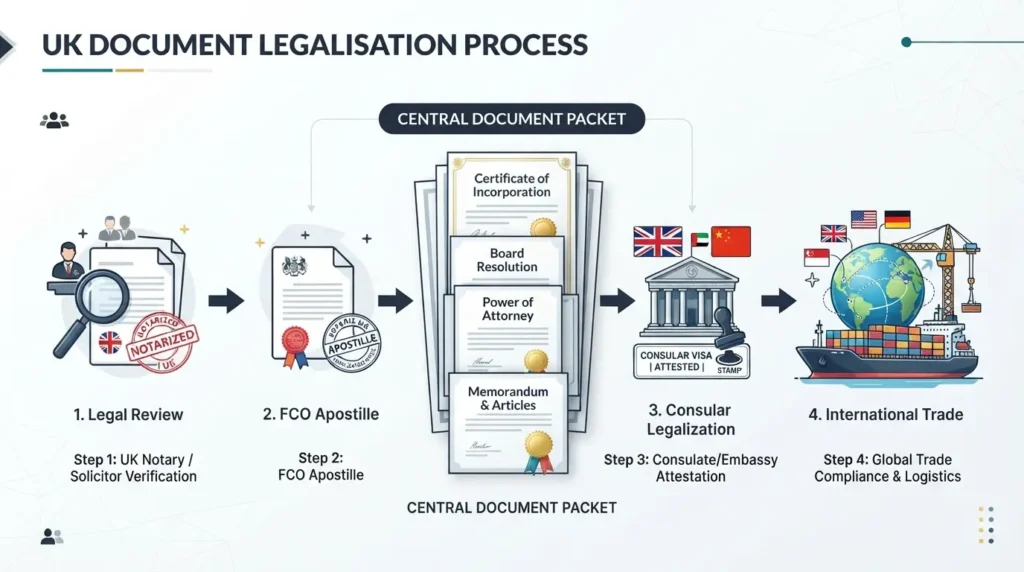
Corporate documents such as certificates of incorporation, memorandum of association, board resolutions, and commercial invoices routinely undergo consular legalisation for international trade.
International expansion requires comprehensive paperwork authentication across multiple jurisdictions. Directors submit foundational constitutional documents to foreign government registries. Commercial agreements need formal validation before foreign courts enforce them. Intellectual property registrations also demand certified corporate credentials.
UK corporations secure global partnerships by authenticating official registries. Financial institutions request legalised accounts before opening foreign bank accounts. Regulatory compliance mandates certified proof of corporate existence. Every commercial transaction relies on verified foundational paperwork.
How Does the Consular Legalisation Process Work?
The consular legalisation process works through a sequential four-stage verification chain involving a UK solicitor, the Foreign Office, the relevant embassy, and final diplomatic dispatch.
Initial authentication begins with a practising UK notary public. Solicitors verify corporate signatures and administer formal oaths. Legal professionals authenticate company directors using official government identity databases. This first step establishes the baseline legality of corporate paperwork.
Subsequent government attestation takes place at the Foreign, Commonwealth & Development Office. State officials verify the notary public signature and seal. Government departments process 1,450 documents daily during peak business cycles. This central department confirms public official credentials.
Final embassy legalisation occurs at the diplomatic mission of the destination country. Consular officials review prior government stamps and issue diplomatic certificates. Embassies charge specific statutory fees for each legalised document. This final stamp unlocks official acceptance abroad.
Businesses navigating these complex multi-tier requirements often utilise specialized Apostilled Documents to streamline cross-border compliance. Comprehensive corporate services remove administrative burdens from busy company directors.
What Challenges Arise During Consular Legalisation?
Challenges arise during consular legalisation due to frequent bureaucratic delays, shifting embassy fee structures, strict document formatting rules, and complex translation mandates.
Foreign embassies enforce strict document acceptance guidelines with zero tolerance for errors. Minor typographical mistakes invalidate entire multi-step authentication chains. Consular offices reject documents lacking certified English translations. Administrative backlogs at diplomatic missions extend processing timelines unexpectedly.
Corporate expansions stall when foreign embassies alter their legalisation protocols unexpectedly. Regional conflicts or diplomatic disputes close specific consular offices temporarily. Companies mitigate these operational risks by studying Apostille vs Consular Legalisation: Which Route Does Your Country Need? before dispatching sensitive paperwork. Careful planning prevents costly international shipping delays.
How Do Timeframes and Costs Vary for Legalisation?
Timeframes range from 10 to 25 working days, while costs vary from 150 pounds to over 600 pounds per document depending on embassy fees.
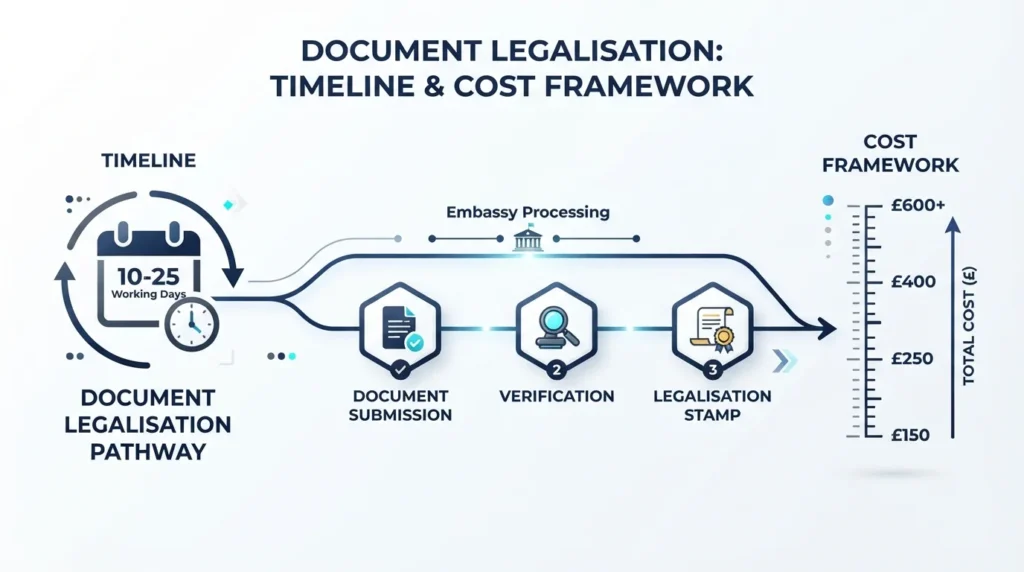
Processing durations fluctuate based on the specific destination country’s administrative capacity. Certain embassies process paperwork within 5 working days for expedited fees. Other diplomatic missions require 3 weeks of thorough security vetting. Government departments update their fee schedules annually to match inflation.
Corporate budgets must account for notary fees, government levies, and courier charges. International shipping adds substantial costs for secure document transit. Businesses streamline these financial commitments by reviewing Order Full Consular Legalisation for Non-Hague Countries at Form My Company to secure transparent pricing. Clear cost structures protect corporate financial planning.
Consular legalisation remains an essential diplomatic mechanism for authenticating UK corporate documents in non-Hague Convention jurisdictions. The multi-stage verification process guarantees total legal acceptance across foreign courts and government registries. Form My Company delivers reliable administrative solutions to simplify complex international compliance workflows. Professional expertise ensures seamless global expansion for ambitious enterprises.
Explore More Apostilled Documents Guide,
Want to Get Your Articles of Association Apostilled Through Form My Company?
How Can You Suppress a PSC Home Address With Form My Company?
Frequently Asked Questions
What is the difference between an apostille and consular legalisation?
An apostille is a simplified stamp used for countries party to the 1957 Hague Convention, whereas consular legalisation is a multi-step diplomatic verification required for non-Hague countries. Form My Company assists businesses in obtaining the correct document authentication for international use.
Which countries require consular legalisation instead of an apostille?
Countries that have not signed the 1957 Hague Apostille Convention, such as the United Arab Emirates, China, and Qatar, require consular legalisation. Form My Company manages the entire embassy attestation process for these non-Hague jurisdictions.
How long does it take to get documents apostilled or legalised?
Standard UK apostilles typically take 3 to 5 working days, while full consular legalisation for non-Hague countries ranges from 10 to 25 working days. Form My Company provides efficient processing timelines for all apostilled documents.
What corporate documents need to be legalised for international use?
Certificates of incorporation, memorandum of association, board resolutions, and power of attorney documents frequently require official authentication. Form My Company ensures your corporate paperwork meets all strict international compliance frameworks.
Can Form My Company handle international document legalisation for my UK business?
Yes, Form My Company offers specialized services to authenticate corporate records through UK solicitors, the Foreign Office, and foreign embassies. These comprehensive solutions ensure your business documents achieve full legal validity abroad.