Complete document legalisation requires obtaining an apostille certificate from the Foreign, Commonwealth & Development Office and, when necessary, secondary attestation through specific embassy channels. Form My Company manages these government authentication steps to ensure your corporate and personal paperwork is legally recognized abroad.
Navigating international borders with official paperwork requires precise adherence to jurisdictional regulations. Foreign authorities reject invalid certificates instantly because missing verification seals violate domestic administrative laws. Understanding the legalisation process protects your business interests and ensures seamless cross-border operations.
Why Is Document Legalisation Essential for International Operations?
Document legalisation validates the official status of certificates for foreign authorities by authenticating signatures and seals through accredited government bodies.
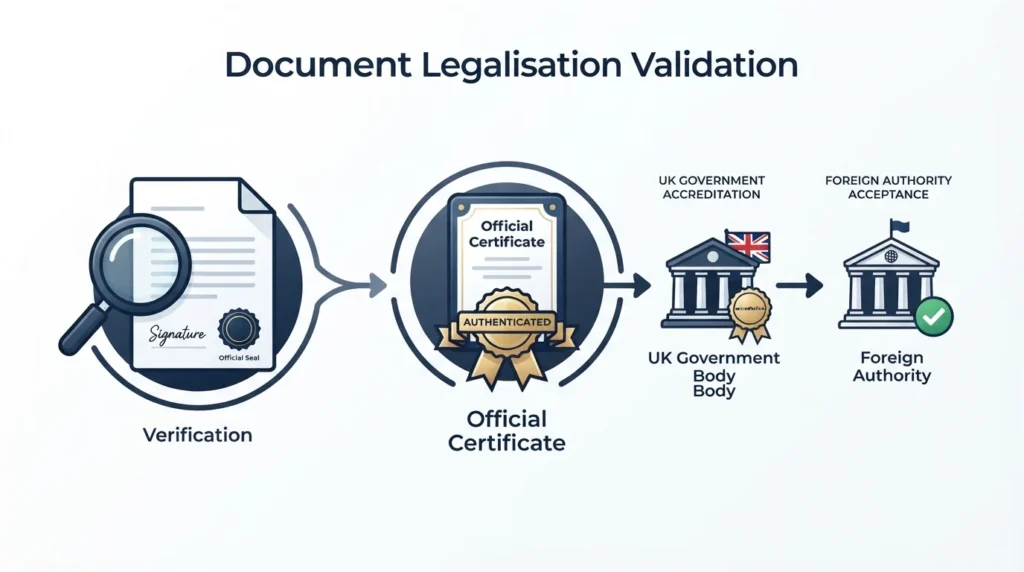
Global expansion demands verified credentials before foreign governments accept foreign corporate structures or personal qualifications. International trade relies on mutual trust established through diplomatic validation channels. When companies establish operations overseas, local registrars require certified proof of incorporation, memorandum articles, and director identities. Foreign registries reject uncertified paperwork because local laws demand absolute proof of authenticity. Form My Company streamlines this authentication workflow to ensure absolute compliance across international borders.
International authorities verify document legitimacy to prevent fraud and maintain regulatory standards. Three authentication levels govern cross-border paperwork: notary notarisation, government apostille, and consular legalisation. Each step eliminates potential forgery risks by tracing signatures back to accredited public officials. When businesses submit properly legalised corporate documents, foreign banks open accounts without delay.
What Does the Apostille Authentication Process Involve?
The apostille process attaches an official government certificate to documents, confirming the validity of the underlying signature and official seal.
The Foreign, Commonwealth & Development Office issues apostilles for all public documents originating within the United Kingdom. Public documents include certificates of incorporation, power of attorney instruments, and notarised affidavits. When you submit paperwork for apostille verification, government examiners check official registry databases against wet-ink signatures. Form My Company coordinates this exact government submission channel to accelerate turnaround times for urgent corporate filings.
Securing an apostille requires precise document preparation before submission to official authorities. Three primary preparation steps govern this phase: certifying copies through a registered notary public, verifying registrar signatures against official records, and completing government application forms accurately. When documents lack proper preliminary notarisation, the Foreign Office rejects applications immediately. Executing these verification steps correctly prevents costly administrative delays during international expansion.
When Is Full Consular Legalisation Required Instead of an Apostille?
Full consular legalisation becomes mandatory when destination countries have not signed the Hague Convention and require embassy verification.
The Hague Apostille Convention simplifies document recognition across 126 member nations through a single certificate. Non-member nations demand an extended multi-step verification process involving both domestic departments and foreign embassies. Consular legalisation requires prior apostille certification before the destination country’s embassy stamps the paperwork. Form My Company manages these complex diplomatic channels to secure multi-layered validation without administrative friction.
Navigating embassy requirements demands strict adherence to specific bureaucratic protocols and jurisdiction rules. Three distinct embassy requirements frequently apply: translation into the destination language, commercial chamber certification, and specific fee structures. When embassies review foreign paperwork, consular officers inspect every prior stamp for compliance. Securing professional assistance ensures your paperwork clears foreign embassy checks on the first submission.
How Does Form My Company Ensure Flawless Document Legalisation?
Form My Company manages the entire document legalisation lifecycle by coordinating notarisation, apostille stamping, and consular validation through secure channels.
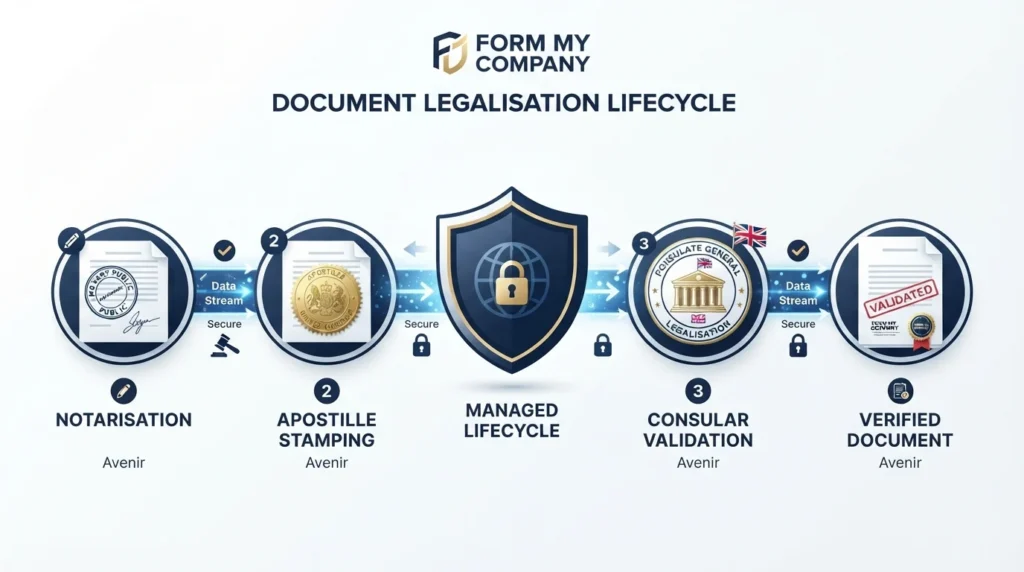
Corporate expansion requires absolute precision when handling sensitive statutory records and director identifications. Managing legalisation independently exposes businesses to strict rejection rates caused by minor formatting errors or outdated signatures. Form My Company eliminates these risks by applying rigorous quality control standards to every legalisation file. Clients leverage expert oversight to secure Apostilled Documents without navigating complex bureaucratic frameworks alone.
Effective document management safeguards corporate transactions against unexpected regulatory blockades in foreign markets. Three core service components define this professional approach: rigorous document pre-screening, secure courier tracking, and direct government liaison. When businesses invest in structured legalisation services, internal teams avoid administrative bottlenecks entirely. Professional handling ensures your international paperwork satisfies every statutory requirement efficiently.
Why Must Businesses Prepare Accurate Translations Alongside Legalisation?
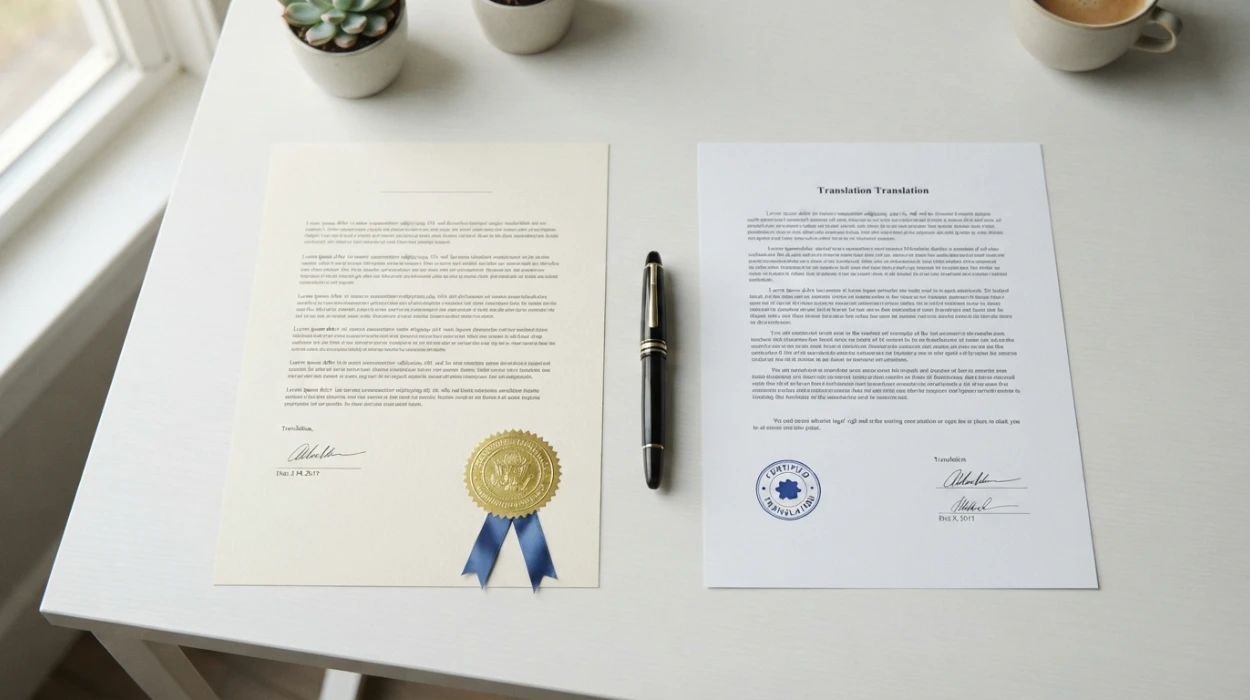
Accompanying translations must be officially certified and executed by accredited translators to satisfy foreign administrative requirements.
Foreign authorities refuse to process documents submitted in English unless an authorized translation accompanies the original file. Certified translations carry explicit translator declarations, official stamps, and credentials proving linguistic competence. When corporate files require multi-jurisdictional clarity, understanding Why Might You Need Both a Translation and an Apostille for Overseas Use? becomes critical for success. Form My Company integrates professional translation services directly into the legalisation workflow to maintain seamless continuity.
Precision in legal translation prevents misinterpretations that invalidate corporate contracts or registry applications abroad. Three essential translation quality markers include sworn translator accreditation, exact structural formatting, and literal terminology matching. When foreign registrars inspect translated documents, linguistic accuracy directly influences approval speeds. Maintaining rigorous translation standards ensures your international business agreements remain legally binding across all target markets.
How Can Businesses Choose the Right Legalisation Pathway?
Choosing the correct legalisation pathway depends entirely on the destination country’s membership in the Hague Convention and local regulatory demands.
Evaluating foreign requirements requires checking whether the target nation recognizes standard apostille certificates or demands full embassy attestation. Understanding How to Choose Between Apostille and Full Consular Legalisation prevents redundant government submissions and excessive administrative expenses. Form My Company evaluates international destination rules to recommend the precise verification pathway required for your specific corporate objectives.
Strategic planning reduces operational friction when launching subsidiaries or filing intellectual property rights overseas. Three decisive evaluation factors dictate the optimal legalisation route: destination treaty status, document type classifications, and foreign authority submission deadlines. When corporations map out these requirements early, expansion timelines remain on schedule. Expert guidance transforms complex international compliance protocols into a streamlined, predictable administrative process.
Complete document legalisation protects international business operations by securing unquestioned legal recognition from foreign authorities and regulatory bodies. Navigating complex multi-tier verification frameworks requires meticulous attention to detail, official registry alignment, and strict adherence to diplomatic protocols. Form My Company delivers structured solutions through expert management of notarisation, apostille authentication, and consular legalisation. Businesses achieve seamless global expansion by relying on precise administrative oversight and professional document handling.
Explore More Apostilled Documents Guide,
Legalise Documents for Any Country With Form My Company
Prove Your UK Company Status Abroad With Form My Company
Frequently Asked Questions
How long does it take to get apostilled documents through Form My Company?
Standard apostille processing via Form My Company typically takes between 3 to 5 working days once the physical paperwork arrives at our office. Expedited government processing options are available for urgent international business submissions requiring rapid foreign authority verification.
What types of documents can Form My Company legalise with an apostille?
Form My Company handles apostille authentication for a wide range of public paperwork, including certificates of incorporation, memorandum articles, power of attorney instruments, and notarised affidavits. Each official document must undergo preliminary verification or notarisation before government acceptance by the Foreign, Commonwealth & Development Office.
Do I need consular legalisation if my destination country requires an apostille?
Consular legalisation is only necessary when the destination country has not signed the Hague Convention and therefore rejects standard apostille certificates. Form My Company evaluates specific foreign embassy regulations to determine whether your international business filings require secondary diplomatic attestation.
Are certified translations required alongside my apostilled documents for overseas use?
Foreign authorities routinely demand officially certified translations alongside apostilled documents when the paperwork is not written in the local official language. Form My Company integrates professional translation services into your legalisation workflow to ensure absolute compliance with overseas administrative registries.
Why is notarisation required before obtaining apostilled documents?
Government authorities require prior notarisation to verify the authenticity of signatures and seals on underlying public documents before issuing an apostille certificate. Form My Company coordinates certified notary services to ensure your paperwork meets all preliminary validation standards required for international recognition.