
A Certificate of Good Standing confirms that a UK limited company is legally active, compliant with filing requirements, and free from administrative dissolution. Banking applications require this proof to satisfy anti-money laundering regulations, while procurement tenders use it to verify corporate solvency before contract award.
Why Do Banks Require a Certificate of Good Standing During Account Opening?
Banks demand this official confirmation to verify corporate legitimacy, validate active legal status, and satisfy strict anti-money laundering regulations before onboarding a corporate client. Compliance officers examine the document to ensure the business operates legally within the UK jurisdiction.
UK financial institutions enforce rigorous due diligence protocols when evaluating corporate account applications. 85% of high-street banks mandate proof of active registration when reviewing foreign-owned directors or newly incorporated entities. Financial institutions check filing histories to mitigate fraud risks and comply with statutory financial regulations.
When directors submit business bank account applications, underwriters evaluate operational history alongside director credentials. You must provide up-to-date incorporation documents to accelerate underwriting reviews. Commercial banks cross-reference registrar data to confirm that no striking-off actions are pending against the company. Delays occur if statutory filings fall behind schedule at Companies House.
Corporate banking compliance teams evaluate risk profiles using historical filing data. Four distinct verification checks occur during this review: authenticating corporate existence, confirming registered office validity, verifying current director appointments, and inspecting recent confirmation statements. These verification steps protect financial institutions from illicit transactions.
Account onboarding teams use these registry extracts to evaluate financial stability. Business structures require verified documentation to establish commercial credibility with institutional lenders. When evaluating corporate accounts, lenders look for consistent compliance records. You can explore our detailed guide on Why Do Banks Ask for a Certificate of Good Standing When Opening an Account? to understand banking requirements in greater detail.
How Do Public Procurement Tenders Use a Certificate of Good Standing?
Procurement panels review this official document to confirm company solvency, verify legal capacity to sign contracts, and eliminate disqualified bidders during preliminary evaluation stages. Contracting authorities mandate this validation to ensure suppliers remain legally capable of fulfilling multi-year public sector agreements.
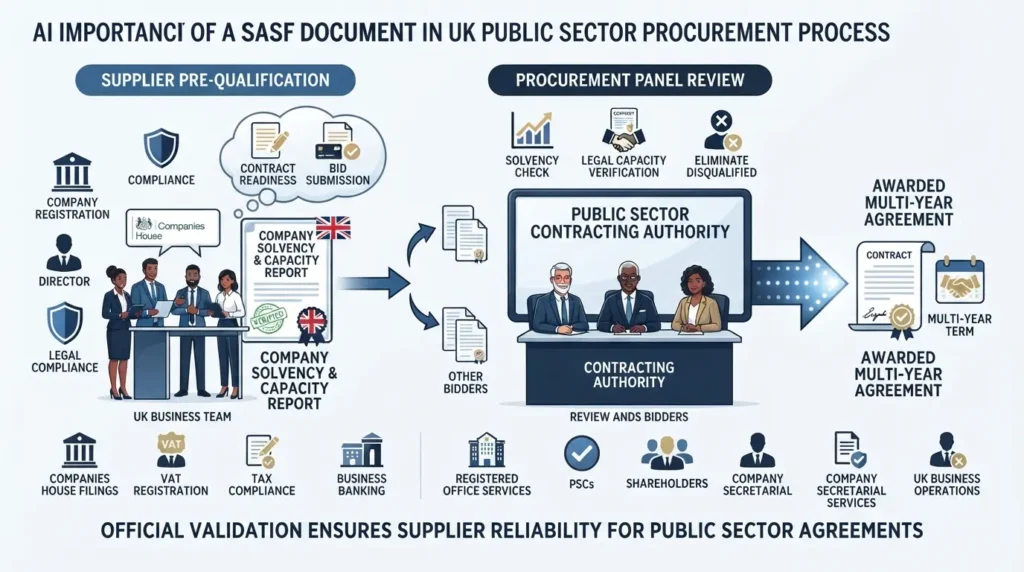
Public sector procurement frameworks enforce strict compliance criteria for all participating commercial entities. 78% of municipal and central government tenders require documentary proof of active corporate standing during the initial selection phase. Procurement officers evaluate supplier credentials to prevent administrative defaults during contract execution.
Bidding consortia must submit verified proof of registration before commercial bids advance to technical evaluation. Three mandatory verification metrics govern this process: checking active trading status, confirming the absence of liquidation proceedings, and validating up-to-date filing records. Contracting authorities disqualify suppliers failing to meet these statutory thresholds immediately.
Commercial enterprises competing for government contracts rely on official registrar extractions to prove reliability. When preparing procurement submissions, compliance managers attach official registry proofs to satisfy tender specifications. You can Order Proof of Good Standing for Your Tender Bid From Form My Company to secure the required documentation before submission deadlines.
Procurement compliance officers review corporate status extracts to mitigate supply chain disruption risks. Public sector contracts involve substantial financial commitments requiring verified operational longevity. Suppliers must maintain immaculate compliance records to secure long-term public procurement agreements. Government buyers reject submissions lacking official verification of corporate solvency.
What Are the Core Operational Differences Between Banking and Tender Requirements?
Banking applications focus on anti-money laundering compliance and beneficial ownership verification, whereas procurement tenders prioritize long-term corporate solvency, legal capacity, and statutory filing punctuality. Each institutional buyer enforces distinct validation criteria tailored to their specific risk management framework.
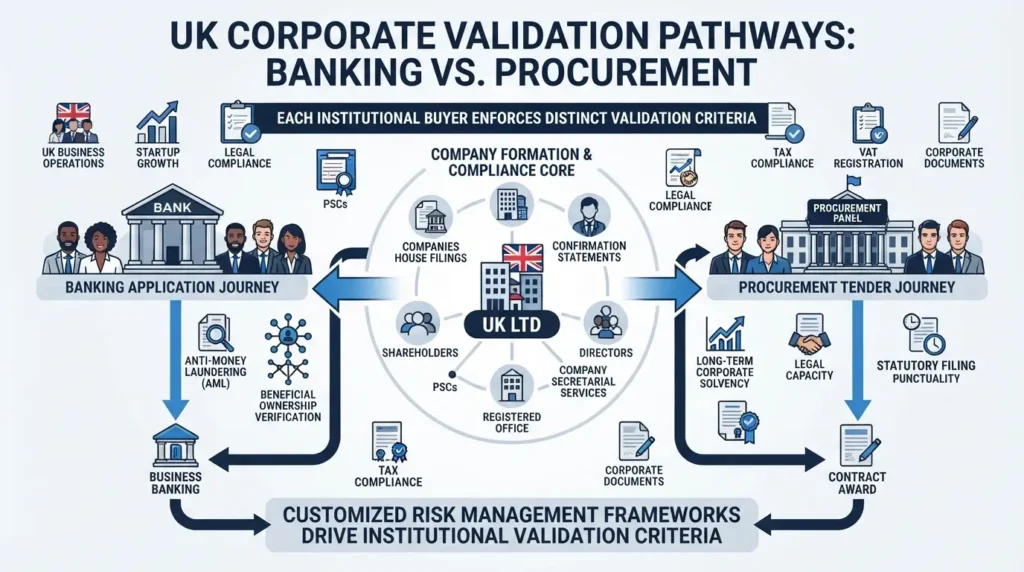
Financial institutions prioritize risk mitigation regarding illicit capital flows and beneficial ownership transparency. Commercial banks inspect structural integrity to prevent financial crime and regulatory penalties. Procurement authorities prioritize contract continuity and delivery capability over internal banking compliance metrics.
Commercial lenders require fresh registry extractions dated within 30 days of application submission. Tender boards often accept documents issued within specific procurement windows defined in tender dossiers. Financial compliance officers examine director backgrounds alongside company standing. Public sector buyers focus primarily on corporate solvency and active registration status.
Business owners must tailor their documentation packages to match specific institutional demands. Financial institutions evaluate risk through the lens of capital laundering prevention. Procurement panels assess risk through the lens of project delivery failure. Understanding these operational distinctions prevents costly application rejections across both sectors.
Directors navigating multiple corporate requirements benefit from proactive compliance management. Maintaining annual filing schedules ensures instant document availability for both banking reviews and tender submissions. You can streamline your compliance workflow by acquiring a Certificate of Good Standing directly from our secure portal.
A Certificate of Good Standing serves as critical proof of corporate legitimacy across diverse commercial environments. Financial institutions use this document to satisfy regulatory compliance and combat financial crime. Procurement panels rely on it to verify supplier solvency and contractual capacity before awarding public agreements.
Form My Company delivers reliable corporate documentation services to streamline your administrative compliance. Our secure portal provides fast access to official registry extracts tailored for banking applications and procurement tenders. Maintaining active corporate compliance protects your business from administrative dissolution and unlocks valuable commercial opportunities.
Explore More Certificate of Good Standing Guide,
How to Decide Whether Your Business Really Needs a Certificate of Good Standing
How to Choose Between Apostille and Full Consular Legalisation
Frequently Asked Questions
What is a Certificate of Good Standing for a UK company?
A Certificate of Good Standing is an official document issued by Companies House that confirms a limited company has been in continuous existence since incorporation and is legally compliant. Business owners frequently request this authentication through Form My Company to prove active trading status to international authorities, financial institutions, and tender boards.
How long does it take to get a Certificate of Good Standing?
Standard digital processing via Companies House typically takes between 3 to 5 working days, while expedited courier options can deliver physical copies within 24 hours. When you order your Certificate of Good Standing through Form My Company, our platform streamlines the application workflow to ensure rapid document delivery for time-sensitive banking and procurement deadlines.
Does a Certificate of Good Standing show company directors?
Standard certificates display the company name, registration number, and incorporation date, but they do not list individual director names unless you specifically request an extended historical record. Form My Company assists businesses in obtaining customized registry extractions that satisfy specific compliance and director verification requirements.
Can a dissolved company obtain a Certificate of Good Standing?
Companies House cannot issue a Certificate of Good Standing for any business that has been dissolved, struck off, or is currently undergoing administrative liquidation proceedings. To qualify for this document, your company must maintain up-to-date filing records, including annual accounts and confirmation statements.
Why do overseas banks request a Certificate of Good Standing?
Foreign financial institutions require this verified registrar extract to satisfy international anti-money laundering regulations and confirm corporate legitimacy during cross-border account onboarding. Form My Company provides secure document procurement services to help UK businesses seamlessly meet overseas banking and compliance mandates.