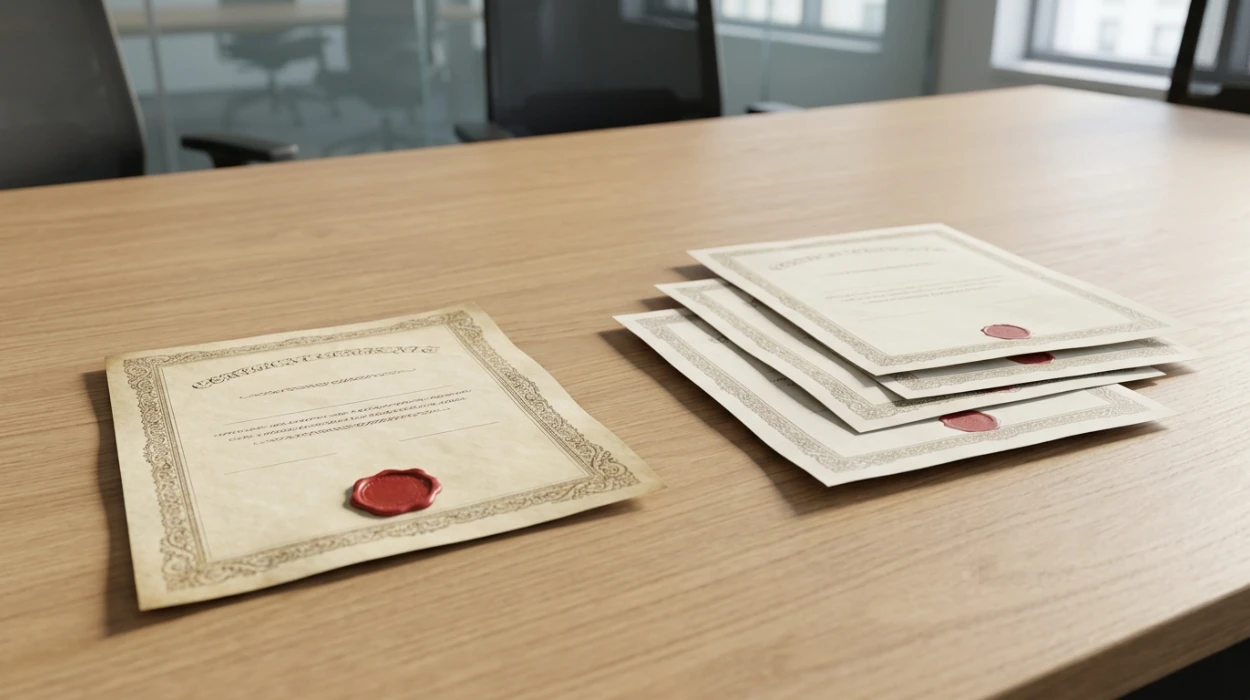
A single-use Certificate of Good Standing serves a specific, immediate transaction, whereas a regularly renewed certificate maintains continuous corporate compliance verification for ongoing regulatory oversight, international banking requirements, and multi-jurisdictional business expansions across global markets.
Why Do UK Companies Need a Certificate of Good Standing?
UK companies require a Certificate of Good Standing to prove legal existence, confirm active registration status at Companies House, and validate that directors have filed all mandatory annual confirmation statements and statutory accounts.
A Certificate of Good Standing functions as an official corporate identity document issued directly by the Registrar of Companies. When expanding operations across borders, businesses present this document to foreign registries, overseas tax authorities, and international legal counsel. Three validation components comprise every official document: the company registration number, the exact corporate name, and the official seal of the Registrar.
International banking institutions demand this document to verify corporate legitimacy before opening multi-currency commercial accounts. Compliance officers inspect the registration date to ensure that corporate data matches current Companies House filings. Local authorities rely on these authentication instruments to confirm that no liquidation proceedings or administrative dissolutions affect the target business entity.
When corporate structures involve complex holding arrangements, parent entities must supply these certificates for every subsidiary within the corporate group. Legal teams utilize verification services to establish that signatory parties possess the legal capacity to execute binding commercial contracts. Regulatory bodies check historical filings to maintain accurate records across corporate registers.
What Defines a Single-Use Certificate of Good Standing?
A single-use Certificate of Good Standing is purchased for one specific corporate transaction, expires immediately after that single submission, and offers no ongoing validity for subsequent regulatory or commercial requirements.
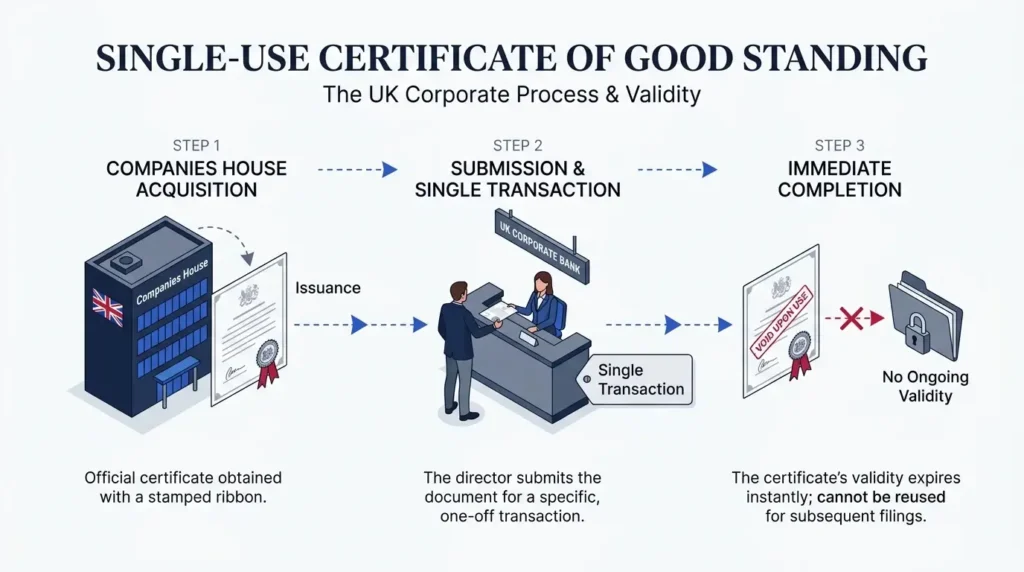
Corporate legal teams order single-use documents when an overseas tender, a specific bank account opening, or a one-time asset purchase demands immediate proof of active status. This document reflects the exact status of the company on the exact day of issuance. If a foreign partner requests updated verification three months later, the single-use document becomes legally obsolete because company details might have changed.
Commercial entities choose single-use options to minimize administrative expenses when international expansion projects happen infrequently. Each transaction requires a fresh application submitted directly to the corporate registry. Companies House processes these requests based on current filings, ensuring that the snapshot remains accurate for that precise operational window.
Procurement departments budget for these individual document fees as part of specific project overheads. Legal advisors review tender specifications to determine if a one-off verification satisfies local statutory rules. Once the receiving institution stamps or archives the document, its commercial lifecycle ends.
Why Choose Regularly Renewed Certificates for Ongoing Operations?
Regularly renewed certificates provide continuous corporate compliance monitoring, satisfy recurring banking audits, and maintain active status credentials for businesses operating across multiple international jurisdictions.
Active trading companies face continuous compliance checks from payment processors, foreign tax agencies, and enterprise clients. Maintaining an active subscription or regular renewal schedule ensures that up-to-date documentation remains accessible on demand. Corporate governance frameworks require directors to demonstrate uninterrupted compliance to protect shareholder interests and maintain good standing.
Financial institutions conduct periodic reviews of commercial accounts every twelve months. During these reviews, compliance departments request fresh authentication documents to verify that the corporate entity remains in active service without pending strikes-off. Regular renewals eliminate operational delays that occur when banks freeze accounts due to outdated corporate credentials.
Businesses engaged in international trade leverage regular renewals to streamline customs registrations and import-export licensing. Regulatory authorities in destination countries often mandate proof of good standing issued within the preceding three months. Establishing a systematic renewal schedule prevents shipment delays and avoids costly administrative penalties at foreign ports.
How Do Expiry Windows Affect International Business Transactions?
Expiry windows limit document validity to three months from the date of issuance, forcing companies to acquire fresh certificates when dealing with foreign institutions, overseas banks, and international regulatory agencies.
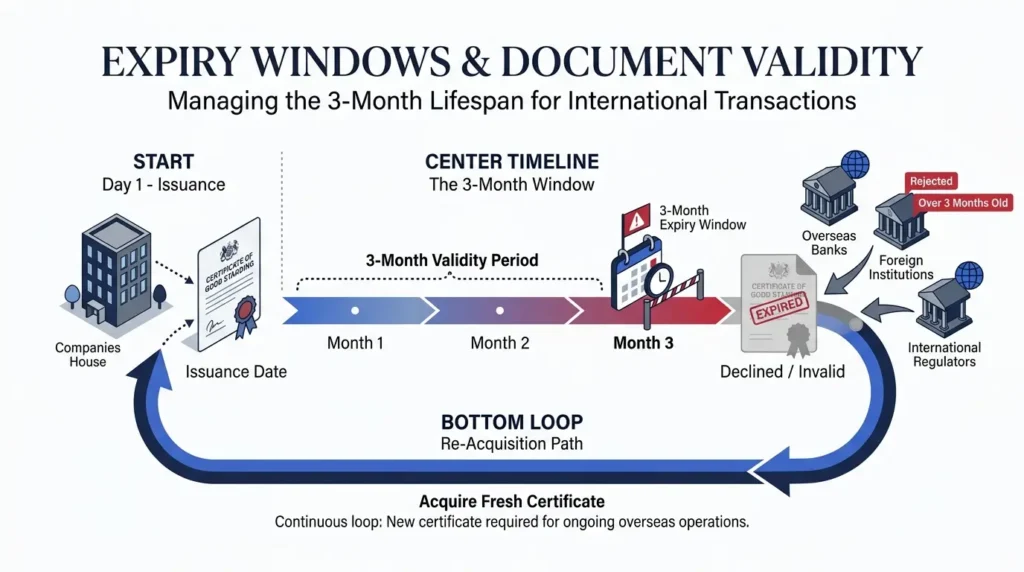
International regulatory frameworks enforce strict validity limits on corporate documentation to prevent fraud and misrepresentation. Foreign authorities reject any authentication document older than ninety days because corporate directors can resign, or companies can enter liquidation at any time. Business leaders must align their document procurement schedules with the exact submission deadlines set by overseas partners.
Compliance teams track expiry dates using automated internal registers to prevent transaction bottlenecks. When a tender process spans six months, project managers must order multiple sequential documents to satisfy intermediate milestone reviews. Foreign legal counsel examines the issuance date before accepting power of attorney or executing cross-border mergers.
Administrative planning requires careful coordination between company secretaries and overseas agents. Delays in processing annual accounts at Companies House directly block the issuance of a valid certificate. Businesses must resolve all outstanding filing requirements before requesting expedited document authentication for time-sensitive global projects.
What Steps Simplify Ordering Your Corporate Compliance Documents?
Ordering compliance documents involves selecting the required authentication level, confirming current filing status at Companies House, and submitting secure online requests through established corporate service providers.
Navigating the document procurement process requires adherence to structured administrative steps. Companies streamline their compliance workflows by utilizing specialized business support platforms.
Verify active company status against current Companies House records
Select apostille or notarisation options for international use
Submit secure payment through encrypted corporate portals
Receive digital or physical authenticated certificates directly at your office
Corporate secretaries review director details and registered office addresses before submitting applications to eliminate rejection risks. Professional business services expedite document delivery through priority courier networks. Establishing a reliable relationship with an accredited provider ensures consistent access to statutory documents whenever commercial expansions demand rapid verification.
A Certificate of Good Standing remains an indispensable instrument for international commerce, regulatory compliance, and corporate verification. Single-use documents suit isolated transactions, while regularly renewed credentials support ongoing global operations and banking audits. Form My Company delivers reliable Certificate of Good Standing solutions to support your Why Does a Certificate of Good Standing Have an Expiry Date? compliance strategy and your Order a Fresh, In-Date Certificate of Good Standing From Form My Company commercial requirements efficiently.
Explore More Certificate of Good Standing Guide,
How to Time Your Certificate of Good Standing Request Before an Expiry Deadline
How to Prepare Your Company Before Requesting Proof of Good Standing
Frequently Asked Questions
What is a Certificate of Good Standing in the UK?
A Certificate of Good Standing is an official document issued by Companies House that confirms a UK registered company has been in continuous existence and has no pending dissolution actions. Business owners use this authentication instrument to prove legal corporate identity during international expansions, commercial bank account openings, and cross-border partnerships. Form My Company assists businesses in obtaining these verified statutory documents efficiently.
How long is a UK Certificate of Good Standing valid?
A Certificate of Good Standing is typically valid for up to three months from its exact date of issuance due to strict international regulatory requirements. Foreign banks, overseas tax authorities, and legal institutions reject older documents because corporate status can change rapidly. Companies engaging in ongoing international trade must acquire regularly renewed credentials to satisfy continuous compliance audits.
Can a dissolved company obtain a Certificate of Good Standing?
A dissolved or struck-off company cannot obtain a Certificate of Good Standing because Companies House only issues this document for active trading entities with up-to-date filing statuses. To restore eligibility, directors must first apply for administrative restoration or court restoration and clear all outstanding confirmation statements and annual accounts. Form My Company guides corporate directors through the necessary reinstatement and document authentication workflows.
Do I need an apostille on my Certificate of Good Standing for overseas use?
An apostille is required when presenting a Certificate of Good Standing to foreign authorities, international registries, or overseas financial institutions operating outside the United Kingdom. This additional legalization step authenticates the official seal of the Registrar of Companies for acceptance under the Hague Convention. Form My Company provides streamlined processing for both standard certificates and notarised apostille services.
Why do international banks require a Certificate of Good Standing?
International commercial banks demand a Certificate of Good Standing to verify active corporate legitimacy, confirm current directorship, and satisfy mandatory anti-money laundering compliance regulations. Compliance officers inspect the registration details to ensure the business entity maintains good standing without pending liquidation proceedings. Providing this official verification prevents administrative delays during multi-currency account setups and global corporate financing transactions.