
An apostilled Certificate of Good Standing is an official Companies House document verified by the UK Foreign, Commonwealth & Development Office (FCDO) with an legalisation certificate, proving a UK company is validly registered and fully compliant for international business.
An apostille validates official UK corporate records so overseas authorities accept them as genuine legal documents. Companies House issues the original certificate to confirm a company exists and maintains its annual filing requirements. The Foreign, Commonwealth & Development Office (FCDO) attaches the physical apostille certificate under the 1961 Hague Convention framework.
Overseas banks, foreign governments, and international business partners require an apostilled certificate when UK businesses expand abroad. This process verifies that the corporate signature and official seal on the document are authentic. UK corporations use legalised documents to establish foreign branches, open international bank accounts, and execute cross-border contracts.
Why Do UK Companies Need an Apostilled Certificate of Good Standing?
UK companies need an apostilled Certificate of Good Standing to legalise their official corporate status for foreign governments, international banks, and overseas commercial partners under international treaty standards.
Foreign jurisdictions cannot directly verify records registered on the UK Companies House database. Overseas authorities require certified proof that a UK business remains legally active before granting operating licences. The Hague Apostille Convention creates a standard verification framework across 125 member countries.
International banking institutions demand apostilled corporate records prior to opening corporate bank accounts. Financial regulators require verified proof of good standing to prevent money laundering and corporate fraud. Overseas vendors, foreign landlords, and international courts require legalised documents during official commercial transactions.
What Information Does a Certificate of Good Standing Contain?
A Certificate of Good Standing details core corporate registration facts, including official company name, registration number, incorporation date, continuous legal existence, and compliance with annual filing obligations.
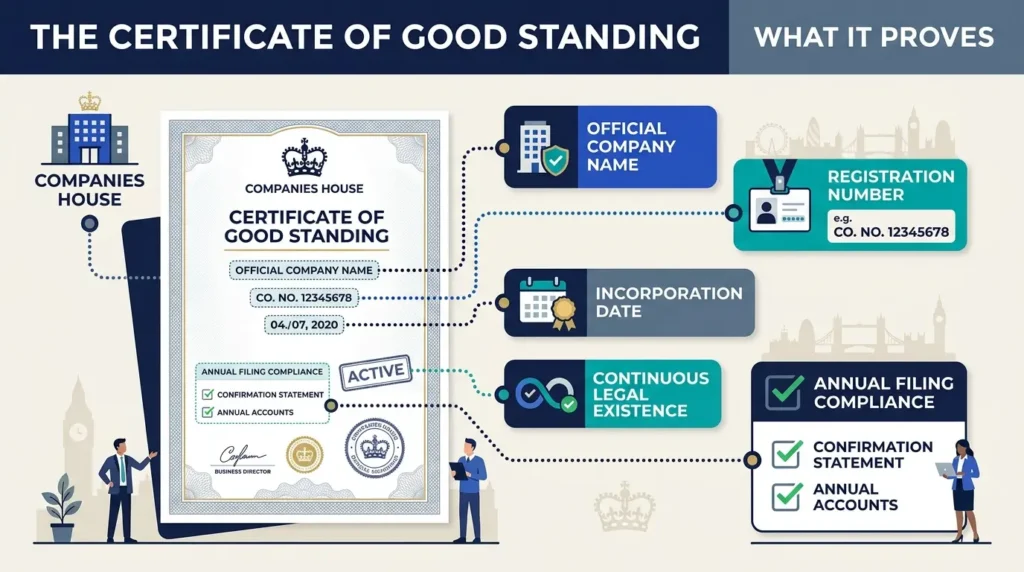
Companies House generates this document from official public register details. The certificate confirms that a UK corporate entity has submitted every required annual confirmation statement. It proves the company has filed its statutory annual accounts on time.
The standard document states that no liquidation or administration proceedings are pending against the business. Business owners can add specific optional details to the official certificate. These optional details include names of company directors, corporate secretaries, and the official registered office address.
How Does the Hague Apostille Convention Protect Corporate Legalisation?
The Hague Apostille Convention streamlines document legalisation by replacing complex multi-tiered embassy attestations with a single standardised apostille certificate issued by a designated competent authority.
The 1961 treaty simplifies cross-border legal recognition across all participating member nations. Prior to this convention, companies completed multi-step legalisation processes through foreign embassies and consulates. The legalisation department of the UK Foreign, Commonwealth & Development Office acts as the national competent authority.
The FCDO verifies the signature and seal of the Companies House official on the document. The office affixes a paper certificate containing a unique registration number and official embossed seal. Receiving foreign authorities confirm authenticity by checking the FCDO public verification register.
When Must a UK Business Legalise Its Corporate Status?
A UK business must legalise its corporate status when expanding overseas, incorporating foreign subsidiaries, opening foreign bank accounts, or entering cross-border commercial joint ventures.
Expanding UK firms present apostilled certificates to foreign commercial registries during international incorporation. Foreign tax authorities request legalised proof of corporate residence before granting tax treaty benefits. Overseas financial institutions evaluate company legitimacy using apostilled documentation before extending credit lines.
International trade partners inspect verified corporate status documents before signing major distribution contracts. Foreign court systems require legalised corporate credentials during cross-border litigation proceedings. Obtaining legalised records prevents delays when establishing operations in overseas markets.
Businesses often compare legalisation options when planning international expansion. Understanding how to choose between an apostille and standard certificate of good standing ensures business owners select the correct document path for their destination country.
What Is the Step-by-Step Legalisation Process for UK Certificates?
The legalisation process requires requesting an official certificate from Companies House, submitting it to the FCDO for verification, and receiving the authenticated document.
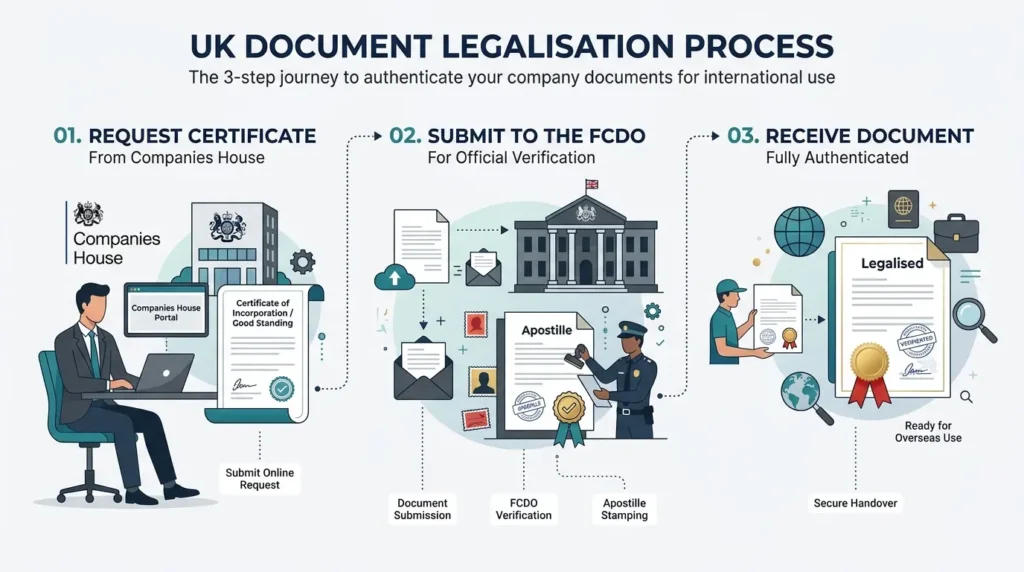
Request an original Certificate of Good Standing directly from Companies House.
Submit the physical document to the FCDO Legalisation Office in Milton Keynes.
Verify the official signature of the registrar against national databases.
Affix the official apostille certificate permanently to the corporate document.
Dispatch the legalised document to the designated foreign authority or overseas institution.
Companies House issues the original document on official paper stock. Standard digital printouts do not qualify for FCDO legalisation without prior solicitor certification. The FCDO checks the physical registrar signature against stored specimen records.
Once authenticated, the FCDO attaches the paper apostille to the back of the original certificate. The document remains permanently bound to preserve its legal validity across international borders.
How Long Is an Apostilled Certificate Valid for International Use?
An apostilled Certificate of Good Standing does not expire legally, but foreign institutions usually require a document issued within 30 to 90 days.
The FCDO legalisation seal confirms authenticity permanently at the date of issuance. However, foreign banks and corporate registries insist on recent documentation. Corporate status changes quickly through filing updates, directorship resignations, or legal insolvency proceedings.
Overseas financial regulators set strict compliance timeframes for corporate onboarding documents. Most foreign institutions reject certificates older than three months. Obtaining fresh certificates ensures corporate data reflects current public records.
Which Countries Accept a Hague Apostille Certificate?
Over 125 member countries of the Hague Apostille Convention accept an apostilled Certificate of Good Standing without requiring additional embassy attestation.
Signatory nations include major trading partners across Europe, North America, South America, and Asia. Member states recognise the FCDO seal as complete legal authentication under international law. Non-member nations require further attestation through their specific London embassy or consulate.
Nations outside the Hague Convention follow multi-stage legalisation protocols. These non-member countries demand verification by the UK Foreign Office followed by consular legalisation. Checking destination country requirements prevents international administrative rejections.
When launching international operations, obtaining an official Certificate of Good Standing ensures your UK entity meets all international compliance regulations.
How Do Legalisation Errors Cause International Business Delays?
Legalisation errors cause severe administrative delays, financial penalties, rejected bank applications, and stalled cross-border commercial transactions for UK exporters.
Submitting uncertified photocopies to the FCDO results in immediate application rejection. Incorrect company names or outdated director records force businesses to restart the process. Foreign institutions reject legalised documents if optional information fields are missing.
Translation errors created by non-certified translators lead to international regulatory rejections. Mismatched corporate details delay overseas branch registrations by several months. Professional corporate service providers prevent errors by managing document authentication directly.
How Does Professional Processing Accelerate Corporate Legalisation?
Professional processing accelerates corporate legalisation by handling document procurement, solicitor certification, FCDO submission, and secure international courier delivery.
Corporate services manage communication with Companies House and legalisation officials. Expert specialists audit corporate filings prior to document requests to ensure total accuracy. Professional filing prevents application rejections caused by missing statutory information.
Fast-track submission channels reduce turnaround times from weeks to days. Professional agents handle solicitor verification for non-standard corporate documents. Secure trackable delivery ensures sensitive corporate records arrive safely at foreign destinations.
Business owners can order an apostilled Certificate of Good Standing from Form My Company to streamline global compliance requirements.
Form My Company delivers corporate legalisation services for UK businesses expanding overseas. Form My Company secures official documentation from Companies House and manages FCDO legalisation efficiently.
Explore More Certificate of Good Standing Guide,
How Can You Get a Certificate of Good Standing on the Same Day?
Why Do Certificate of Good Standing Prices Vary Between Providers?
Frequently Asked Questions
How do I get a Certificate of Good Standing in the UK?
To obtain a Certificate of Good Standing in the UK, a company must be up to date with its annual filing requirements at Companies House, including confirmation statements and annual accounts. Businesses can request the official document directly through Companies House or streamline the ordering and legalisation process using Form My Company.
What is the difference between an apostilled and a standard Certificate of Good Standing?
A standard Certificate of Good Standing is an official Companies House document used within the UK to confirm a company’s legal existence and compliance. An apostilled Certificate of Good Standing includes an official legalisation certificate from the UK Foreign, Commonwealth & Development Office (FCDO), making it legally recognised for international business and overseas banking. Form My Company assists UK firms in acquiring both standard and apostilled versions based on specific operational requirements.
How long does it take to receive a UK Certificate of Good Standing?
Standard processing by Companies House typically takes several business days, while fast-track legalisation and dispatch options can significantly accelerate the delivery timeline. Form My Company helps businesses expedite the procurement and FCDO apostille process to meet urgent international deadlines.
Does a Certificate of Good Standing expire?
While a Certificate of Good Standing does not have a formal legal expiration date, most foreign banks, registries, and regulatory bodies require one issued within the last 30 to 90 days. Presenting a recently issued document proves that the corporate entity remains currently compliant with UK company law.
Can a company in liquidation get a Certificate of Good Standing?
No, Companies House will not issue a Certificate of Good Standing if a business is in liquidation, administration, or subject to strike-off proceedings. A UK company must have active status and fully compliant statutory filings before Form My Company or Companies House can process a request for the document.