
A notarised Certificate of Good Standing verifies the signature and identity of the issuing official through a UK notary public, whereas an apostilled certificate adds an official legal seal from the Foreign, Commonwealth & Development Office (FCDO) for international recognition under the Hague Convention.
What Is a Certificate of Good Standing in the UK?
A UK Certificate of Good Standing is an official document issued by Companies House that confirms a company is active, compliant, and up to date with filing obligations.
A Certificate of Good Standing confirms that a registered UK entity continuously fulfills statutory filing requirements under the Companies Act 2006. The document details essential administrative records, including the company name, incorporation date, active status, and confirmation that no liquidation or strike-off proceedings are pending.
Official authorities, foreign commercial registries, and overseas banks require this verification document before executing international corporate actions. The filing record serves as concrete evidence of legal existence when expanding operations into overseas territories. UK entities obtain these official statements directly from Companies House to maintain legal validity across global markets.
What Does Notarisation Involve for Company Certificates?
Notarisation involves a qualified notary public who authenticates the origin of the document, verifies the signature of the officer, and attaches a formal notary certificate.
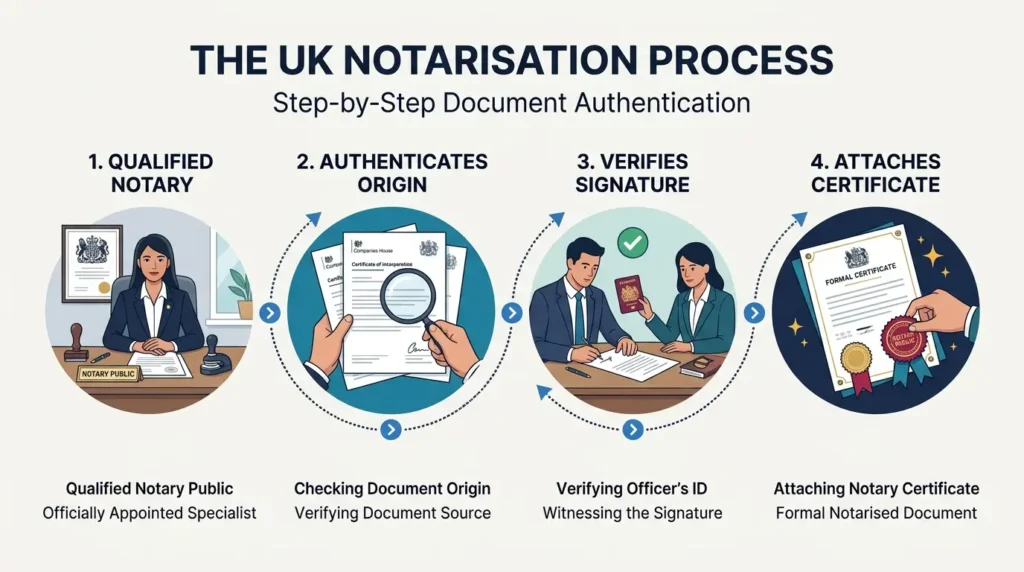
Notarisation acts as the first legal verification layer for UK corporate filings. A practicing notary public reviews the official document issued by Companies House to authenticate statutory signatures and verify director credentials. The notary attaches a formal legal certificate, official stamp, and signature to confirm document authenticity.
Many foreign banking institutions and cross-border commercial partners request notarised records during onboarding protocols. Notarisation validates that the corporate filing is genuine and legally binding within domestic jurisdiction.
Review official statutory documents issued directly by Companies House
Verify signature authenticity using official public registers
Attach legal notary certificates, official seals, and signatures
When evaluating legal compliance frameworks, business owners should review Comparing Countries’ Requirements for a Legalised Certificate of Good Standing to understand regional verification variances before submitting documentation abroad.
What Does an Apostille Legalisation Process Entail?
An apostille is a legal certificate issued by the FCDO that verifies the signature, seal, or stamp on a public document for international recognition.
The Foreign, Commonwealth & Development Office (FCDO) attaches an apostille certificate directly to notarised or official public documents. This legalisation process validates the official seal of the issuing authority or public notary. The apostille certificate includes a unique registration number, official signature, and secure FCDO embossing stamp.
International governments accept apostilled records under the terms established by the 1961 Hague Apostille Convention. The legalisation process creates an uninterrupted chain of official authentication. Overseas regulatory authorities accept apostilled business records without requesting secondary verification from domestic embassies.
| Verification Stage | Issuing Authority | Verification Purpose | Primary Scope |
| Notarisation | UK Notary Public | Authenticates official signatures and officer identities | Domestic & Preliminary |
| Apostille | FCDO Legalisation Office | Validates notary signature and official public seal | Global Hague Member Nations |
How Do Notarised and Apostilled Certificates Compare Directly?
Notarised certificates carry verification from a private notary public, whereas apostilled certificates carry statutory legalisation from the UK government for international enforcement.
The critical distinction between notarisation and apostillation lies in the authority level of the legal seal. A notary public provides private professional verification of document signatures. The FCDO provides sovereign governmental legalisation that guarantees universal validity across international treaty jurisdictions.
Notarisation serves as a prerequisite step for obtaining an apostille on corporate records. Domestic authorities often accept simple notarisation for standard corporate transactions. Foreign ministries, legal courts, and international registries strictly require a full FCDO apostille before accepting UK entity filings.
Why Do Foreign Authorities Require an Apostille Over Simple Notarisation?
Foreign authorities require an apostille because international treaties standardise legal validation protocols across member states without requiring individual diplomatic embassy legalisation.
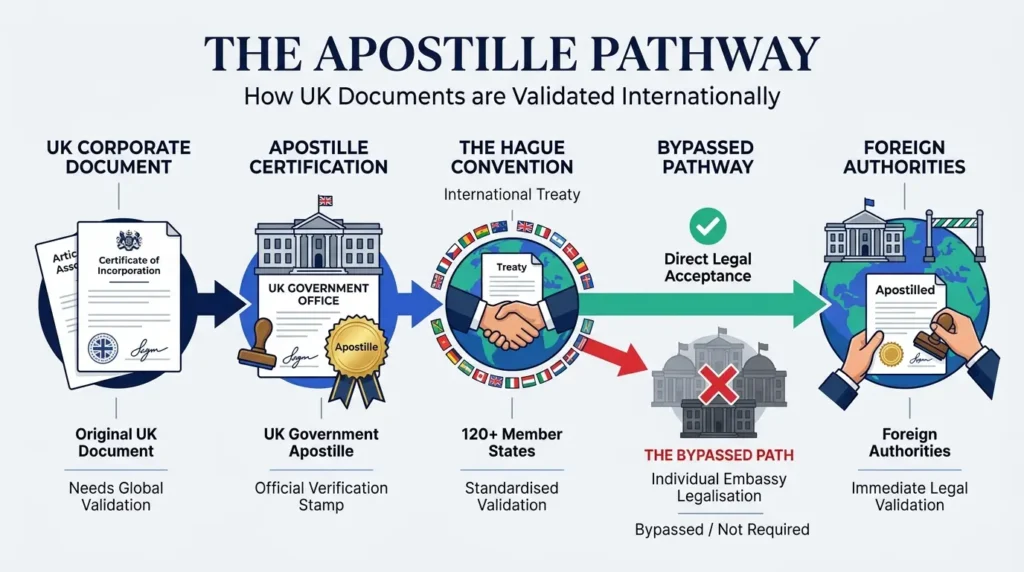
Global commercial registries enforce strict compliance guidelines to prevent corporate fraud, money laundering, and identity falsification. Overseas regulators cannot independently verify the credentials of thousands of individual UK notary public officials. The Hague Convention simplifies this process by designating the FCDO as the central legalisation authority in the United Kingdom.
A single apostille certificate establishes legal authenticity across 125 member nations participating in the Hague treaty framework. Foreign government agencies check the official FCDO register to validate the document online. This standardized legal framework accelerates cross-border commercial transactions, legal filings, and foreign bank account registrations.
When Should a UK Business Notarise or Apostille Its Certificates?
A business must secure an apostille when opening overseas bank accounts, setting up foreign subsidiaries, or executing international commercial contracts.
When expanding operations into non-Hague nations, corporate officers must complete consular legalisation following initial notarisation. Overseas banking institutions demand apostilled legal records during standard Know Your Customer (KYC) onboarding protocols. Foreign business registries mandate legalised filings before granting trade licenses or branch registration approvals.
Company directors should confirm precise legalisation rules with recipient foreign institutions before submitting corporate files. Obtaining a legalised document prevents operational delays during cross-border restructurings, property purchases, or international litigation proceedings.
Organisations looking to streamline their corporate verification process can order an official Certificate of Good Standing directly to fulfill international compliance standards efficiently.
How Does Form My Company Expedite the Legalisation Process?
Form My Company manages the entire submission workflow by coordinating directly with Companies House, public notaries, and the FCDO to secure verified legalisation.
Navigating multi-tiered legalisation requirements involves complex administrative steps, government appointments, and strict document formatting rules. Form My Company handles document procurement, notary authentication, and FCDO apostille submissions through streamlined operational workflows.
Professional corporate services eliminate administrative rejection risks caused by improper notarisation formats or invalid registry filings. Expedited submission channels ensure that international corporate documents receive official legalisation within minimal timeframes.
Corporate leaders can Secure an Apostille on Your Certificate of Good Standing Through Form My Company to guarantee fast compliance processing for overseas business expansion.
Understanding the distinct roles of notarisation and apostille legalisation is essential for UK entities engaging in cross-border commerce. While notarisation authenticates document origin at a professional notary level, an apostille provides government-level legalisation recognized across international borders. Selecting the correct level of verification prevents regulatory delays, safeguards cross-border transactions, and ensures full compliance with foreign authorities. Form My Company provides end-to-end corporate legalisation solutions, handling every stage of document procurement, notarisation, and FCDO apostille authentication.
Explore More Certificate of Good Standing Guide,
What Is an Apostilled Certificate of Good Standing?
How Can You Get a Certificate of Good Standing on the Same Day?
Frequently Asked Questions
What is a UK Certificate of Good Standing?
A UK Certificate of Good Standing is an official statutory document issued by Companies House confirming that a company is active, compliant, and up to date with its annual filings. It serves as legal evidence that an entity has maintained continuous compliance under the Companies Act 2006. Businesses often request this document through Form My Company when opening corporate bank accounts or expanding operations internationally.
How long is a Certificate of Good Standing valid for?
A Certificate of Good Standing does not have a formal legal expiration date, but most financial institutions, registries, and foreign governments require one issued within the last 3 to 6 months. Recipient authorities mandate recent documents to verify that no liquidation, insolvency, or strike-off proceedings have commenced. Form My Company recommends obtaining a newly issued certificate prior to executing major cross-border transactions or corporate filings.
Can a company get a Certificate of Good Standing if filings are overdue?
No, Companies House will not issue a Certificate of Good Standing if a business has overdue confirmation statements, annual accounts, or outstanding regulatory breaches. The company must first submit all pending statutory filings and clear any compliance defaults to restore good standing status. Once administrative requirements are met, Form My Company can facilitate the order and dispatch of the official document.
What is the difference between a Certificate of Good Standing and a Certificate of Incorporation?
A Certificate of Incorporation proves that a business was legally formed on a specific date, while a Certificate of Good Standing verifies that the company remains active and compliant today. While the incorporation certificate is a one-time issuance, a good standing certificate provides real-time validation of ongoing regulatory compliance. Both official corporate documents are essential when verifying business status for overseas licensing and legal matters.
Does a Certificate of Good Standing require an apostille for international use?
Yes, foreign government agencies, banks, and commercial registries outside the UK typically require an apostilled Certificate of Good Standing to recognize its legal authority under the Hague Convention. The Foreign, Commonwealth & Development Office (FCDO) attaches an apostille certificate to legalise the document for international enforcement. Services provided by Form My Company include full legalisation support, coordinating notary certification and FCDO apostille processing for overseas compliance.