
The Memorandum of Association establishes a UK company’s corporate existence and legal identity, while the Articles of Association define internal governance rules, director authority, voting rights, and operational powers required to conduct lawful business activities.
What Is the Legal Function of the Memorandum of Association?
The Memorandum of Association serves as the foundational legal document confirming the intent of subscribers to form a UK company under the Companies Act 2006, establishing its official corporate status and initial share capital structure.
The Memorandum of Association represents the legal origin of a private limited company in the UK. Subscribers sign this document during the incorporation process to state their wish to form a legal entity. Historic company registrations included an explicit objects clause within the memorandum to restrict commercial activities. The Companies Act 2006 reformed this requirement for entities formed after October 2009. Modern company memorandums contain a standardized legal statement. This statement confirms that subscribers agree to take at least one share each in the commercial entity.
Corporate law treats the memorandum as a static historical record. The document cannot be altered after the Registrar of Companies issues the Certificate of Incorporation. It records the names of founding members and the initial share commitments at the time of registration. Financial institutions and legal professionals examine the memorandum during initial due diligence procedures. This document validates that the company exists as an independent legal person with corporate capacity.
Entities operating with older constitutional documents often require legal reviews to confirm historical operational boundaries. When companies need to replace damaged historical records or update constitutional paperwork, specialized providers offer Supplementary Company Documents to maintain complete statutory registers. Legal registers must remain accurate to ensure corporate legitimacy during commercial audits.
How Do the Articles of Association Define Company Powers?
The Articles of Association function as a binding contract between the company and its officers, detailing explicit operational powers, decision-making thresholds, director duties, and procedural rules for managing corporate affairs.
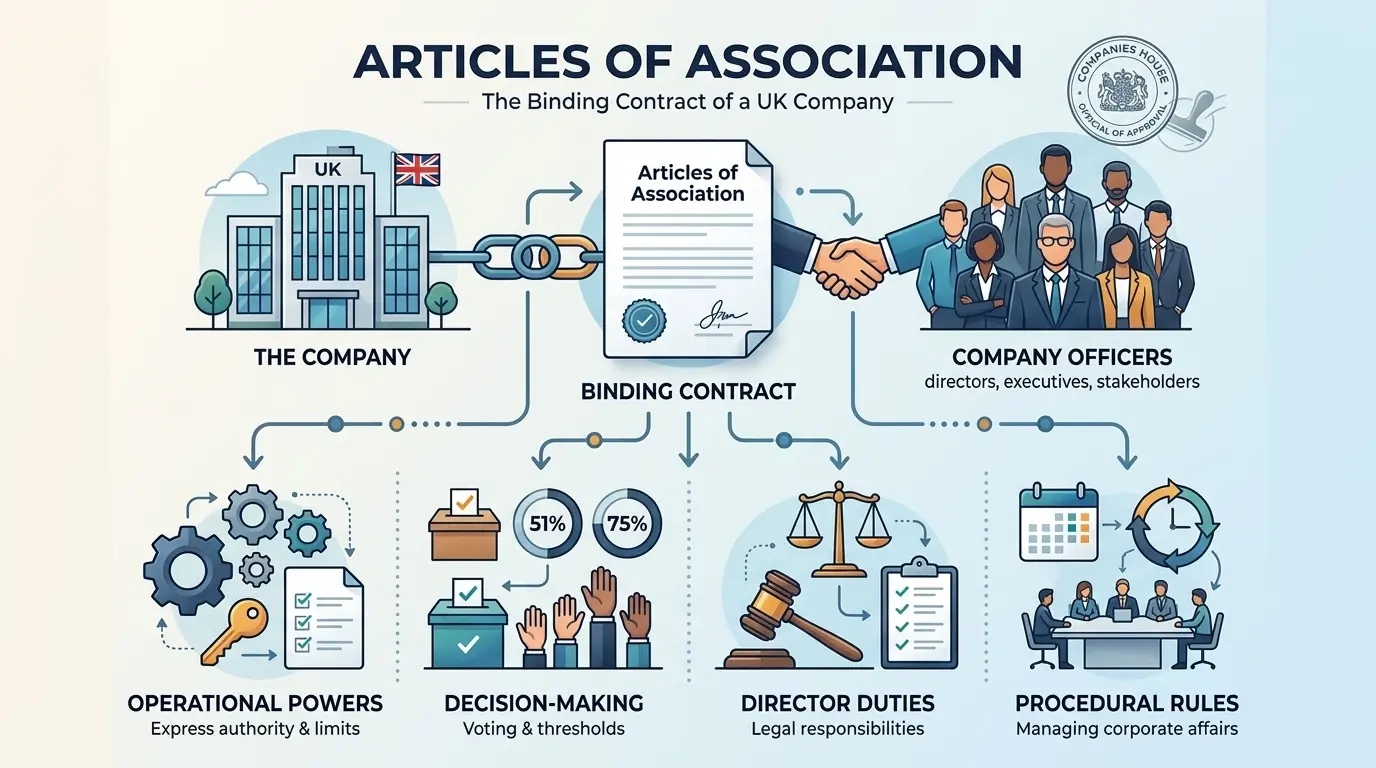
The Articles of Association act as the primary operational blueprint for UK companies. Section 31 of the Companies Act 2006 dictates that a company’s objects are unrestricted unless the articles explicitly limit them. This default statutory rule grants modern entities legal capacity to engage in any lawful commercial activity. Most businesses adopt Model Articles provided by UK legislation to establish baseline operational guidelines. Companies can draft bespoke articles to insert specific restrictions on board authority.
Corporate powers set out in the articles govern critical business activities. These powers regulate borrowing limits, asset charges, director appointments, dividend declarations, and board meeting quorum requirements. Board members must exercise their powers in accordance with the specific clauses set out in these constitutional documents. Actions taken outside the scope of defined authority risk being deemed ultra vires or legally invalid. Directors must examine constitutional limits prior to executing high-value commercial transactions or corporate restructures.
Shareholders rely on the articles to protect their ownership rights and financial investments. The articles specify pre-emption rights, share transfer procedures, and drag-along or tag-along clauses. When directors plan equity changes, they must check company articles before issuing new shares to ensure statutory compliance and avoid legal disputes with existing shareholders. Clear procedural adherence protects board decisions from future judicial challenges.
What Are the Key Internal Governance Rules Outlined in Articles?
Internal governance rules in the articles dictate voting rights, board meeting procedures, director appointment methods, quorum requirements, and shareholder resolution protocols necessary for compliant corporate administration.
Governance provisions structure how officers and shareholders make binding corporate decisions. The articles define the exact thresholds required to pass ordinary resolutions and special resolutions. Ordinary resolutions require a simple majority exceeding 50% of votes cast by eligible shareholders. Special resolutions demand a qualified majority of at least 75% to pass legal changes. The articles specify whether voting occurs through a show of hands or formal poll ballots.
Director powers within governance clauses govern daily operational management and strategic decision-making. The articles establish minimum and maximum numbers of board members required to hold valid meetings. They mandate specific notice periods for calling general meetings and board sessions. Governance rules dictate proxy appointment processes, casting vote privileges for board chairs, and written resolution procedures for remote decision-making.
Corporate conflicts often arise when officers neglect internal governance rules. Flawed notice procedures or invalid quorums undermine the legal validity of board resolutions. Commercial lenders and corporate investors analyze governance records during funding rounds. Strict adherence to constitutional provisions prevents administrative delays and costly litigation between company members.
| Governance Feature | Standard Model Articles Provision | Custom/Bespoke Articles Option |
| Objects Clause | Unrestricted commercial capacity | Specific business purpose limitations |
| Director Borrowing | Unlimited board authority | Fixed monetary caps requiring vote |
| Share Transfers | Director discretion to refuse | Mandatory pre-emption rights |
| Board Quorum | Minimum two directors required | Custom quorum based on ownership |
How Do Constitutional Documents Limit Director Authority?
Constitutional documents limit director authority by establishing explicit financial thresholds, requiring prior shareholder approval for specific transactions, and restricting powers to bind the entity in commercial contracts.
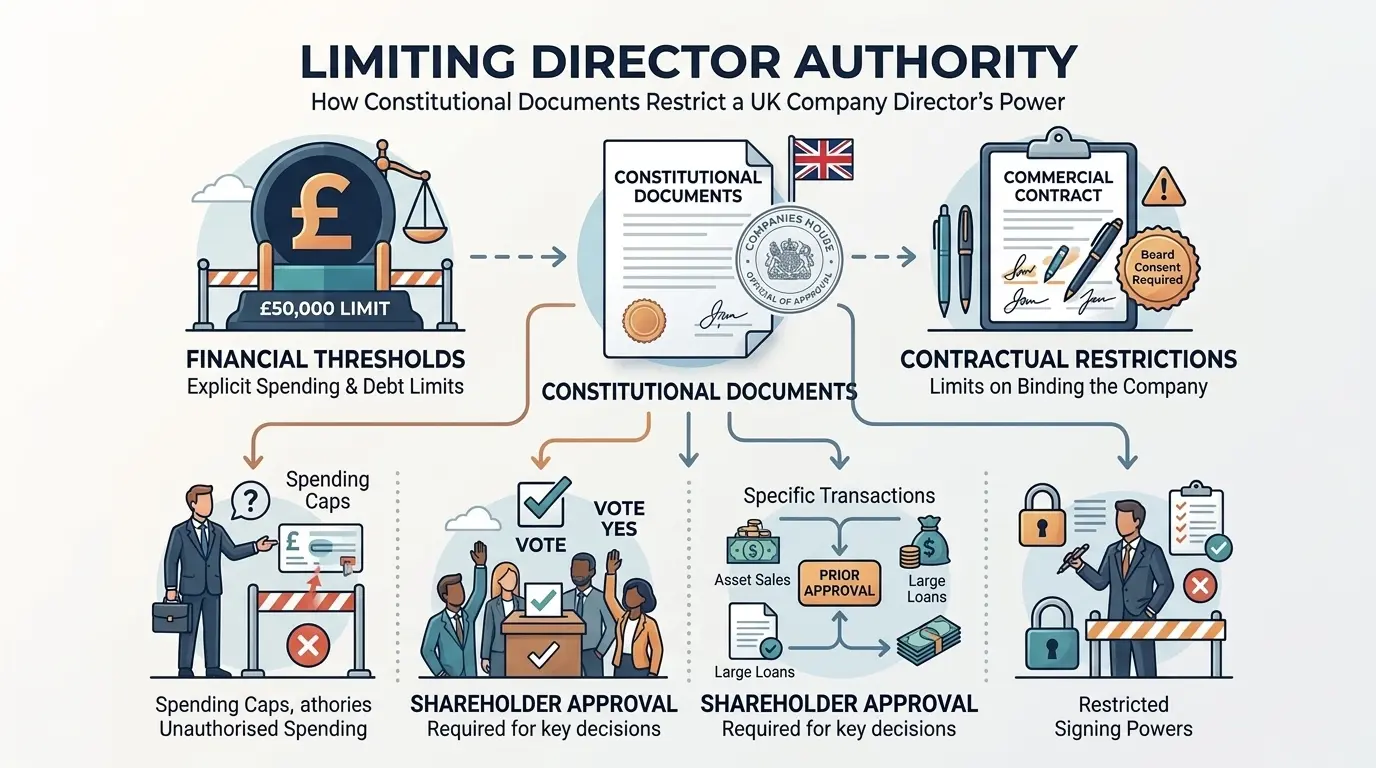
Section 171 of the Companies Act 2006 obligates directors to act strictly in accordance with the company’s constitution. The articles frequently impose mandatory restrictions on board powers regarding capital expenditures and debt financing. For instance, articles may prohibit directors from securing corporate loans above £500,000 without prior shareholder approval via an ordinary resolution. Directors who exceed these explicit internal limits breach their legal duties to the corporate entity.
Third parties dealing with UK companies receive protection under Section 40 of the Companies Act 2006. Good-faith commercial partners can enforce contracts even if directors exceed internal constitutional limits. However, the company retains the legal right to take action against directors who breach internal restrictions. The board remains accountable to shareholders for financial losses resulting from unauthorized corporate commitments.
Companies enforce internal controls through clear delegations of authority within the articles. Specific provisions may mandate joint signatures from two directors for contract execution or bank transfers. Restrictive covenants prevent single board members from selling core corporate assets or creating fixed charges over business property. Internal auditing teams review these clauses regularly to ensure board actions match constitutional limits.
What Happens When a Company Acts Outside Its Express Powers?
When a company acts outside its express powers, the transaction remains legally binding on third parties under UK law, but directors face personal liability for breach of duty.
Historically, transactions exceeding company powers were void under the strict ultra vires doctrine. Modern UK company law under the Companies Act 2006 protects external commercial partners by preserving contract validity. Contracts executed by directors outside constitutional restrictions remain fully enforceable by external counterparties. This statutory protection maintains commercial certainty in UK business transactions and trade relations.
Internal consequences for unauthorized corporate actions remain severe for company officers. Shareholders can apply for court injunctions to restrain directors from executing unauthorized transactions before completion. If an unauthorized transaction completes, shareholders can vote to ratify the action through a special resolution requiring a 75% majority. Without shareholder ratification, directors face personal financial liability to indemnify the company for resulting losses.
Corporate governance frameworks require prompt rectification of administrative breaches. Boards must review historical resolutions to identify unauthorized decisions and correct compliance errors. Shareholders hold statutory rights to remove non-compliant directors under Section 168 of the Companies Act 2006. Transparent governance records preserve corporate credit ratings and maintain investor confidence.
How Can a Company Modify Its Articles of Association?
A company modifies its Articles of Association by passing a special resolution requiring at least a 75% majority vote from eligible shareholders during a formal general meeting.
Modifying constitutional documents allows growing companies to adapt to changing commercial requirements. Shareholders must receive proper notice detailing the proposed text amendments before voting. The notice period for a general meeting is typically 14 clear days for private limited companies. Shareholders can also pass special resolutions via written consent if the constitutional articles permit written resolution procedures.
Once shareholders approve the amendments, the company must file the updated articles with Companies House within 15 days. Section 30 of the Companies Act 2006 mandates this strict statutory filing deadline. The company must submit a copy of the special resolution alongside the full revised text of the articles. Failure to file updated constitutional documents within the statutory timeframe constitutes a criminal offense by company officers.
Corporate entities must maintain official print copies of their updated constitution at their registered office address. Financial institutions, auditors, and legal representatives demand certified constitutional copies during commercial transactions. Corporate managers can order a bound copy of Memorandum and Articles from Form My Company to ensure statutory records remain fully compliant and accessible for external inspection. Form My Company assists UK entities by providing official documentation services that align with Companies House statutory requirements.
Explore More Supplementary Company Documents Guide,
What Is Consular Legalisation for Non-Hague Convention Countries?
When Does a Document Need Embassy Attestation as Well as an Apostille?
Frequently Asked Questions
What supplementary company documents are required for UK business compliance?
UK companies typically require supplementary documents such as certified copies of the Memorandum and Articles of Association, certificates of good standing, official register extracts, and share certificates to maintain legal compliance. These official records validate corporate identity, governance structures, and officer authority during administrative audits or financial reviews. Services provided by Form My Company allow businesses to obtain official Supplementary Company Documents to fulfill statutory requirements efficiently.
How do I order certified copies of my company’s Memorandum and Articles of Association?
You can request official certified copies directly through Companies House or via professional business service providers like Form My Company. Ordering certified Supplementary Company Documents ensures that bank accounts, legal representatives, and foreign authorities receive fully authenticated proof of corporate constitution and director powers. The ordering process involves selecting the required statutory record, specifying certification levels, and submitting company identification details.
Why do banks and lenders request supplementary company documentation?
Financial institutions require supplementary corporate documentation to satisfy strict Anti-Money Laundering (AML) and Know Your Customer (KYC) regulatory compliance frameworks. Reviewing documents like the Articles of Association and registers of officers allows lenders to verify legal ownership, confirm borrowing authority, and identify ultimate beneficial owners. Obtaining certified Supplementary Company Documents from Form My Company provides financial partners with verified statutory evidence to approve accounts and loan facilities.
Can a company update its supplementary documents after incorporation?
Yes, private limited companies can update statutory documents like the Articles of Association or internal registers whenever corporate changes occur. Any constitutional amendment requires passing a formal resolution and filing the revised paperwork with Companies House within statutory deadlines. Utilizing Form My Company to manage updated Supplementary Company Documents ensures that all legal amendments are accurately formatted, registered, and maintained for inspection.
What is the difference between standard and certified company documents?
Standard company documents serve as basic internal or informational copies of statutory filings downloaded from public registers. Certified company documents, however, carry official legal authentication verifying that the paperwork is an accurate, true copy of the official record filed with the Registrar of Companies. Form My Company assists entities in acquiring certified Supplementary Company Documents required for legal transactions, foreign apostilles, and commercial due diligence.