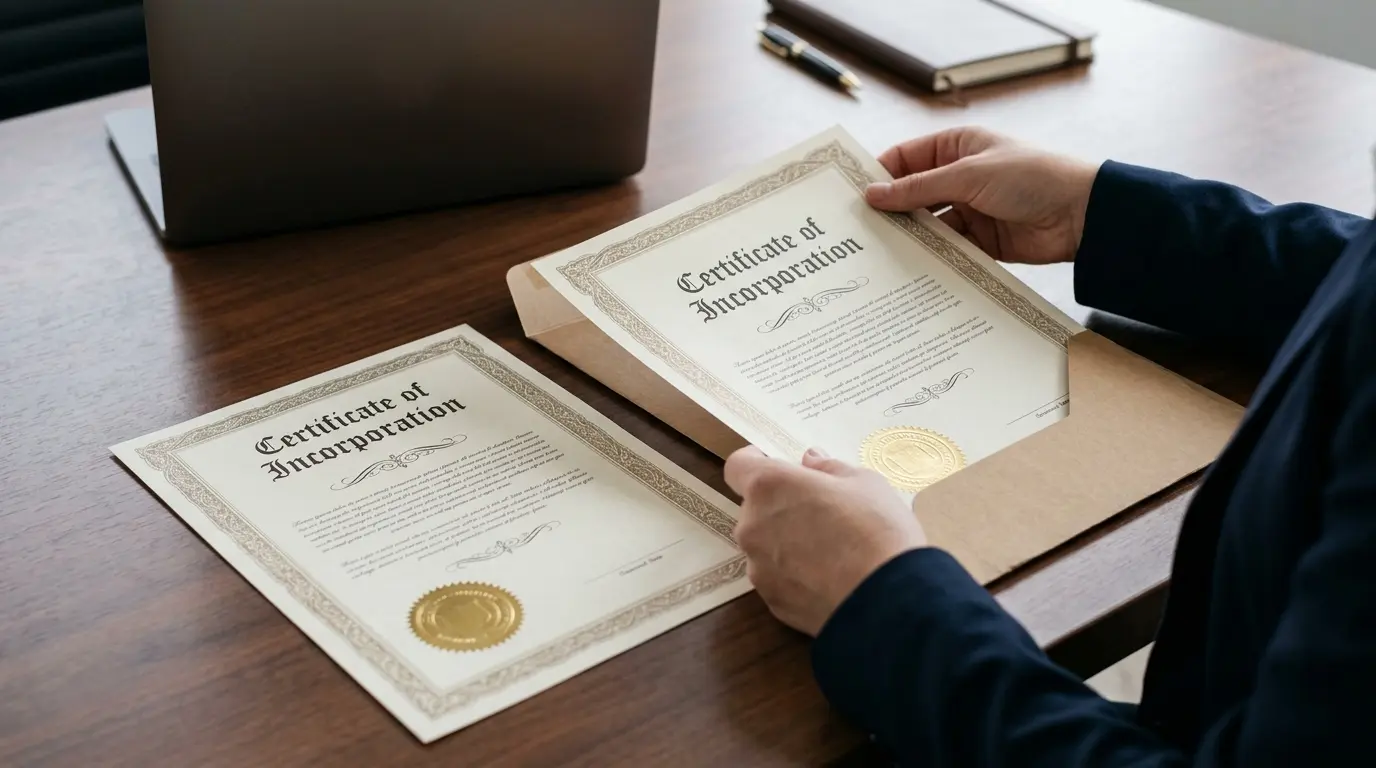
To get an updated certificate after a company name change, pass a special resolution, submit Form NM01 to Companies House, and pay the statutory fee. Companies House issues a Certificate of Incorporation on Change of Name once directors successfully complete registration.
What Is the Process for Changing a UK Company Name?
UK companies change their registered name by passing a special resolution with 75% shareholder approval and submitting official notification to Companies House. The registrar updates the index of company names upon verifying the statutory filing.
The Companies Act 2006 governs corporate identity modifications across all United Kingdom jurisdictions. Directors initiate the process by checking the official registry to ensure the proposed name complies with statutory naming rules. The registry rejects proposed names that match existing registered entities or contain restricted sensitive words without prior Secretary of State approval.
Shareholders formally authorize the name change during an extraordinary general meeting or through a written resolution. A minimum 75% majority vote must approve the special resolution before filing legal documentation. Directors record the resolution outcome in corporate records within 15 days of passage to maintain statutory compliance standards.
Electronic submission of Form NM01 speeds up official registry processing. Companies House processes standard electronic filings within 24 hours, whereas postal submissions require up to 10 working days. Companies House approves the submission and updates the public register immediately.
Understanding what is a change of name certificate of incorporation helps directors distinguish between original formation records and post-incorporation amendments. The official registry assigns the revised certificate to the original company registration number. This legal continuity ensures historical filing records remain intact throughout the corporate lifecycle.
How Do You Request Updated Supplementary Company Documents?
Directors request updated supplementary company documents directly through Companies House online services or through accredited corporate formation agents. Accredited agents verify statutory details before ordering replacement certificates.
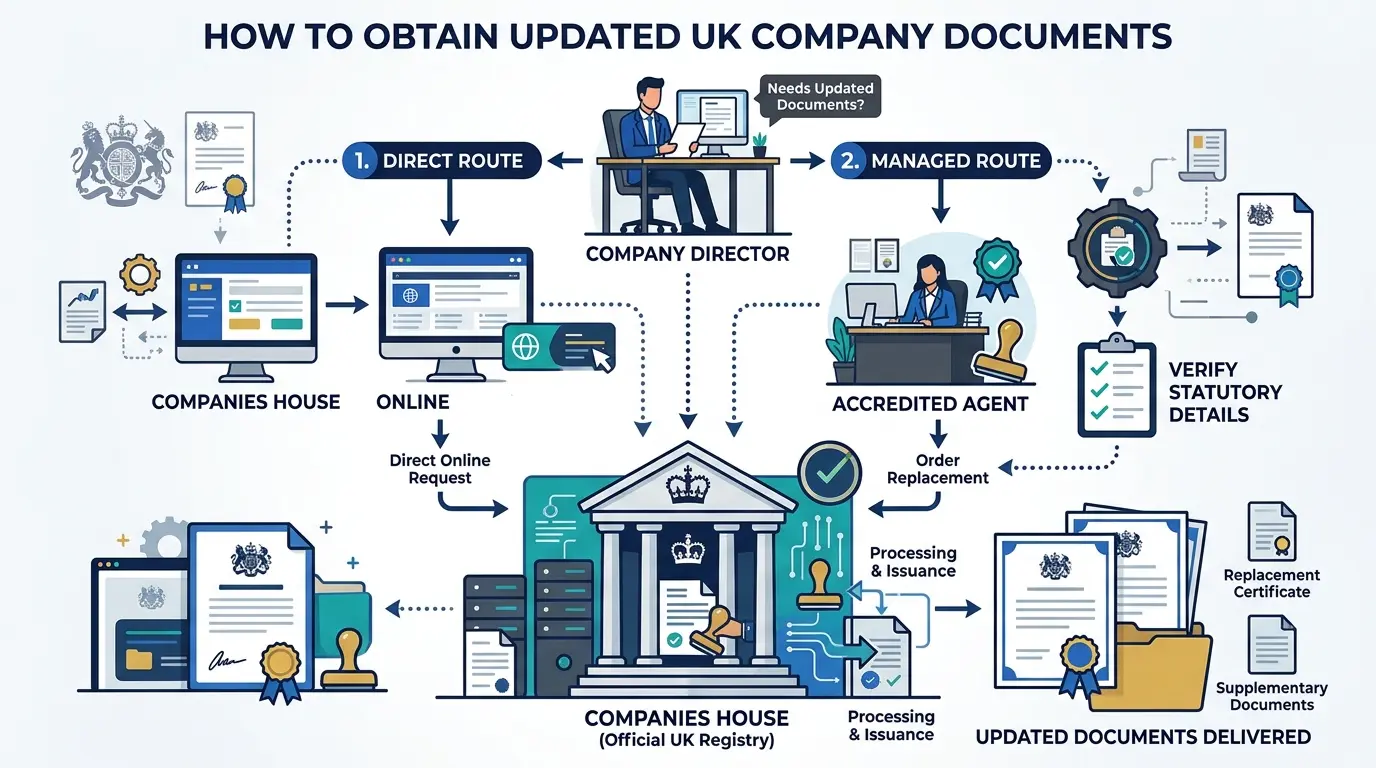
Official corporate documentation updates require direct communication with official filing channels. When directors file Form NM01, Companies House automatically issues a digital copy of the Certificate of Incorporation on Change of Name. Digital certificates arrive via electronic mail in secure PDF formats.
Printed hardcopy certificates require a separate filing request through official registries or corporate service providers. Companies House charges specific statutory administrative fees for physical document generation. Standard physical certificates arrive via postal services within five working days of order placement.
Third-party verification platforms and corporate banking institutions require original or certified document copies. Directors order Supplementary Company Documents to obtain official legal proof of updated corporate details. Certified document copies validate corporate authenticity for international trade, bank account modifications, and regulatory audits.
Corporate administrative bodies issue documents containing specific security features. Official papers include watermarks, official registry seals, and unique certificate verification numbers. These features protect commercial entities against corporate identity theft and fraud attempt schemes.
Why Is an Updated Name Change Certificate Necessary for Corporate Compliance?
An updated certificate provides legal proof that a corporate entity operates under an officially recognized name. Banking institutions, regulatory authorities, and commercial partners require this document to verify identity.
UK corporate compliance regulations mandate that registered entities display accurate legal titles across all commercial operations. Section 82 of the Companies Act 2006 requires companies to state their registered name on business correspondence, invoices, websites, and official notices. Failing to display accurate legal titles incurs financial penalties for corporate officers.
Financial institutions lock business bank accounts when company details fail to match registry databases. Banks conduct periodic anti-money laundering checks requiring physical proof of corporate amendments. Presenting an outdated certificate halts loan applications, international transfers, and merchant account processing functions.
Commercial contracts require accurate legal entity names to maintain enforceability in court proceedings. Counterparties verify corporate status on public registries before executing binding commercial agreements. Presenting mismatched company documentation invalidates commercial contracts and exposes business operations to unnecessary legal liabilities.
Tax authorities require immediate notification following registered corporate changes. HM Revenue and Customs updates payroll records, value-added tax accounts, and corporation tax files using official registry certificates. Timely updates prevent administrative tax penalties and maintain tax filing continuity across financial reporting years.
What Steps Must Businesses Take After Receiving the New Certificate?
Businesses must update business bank accounts, tax authorities, insurance policies, operational websites, contracts, and legal assets immediately after receiving the certificate. Statutory deadlines require prompt notification to public registers.
Receiving the legal certificate triggers immediate post-change administrative duties. Directors update statutory registers at the registered office address within 14 days of filing approval. statutory records include the register of members, register of directors, and corporate minute books.
Contractual obligations require systematic updating across commercial operations. Three primary operational updates: updating vendor contracts, revising employment agreements, and notifying institutional lenders. Contracts remain legally binding, but updating entity details ensures administrative alignment across all ongoing operations.
Intellectual property registers require formal updates to maintain trademark protections. The UK Intellectual Property Office charges specific administrative fees to amend registered trade mark ownership details. Failure to update property registers creates legal ownership disputes during commercial brand enforcement actions.
Digital assets require systematic revisions to mirror official registry updates. Website footers, terms of service pages, privacy policy disclosures, and digital marketing materials must present the updated legal title. Transparency builds client trust and maintains statutory compliance with UK e-commerce disclosure rules.
How Long Does It Take to Receive a Change of Name Certificate?
Companies House processes digital name change applications within 24 hours of electronic submission. Same-day fast-track processing options deliver approved certificates within three hours when submitted before statutory daily deadlines.
Standard electronic submissions through approved software portals take between 12 and 24 hours. Digital processing eliminates postal transit times and manual processing bottlenecks. Companies receive electronic notification alongside digital certificate attachments immediately upon approval.
Postal submissions require longer processing times due to manual handling procedures. Paper Form NM01 submissions take between 5 and 10 working days for complete registry verification. Statutory registry delays increase during peak annual filing periods such as tax year endings.
Fast-track registry services expedite urgent corporate restructuring requirements. Companies House offers a same-day service for electronic filings submitted before 15:00 Monday through Friday. Fast-track options incur higher registry fees but guarantee rapid processing for commercial transactions.
Corporate formation specialists streamline application workflows to avoid administrative rejections. When registry officials reject filings due to formatting errors or naming conflicts, the timeline resets completely. Correct initial filings guarantee predictable delivery timelines for critical business documentation.
How Can Businesses Ensure Accuracy When Filing for Document Updates?
Businesses ensure accuracy by cross-referencing corporate details against existing registry records prior to submitting application forms. Verification prevents processing rejections caused by administrative mismatches.
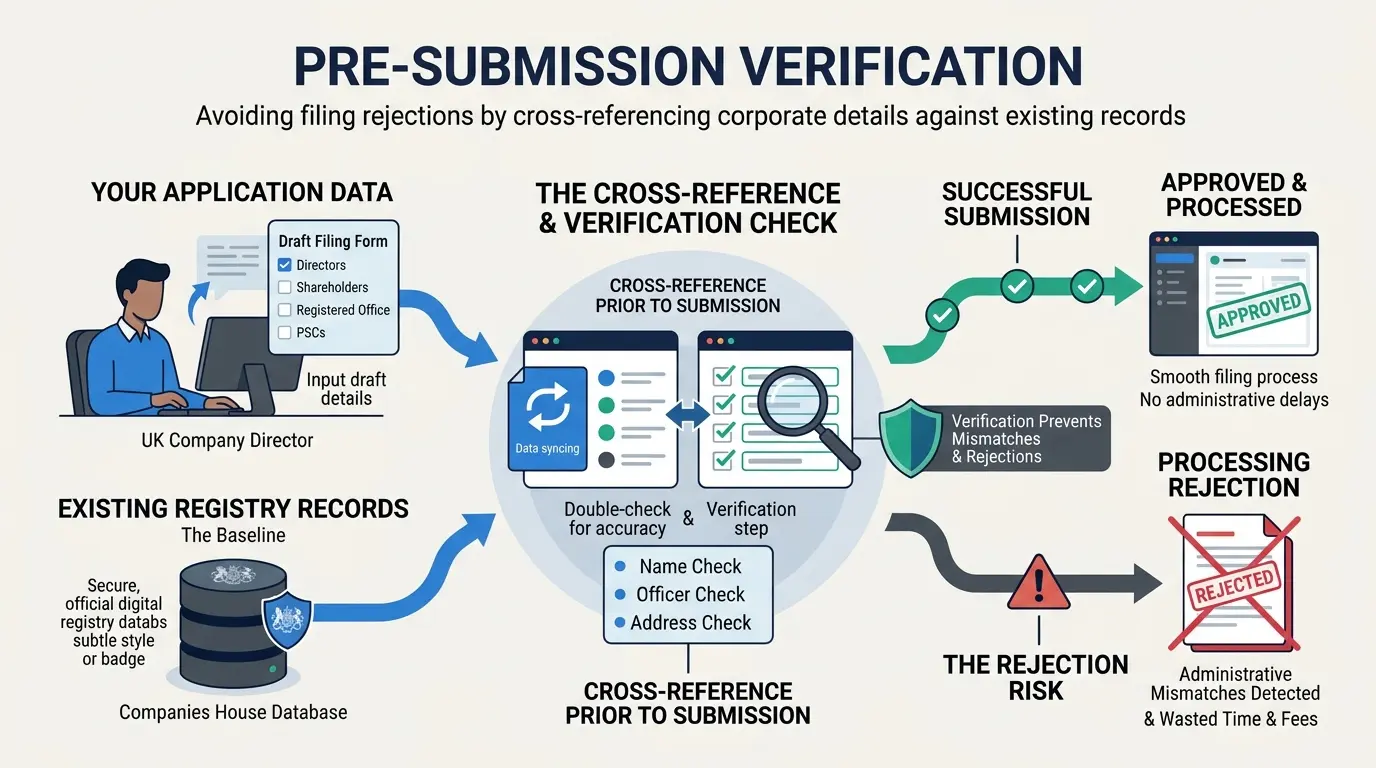
Registry rejections occur when submitted information strays from registered company records. Directors verify existing corporate identification numbers, current legal titles, and officer credentials before filing Form NM01. Even small spelling discrepancies cause immediate application rejections from registry examiners.
Name availability checks eliminate statutory naming conflicts before resolution drafting. The public register updates continuously, allowing other entities to register similar names prior to filing completion. Checking name availability on submission day guarantees statutory compliance and prevents registry rejection.
When corporate structures require urgent document processing, directors can request an updated incorporation certificate with Form My Company to ensure statutory compliance and rapid filing accuracy. Professional oversight eliminates administrative errors and ensures immediate statutory acceptance.
Filing professionals audit submission data against Companies House standards before formal lodgment. Professional validation checks corporate resolutions, officer signatures, and statutory forms. Systematic audits eliminate filing delays and ensure rapid document delivery.
Obtaining an updated Certificate of Incorporation on Change of Name requires passing a special resolution, submitting Form NM01, and fulfilling registry requirements. UK corporate compliance standards mandate accurate document updates across banking institutions, tax authorities, and commercial partner networks. Prompt administrative action ensures legal continuity and protects business operations.
Form My Company provides comprehensive document retrieval and filing services for UK businesses updating corporate records. Through professional document processing and direct Companies House integration, Form My Company delivers official supplementary corporate documentation with statutory precision.
Explore More Supplementary Company Documents Guide,
How to Use Your Certificate of Incorporation to Verify Your Business
Bound vs Loose-Leaf Articles: Which Should Your Company Keep?
Frequently Asked Questions
How long does it take to receive updated supplementary company documents after a corporate change?
Form My Company processes and issues updated supplementary company documents within 24 to 48 hours following official Companies House confirmation. Electronic copies arrive instantly via email upon filing approval, while physical certified copies ship through tracked postal delivery within three working days.
What supplementary company documents are required after updating business details?
After updating corporate details, UK businesses typically require an updated Certificate of Incorporation on Change of Name, amended Articles of Association, and revised Share Certificates. Form My Company prepares these essential supplementary company documents to maintain statutory compliance with banking institutions, regulatory bodies, and legal registries.
Can I order official supplementary company documents online for my UK business?
Yes, UK directors can securely request official supplementary company documents online through the Form My Company portal. The service provides authenticated digital and printed corporate records—including change of name certificates and good standing certificates—directly retrieved and compiled from official Companies House registers.
Why do banks require updated supplementary company documents after a name change?
Financial institutions require updated supplementary company documents to satisfy anti-money laundering regulations and verify corporate identity continuity under the new business name. Form My Company supplies certified official documentation that validates legal identity transitions for corporate banking and commercial agreement updates.
What is the difference between standard filing confirmation and official supplementary company documents?
Standard filing confirmation merely acknowledges that Companies House received a statutory update, whereas official supplementary company documents serve as legally binding proof of current corporate structure and status. Form My Company issues fully verified supplementary corporate records, including stamped certificates and certified articles, required for formal legal and financial verification.