
Yes, you can use a virtual office as a registered office address in the UK provided it is a physical street address that receives official mail and complies with Companies House regulations under the Economic Crime and Corporate Transparency Act 2023.
Is a Virtual Office Legally Allowed for UK Company Registration?
UK law explicitly permits companies to register a virtual office address with Companies House, provided the address provides a physical location for statutory mail delivery and remains capable of receiving official correspondence from government bodies.
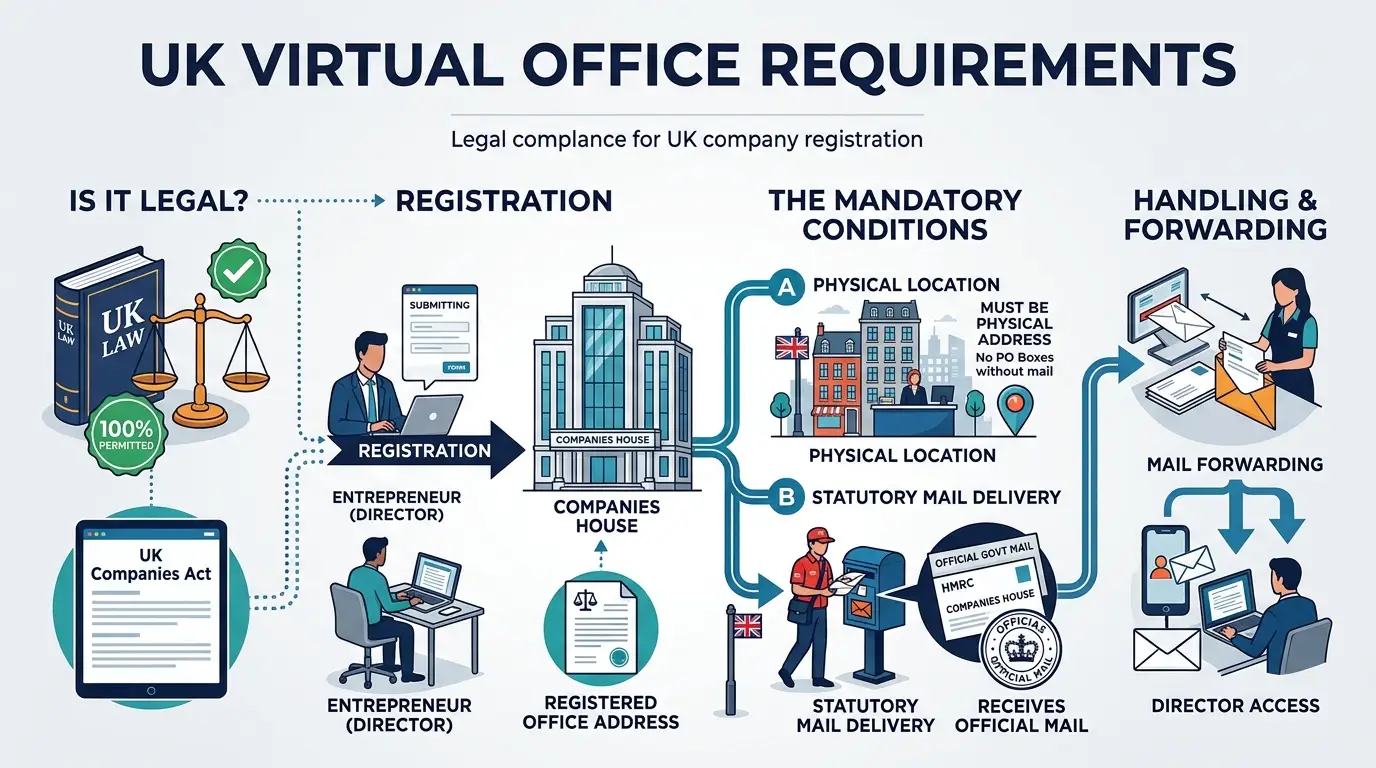
Companies House requires every registered entity in the United Kingdom to maintain an appropriate physical address. Under Section 86 of the Companies Act 2006, as amended by the Economic Crime and Corporate Transparency Act 2023, a registered office must be a physical street address within the same UK jurisdiction where the business registers. PO Boxes without physical staff presence fail to meet statutory criteria. Virtual offices fulfill these legal obligations when they provide physical premises to capture and forward mail.
Commercial corporate governance mandates that official notices delivered to the address reach the company directors promptly. Government institutions like HM Revenue and Customs (HMRC), the Insolvency Service, and UK Courts send legal notices directly to registered office addresses. When directors select a virtual office provider, they must confirm that the physical premises operate continuous mail handling facilities during standard business hours.
The Economic Crime and Corporate Transparency Act 2023 tightened compliance standards across the corporate landscape. The law explicitly bans pure PO Box addresses lacking physical operational staff. Virtual office services operating from real commercial buildings comply with these stricter parameters. Businesses using these services ensure their public records remain fully compliant with UK corporate law.
Using a virtual office helps company officers separate public filings from private residential locations. Directors protect personal privacy while maintaining professional market presence. Registration requires submitting exact location details to Companies House, where the address becomes part of public record accessible through the official online register.
What Are the Key Legal Requirements for a Registered Office Address?
A valid registered office address must exist as a physical location in the jurisdiction of incorporation, receive official statutory post, acknowledge hand-delivered legal documents, and refrain from utilizing unstaffed post office box arrangements.
Companies House mandates four strict compliance criteria for corporate addresses. First, the address must sit in the same UK country of incorporation: England and Wales, Scotland, or Northern Ireland. A company registered in England cannot host its legal address in Scotland. The location must exist as a physical structure capable of receiving mail by hand or post.
Second, the location must process documents delivered by hand or post. Official couriers, court bailiffs, and government officers frequently deliver statutory documents directly to corporate addresses. When process servers drop court summonses at the address, the site management must sign for and log the delivery immediately. Virtual office locations maintain dedicated reception staff to manage these statutory responsibilities.
Third, the site must facilitate prompt notification to company directors. Delayed notice delivery creates legal exposure, default judgments, or financial penalties. Compliant service providers digitize or forward post on the day of receipt. Directors maintain ultimate legal responsibility for responding to statutory correspondence within statutory deadlines.
Fourth, the registered address must align with anti-money laundering regulations. Service providers must verify clients before issuing address approval. Failure to maintain a compliant address allows Companies House to strike off the company from the register after issued warnings.
How Does the Economic Crime Act Impact Virtual Office Usage?
The Economic Crime and Corporate Transparency Act 2023 forces virtual office addresses to qualify as “appropriate addresses” where documents come to the attention of company representatives and post gets officially acknowledged.
The 2023 Act updated statutory address rules to prevent fraudulent corporate registrations. Under revised legislation, an address ceases to be appropriate if mail delivered to it routinely goes unacknowledged or unretrieved. Companies House received expanded powers to investigate, challenge, and remove non-compliant corporate addresses from the public register.
Corporate service providers now undergo compulsory registration with HMRC or professional bodies under Money Laundering Regulations (MLR). Providers verify the identity of beneficial owners before allowing address usage. When providers identify suspicious registration patterns, they report details to the Financial Conduct Authority or National Crime Agency.
Companies using non-compliant addresses face severe enforcement actions. Companies House issues compliance notices demanding address rectification within 28 days. If a business fails to supply a compliant address, Companies House changes the address to a default location or initiates strike-off proceedings. Company directors face personal fines and potential disqualification for willful non-compliance.
These legislative changes elevated market standards for corporate address providers. Modern virtual offices must supply documented proof of occupancy, land registry title deeds, or lease agreements upon request. Legitimate providers issue official documentation to help businesses verify proof of address for banks and regulatory bodies.
What Is the Difference Between a Registered Office and a Trading Address?
A registered office serves as the official legal address for government communications and public records, whereas a trading address represents the actual physical site where daily business operations, sales, and client interactions occur.
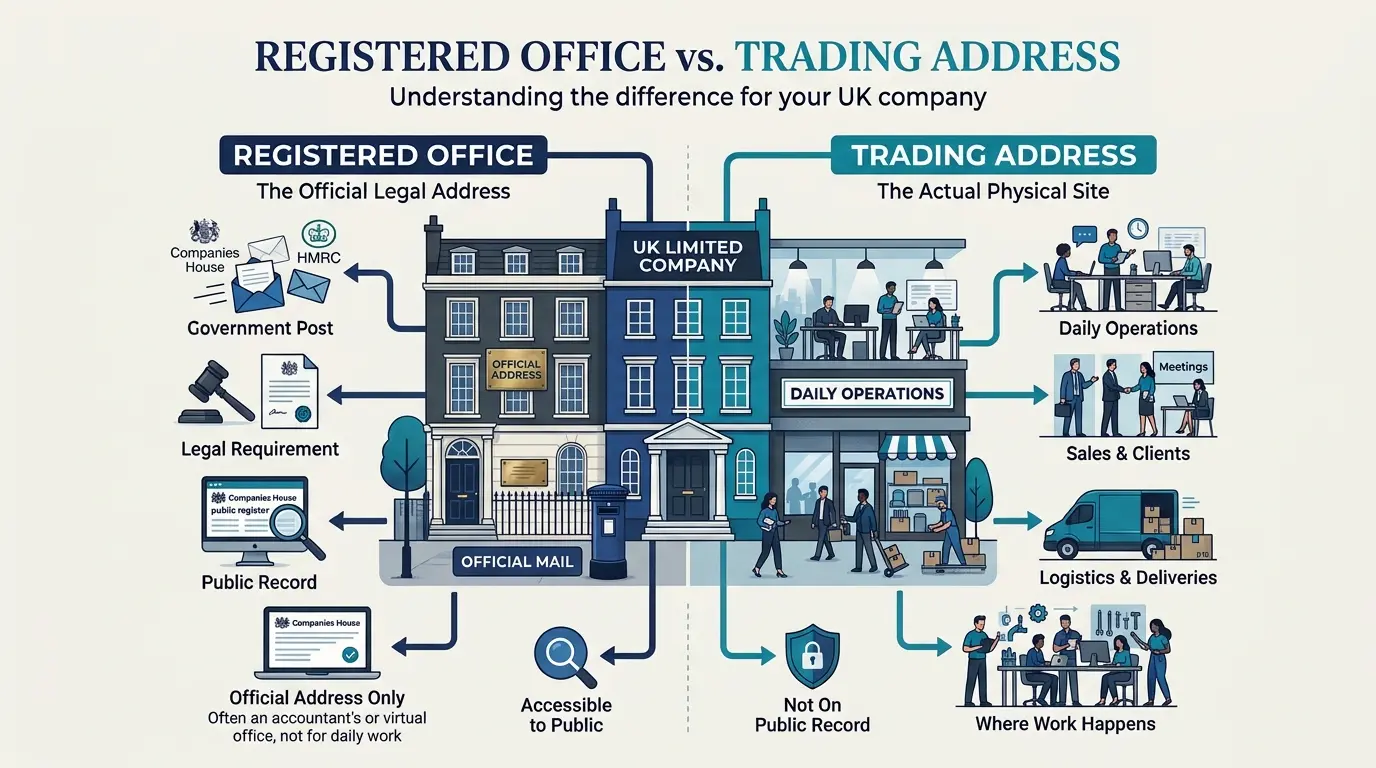
Corporate entities in the UK manage different address classifications for distinct operational purposes. The registered office address forms the official legal anchor of the company. Companies House, HMRC, and the courts use this address exclusively for legal notices, tax assessments, and statutory compliance audits. This address appears prominently on public corporate registries.
A trading address marks the commercial footprint of the business. Companies display trading addresses on marketing materials, customer invoices, and trade contracts. A business can maintain multiple trading addresses across different locations while holding just one registered office address. While registered offices require UK jurisdictional alignment, trading addresses can locate anywhere globally.
The law requires businesses to display their registered office details on specific corporate media. Company websites, business letters, order forms, and official emails must list the registered office address alongside the registered company number. Companies using virtual offices for legal registration frequently use the same address for trading purposes to project consistent commercial presence.
Selecting different addresses for registration and trading helps manage administrative workflows. Separating legal notices from general customer correspondence prevents critical government letters from getting misplaced among daily operational post. Virtual office staff process regulatory mail separately, protecting legal response timelines.
How Do You Choose a Compliant Virtual Office Provider?
Select a compliant virtual office provider by verifying their HMRC anti-money laundering registration, confirming physical building access, auditing mail processing speed, and validating official address approval credentials.
Selecting a provider requires checking statutory credentials before signing service contracts. 84% of compliance failures stem from unverified service providers operating without proper anti-money laundering registration. Businesses should request the provider’s HMRC MLR registration number to confirm statutory authorization. Legitimate operators gladly supply these details during initial onboarding.
Evaluate the mail handling procedures operated by the facility. Reliable providers offer physical mail forwarding, daily scan-to-email services, and secure physical storage options. When selecting mail processing terms, ensure the provider offers same-day scanning for statutory post from HMRC and Companies House to prevent missed legal deadlines.
Confirm the physical reality of the advertised location. The address must reflect an actual commercial building rather than a residential house or unstaffed storage locker. Inspect the lease structure or land ownership of the service provider. Secure providers hold long-term commercial leases or own the property outright, ensuring long-term address stability for your business.
Review document verification requirements during onboarding. Compliant providers require government-issued photo identification, proof of residential address, and corporate registration documents. Avoid providers claiming to offer instant address usage without identity verification, as these services often violate UK anti-money laundering frameworks and risk regulatory shutdown.
How Do You Change Your Registered Office to a Virtual Address with Companies House?
Change your registered office address by filing Form AD01 electronically through Companies House WebFiling, updating internal company registers, and notifying statutory business stakeholders within 14 days.
The process of updating corporate records with Companies House follows direct administrative steps. First, pass a formal board resolution approving the change of registered office address. Record this decision in the official company board minutes. Ensure the new virtual office contract is active before submitting official regulatory forms.
Second, log into Companies House WebFiling or use approved company formation software. Complete Form AD01 (Notice of change of registered office address). Enter the exact new virtual office address, including the precise suite or office unit number specified in your provider agreement. Submit the form electronically for instant processing without filing fees.
Third, await confirmation from Companies House. Electronic filings typically process within 24 hours. The address change takes legal effect once Companies House registers the submission. However, third parties can legally serve documents at the previous address for up to 14 days following the official update.
Fourth, update internal registers and commercial touchpoints. Update business stationary, email footers, corporate websites, and financial accounts immediately. Notify key stakeholders including banks, insurers, utility providers, and software service providers. You can access Supplementary Company Documents to ensure all corporate filings, resolutions, and governance records comply with statutory requirements during address transitions.
What Documents Are Needed to Authenticate a Virtual Address for Banking?
Authenticating a virtual address for corporate banking requires providing a signed service agreement, utility bill issued to the building, provider anti-money laundering certificate, and statutory registration filings.
UK banks enforce strict Know Your Customer (KYC) standards when opening business accounts or updating corporate files. Financial institutions verify that a virtual office represents a legitimate business contact point rather than an unverified front. Directors must present specific documentation to satisfy bank compliance departments.
Provide the official virtual office contract signed by both parties. This contract confirms your legal right to use the address for corporate registration. Combine this with the invoice proving active payment for the address service. Banks scrutinize these documents to ensure the service agreement remains valid and active.
Supply proof of business registration showing the updated address. Present the Companies House incorporation certificate or Form AD01 confirmation. When financial institutions request further validation regarding address legitimacy, directors can review how to prove a virtual registered office is legitimate to gather essential compliance documents, land registry extracts, and provider credentials.
Certain banks request evidence of statutory authority regarding mail handling. Providing a formal authorization letter helps streamline bank reviews. Companies can add a Letter of Authority to your virtual office with Form My Company to grant explicit legal permission for document collection and address verification requests from commercial institutions.
Explore More Supplementary Company Documents Guide,
What Do Investors Look for in Your Articles of Association?
What Are the Share Transfer Rules in Articles of Association?
Frequently Asked Questions
What Are Supplementary Company Documents for a UK Business?
Supplementary company documents are official legal filings, certified certificates, and statutory records submitted to or retrieved from Companies House after initial incorporation. Through the Supplementary Company Documents service, Form My Company assists businesses in obtaining verified records such as Certificates of Good Standing, change of company name certificates, updated Articles of Association, and filed share structure forms.
Why Do Banks Require Certified Supplementary Company Documents?
Financial institutions require certified supplementary records during Know Your Customer (KYC) onboarding to verify an entity’s current legal status, active officers, and official ownership structure. Using the Supplementary Company Documents service from Form My Company ensures that UK firms receive officially authenticated documents directly from Companies House, preventing account opening delays.
When Must a Business File Supplementary Company Documents with Companies House?
Companies House mandates supplementary filings whenever a business updates its key structural details, such as issuing new shares, appointing or terminating directors, changing registered office addresses, or transferring ownership. Form My Company manages these statutory submissions through its Supplementary Company Documents service to keep corporate registers accurate and avoid late-filing compliance penalties.
How Can You Get Official Copies of Supplementary Company Documents?
Official copies can be retrieved electronically or ordered as physical certified hard copies stamped by Companies House for legal and banking validity. The Supplementary Company Documents portal from Form My Company simplifies this procedure by sourcing, compiling, and delivering verified statutory filings directly to business owners.
Are Supplementary Company Documents Mandatory for Small UK Limited Companies?
Yes, all active UK limited companies must maintain and file required supplementary corporate records to comply with the Companies Act 2006. Form My Company provides a dedicated Supplementary Company Documents service that ensures small businesses retain full regulatory compliance, protecting directors from statutory fines or compulsory strike-off warnings.