
Updating your Letter of Authority after changing your registered office address requires issuing a revised document containing the new official address details, executing it through company officers, and providing it to relevant authorities, banks, or corporate agents to maintain valid legal representation.
Why Must You Update Your Letter of Authority After Changing Your Registered Address?
Updating your Letter of Authority ensures your designated agent maintains legal standing to act on your behalf, prevents compliance rejections from financial institutions, and aligns corporate records with Companies House registries to preserve valid third-party representation across all commercial frameworks.
A Letter of Authority establishes official legal representation between a UK company and designated third parties. When a company changes its registered office address, Companies House updates the official public register. Any existing legal authorisation referencing an outdated registered address becomes legally inconsistent. Third-party institutions compare corporate authorisations against active public registry records during compliance audits.
Financial institutions, government agencies, and legal representatives require exact alignment between corporate documents and public registers. An outdated address invalidates verification checks. Continued use of obsolete documents risks immediate rejection during banking operations, tax filings, or statutory representation. Updating the document preserves seamless administrative continuity and protects official corporate relationships across all regulatory operations.
Regulatory frameworks under UK company law mandate accurate representation in all executed company instruments. Corporate officers must ensure all active delegations of authority reflect current corporate details. Maintaining inaccurate documentation exposes officers to compliance risks during anti-money laundering assessments. Updating the document immediately after an address change satisfies legal obligations and maintains institutional trust.
What Steps Are Required to Update a Letter of Authority in the UK?
Updating a Letter of Authority requires drafting a revised document with current corporate details, passing a formal board resolution, executing the instrument via authorized directors, and distributing signed copies to all active corporate service providers and banking partners.
Updating an official legal authorization involves systematic administrative and corporate governance procedures. Directors must follow precise execution steps to ensure the replacement instrument satisfies statutory requirements:
Draft a replacement authorization document reflecting the new registered office address.
Convene a formal meeting of the board of directors to approve the document revision.
Record the official approval in the company minute book via formal resolution.
Execute the revised instrument using official signatures of authorized directors or legal seals.
Revoke all previously issued authorizations referencing the former corporate address.
Dispatch verified copies of the new authorization to financial institutions, statutory bodies, and third-party agents.
The updating process requires strict attention to corporate governance protocols. Directors must verify that every third-party representative receives the updated instrument promptly. Failing to distribute revised documentation creates administrative bottlenecks and delays critical corporate actions.
Which Key Information Must Change on the Revised Letter of Authority?
The revised Letter of Authority must display the updated registered office address, current company registration number, valid date of execution, updated director signatures, and explicit clauses revoking previous authorizations to maintain total legal clarity.
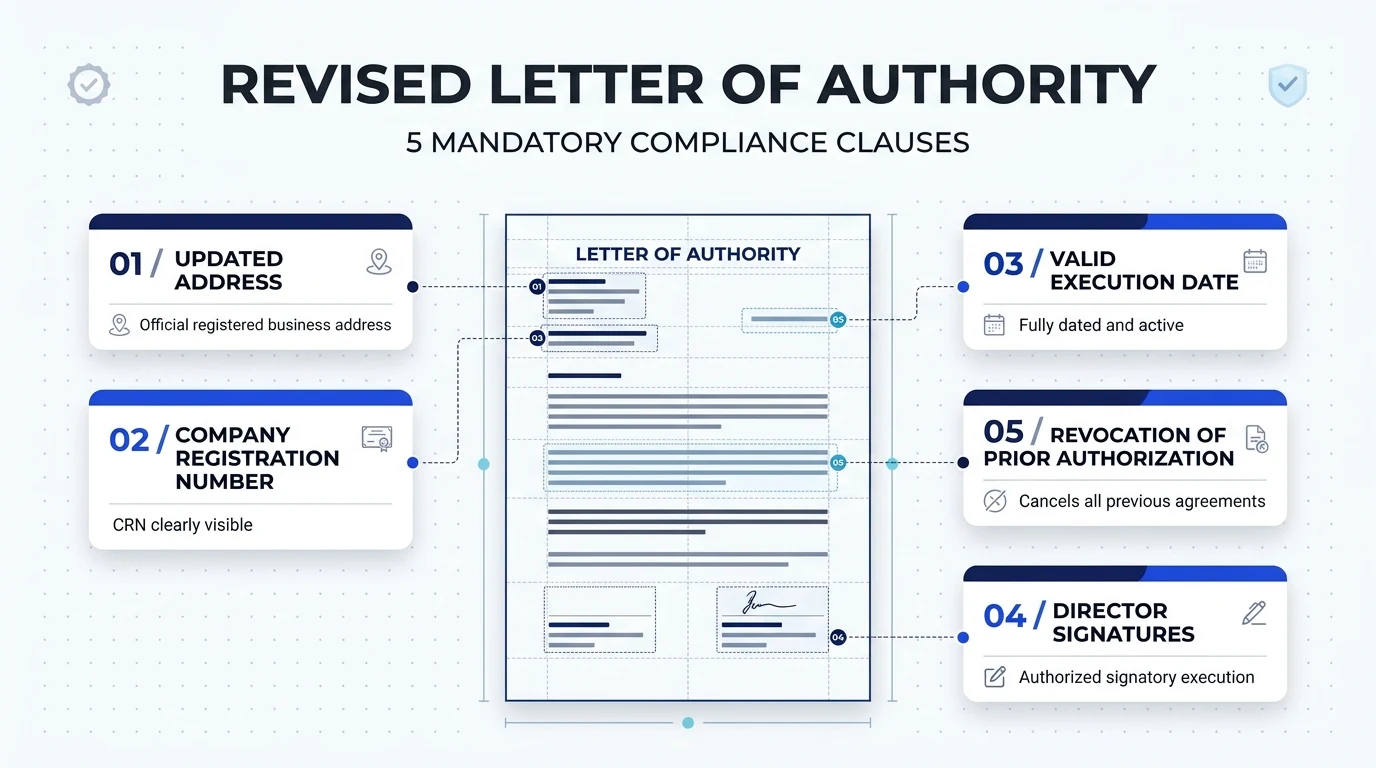
A legally binding authorization document relies on absolute factual accuracy across all standard identification fields. When drafting the updated document, corporate secretaries must review specific structural details:
Insert the full, new registered office address exactly as recorded on the official Companies House register.
Confirm the UK company registration number matches active statutory records.
Update the execution date to reflect the exact day of new board approval.
State explicit revocation language nullifying all prior authorization letters bearing previous addresses.
Re-authenticate director names, official titles, and authorization limits for designated agents.
Every field in the updated instrument serves a distinct compliance role during institutional reviews. Financial institutions utilize automated optical character recognition tools to scan corporate filings against registry databases. Discrepancies in street names, postcodes, or officer titles trigger manual compliance holds. Ensuring complete precision eliminates processing delays and secures uninterrupted representation rights.
How Does an Address Change Affect Third-Party Agent Authorisations?
An address change invalidates existing agent authorisations if third-party institutions detect discrepancies between active corporate letters and public registry records, leading to suspended account services, delayed filings, and interrupted commercial transactions.
Third-party agents rely on valid legal instruments to represent your business before statutory bodies, financial networks, and legal authorities. When a business alters its official location, existing authorisations lose direct alignment with statutory registers. Institutions conducting routine identity verification checks flag these discrepancies immediately.
Agents operating under invalid documentation face immediate restriction. HMRC and financial services platforms halt third-party operations when authority documents contain obsolete corporate records. To understand the wider administrative implications of moving your corporate head office, review What Happens When You Change Your Registered Office Address? to prevent operational disruptions.
Uninterrupted delegation requires immediate document replacement. When corporate records change, agents cannot legally sign contracts, file statutory returns, or manage banking instructions until presented with updated authority documents. Business directors must proactively replace outdated instruments to ensure third-party contractors operate without administrative barriers.
Who Needs to Receive the Updated Letter of Authority Immediately?
Banking partners, HMRC, external accountants, legal representatives, corporate service providers, and utility vendors must receive the updated Letter of Authority immediately to prevent operational freezes and maintain valid corporate communications.
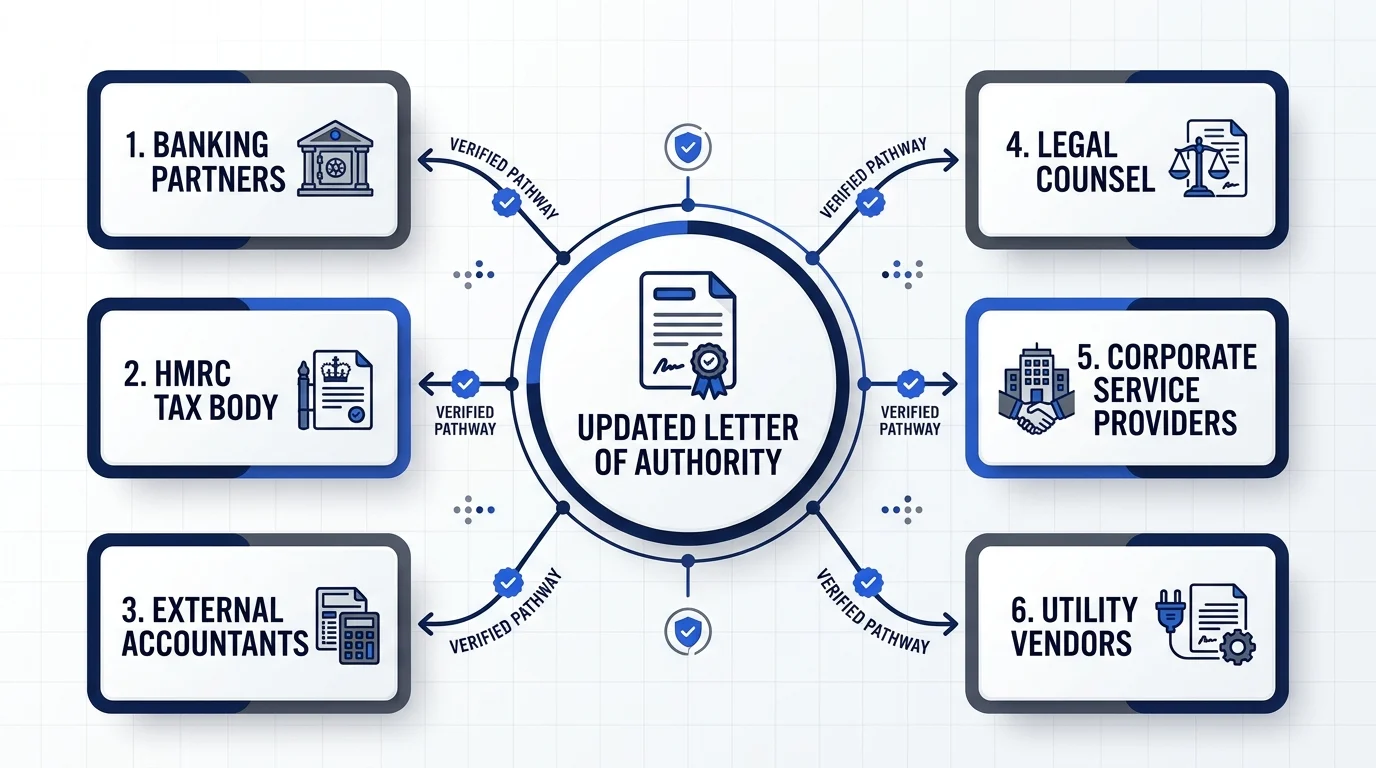
Prompt distribution of the updated instrument prevents operational bottlenecks across your business ecosystem. Directors must prioritize notification based on risk exposure and administrative dependency:
Banking institutions managing active commercial accounts, loan facilities, or payment gateways.
Her Majesty’s Revenue and Customs for tax representation, VAT management, and payroll processing.
External accountancy firms managing statutory annual accounts and corporate tax returns.
Legal counsels executing real estate transfers, commercial contracts, or regulatory filings.
Corporate service providers managing company secretarial duties, mail handling, and compliance monitoring.
Providing prompt notifications ensures uninterrupted commercial workflows. Financial institutions frequently freeze trading accounts when identity validation checks fail due to mismatched records. Distributing updated documentation immediately upon execution safeguards operational liquidity and preserves institutional partnerships.
What Legal Risks Arise from Using an Outdated Letter of Authority?
Using an outdated Letter of Authority creates risk of contract invalidation, anti-money laundering compliance failure, processing rejection by regulatory bodies, and potential director liability for negligent representation under UK corporate law.
Operating commercial activities with outdated corporate documents exposes business entities to serious legal and financial liabilities. Under UK corporate regulations, documents containing inaccurate corporate data fail standard legal verification tests:
Risk of contract voidance due to improper execution or unauthorized representation claims.
Rejection of statutory filings by regulatory agencies leading to late submission fines.
Failure of Anti-Money Laundering (AML) and Know Your Customer (KYC) institutional compliance checks.
Suspension of credit lines, merchant services, and international payment facilities.
Exposure of directors to breach of duty claims for failing to maintain accurate statutory documents.
Regulatory frameworks enforce strict transparency requirements on corporate entities. Using invalid address credentials, even unintentionally, compromises corporate standing. Third parties gaining commercial advantages can challenge decisions signed under obsolete authority letters. Maintaining updated corporate documentation secures organizational integrity and insulates directors from regulatory scrutiny.
How Can Form My Company Assist with Updating Corporate Documents?
Form My Company assists businesses by drafting fully compliant replacement authorization instruments, updating statutory corporate registers, and providing professional company secretarial support tailored to current UK regulatory standards.
Managing corporate documentation updates requires specialized administrative expertise to ensure full statutory compliance. Business owners seeking fast document updates can secure professional support through our comprehensive Supplementary Company Documents service tailored for UK entities.
Form My Company simplifies corporate secretarial administration through streamlined document generation systems. When corporate details change, our secretarial specialists draft fully compliant instruments matching your specific organizational structure. We eliminate compliance risks by ensuring every document adheres precisely to current UK legal frameworks.
Maintaining consistent corporate records protects your business from administrative interruptions. Form My Company offers end-to-end secretarial maintenance, handling everything from resolution drafting to statutory registry notifications. Partnering with professional secretarial providers allows directors to focus on core commercial growth while maintaining flawless compliance records.
When Should You Request a Fresh Letter of Authority From Professionals?
You should request a fresh Letter of Authority immediately following any corporate structure change, including registered address relocations, director resignations, share capital alterations, or changes in designated third-party representation scopes.
Professional corporate service providers deliver speed, precision, and guaranteed compliance when updates are required. Rather than manually drafting legal instruments, directors can choose to Request a Fresh Letter of Authority From Form My Company to receive fully compliant documentation within hours.
Professional document drafting eliminates formatting errors, omitted legal clauses, and execution failures. Service providers maintain up-to-date templates that incorporate current statutory amendments and banking compliance standards. This professional oversight guarantees third-party acceptance across financial institutions and government registries.
Engaging external secretarial experts ensures seamless integration between your Companies House records and internal authorization instruments. Professional providers manage the entire workflow, from drafting resolutions to preparing execution packets. Requesting fresh documentation through trusted partners protects your organization’s legal standing and ensures administrative continuity.
Updating your Letter of Authority after an address change is a critical administrative task that protects your business’s legal standing and operational continuity. Outdated documentation risks contract invalidation, banking service suspensions, and statutory compliance failures. By systematically updating your corporate instruments, passing appropriate board resolutions, and distributing revised letters to key stakeholders, you maintain seamless third-party representation. Form My Company provides expert secretarial solutions and professional document drafting services to ensure your corporate governance records remain fully compliant with UK statutory requirements.
Explore More Supplementary Company Documents Guide,
How to Use Certified Formation Documents to Apply for Business Finance
How Often Should You Renew Certified Copies of Company Records?
Frequently Asked Questions
What Are Supplementary Company Documents in the UK?
Supplementary Company Documents are official corporate records filed after initial business registration to verify ongoing regulatory compliance and structural updates. They include certified copies of confirmation statements, shareholder registers, and official letters of authority required by financial institutions and regulatory bodies. Form My Company provides a streamlined Supplementary Company Documents service to help UK businesses manage essential statutory updates efficiently.
Why Do UK Companies Need an Updated Letter of Authority?
An updated Letter of Authority establishes valid third-party representation and ensures compliance with UK anti-money laundering frameworks. Outdated address details or obsolete director information can invalidate agent privileges and cause immediate rejections from corporate banking partners. Form My Company assists businesses in maintaining valid Supplementary Company Documents to prevent compliance holds and operational disruptions.
How Do You Update a Letter of Authority After an Address Change?
Updating a Letter of Authority requires drafting a revised instrument with the new registered office address, recording formal board approval, and executing the document through authorized directors. The revised authorization must then be distributed to financial institutions, statutory authorities, and legal partners to replace outdated records. Form My Company manages this process through its Supplementary Company Documents service to ensure statutory precision.
What Is Included in Official Supplementary Company Documents?
Official Supplementary Company Documents encompass post-incorporation statutory records such as Certificates of Good Standing, director appointment notices, share allotment forms, and formal letters of authority. These filings substantiate current corporate governance, shareholding structures, and officer credentials during third-party due diligence. Form My Company offers access to fully certified Supplementary Company Documents tailored to UK corporate requirements.
What Legal Risks Arise from Using Outdated Corporate Documents?
Using outdated corporate documents exposes a business to contract voidance, regulatory filing penalties, and anti-money laundering compliance failures. Inconsistent records between internal authorization letters and the Companies House public registry can freeze bank accounts and restrict corporate trading abilities. Utilizing the Supplementary Company Documents solutions from Form My Company ensures complete alignment with statutory registers to protect director liability.