

For a UK private limited company, “Ltd” is the common shortened form of “Limited”; choosing between them doesn’t change the company’s structure. A company limited by shares must have at least one shareholder, and a private limited company must have at least one director. One common mistake when setting up a limited company is focusing on its name while overlooking decisions with longer-term effects.
It’s understandable to want the registration details right first time. The name matters, but so do the company type, who owns its shares and how those shares are allocated. Mistakes in these choices can create complications when ownership or decision-making needs to change.
This guide explains what to check before registering, from choosing a name and structure to entering application details consistently. It also covers the filing requirements to keep track of after incorporation, so you can see what needs attention at each stage.
Key Takeaways
- Choose between “Limited” and “Ltd” with confidence, then focus on the company structure and share arrangements that affect ownership and control.
- Consider how your registered office address affects privacy, as company address details appear on the public register.
- Plan for ongoing filing duties: Companies House says a UK limited company’s first annual accounts are due 21 months after incorporation.
- Match the structure to your purpose, whether that points to an Ltd, an LLP or a company limited by guarantee.
- Use consistent names and details throughout the application to reduce the risk of rejection or later corrections.
1. Should I choose Limited or Ltd in my company’s name?
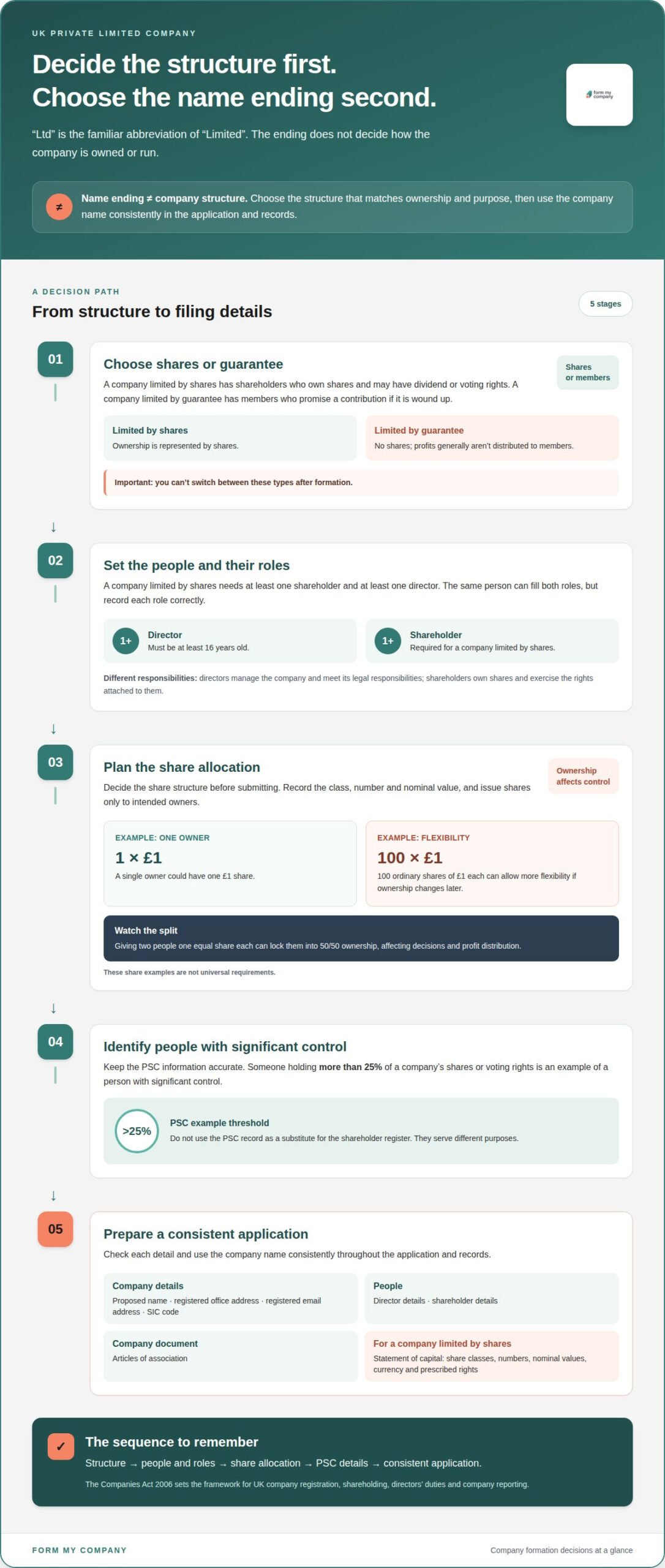
“Ltd” is the familiar abbreviation of “Limited” for a UK private limited company. The name ending does not determine whether a company is limited by shares or by guarantee. Choose the structure that matches how the organisation will be owned and run, then use the company name consistently in the application and its records.
To register with Companies House, provide the proposed company name, registered office address, registered email address, SIC code, director details and shareholder details. You also need the company’s articles of association and, for a company limited by shares, a statement of capital showing share classes, numbers, nominal values, currency and prescribed rights. The Companies Act 2006 sets the framework for UK company registration, shareholding, directors’ duties and company reporting, according to the UK legislation register.
First, decide between a company limited by shares and one limited by guarantee. A company limited by shares has shareholders who own shares and may receive dividends or voting rights. A company limited by guarantee has members who promise a contribution if the company is wound up, rather than shareholders. It has no shares, and profits generally aren’t distributed to members. The structure matters: you can’t switch between these types after formation.
For a company limited by shares, appoint at least one director and have at least one shareholder. The same person can hold both roles, and a director must be at least 16 years old. Directors manage the company and meet its legal responsibilities; shareholders own shares and exercise rights attached to them. Record each role correctly, even when one person fills both.
Set the share structure before submitting the application. A single owner could have one £1 share, while 100 ordinary shares of £1 each can allow more flexibility if ownership changes later. These are examples, not universal requirements. Record the share class, number and nominal value, and issue shares only to intended owners. Two people given one equal share each can be locked into a 50/50 ownership split, affecting decisions and profit distribution.
Identify each person with significant control, or PSC, and keep the information accurate. Someone holding more than 25% of a company’s shares or voting rights is an example of a PSC. Don’t treat this record as a substitute for the shareholder register; the two serve different purposes. If the company handles personal data, it must comply with GDPR and the UK Data Protection Act 2018, according to the Information Commissioner’s Office.
2. Common mistakes when forming a UK limited company
Founders may choose a name too quickly, enter an unsuitable registered office or select a SIC code that misrepresents the company’s activity. These details identify the company on the register, so make sure each one reflects the business being formed.
Companies House can reject a name that is identical or very similar to an existing company name. Certain sensitive words may also require supporting documentation. For example, using “Bank” requires written permission from the Financial Conduct Authority. Check the proposed name against these restrictions before completing the application, and enter it consistently throughout.
Choose a registered office that is a physical postal address, not a PO Box. It must be verifiable through Royal Mail’s Postcode and Address Finder and located in the UK country where the company is incorporated. For example, a company registered in Scotland needs its registered office in Scotland. The address appears on the public register and can be searched online.
Using a director’s home as the registered office can expose that address publicly. Business owners who want to keep their home address separate can use a suitable business address instead. Form My Company’s registered office address service is relevant when you need an address for company registration. Select the address before filing, rather than treating it as an afterthought.
Enter the registered office and each director’s service address as separate application details. The registered office is the company’s official address; the service address is recorded for an individual director. Put the right information in each field rather than assuming one address automatically serves both purposes.
Choosing the wrong company type can create complications if the organisation’s purpose or ownership doesn’t match its legal structure. A company limited by guarantee has members rather than shareholders, while a company limited by shares has share ownership. Consider the planned activities, ownership and investment needs before registering. Changing the structure later can be complex, so settle this decision before submitting the application.
Choose a SIC code that accurately describes the company’s business activity. A mismatch can give an inaccurate picture of the company and may affect matters such as insurance premiums or eligibility for support programmes. Identify the main activity first, then select the closest applicable code instead of guessing from the company name.
Finally, assess whether the company’s handling of personal data means it must pay the ICO data-protection fee. Most small UK businesses pay £40 per year. Use the ICO’s fee assessment to establish whether the organisation needs to register and pay; don’t assume incorporation alone settles the question.
3. Filing confirmation statements and annual accounts
Companies House filings keep the public record and the company’s financial information up to date. A confirmation statement checks whether register details remain correct, including information about directors, shareholders and people with significant control. It’s required even if the company is dormant, so don’t ignore filing dates because the business is inactive.
Companies House requires a UK limited company to file a confirmation statement within 14 days after the end of its 12-month review period. Use the review period shown for the company, then allow time to prepare and submit the statement. Check the company details carefully before filing, as errors can leave the public record inaccurate.
Annual accounts are a separate filing. Companies House says a UK limited company’s first annual accounts are due 21 months after incorporation. After that first filing, the usual deadline is nine months after the accounting reference date. Accounts must be filed even if the company has stopped trading; some non-trading companies may submit dormant accounts instead.
Keep accounting records throughout the year, not just before a deadline. Record income, spending, invoices, receipts and amounts owed, and separate company transactions from personal spending. A dedicated company bank account helps create a clear financial trail. Mixing funds, losing receipts or relying on incomplete spreadsheets can make it harder to prepare accurate accounts.
Corporation Tax has its own registration, return and payment requirements. HM Revenue & Customs says a company must file its Corporation Tax return within 12 months after the end of its accounting period. Corporation Tax is due within nine months and one day after that period ends. A newly formed UK company that is not trading still needs to inform HMRC of its non-trading status.
Professional accounting support can help organise records, prepare accounts and track filing dates. Choose support that fits the company’s activities and reporting needs, but remember that directors remain legally responsible for company records, accounts and performance. Limited companies generally face higher accountancy fees than sole traders, so include the ongoing cost in your business budget.
These are formation fees, not accountancy costs. Budget for them separately from recurring accounting work and tax payments.
4. Choosing between LTD, LLP and company limited by guarantee
Choose a legal structure based on ownership, responsibility and how the organisation will use its profits. “Ltd” usually means a private company limited by shares. An LLP is a limited liability partnership, while a company limited by guarantee has members who promise a contribution if it is wound up. These structures serve different purposes, so don’t choose by name alone.
An Ltd is a legal entity separate from its shareholders and directors. Shareholders’ responsibility for company debts is generally limited to their investment. Shares can also set out who owns the business and how voting rights or dividends are allocated. By contrast, a sole trader runs the business personally, with fewer company reporting formalities, but without the same separation between the business and its owner. Weigh limited liability against the additional records and filings a company requires.
An LLP suits a business organised around members working together as partners. It has members rather than shareholders, so it isn’t simply an Ltd with a different label. Consider how the partners will make decisions, share profits and manage responsibilities. LLP formation is relevant when the intended owners want a partnership structure with limited liability.
A company limited by guarantee has no shares. Its members agree to contribute a nominal sum if the company is wound up, and profits generally aren’t distributed to members. This structure is often used by non-profit organisations and may suit one focused on its purpose rather than distributing profits to owners. Don’t choose it expecting to convert to a company limited by shares later; switching between these structures isn’t possible.
Before choosing, write down who will own or join the organisation, how decisions will be made and whether profits should be distributed. For example, founders planning to divide ownership between investors may need a share-based structure. A community-focused organisation that won’t distribute profits may consider a guarantee structure. Match the choice to the organisation’s real plans, not convenience.
Check the company name separately from its legal form. Companies House can reject a name identical or very similar to an existing company name. Search for availability before preparing the application, and make sure the name suits the intended structure. A name that suggests a different type of organisation can confuse customers or members, even if it passes registration checks.
Common mistakes when setting up a limited company include treating “Ltd”, “LLP” and “limited by guarantee” as interchangeable. Compare ownership, liability, profit distribution and filing responsibilities before registering. The right structure should reflect how the organisation will actually operate, not just how its name looks.
5. Checking application details for spelling and consistency
Mixing personal and company finances makes it harder to identify business income, spending and outstanding amounts. Don’t use a company account for personal spending. Where appropriate, record withdrawals as wages, dividends or director’s loan repayments, and keep supporting records for each transaction.
Review the company name exactly as it will appear on the incorporation application. Companies House can reject names identical or very similar to existing company names. A typo may also require correction after registration, so check every word, space and ending before submitting the formation details.
Check name availability and restricted words separately. Certain sensitive words need supporting documentation from the relevant body, and using “Bank” requires written permission from the Financial Conduct Authority. Don’t assume a name can be registered just because it looks suitable.
A Companies House name check and a trade mark search answer different questions. Treat them as separate checks before using the name publicly. A name’s availability for company formation doesn’t establish that it is suitable for every commercial use, so consider possible conflicts with existing trade marks too.
Compare each application field with the information supplied for that person or company. Enter directors, subscribers, company secretaries and People with Significant Control using their full names, not initials. For example, don’t use “J Smith” in one place and “Jamie Smith” elsewhere. Consistent entries help keep the incorporation record accurate.
Check the statement of capital against the ownership decision, including each share class, number and nominal value. Then review the articles of association and the names of everyone involved. A mismatch between the application and supporting documents can create uncertainty about who owns shares or holds a role.
Review the SIC code just as carefully. It should describe the company’s actual business activity, not merely echo its name. Check the application as a whole: the name, people, share details and business activity should give a consistent picture of the new company.
Before submitting, read the completed application from beginning to end. Correct spelling, names and figures while the details are together, rather than relying on memory after incorporation. For help with the formation process, review the company formation packages.
Form My Company
Form My Company helps entrepreneurs move from formation decisions to registering a UK company. Its company formation packages support the process, with options including Digital, Digital & Print and Entrepreneurs Choice. For plans that call for a partnership structure, Limited Liability Partnership (LLP) Formation is also available.
Turn to Form My Company when you’re ready to act on your choice of company type and want a formation package to support registration. Having your preferred company name, structure and ownership details ready can help you take the next step with clarity.
Contact Form My Company to discuss your company formation needs.
Make your next step a considered one
Formation begins a company’s working life; it isn’t just an isolated administrative task. As the business develops, its ownership, activities and priorities may change. Make a habit of reviewing important decisions against how the company actually operates, so its records and arrangements continue to reflect the business.
Common mistakes in setting up a limited company are easier to avoid when you make deliberate choices that fit your plans. Take time to decide what matters most for your venture, then move forward with a clear understanding of the steps involved.
If you’re ready to take that next step, contact Form My Company about your formation. A considered start gives you a stronger foundation to build on.
Frequently Asked Questions
Should I choose Limited or Ltd in my company’s name?
Either ending can identify a private company limited by shares, provided the name meets registration rules. “Ltd” is the shorter form, while “Limited” spells out the same word. Treat the suffix as part of the registered name and use it consistently on company documents and when identifying the business. The ending alone doesn’t tell you whether shares, membership or another structure suits your plans.
What mistakes do most people make when forming a limited company in the UK?
Common errors include choosing a SIC code that doesn’t reflect the company’s main activity, entering inconsistent names and overlooking what an address choice reveals publicly. For example, a consultancy shouldn’t choose a code for an unrelated retail activity simply because its proposed company name sounds broad. Before submitting, check that each application detail describes the same business, its people and its intended work.
How do I keep my company protected from day one?
Start by separating company transactions from personal spending, and keep invoices and receipts with the relevant records. If you use your home as the registered office, that address appears on the public register, so consider the privacy implications before filing. If your business handles personal data, the Information Commissioner’s Office says UK businesses must comply with GDPR and the Data Protection Act 2018. Keep access to business records controlled.
What laws and regulations does a limited company need to follow?
The Companies Act 2006 sets the framework for UK company registration, shareholding, directors’ duties and company reporting, according to the UK legislation register. Other rules depend on the company’s activities. For example, the Information Commissioner’s Office identifies GDPR and the Data Protection Act 2018 as requirements for businesses handling personal data. Businesses selling to the public must also ensure their contracts and practices comply with the Consumer Rights Act 2015.
What are your ongoing obligations?
Keep the company’s statutory and financial records accurate, file annual accounts and submit confirmation statements to Companies House. A dormant company still has filing duties. Tell HMRC when the company becomes active, and manage Corporation Tax obligations separately from Companies House submissions. If the business employs staff, responsibilities can include payroll, National Insurance and workplace pensions for eligible employees. Assign someone to track each obligation and keep evidence of completed filings.
What mistakes should you avoid?
Don’t treat company money as personal spending or leave transactions unexplained. For instance, record a payment to a director under the appropriate route, such as wages, dividends or a director’s loan repayment. Don’t rely on memory for receipts or assume filing the application makes future record-keeping automatic. A simple process for recording decisions and transactions helps explain the company’s financial position.
Why is it so easy to slip up when starting a limited company?
Formation brings together details that affect different parts of the company: its name, address, business activity, ownership and people’s roles. Even a small inconsistency, such as a person’s name appearing differently across records, can make company information harder to interpret. The pressure to get started can also distract founders from future filings. Work through each decision in order and keep one accurate record of the details submitted.
What are the rules for appointing directors, shareholders and people with significant control?
A UK private company must have at least one director, and a director cannot be under 16 years old. A company limited by shares needs at least one shareholder; one person can hold both roles. Record full names rather than initials. Identify people with significant control, including someone with more than 25% of shares or voting rights, and keep the company’s ownership and control records aligned when those details change.


