To apply for a UK business grant, you need your Certificate of Incorporation, Articles of Association, Memorandum of Association, historic or projected financial statements, business bank account details, proof of business address, director identity documents, and a comprehensive business plan.
Why Do UK Grant Providers Require Specific Business Documents?
UK grant providers require specific business documents to verify corporate identity, confirm legal compliance, prevent fraudulent applications, and evaluate economic viability before allocating public or private funding.
Grant bodies assess legal standing through official records before distributing funds. Public institutions and private trusts manage taxpayers or donor capital. Strict regulatory frameworks govern funding allocation across England, Scotland, Wales, and Northern Ireland. Assessors review corporate records to verify that your company operates legitimately within registered boundaries.
Grant administrators evaluate financial risk using corporate documentation. Officers check whether an applicant maintains proper governance frameworks. Missing corporate filings signal weak management and operational instability. Submitting complete verification packages accelerates application processing times significantly.
Funding bodies align approval criteria with Anti-Money Laundering legislation. Official corporate records prove beneficial ownership structures. Evaluators match director details against Companies House registers. Preparing complete background records ensures your business passes initial compliance screenings immediately.
Which Corporate Legal Documents Prove Your Business Status?
Corporate legal documents that prove business status include the Certificate of Incorporation, Memorandum of Association, Articles of Association, Share Register, and confirmation statements filed with Companies House.
The Certificate of Incorporation serves as legal proof of corporate formation. This document displays your unique company registration number and date of registration. Funding administrators require this document to confirm entity existence.
Articles of Association outline corporate governance rules and operational parameters. Assessors inspect these articles to verify borrowing powers and decision-making authority. You must submit official filings that accurately reflect your internal structure.
Memorandum of Association lists initial subscribers establishing the corporate body. Grant assessors review this paper to trace entity history. When applying for specialized funding, presenting verified Supplementary Company Documents confirms corporate authenticity and satisfies strict underwriting standards.
Confirmation statements provide updated company ownership and address records. Assessors check these documents against public registers to verify accuracy. Keeping statutory books current prevents funding rejections caused by administrative discrepancies.
What Financial Records Must You Submit for Grant Approval?
Financial records required for grant approval include audited accounts, balance sheets, profit and loss statements, cash flow forecasts, business bank statements, and tax clearance records.
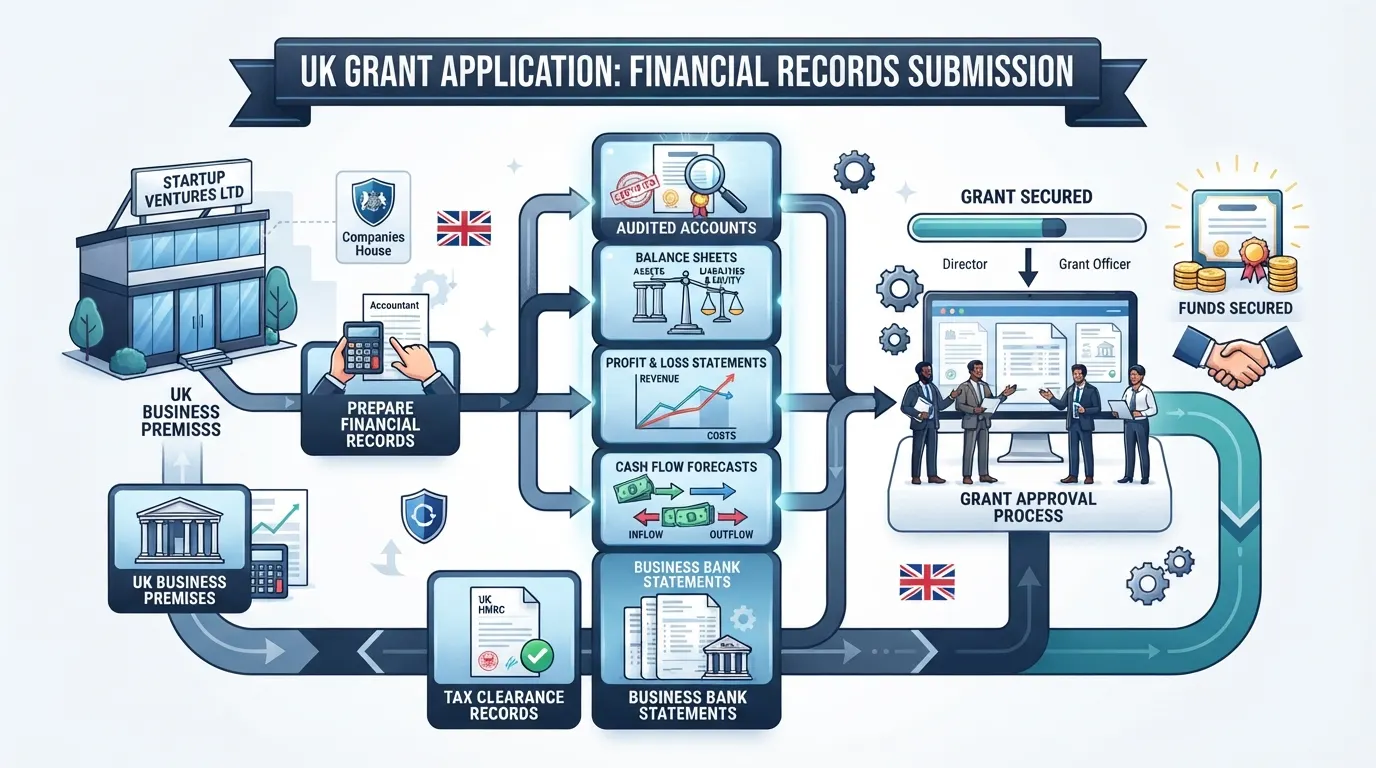
Historic financial statements show your operational trajectory over recent trading periods. Evaluators inspect revenue figures, net margins, and existing debt obligations. Established entities provide two to three years of statutory accounts.
Cash flow projections demonstrate how your company manages incoming and outgoing liquidity. Assessors analyze projections to determine financial sustainability during the project lifecycle. Forecasts must display realistic revenue expectations and cost breakdowns.
Business bank statements verify active trading operations and current liquidity. Funding bodies require three to six months of consecutive statements. Accounts must display matching registered business names and primary operating addresses.
Tax compliance documentation proves your business fulfills statutory obligations with HM Revenue and Customs. Submit VAT certificates, PAYE records, and Corporation Tax statements. Clean tax records confirm corporate responsibility and fiscal stability.
How Do You Prepare a Business Plan for Grant Assessors?
You prepare a business plan for grant assessors by detailing project objectives, budget breakdowns, market analysis, risk mitigation strategies, management credentials, and measurable economic outcomes.
Project objectives must align directly with the grant provider funding criteria. Define project scope using precise milestones and clear timelines. Explain how requested funds drive research, development, or regional expansion.
Budget breakdowns outline exact resource allocations for proposed activities. Itemize capital expenditure, labor costs, operational overheads, and subcontractor expenses. Clear cost breakdowns enable assessors to calculate return on investment accurately.
Market analysis demonstrates commercial viability and industry demand. Include data regarding target demographics, competitor positioning, and addressable market size. Solid market statistics validate proposed revenue growth strategies.
Risk assessment models identify operational, financial, and market challenges. Detail clear mitigation tactics for each potential obstacle. Showing proactive planning proves operational maturity to application reviewers.
When assembling grant applications, learning How to Prepare Company Paperwork for Grant and Funding Bodies helps maintain structural consistency across all statutory schedules.
Explore More Supplementary Company Documents Guide,
What Documents Does the Home Office Need for a Sponsor Licence?
What Company Records Do Buyers Ask for When You Sell a Business?
Which Identity and Address Documents Confirm Director Verification?
Identity and address documents that confirm director verification include valid passports, photocard driving licenses, utility bills, council tax statements, and bank statements issued within three months.
Valid passports prove nationality and legal identity for registered company directors. Assessors inspect passport scans to confirm match against official filings. Scans must show clear photographs, signatures, and machine-readable zones.
Photocard driving licenses serve as secondary photo identification for verification checks. Evaluators verify license numbers against official database registries. Expired identification credentials result in immediate application disqualification.
Utility bills confirm primary residential addresses for all company directors. Submit gas, electricity, water, or landline phone statements. Documents must display full names and residential addresses clearly.
Council tax statements provide government-issued proof of residential address history. Issued statements must cover the current financial year. Address details across all documents must match registered director records exactly.
What Proof of Business Location and Premises Is Required?
Proof of business location and premises includes commercial lease agreements, property deeds, utility bills, business rates statements, and land registry title documents.
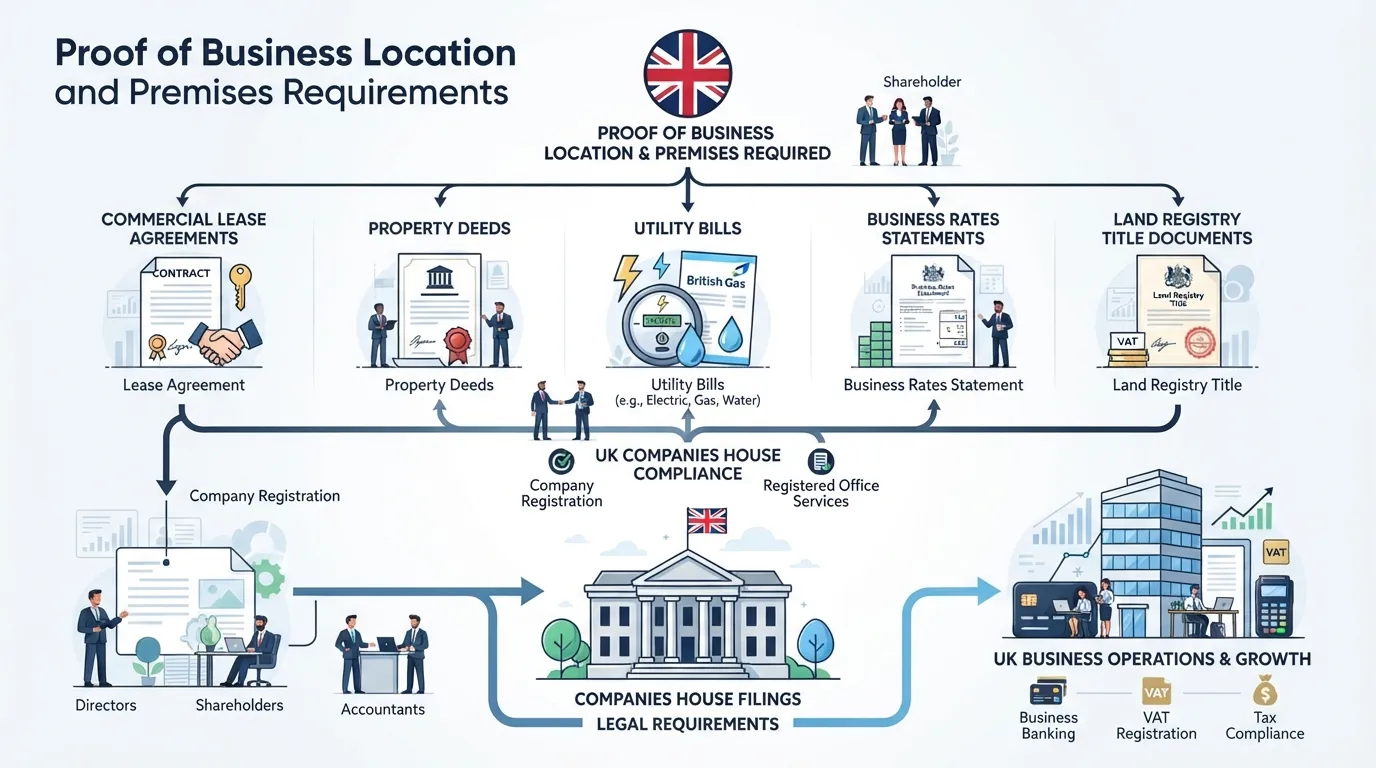
Commercial lease agreements confirm legal right of occupancy for operational premises. Contracts must display tenant details, landlord information, and lease duration. Ensure lease terms cover the duration of the grant project.
Property deeds prove outright ownership of commercial operating locations. Submit certified land registry titles when claiming property ownership. Ownership records substantiate asset values listed on corporate balance sheets.
Business rates invoices verify active commercial occupation within local authority boundaries. Funding providers use rates bills to validate regional grant eligibility. Submit current year bills displaying zero balances or active payment plans.
Utility statements for commercial addresses confirm daily operational activity. Provide recent energy or telecommunication bills matching the trading address. Address alignment prevents delays during physical location checks.
How Do You Organise Documents to Speed Up Processing?
You organize documents to speed up processing by indexing files, standardizing file names, converting pages to high-resolution PDF format, and auditing paperwork before submission.
Standardized file naming formats allow reviewers to identify documents quickly. Name files using clear labels, dates, and document categories. Clear labeling prevents confusion during multi-stage evaluation processes.
PDF formatting preserves layout integrity across different operating systems. Convert scanned physical documents into text-searchable digital files. High-resolution scans ensure signatures and official stamps remain legible.
Document indexing structures paperwork into logical sections for review panels. Create a cover page listing all enclosed corporate and financial files. Organized submissions demonstrate professional management standards.
Internal pre-submission audits identify missing pages or outdated certificates prior to filing. Review expiration dates on all identity and address documents. Correcting errors before submission prevents funding delays.
To simplify administrative preparation, choosing to Get Grant-Ready Company Documents From Form My Company secures properly formatted corporate paperwork designed for funding panel evaluation.
What Common Documentation Errors Cause Grant Rejections?
Common documentation errors causing grant rejections include mismatched addresses, expired identification, uncertified accounts, unsigned forms, incomplete application schedules, and missing statutory filings.
Address discrepancies between Companies House records and bank statements trigger fraud alerts. Ensure every document reflects identical corporate names and registered locations. Update public registers before submitting funding applications.
Expired identification documents fail basic Anti-Money Laundering screening protocols. Check passport and driving license expiration dates systematically. Replace outdated credentials prior to initiating application processes.
Unsigned financial statements lack regulatory authority and legal standing. Ensure qualified accountants sign off statutory accounts. Submit fully executed documents containing authorized signatures.
Incomplete application forms lead to immediate administrative rejection by reviewers. Fill out all mandatory fields and attach requested supporting schedules. Thorough applications move directly to technical evaluation stages.
Frequently Asked Questions
What exact supplementary company documents do UK grant assessors require?
UK grant funding bodies typically require certified copies of your Certificate of Incorporation, Memorandum and Articles of Association, updated share registers, and recent Confirmation Statements to verify corporate legitimacy. Securing official extracts through the Supplementary Company Documents service from Form My Company ensures all corporate governance records meet formal underwriting standards.
Why is a Certificate of Good Standing necessary for UK business grant applications?
A Certificate of Good Standing confirms that a UK entity has maintained continuous legal existence, up-to-date filing compliance, and no active winding-up proceedings with Companies House. Form My Company provides official status extracts through its Supplementary Company Documents service to prove financial standing and reduce compliance rejections.
How do updated Articles of Association affect grant funding eligibility?
Grant evaluators review Articles of Association to confirm internal corporate governance, director decision-making authority, and legal borrowing limitations. Ordering registered copies via Form My Company using the Supplementary Company Documents service ensures assessors inspect verified, current operational rules.
Which director verification documents are needed to apply for a UK grant?
Assessors demand valid photographic identification, such as passports or driving licenses, alongside utility bills or council tax statements issued within three months to verify director identities. Supplementary filings, including Companies House director appointment records from Form My Company, validate official ownership structures alongside personal identity checks.
What financial compliance filings must accompany supplementary corporate records?
Applicants must provide statutory audited accounts, profit and loss statements, cash flow forecasts, and six months of consecutive business bank statements. Combining these financial records with validated statutory paperwork from Form My Company via the Supplementary Company Documents platform delivers a complete compliance package for assessment panels.