Supplementary company documents are official statutory records that verify a registered business’s legal identity, corporate structure, director authority, and filing compliance. UK corporate entities present these certified extracts to financial institutions, commercial landlords, insurers, and regulatory bodies to validate legitimacy during formal due diligence procedures.
What Are Supplementary Company Documents in UK Corporate Governance?
Supplementary company documents are official statutory filings that provide certified evidence of a company’s legal status beyond basic incorporation certificates. These credentials include Certificates of Good Standing, Articles of Association, Confirmation Statements, and official registers detailing directors, secretaries, and shareholders.

Corporate entities in the United Kingdom register their legal existence with Companies House upon formation. While a Certificate of Incorporation proves basic registration, institutional partners require ongoing proof of compliance. Supplementary documentation provides real-time verification of an entity’s internal structure and legal standing.
These specialized credentials include four core statutory records: Certificates of Good Standing, Memorandum and Articles of Association, Confirmation Statements, and certified copies of official company registers. Financial institutions request these filings to confirm that a company remains active on the public register.
Regulatory frameworks enforce strict record-keeping standards across 100% of UK limited companies. When commercial entities engage in international trade, overseas authorities demand apostilled supplementary records to validate corporate power. Possessing updated statutory extracts ensures corporate officers meet all legal verification requirements without delay.
Why Do Financial Institutions Require Supplementary Business Credentials?
Financial institutions require supplementary business credentials to fulfill statutory Anti-Money Laundering mandates and verify corporate account authority. Official company filings prove beneficial ownership, validate director identity, and confirm that an enterprise maintains active registration on the public corporate database.
UK banking regulations compel lenders to conduct rigorous Know Your Customer checks before opening commercial accounts. Banks analyze supplementary filings to identify ultimate beneficial owners holding 25% or more of voting rights. Accessing verified registry extracts prevents illicit capital flows across commercial banking networks.
Commercial lenders inspect statutory documents during corporate loan assessments and credit applications. When underwriters evaluate corporate risk profiles, they examine three specific metrics: statutory filing consistency, director appointment histories, and capital allocation records. Verified documentation confirms that company representatives possess legal authority to bind the entity to debt agreements.
Discrepancies in public corporate filings cause 42% of commercial account delays across UK banking institutions. Presenting certified records resolves discrepancies regarding registered office locations and director credentials. Corporate entities maintain operational readiness when they acquire supplementary company documents to satisfy institutional compliance reviews promptly.
How Do Supplementary Documents Validate Corporate Structure and Ownership?
Supplementary filings validate corporate structure by documenting share allocation, voting rights, officer appointments, and control frameworks. Certified records confirm how a limited company distributes equity, delegates management authority, and structures its internal governance rules.
Every limited company operates under specific governance rules established during corporate formation. The Articles of Association serve as the legal constitution of the business, defining director powers and shareholder voting procedures. External partners examine these structural rules to verify corporate decision-making authority.
Ownership verification relies on certified equity schedules detailing issued share capital and voting rights allocations. When corporate entities structure joint ventures or seek investment, partners review filings to confirm equity distributions. Official Confirmation Statements detail changes in shareholdings, ensuring complete transparency regarding ownership structures.
Corporate governance frameworks mandate accurate reporting for Persons with Significant Control (PSC). Public registers list individuals holding substantial influence over company management. Certified PSC extracts prove legal control structures, enabling corporate law firms to verify compliance during mergers and acquisitions.
What Specific Documents Function as Official Supplementary Records?
Official supplementary records comprise four primary document types: Certificates of Good Standing, Memorandum and Articles of Association, Confirmation Statements, and certified register copies. Each filing verifies distinct legal, operational, and structural aspects of a registered company.
The Certificate of Good Standing functions as official proof that a company maintains up-to-date filing returns with Companies House. This document confirms active legal status, confirming that no strike-off proceedings exist against the company. Foreign registries mandate this certificate before granting operational licenses to UK businesses abroad.
The Memorandum and Articles of Association outline the internal regulations and constitutional powers of a corporate entity. The Memorandum records the initial subscribers’ intent to form the company, while the Articles establish director borrowing limits and shareholder meeting protocols. Commercial partners inspect these constitutional rules to ensure proposed transactions fit within authorized corporate scope.
Submit Certificates of Good Standing to confirm ongoing statutory filing compliance
Present Memorandum and Articles of Association to demonstrate corporate governance parameters
Provide updated Confirmation Statements to verify current director and shareholder rosters
Supply certified register extracts to authenticate internal company records for institutional audits
When enterprises prepare for legal audits or commercial loan applications, corporate teams must learn how to prepare company documents for commercial insurance cover and statutory verification efficiently.
How Do Statutory Document Discrepancies Impact Commercial Operations?
Statutory document discrepancies delay contract executions, cause bank account freezes, invalidate insurance policies, and trigger regulatory penalties. Inaccurate registry details prevent commercial partners from verifying legal identity, halting business operations until companies update official filings.
Commercial contract negotiations freeze when corporate registry details conflict with signed agreement details. If a company updates its registered office address without filing statutory forms, legal notices served to the old address remain legally binding. Discrepancies between physical operating locations and registered office filings raise compliance flags during contract verification.
Insurance underwriters void commercial policies when company names or registration numbers contain structural errors. If an enterprise operates under an unrecorded trading name, insurers cannot validate asset ownership during loss claims. Correcting corporate records on the public register protects businesses from unresolvable indemnity disputes.
Regulatory enforcement bodies penalize companies that fail to maintain accurate statutory registers. Directors face personal fines up to £5,000 for non-compliance with annual confirmation filing deadlines. Resolving record errors immediately preserves corporate standing and prevents automatic strike-off warnings from government authorities.
When Must Corporate Entities Update and Issue Supplementary Records?
Corporate entities must update and issue supplementary records during annual compliance filings, director changes, share transfers, international expansions, and institutional onboarding. Prompt filings ensure public registers reflect current operational structures accurately at all times.
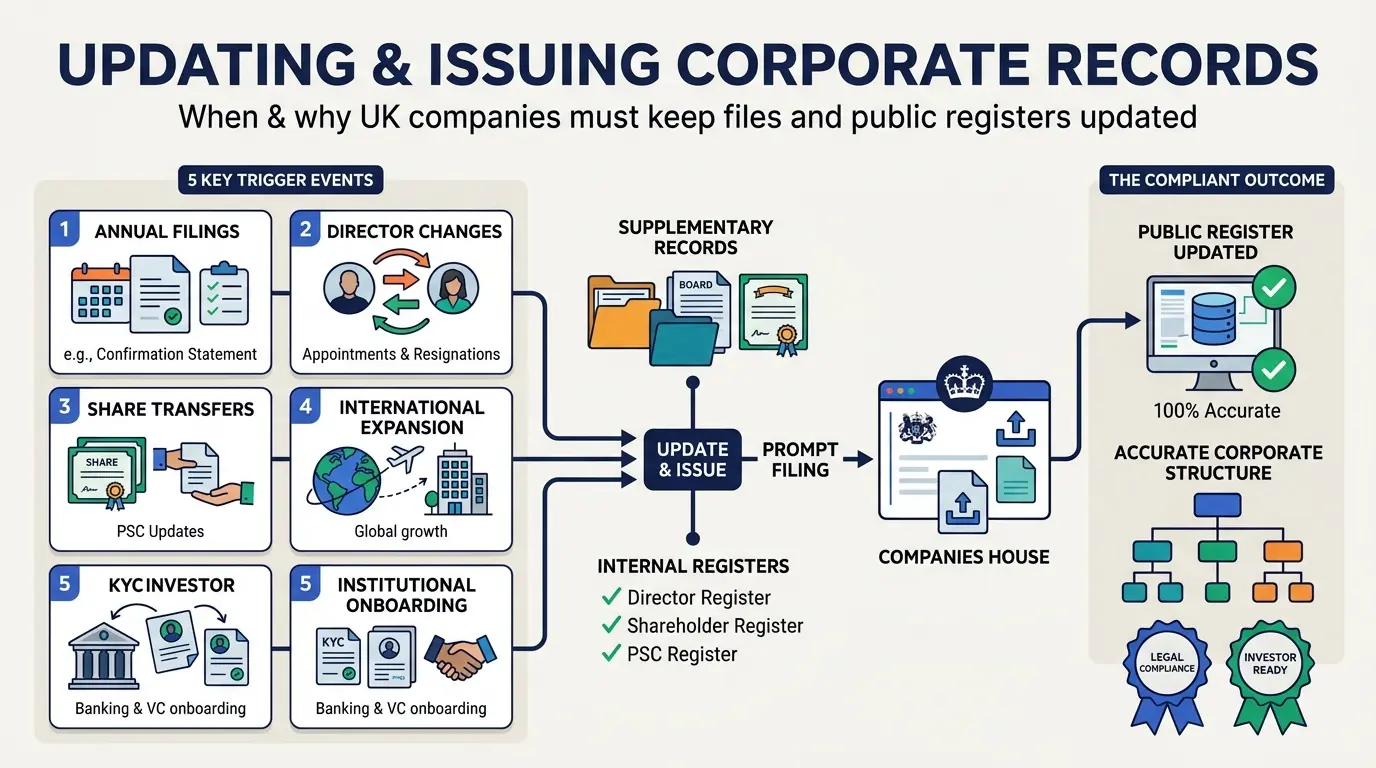
Annual confirmation filings represent the baseline requirement for updating corporate records. Every UK company must confirm its registry details at least once every 12 months, even if no corporate changes occurred. Submitting timely updates ensures the public database reflects current director names and registered office addresses.
Material corporate changes require immediate filing with Companies House within statutory deadlines. When a company appoints a new director or issues additional equity, corporate secretaries must submit official notification forms within 14 days. Delaying these statutory updates leaves public records inaccurate, exposing the business to compliance sanctions.
Cross-border expansion requires companies to present legal extracts authenticated by government authorities. Foreign jurisdictions demand legalization or Hague apostille certification on UK corporate documents before recognizing company status. Businesses can get insurer-ready company documents from Form My Company to fulfill strict international verification standards rapidly.
How Does Official Document Verification Support Regulatory Compliance?
Official document verification supports compliance by satisfying statutory record-keeping rules, fulfilling Anti-Money Laundering standards, and maintaining corporate transparency. Certified registry extracts provide verifiable evidence of legal standing during regulatory enforcement audits.
Regulatory compliance frameworks mandate that financial services, legal practices, and corporate service providers maintain detailed client records. Verification frameworks require institutions to validate corporate identity using official registry data. Satisfying these statutory standards prevents corporate entities from facilitating unauthorized financial operations.
Official verification protects corporate officers against personal liability claims. When directors maintain certified registers detailing board resolutions and shareholder approvals, they establish clear evidence of proper corporate governance. Demonstrating compliant record-keeping practices shields management teams during statutory insolvency investigations.
Digital registry integration enables automated verification across government databases. Public authorities cross-reference corporate filings with tax registries to verify reporting consistency across financial periods. Maintaining accurate supplementary filings ensures seamless compliance verification across all corporate regulatory frameworks.
Supplementary company documents form the structural foundation of UK corporate compliance, institutional trust, and commercial verification. Providing certified statutory extracts allows registered companies to prove legal existence, authenticate director authority, satisfy banking due diligence, and maintain continuous operational readiness. Maintaining up-to-date public filings protects corporate entities from administrative delays and statutory penalties.
Form My Company assists UK enterprises by delivering certified company extracts, statutory filings, and official registry documentation formatted to meet institutional compliance standards.
Explore More Supplementary Company Documents Guide,
What Documents Prove Who Owns and Runs a UK Company?
Why Do Accountants Ask for Your Company Formation Documents?
Frequently Asked Questions
What are supplementary company documents in the UK?
Supplementary company documents are official statutory records that provide certified proof of a registered business’s legal identity, corporate governance, and operational status beyond a standard incorporation certificate. These records include Certificates of Good Standing, Articles of Association, and Confirmation Statements required by external third parties. Through Form My Company, UK businesses can request certified supplementary company documents to satisfy statutory audits and legal verification requirements.
Why do banks require supplementary company documents to open a business account?
Financial institutions require supplementary company documents to perform mandatory Anti-Money Laundering (AML) checks and verify the corporate structure of a business entity. These official filings confirm the identity of directors, legal shareholding distributions, and active registration standing on Companies House before account approval. Ordering official supplementary company documents via Form My Company ensures corporate entities submit fully compliant verification files to satisfy bank onboarding standards.
How do I get an official Certificate of Good Standing for my company?
An official Certificate of Good Standing can be obtained directly from Companies House or through a professional corporate service provider. This statutory document certifies that a limited company has maintained continuous compliance with annual filing obligations and faces no active strike-off proceedings. Form My Company assists corporate clients in procuring updated supplementary company documents, including fast-tracked Certificates of Good Standing for commercial transactions.
What is the difference between a Certificate of Incorporation and supplementary company documents?
A Certificate of Incorporation serves as a static legal birth certificate issued at the time a business is registered, establishing its initial corporate existence. In contrast, supplementary company documents provide dynamic, real-time proof of ongoing compliance, active director appointments, and current constitutional rules throughout the company’s lifecycle. Obtaining supplementary company documents through Form My Company allows businesses to validate their present legal standing during institutional due diligence.
When are supplementary company documents needed for commercial insurance?
Commercial insurance underwriters require supplementary company documents during initial policy onboarding, coverage renewals, or major corporate restructurings to accurately evaluate operational risk profiles. Submitting certified Articles of Association and registry extracts ensures the named insured matches the active corporate entity to prevent claim invalidation. Form My Company supplies certified supplementary company documents formatted to meet strict commercial underwriting and compliance standards.