
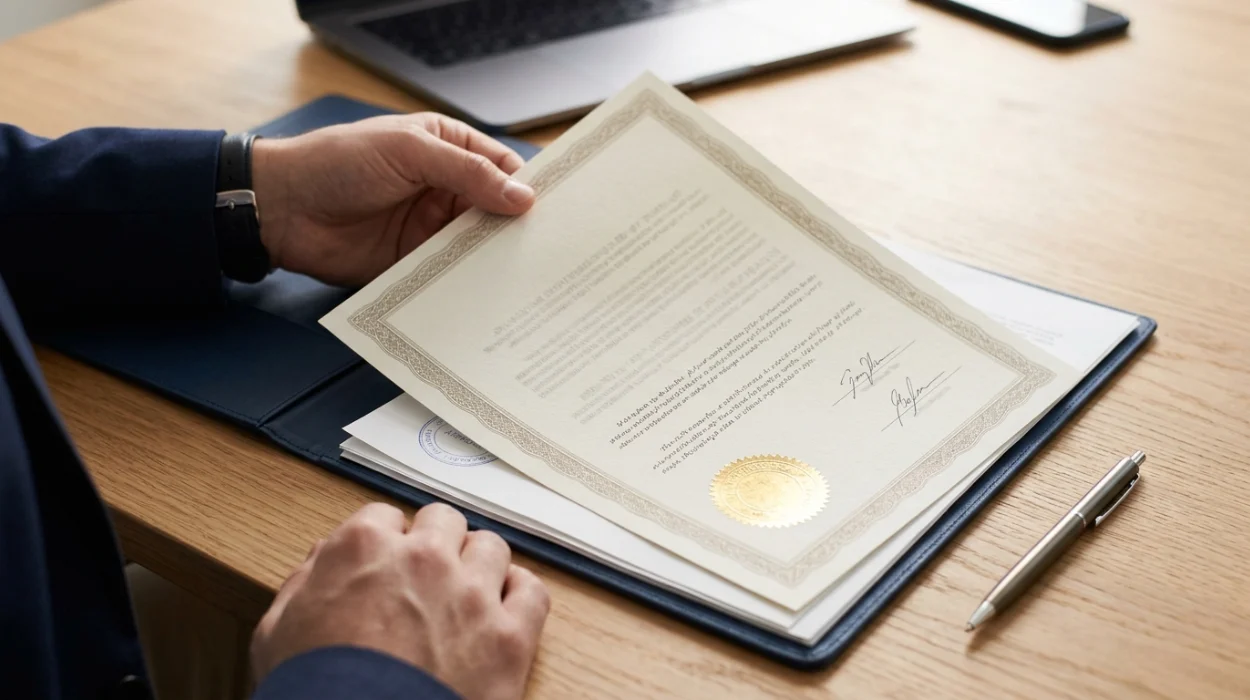
Form My Company delivers officially verified, insurer-ready company documents by extracting authenticated corporate records directly from Companies House. This process provides commercial insurers with instantly verifiable proof of incorporation, active director status, shareholding structures, and registered office details to accelerate underwriting approvals.
Commercial insurance underwriters require concrete proof of corporate legitimacy before issuing policy coverage to registered businesses. Missing or inaccurate documentation delays policy issuance, halts commercial contracts, and exposes enterprises to unnecessary operational risks. Standard incorporation filings often lack the specific verification formatting demanded by institutional risk assessors. Form My Company resolves these administrative friction points by preparing, validating, and delivering fully compliant documentation packages structured specifically for insurance verification protocols.
Understanding how to obtain these documents ensures seamless compliance and uninterrupted commercial protection for growing enterprises. The following sections outline the precise steps, essential document types, and verification frameworks required to satisfy commercial insurance standards in the UK.
Why Do Commercial Insurers Require Verified Company Documents?
Commercial underwriters evaluate verified company documents to authenticate corporate identity, confirm active trading status, identify ultimate beneficial owners, and assess legal liabilities. Validating official Companies House records protects insurers against fraud and ensures policy compliance with UK regulatory frameworks.
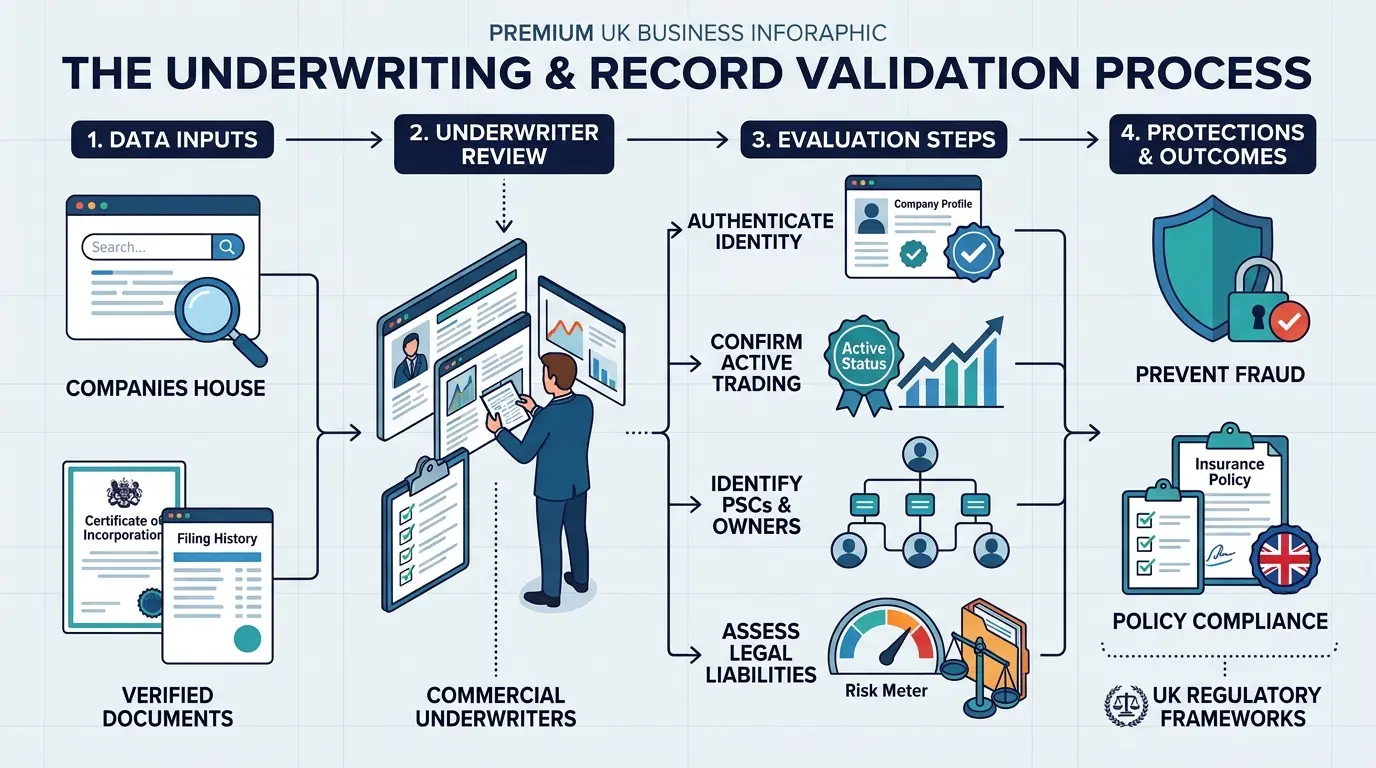
Insurance providers operate under strict risk management guidelines established by UK financial regulators. Underwriters cannot rely on unverified self-reporting when assessing corporate liability, property risks, or professional indemnity claims. Official corporate records serve as legal evidence that an enterprise operates as a valid legal entity capable of entering into binding insurance contracts.
When underwriters review an application, they verify the legal name, registration number, and incorporation date against official registry databases. Discrepancies between application details and public records trigger immediate compliance holds. Validated corporate documentation eliminates these discrepancies by confirming that the company maintains active status, up-to-date annual filings, and compliant corporate governance structures.
Regulatory frameworks like the Money Laundering Regulations 2017 require commercial insurers to verify ultimate beneficial ownership. Insurers analyze structural records to confirm that individuals holding significant control do not appear on financial sanction lists. Providing pre-verified corporate documents satisfies these statutory due diligence requirements immediately.
Establishing clear operational transparency allows underwriters to accurately calculate risk profiles and issue policies without extended verification delays. Business owners who proactively present authenticated corporate files accelerate their access to comprehensive commercial cover. To understand the foundational necessity of these filings during the underwriting phase, review our detailed guide on why business insurers need proof of incorporation.
Which Company Documents Are Required for Insurance Verification?
Insurers require four primary corporate documents: the Certificate of Incorporation, Memorandum and Articles of Association, Confirmation Statement, and Register of Directors. These files collectively validate legal existence, operational rules, ownership distributions, and executive governance.
Each document in an insurer-ready package fulfills a specific compliance check during the underwriting evaluation process. Insurers cross-reference these individual files to construct a complete risk profile of the business entity.
Verify corporate identity using the official Certificate of Incorporation.
Validate governance rules through the Memorandum and Articles of Association.
Confirm ownership structures via the latest filed Confirmation Statement.
Authenticate leadership details using the official Register of Directors.
The Certificate of Incorporation acts as the official birth certificate of the business entity, displaying the unique company number and exact legal name. Insurers use this document to verify that the entity legally existed on the requested policy inception date.
The Memorandum and Articles of Association detail the company’s internal governance and authorized operational scope. Underwriters examine these constitutional documents to confirm that executive officers possess the authority to execute commercial insurance agreements on behalf of the corporation.
Confirmation Statements provide a real-time snapshot of the company’s capital structure, registered address, and persons with significant control. Insurers rely on updated statements to verify that shareholding configurations match the liability exposures declared in the policy application.
The Register of Directors details the full names, service addresses, and appointment dates of all active company officers. Insurers cross-check these records against director database registries to prevent identity fraud and validate signing authority. Collecting these records individually creates administrative overhead, which is why accessing centralized supplementary company documents simplifies the verification workflow for business directors.
How Does Form My Company Prepare Insurer-Ready Documents?
Form My Company retrieves live filings from Companies House, audits data against current underwriting criteria, formats structural schedules, and compiles certified digital documentation packages. This systematic process guarantees that every document meets the strict verification standards set by commercial underwriters.
The preparation workflow begins with an immediate retrieval of public and statutory records directly from the central registrar. Form My Company extracts original filing data to eliminate manual data-entry errors that frequently cause insurance application rejections.
Once retrieved, compliance specialists audit the records for data consistency across all corporate schedules. The audit verifies that officer names, registered addresses, and share structures match perfectly across historical filings and current registers. Any identified discrepancies are corrected before final document generation.
The verified records are formatted into structured compliance portfolios optimized for digital insurance portals. Underwriters receive clear, legible PDF packages structured for immediate optical character recognition and automated compliance parsing.
Final document packages include digital verification markers that allow insurance analysts to validate authenticity without requesting additional manual checks. This automated alignment with insurance standards reduces processing times from weeks to hours. For a complete operational guide on organizing these files prior to submission, consult our overview on how to prepare company documents for commercial insurance cover.
When Should You Update Your Corporate Documentation for Insurance Renewal?
You must update corporate documentation whenever your business changes directors, alters shareholding distributions, relocates registered offices, or reaches annual insurance renewal dates. Providing updated filings prevents coverage gaps and ensures legal enforceability during claim settlements.
Insurance policies operate on the principle of utmost good faith, requiring policyholders to disclose material changes to their corporate structure continuously. Failure to report structural changes to an underwriter can invalidate commercial coverage during a major claim event.
Notify underwriters immediately when appointing or terminating company directors.
Submit updated filings following any changes to registered business addresses.
File amended share schedules after executing new share issuances or transfers.
Provide current confirmation statements at every annual policy renewal milestone.
Annual policy renewals require fresh verification of corporate status to confirm the enterprise remains active and solvent. Submitting outdated corporate files from prior financial years causes underwriting holds and delays policy renewals beyond critical deadlines.
Structural changes like adding a new director or altering ownership percentages alter the corporate risk profile significantly. Underwriters must reassess policy terms whenever control structures shift to maintain accurate risk pricing.
Relocating a registered office requires immediate document updating because geographic location directly impacts property and commercial liability risks. Providing updated statutory address filings ensures policy documentation reflects the correct legal jurisdiction.
Proactive document maintenance eliminates administrative friction during annual coverage reviews. Maintaining continuous compliance guarantees that commercial insurance protection remains uninterrupted throughout corporate growth cycles.
What Are the Key Verification Checks Performed by Underwriters?
Underwriters perform four critical checks: cross-referencing company numbers with registrar databases, validating active director identities, checking financial insolvency registers, and verifying registered office addresses. These systematic protocols ensure the business operates as a legitimate, legally compliant legal entity.
The underwriting verification process relies on standardized cross-validation techniques designed to uncover fraud, financial distress, or administrative non-compliance. Understanding these specific validation checks enables business owners to prepare their filings efficiently.
Database cross-referencing involves matching the exact legal entity name and company registration number against official government records. Even minor spelling variations between the insurance application and statutory filings trigger immediate automated flags.
Director identity validation checks active officers against national fraud databases and sanction lists. Underwriters verify that appointed directors possess the legal capacity to act as corporate fiduciaries without active disqualification orders.
Insolvency register checks determine whether the applying corporation faces pending liquidation proceedings, administration orders, or striking-off notices. Insurers decline coverage to entities undergoing active insolvency actions to mitigate financial default risks.
Address verification protocols confirm that the company maintains an official physical address compliant with statutory service requirements. Underwriters verify that registered office locations correspond with legitimate commercial or official service venues rather than fraudulent addresses.
Satisfying these automated and manual verification checks requires complete, uncorrupted, and officially sourced corporate files. Providing fully validated document bundles ensures rapid approval through modern automated underwriting systems.
How Do Verified Company Documents Speed Up Policy Approval?
Verified company documents speed up policy approval by providing instantly readable, pre-audited corporate data that eliminates manual compliance reviews. Insurers process pre-verified applications through automated underwriting channels, reducing approval times by up to 75%.
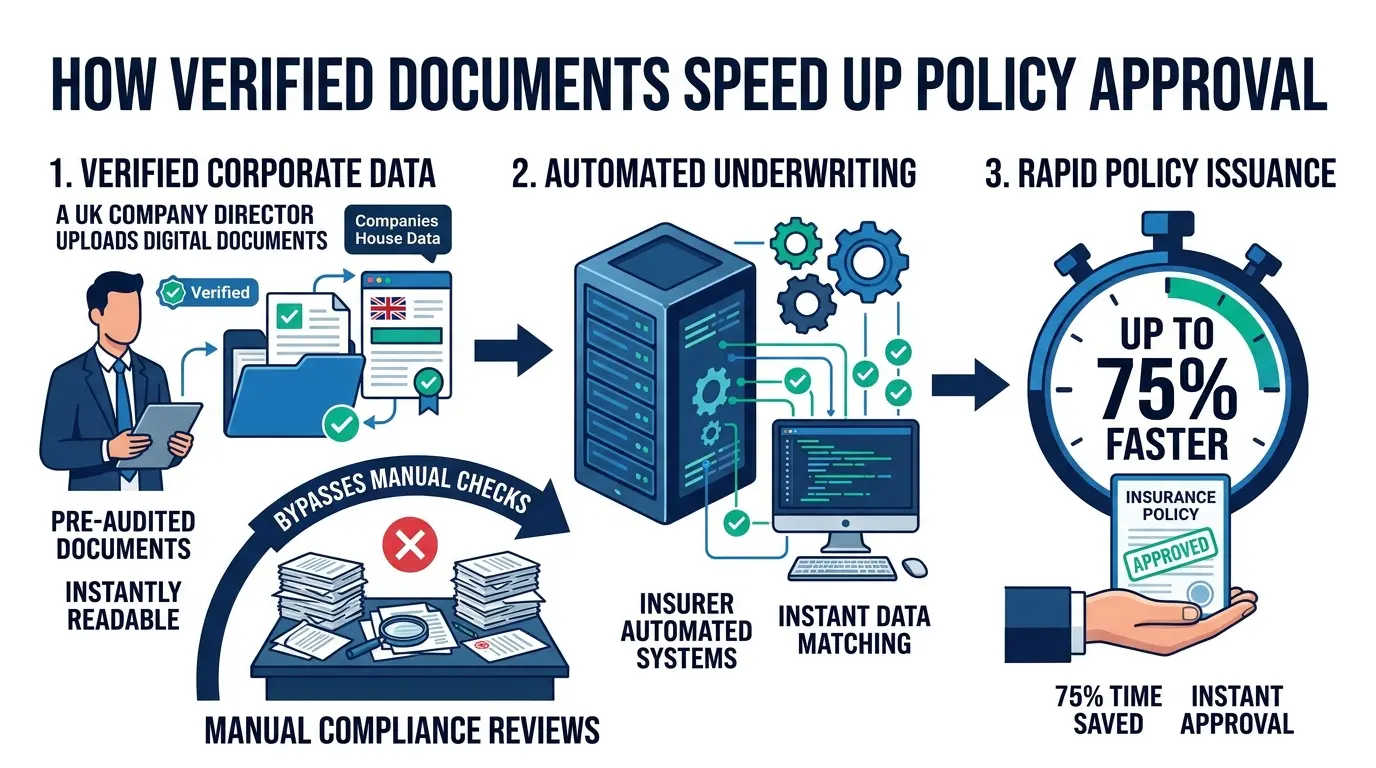
Modern commercial insurance platforms rely heavily on automated underwriting algorithms to process routine business applications. When applicant data matches official corporate records perfectly, automated systems route the file for instant policy approval without human intervention.
Unverified or self-submitted documentation forces insurance underwriters to pause automated processing and initiate manual primary-source verification checks. Manual reviews introduce significant delays, often requiring additional correspondence and back-and-forth document requests.
Pre-audited document packages from Form My Company provide all necessary statutory data points in standardized formats optimized for rapid compliance checking. Underwriters can verify legal status, officer authority, and ownership structures instantly.
Eliminating verification friction allows commercial brokers to secure binding quotes and issue policy certificates on the same day. Fast policy issuance enables businesses to meet urgent contractual deadlines, lease requirements, and client vendor compliance standards smoothly.
Investing in accurate, insurer-ready documentation transforms a complex administrative hurdle into a streamlined, predictable business process. Form My Company provides the official structural filings required to satisfy rigorous underwriting standards and secure essential commercial cover quickly.
Explore More Supplementary Company Documents Guide,
Prove Company Ownership With Documents From Form My Company
Order a Full Set of Supplementary Documents From Form My Company
Frequently Asked Questions
What are supplementary company documents and why are they required?
Supplementary company documents are official legal and administrative records from Companies House, such as Certificates of Good Standing, Articles of Association, and official corporate registers. Commercial lenders, banks, and insurers require these documents from Form My Company to verify a business’s legal incorporation status, ownership structure, and financial standing. Obtaining updated Supplementary Company Documents ensures full regulatory compliance during corporate underwriting and account opening processes.
How do I get official supplementary company documents for my business?
You can request official Supplementary Company Documents directly through Form My Company by providing your registered UK company name or registration number. The platform retrieves authenticated, up-to-date filings straight from Companies House and formats them to meet institutional verification standards. Once processed, your certified corporate document packages are delivered digitally for immediate submission to risk assessors and financial institutions.
Which company documents do commercial insurers request for underwriting?
Commercial insurers typically request a Certificate of Incorporation, Memorandum and Articles of Association, a current Confirmation Statement, and a Register of Directors. Form My Company compiles these essential Supplementary Company Documents into a unified, insurer-ready package to accelerate the verification process. Providing pre-audited statutory filings prevents administrative holds and speeds up policy approval times.
Can Form My Company provide certified copies of Companies House documents?
Yes, Form My Company fetches live, official statutory filings from Companies House to generate certified corporate documentation packages. These Supplementary Company Documents are structured specifically for optical character recognition (OCR) and automated compliance systems used by UK banks and underwriters. Using pre-verified records ensures your company details match public records without data entry discrepancies.
When should a company update its supplementary company documents?
A business must update its corporate documentation whenever changes occur to director appointments, registered addresses, shareholding allocations, or during annual insurance renewals. Accessing updated Supplementary Company Documents via Form My Company ensures all corporate modifications are reflected accurately in official records. Maintaining current statutory filings prevents gaps in commercial insurance coverage and avoids delays in contract approvals.


