Ordering a full set of supplementary documents from Form My Company ensures your UK business maintains regulatory compliance, satisfies banking requirements, and presents verified corporate credentials to external stakeholders through authenticated legal paperwork.
What Are Supplementary Company Documents for UK Businesses?
Supplementary company documents are official administrative records and certificates that confirm your business’s legal standing, ownership structure, operational rules, and statutory compliance with Companies House standards.
UK corporate law requires limited companies to maintain accurate statutory registers and official records. Supplementary company documents expand upon basic incorporation papers. They provide comprehensive legal proof regarding corporate structure and authority.
These documentation packages contain specific statutory credentials. Standard sets include the Memorandum and Articles of Association, Certificate of Incorporation, share certificates, and statutory registers. Financial institutions request these records during business bank account applications. Mortgage lenders, institutional investors, and foreign commercial partners inspect these files during corporate due diligence checks.
Companies House registers basic corporate filings online. However, third parties frequently demand certified hard copies or fully updated internal ledgers. Maintaining complete supplementary documentation prevents operational delays during commercial transactions. Official records establish legal clarity regarding director appointments, shareholder percentages, and voting rights.
Corporate governance frameworks mandate continuous record maintenance. Losing primary certificates disrupts legal transactions and delays contract executions. Ordering a complete documentation set restores statutory records and maintains regulatory compliance across all business operations.
Which Records Are Included in a Complete Supplementary Document Pack?
A complete supplementary document pack includes the Certificate of Incorporation, Memorandum and Articles of Association, official share certificates, combined statutory registers, and corporate seal certificates.
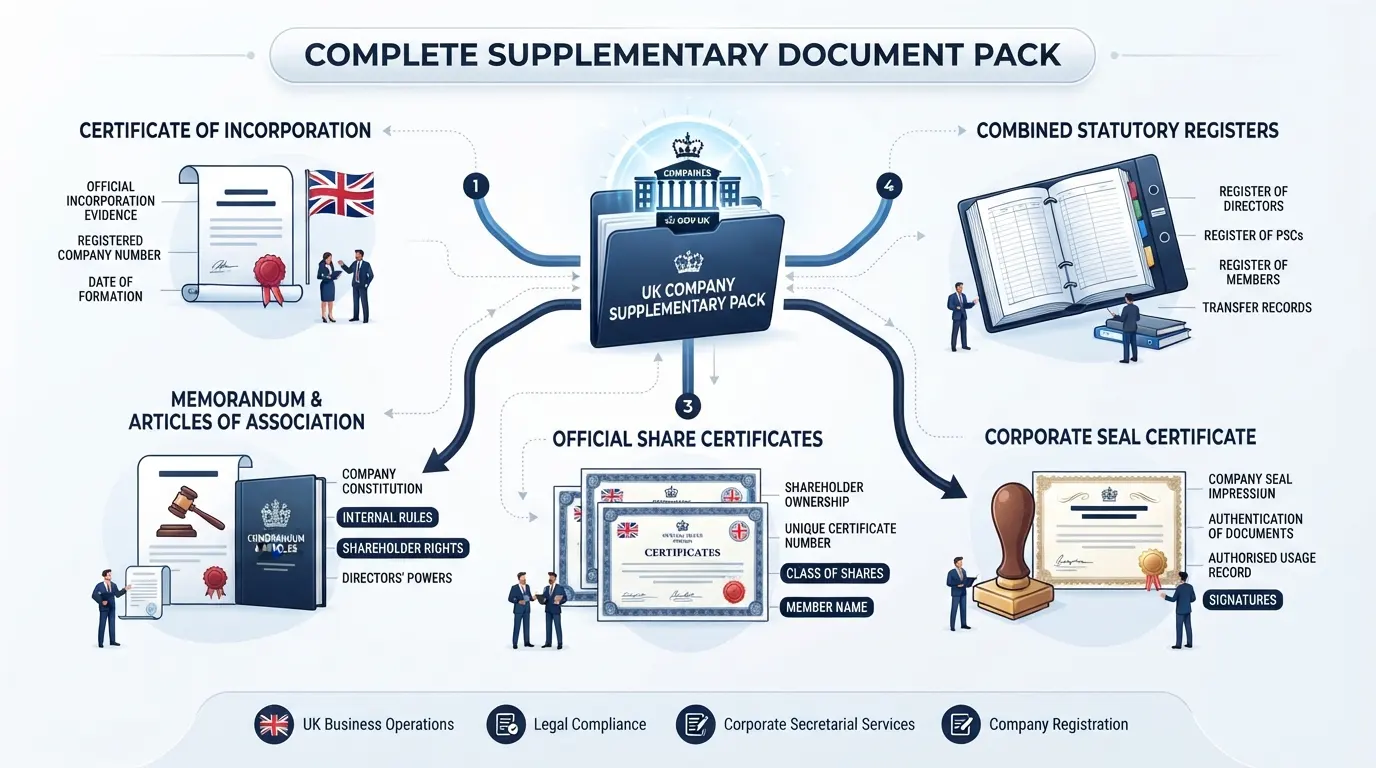
The Certificate of Incorporation acts as the official birth certificate of a UK legal entity. It displays the unique company registration number, incorporation date, and legal structure type. Lenders demand this document to verify legal existence.
The Memorandum and Articles of Association establish the internal governance rules of your enterprise. The memorandum states the initial subscribers’ intent to form the company. The articles define director powers, shareholder voting thresholds, dividend distribution rules, and share transfer procedures. Commercial partners review these articles to confirm director signing authority.
Share certificates provide physical and legal proof of equity ownership. Each certificate details the number of shares held, share class designations, and nominal values. Corporations issue these records to shareholders immediately following share allocations or equity transfers.
Combined statutory registers track corporate changes over time. These registers comprise five specific books:
Register of Directors and Secretaries
Register of Directors’ Residential Addresses
Register of Shareholders (Members)
Register of Persons with Significant Control (PSC)
Register of Mortgages and Charges
Statutory ledgers store legal history. Third parties review these ledgers to validate corporate integrity during acquisitions.
When Does Your Business Need Certified Supplementary Documents?
Businesses need certified supplementary documents when opening commercial bank accounts, securing debt financing, onboarding high-value clients, transferring equity, or switching professional service providers.
Financial institutions enforce strict Anti-Money Laundering (AML) protocols. Banks verify corporate governance structures before approving commercial accounts. Underwriters review statutory registers to identify ultimate beneficial owners. Missing ownership records delay account activation timelines.
International commercial operations require legal document authentication. Foreign governments demand apostilled or certified company documents when UK businesses open overseas branches. Officials inspect these papers to confirm corporate legitimacy under international law.
Commercial debt financing triggers rigorous legal scrutiny. Lenders examine company articles to verify borrowing limits and director authorities. Providing outdated filings stalls loan approvals. Supplying updated documentation accelerates financial underwriting.
Corporate restructuring requires immediate document updates. Appointing new directors or reallocating share capital alters statutory records. Issuing updated share certificates protects investor equity and updates internal registers.
Service transitions also require comprehensive document handovers. When changing corporate advisors, management teams must supply complete operational records to new representatives. Reviewing the guide on How to Hand Over Company Documents When Switching Accountants simplifies this transition process and prevents administrative disruptions.
Why Do Third Parties Require Official Company Verification Files?
Third parties require official company verification files to validate corporate authority, assess legal liability, prevent fraud, and satisfy statutory Anti-Money Laundering compliance obligations.
Regulatory frameworks compel professional bodies to audit corporate clients. Solicitors, accountants, and financial brokers risk regulatory penalties if they engage unverified commercial entities. Inspecting original documentation fulfills statutory Know Your Customer (KYC) requirements.
To understand why professionals conduct these checks, review the analysis covering Why Do Accountants Ask for Your Company Formation Documents?. Professional advisors inspect articles to confirm that directors possess appropriate legal authorization to execute contracts.
Corporate fraud prevention requires rigorous verification procedures. Bad actors sometimes submit altered filings or unauthorized corporate changes to Companies House. Counterparties request official supplementary documentation to cross-reference public filings against certified internal registers.
Contract enforcement depends on proper corporate authority. Contracts signed by unauthorized personnel create legal vulnerabilities. Counterparties verify director powers inside company articles before executing high-value commercial agreements.
Commercial landlords examine corporate records before signing commercial leases. Landlords evaluate corporate solvency, director identity details, and equity structures. Presenting authenticated records demonstrates financial stability and accelerates lease negotiations.
How Does Ordering Supplementary Documents Simplify Corporate Compliance?
Ordering supplementary documents simplifies corporate compliance by centralizing statutory records, correcting ledger discrepancies, standardizing internal governance, and providing instant audit-ready files.
Managing statutory records internally creates administrative burdens for business owners. Legal details become fragmented across digital files, email threads, and physical folders. Ordering central documentation organizes statutory data into standardized reference binders.
Companies House public registers do not store internal company registers. The public register records basic filings, but companies must maintain internal statutory registers independently. Ordering professional documentation bridges this gap by generating compliant statutory books.
Accurate records simplify corporate tax filings and statutory reporting. Professional corporate services prepare documents using compliant legal phrasing. Standardized records eliminate formatting errors that trigger corporate filing rejections.
Audit readiness protects directors from statutory penalties. UK law penalizes directors who fail to maintain accurate statutory registers. Keeping updated supplementary records safeguards officers against administrative fines and corporate non-compliance penalties.
Why Choose Form My Company for Your Supplementary Documentation?
Form My Company delivers fully compliant, professionally formatted supplementary document packages that meet UK Companies House standards and satisfy corporate banking requirements.
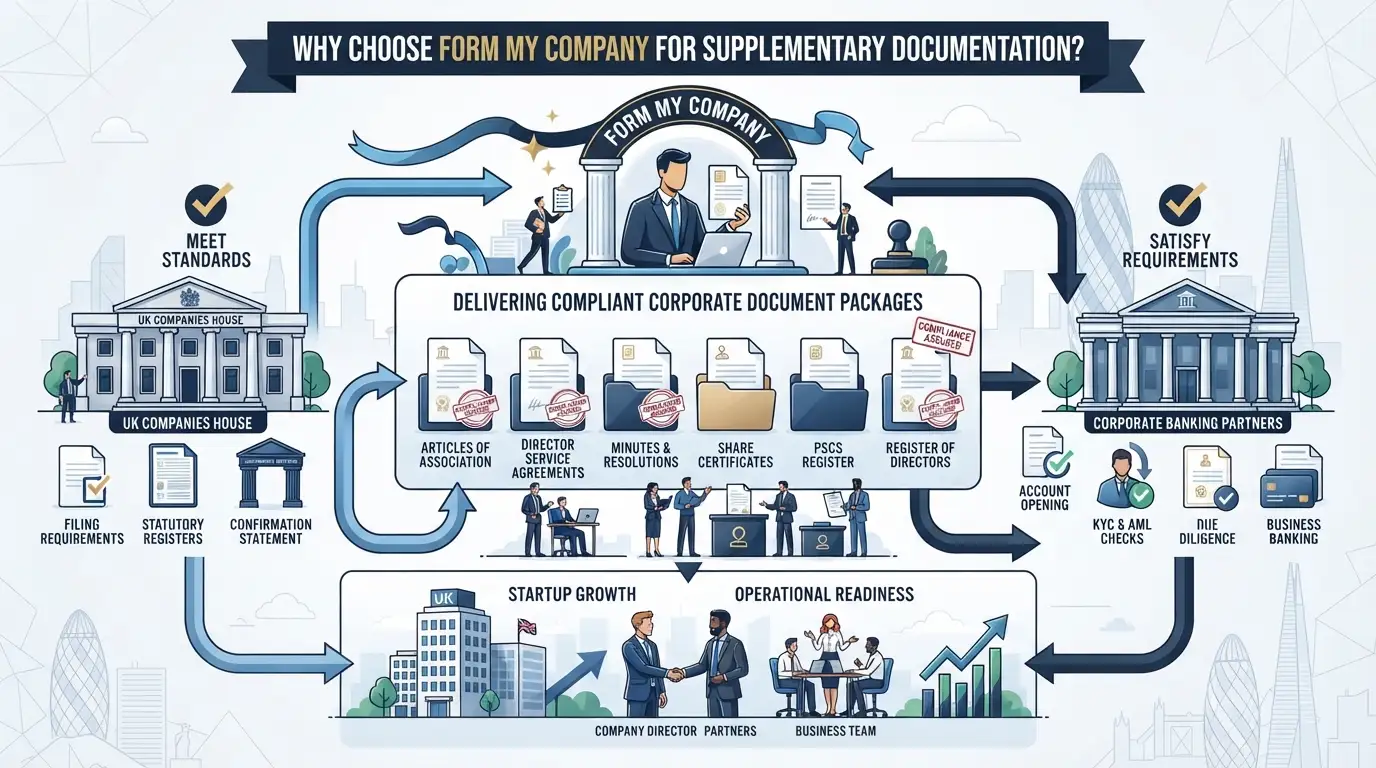
Form My Company generates customized corporate document packages tailored to your specific business structure. Experienced corporate compliance specialists verify every file against current Companies House data. This verification process eliminates record discrepancies and guarantees document accuracy.
Fast processing timelines prevent commercial delays. Form My Company prepares complete document sets rapidly, delivering digital files and printed bound registers directly to your office. Immediate access to accurate paperwork keeps business deals moving forward.
Customized articles of association address specific operational requirements. Standard model articles do not always fit complex shareholder structures. Form My Company structures governance paperwork to match your precise corporate management needs.
Businesses ready to secure official administrative records can order a full set of supplementary documents from Form My Company to receive fully authenticated corporate paperwork.
Professional document presentation reinforces corporate credibility. High-grade physical documentation binders present an executive image during investor meetings, banking presentations, and corporate audits.
Explore More Supplementary Company Documents Guide,
Order a Sale-Ready Company Document Pack From Form My Company
Get Grant-Ready Company Documents From Form My Company
What Is the Step-by-Step Process to Order Supplementary Documents?
The process to order supplementary documents requires submitting your company registration number, selecting required document types, verifying corporate data, and receiving certified digital or physical packages.
Ordering statutory documentation involves a structured four-step procedure:
Enter company registration details using the secure online portal.
Select specific document packages matching your corporate compliance requirements.
Verify automated data extractions against current internal records.
Download digital files or receive bound physical documentation by courier.
System integration pulls existing records directly from Companies House. Automatic data populating eliminates manual typing errors. Specialized software formats statutory registers, share certificates, and company articles to meet legal standards.
Review steps ensure absolute operational accuracy. Compliance team members cross-reference officer details, PSC statements, and share allocations before finalizing documentation. Double verification guarantees full legal compliance.
Digital deliveries arrive in secure, high-resolution PDF formats suitable for electronic transmission. Physical orders arrive in professional ring-bound presentation folders ready for commercial use.
Form My Company provides comprehensive supplementary company documentation services for UK businesses. Obtaining professionally formatted statutory registers, share certificates, and corporate articles ensures complete regulatory compliance. Authenticated corporate documents satisfy strict banking standards, accelerate commercial due diligence, and streamline accounting transitions. Form My Company handles corporate paperwork preparation, allowing business owners to focus on commercial growth.
Frequently Asked Questions
What are supplementary company documents?
Supplementary company documents are official legal and administrative records—such as statutory registers, share certificates, and modified Articles of Association—that complement basic incorporation paperwork for UK businesses. Services like Supplementary Company Documents from Form My Company provide these standardized corporate records to ensure ongoing statutory compliance under the UK Companies Act 2006.
Why do banks require supplementary company documents to open a business account?
UK financial institutions require supplementary company documents to satisfy strict Anti-Money Laundering (AML) and Know Your Customer (KYC) compliance protocols before opening a business bank account. Reviewing verified statutory registers, official share certificates, and corporate governance papers allows banks to confirm director authority and validate ultimate beneficial ownership.
How can a business replace lost official company formation documents?
A UK business can replace lost or misplaced statutory records by ordering a comprehensive set of Supplementary Company Documents from Form My Company. These replacements are generated directly from verified Companies House records and official statutory filings to restore your firm’s complete legal registry.
What is the difference between standard public filings and statutory company documents?
Standard public filings at Companies House record high-level corporate data for public inspection, whereas statutory company documents comprise detailed internal registers and legal certificates owned by the enterprise. UK corporate law mandates that limited companies independently maintain up-to-date statutory registers, including member ledgers and Persons with Significant Control (PSC) registers, alongside public filings.
When should a company update its supplementary corporate records?
A business must update its supplementary corporate records whenever structural governance changes occur, such as appointing new directors, issuing or transferring shares, or altering voting rights. Updating these files through Form My Company ensures administrative continuity, prevents delays during corporate audits, and simplifies professional handovers to legal or financial advisors.