

Switching accountants requires transferring statutory registers, historical tax filings, accounting records, payroll data, and confirmation statements. Provide these documents via a secure digital portal or encrypted email to ensure continuous HMRC compliance and prevent operational disruption during your practice transition.
Changing your accounting service provider marks a critical operational shift for any UK business. Managing the legal transfer of corporate records protects your business against compliance gaps, penalty notices, and unexpected tax liabilities.
A structured document handover guarantees that your new financial advisor gains immediate access to historical transaction data. Clear communication between incoming and outgoing accounting teams minimizes administrative friction.
UK company directors hold legal responsibilities under the Companies Act 2006 to maintain accurate corporate accounting records. Transferring these documents systematically ensures your new practice can verify historical VAT returns and corporate tax assessments.
What Corporate Records Must You Transfer When Changing Accountants?
Transfer your certificate of incorporation, articles of association, statutory registers, annual accounts, VAT records, and corporation tax submissions. You must also supply payroll records, PAYE reference numbers, and recent bank statements to complete the professional onboarding process.
Corporate identity documents form the foundation of your new accounting relationship. Incoming accounting firms inspect these files to verify beneficial ownership structures and confirm officer details against Companies House records.
Statutory books record historical changes in company ownership, director appointments, and share allocations. Missing statutory registers trigger delays during Anti-Money Laundering verification procedures.
Financial statements from previous accounting periods allow your new team to establish accurate opening balances. Providing full trial balances alongside detailed general ledgers ensures continuous accounting accuracy across fiscal years.
Tax filing histories prevent duplicate submissions and clarify outstanding liabilities with HM Revenue and Customs. Disclosing past Corporation Tax calculations allows your incoming team to review previous R&D tax credit claims or capital allowance deductions.
Payroll files retain critical data regarding employee tax codes, national insurance obligations, and pension scheme enrollments. Handing over complete Year-to-Date payroll reports prevents statutory payment miscalculations during active pay cycles.
How Does the Professional Clearance Process Work?
The professional clearance process requires your new accountant to send a formal letter to your outgoing accountant requesting access to your complete financial records, historical working papers, and outstanding tax correspondence upon your explicit written authorization.
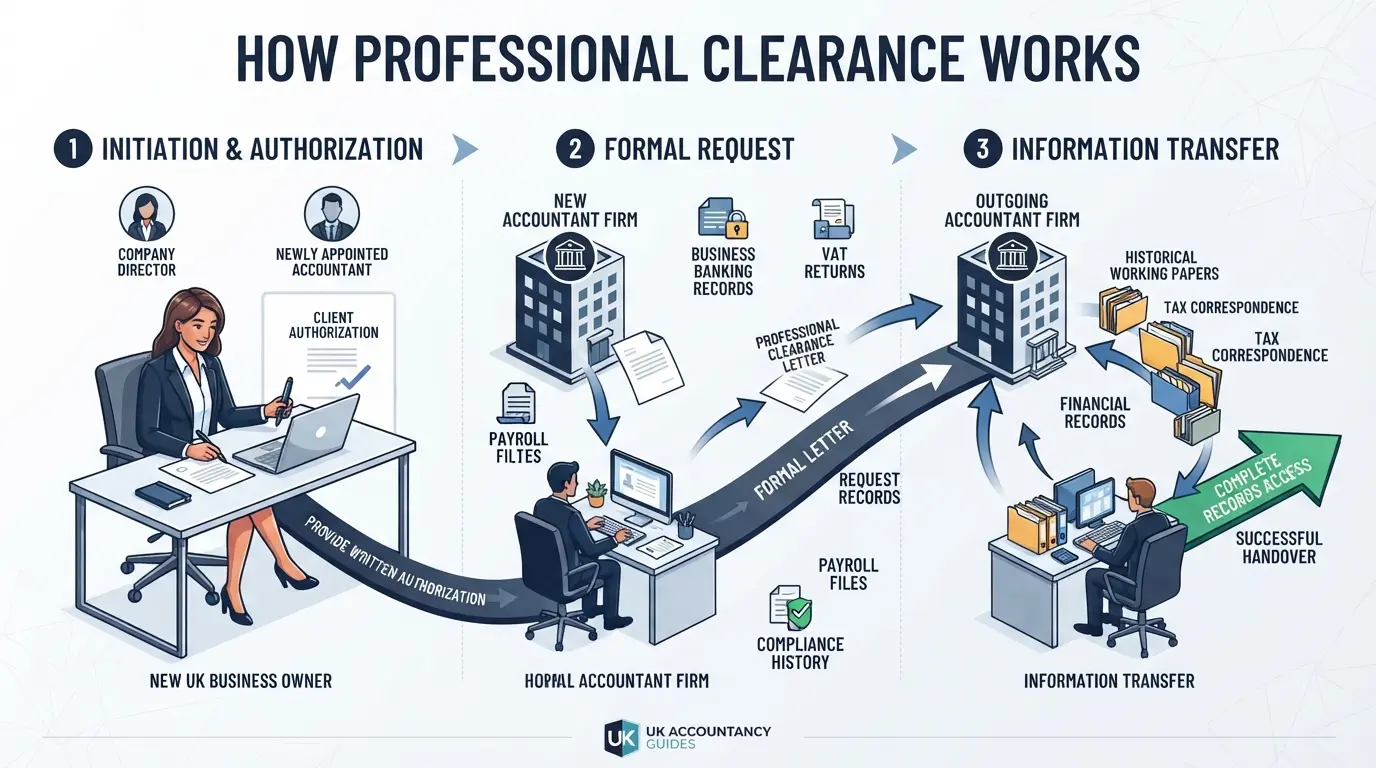
Professional ethical guidelines govern how UK accountants transition clients between practices. Your written permission authorizes your former firm to disclose confidential financial data to your new service provider.
Outgoing accountants prepare a detailed handover pack containing client working papers, trial balances, and recent tax computations. Regulations established by professional bodies compel outgoing practitioners to respond to clearance requests without unnecessary delay.
Unsettled fee disputes between clients and outgoing practices can sometimes delay document releases. Former accountants may exercise a legal lien over specific accounting records until clients settle outstanding administrative fees.
Direct communications between practitioners reduce administrative burdens on company directors. Your new accountant inspects received clearance packages to verify record completeness before initiating live statutory filing procedures.
Reviewing historical communication logs during clearance helps uncover ongoing HMRC inquiries or open tax disputes. Early disclosure allows incoming financial advisors to formulate appropriate representation strategies.
Which Statutory Company Documents Validate Your Corporate Structure?
Validate your corporate structure by providing updated share certificates, register of members, register of directors, PSC registers, and official incorporation documentation. These records prove legal ownership and confirm director authority under current UK business legislation.
Incorporation documents establish your corporate entity as a distinct legal structure under UK company law. Your new accounting provider evaluates these original filings to confirm your registered office address and company registration number.
Statutory registers track historical changes in share ownership and corporate leadership since company formation. Presenting accurate registers of members prevents disputes concerning shareholder voting power and dividend entitlement distribution.
Persons with Significant Control registers document individuals who hold more than 25 percent of company voting rights. Maintaining compliant PSC registers protects corporate officers against statutory fines issued by Companies House.
Articles of Association define internal corporate governance rules and director operational boundaries. Incoming financial teams inspect these articles to verify borrowing limits, dividend authorization protocols, and share transfer restrictions.
When internal corporate records become lost or outdated, directors must source replacement structural documentation. Securing official copies of your company setup files ensures smooth regulatory compliance during practice transitions. Obtaining Supplementary Company Documents supplies verified legal records to validate your corporate structure for incoming financial advisers.
Explore More Supplementary Company Documents Guide,
How to Build a Document Pack Before Selling Your Company
How to Prepare Company Paperwork for Grant and Funding Bodies
Why Do Incoming Accountants Require Previous Tax Submissions?
Incoming accountants require previous tax submissions to verify historical HMRC compliance, audit carry-forward losses, confirm VAT calculation methods, and reconcile opening balances against past corporate returns to prevent tax assessment errors.
Historical Corporation Tax returns establish baseline financial positions for your commercial enterprise. Reviewing past computations enables your new accountant to identify unused trading losses available for offset against future corporate profits.
Value Added Tax records verify whether your business utilizes specific accounting schemes such as flat rate or cash accounting methods. Providing historical VAT filings allows your incoming advisor to confirm compliance with Making Tax Digital rules.
PAYE alignment reports verify that past payroll deductions match live HMRC account balances. Uncovering historical payroll discrepancies early protects your business from unexpected interest charges or automated statutory penalties.
Capital allowance claims from previous accounting periods carry forward into future tax calculations. Inspecting previous asset registers guarantees that your new firm claims appropriate tax relief on historical capital expenditures.
Understanding historical accounting decisions clarifies why previous advisers adopted specific tax positions. Reviewing past records allows your new practitioner to assess your risk profile and optimize ongoing tax compliance strategies.
Examining incoming request requirements clarifies why new practices request extensive background data. Reviewing Why Do Accountants Ask for Your Company Formation Documents? explains the statutory obligations driving information requests during onboarding.
How Do You Transfer Digital Accounting Data Securely?
Transfer digital accounting data securely by reassigning cloud software administrator permissions, exporting full ledger backups as encrypted CSV files, and transmitting sensitive tax documents via multi-factor authenticated client portals.
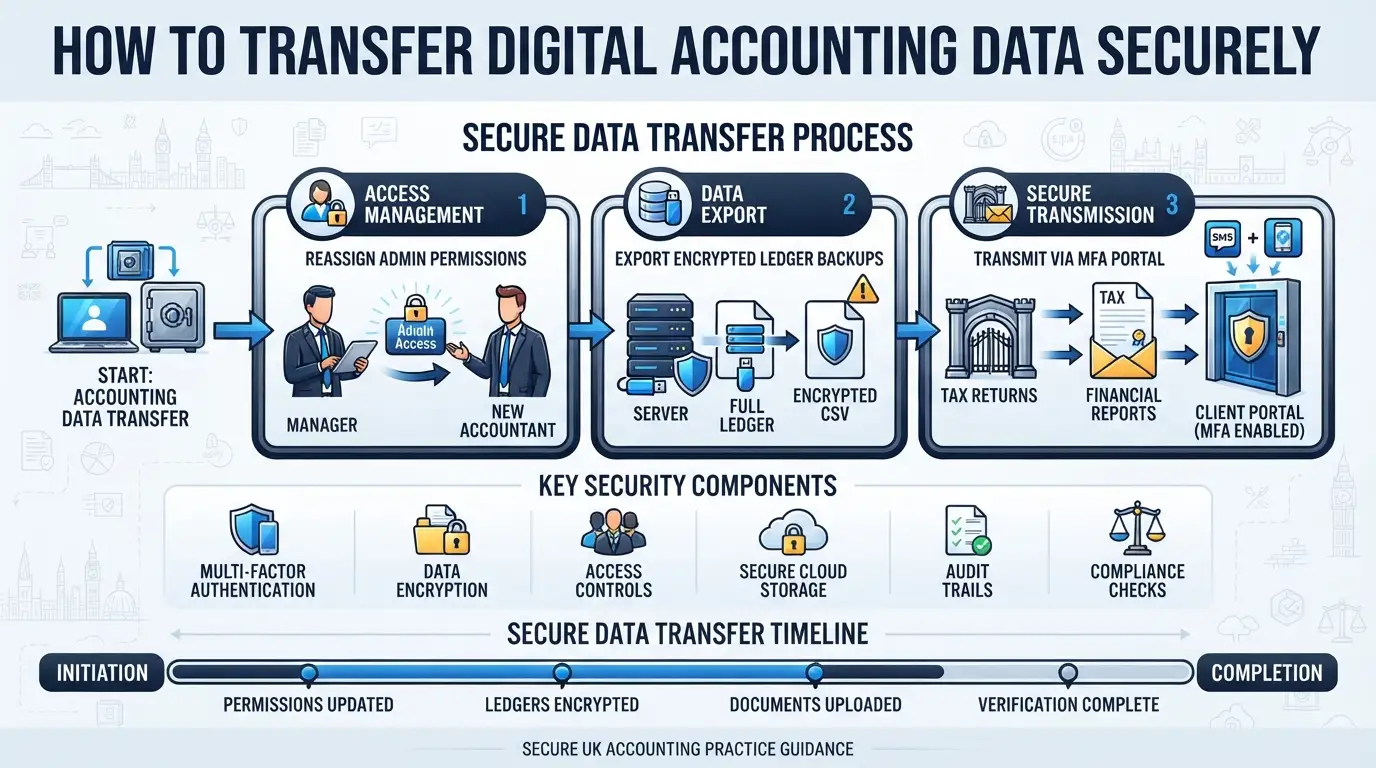
Cloud accounting platforms streamline practice transitions by permitting instant software permission reassignments. Updating user access settings transfers subscriber administration rights directly to your incoming financial team without data export friction.
Data encryption protocols shield sensitive financial information during active network transmission. Transmitting company records via password-protected links or end-to-end encrypted storage prevents unauthorized access by third parties.
Exporting complete trial balances, customer databases, and supplier ledgers creates offline data backups before account permissions change. Retaining local copies of historical database exports protects your enterprise against data loss during platform migration.
Bank feed integrations require manual reconfiguration when transitioning between accounting practices. Re-authenticating open banking connections within your primary software ensures continuous automated transaction importing.
Document retention schedules dictate how long corporate records must remain accessible following practice transfers. Storing digital archives in structured file directories maintains compliance with UK six-year statutory record retention mandates.
What Are Common Handover Delays and How Do You Avoid Them?
Avoid handover delays by clearing outstanding accounting invoices, requesting professional clearance early, compiling complete corporate registers beforehand, and establishing clear document transfer deadlines between outgoing and incoming accountancy practices.
Unpaid invoices represent the primary cause of document handover delays in the UK accounting sector. Settling final billings promptly removes legal justification for outgoing firms to withhold client working papers.
Incomplete statutory records create significant friction during Anti-Money Laundering checks. Auditing your corporate record files prior to initiating practice switches ensures all required documents are ready for immediate transmission.
Vague communication timelines slow down the exchange of accounting records between firms. Defining firm handover schedules keeps both incoming and outgoing practitioners accountable to agreed operational transition deadlines.
Outdated director contact details registered at Companies House delay identity verification procedures. Updating officer profile entries beforehand enables your new accounting team to complete AML compliance protocols efficiently.
Missing physical share certificates or unrecorded equity changes force incoming teams to reconstruct corporate ledgers. Ordering replacement structural paperwork ahead of your transition keeps onboarding timelines intact. Securing a complete set of legal files accelerates client onboarding. Choosing to Order a Full Set of Supplementary Documents From Form My Company provides replacement corporate papers to eliminate onboarding delays.
Form My Company assists UK business owners by providing statutory company documents required during accounting transitions. Providing verified legal paperwork ensures your new accounting firm completes compliance onboarding without administrative friction.
Frequently Asked Questions
What are supplementary company documents for a UK business?
Supplementary company documents are official legal and administrative records that complement a business’s primary incorporation certificate and articles of association. These records include statutory registers, share certificates, change of name certificates, and official proof of registered address. Form My Company provides certified copies of supplementary company documents to help UK directors maintain corporate compliance and satisfy identity verification requirements.
Why do banks and accountants request supplementary company documents?
Financial institutions, lenders, and accountants request supplementary company documents to verify a business’s legal ownership structure and confirm director authority under Anti-Money Laundering (AML) regulations. Reviewing updated statutory registers and share certificates ensures that third parties interact with authorized company officers. Business owners can order missing or updated supplementary company documents through Form My Company to complete corporate onboarding without delays.
How do I get replacement statutory registers or share certificates?
Replacement statutory registers and official share certificates can be compiled using verified historical filings held at Companies House. If original legal paperwork is lost, stolen, or outdated during corporate restructurings, directors must reissue these records to preserve legal proof of membership. The Form My Company supplementary company documents service delivers accurately prepared corporate records tailored to current statutory guidelines.
What is included in a full set of supplementary company documents?
A full set of supplementary company documents typically contains a register of members, register of directors, Persons with Significant Control (PSC) register, share certificates, and current articles of association. Additional certificates, such as proof of good standing or official address confirmation letters, are also included depending on administrative needs. Ordering a complete package via Form My Company ensures businesses hold all necessary statutory paperwork for legal and financial audits.
How long does it take to obtain supplementary company documents?
The processing time for supplementary company documents ranges from same-day digital delivery to 24–48 hours for printed and certified hard copies. Digital PDF formats are dispatched rapidly to meet urgent banking, accountancy handover, or legal deadlines. Form My Company streamlines document retrieval and drafting, ensuring UK businesses receive verified supplementary company documents promptly.


