UK companies pass online marketplace seller verification by submitting matching official incorporation certificates, director identity proofs, and recent proof-of-address documents that align perfectly with their registered Companies House records. Verification systems automatically flag and reject applications containing spelling discrepancies, outdated addresses, or unverified beneficial ownership details.
Why Do Online Marketplaces Require UK Company Seller Verification?
Marketplaces enforce seller verification to prevent fraud, maintain tax compliance, and protect buyers under UK commercial trading laws. Digital platforms validate corporate entities through official registries to confirm legitimate business operations, ownership structures, and verified physical operating locations across the United Kingdom.
Online marketplaces process billions of pounds in transactions every year. Regulators enforce anti-money laundering regulations and strict seller identification requirements on third-party platforms. Platforms run automated checks against Companies House databases to verify that registered UK businesses operate legally.
Failure to verify company identities exposes marketplaces to regulatory fines, tax evasion liabilities, and consumer fraud risks. Platforms suspend accounts instantly when corporate documentation fails initial authentication algorithms. Knowing what documents online marketplaces ask UK sellers for helps directors gather necessary paperwork before initiating their registration applications.
Biometric checks and official record lookups form the primary defense against fraudulent registrations. Platforms validate VAT registration numbers, Economic Operators Registration and Identification (EORI) details, and active director standings. UK companies that maintain accurate corporate registers clear these security hurdles without delays.
Which Documents Do UK Companies Need for Marketplace Verification?
UK companies require official incorporation certificates, director identification, bank statements, proof of address, and beneficial ownership structures for marketplace verification. Submitting complete, unaltered documents speeds up automated account approval processes across all major UK digital platforms.
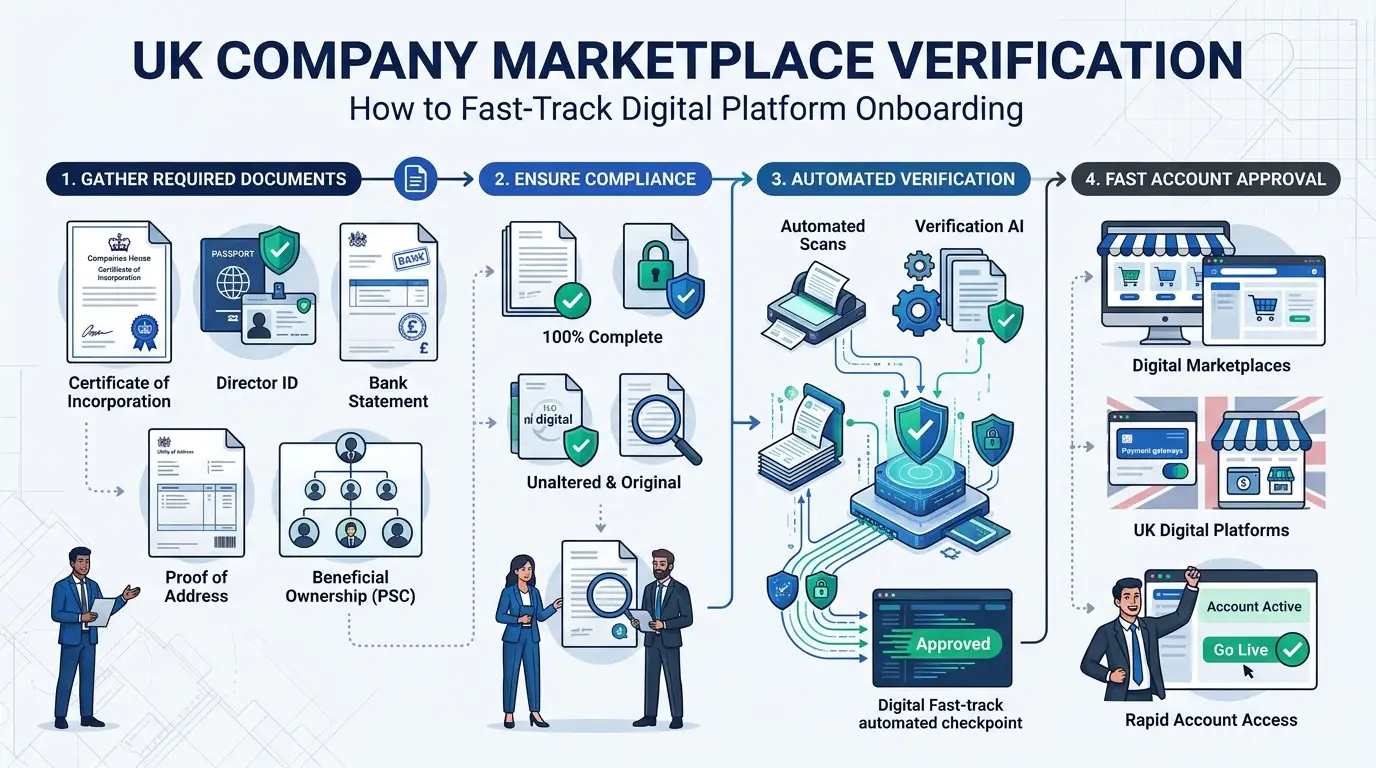
Marketplace verification algorithms scan four core document types: official corporate registration records, director identity documents, corporate bank statements, and utility bills. Algorithms compare every character on submitted documents against public records.
Provide official Certificate of Incorporation issuing from Companies House
Submit valid passports or UK driving licences for all active directors
Upload corporate bank statements showing official trading names and registered addresses
Produce utility bills issued within the last 90 days matching exact company addresses
Discrepancies in punctuation or formatting trigger immediate manual reviews. Submitting clear color scans instead of mobile photos prevents automated scan failures. Ensure all PDF files remain uncompressed and unedited to pass security checks.
Companies with complex ownership structures must document all individuals holding 25% or more of voting rights. Platforms require full legal names, residential addresses, and birth dates for every ultimate beneficial owner. Providing complete ownership records upfront eliminates repeated requests for additional verification evidence.
How Can UK Companies Prevent Rejection During Verification Checks?
Companies prevent verification rejection by aligning submitted business details precisely with Companies House records, providing valid documents, and uploading legible scans. Matching registered corporate names, official addresses, and active director profiles ensures seamless automated compliance validation.
Marketplace verification systems fail applications due to simple typographical mistakes. Entering an abbreviated business name online when official incorporation documents display the full legal title causes immediate system flags.
When directors update registered addresses at Companies House, they must update utility accounts and bank profiles simultaneously. Submitting bank statements displaying outdated addresses leads to instant verification failure. Ensure bank statements show active transaction history alongside official business branding.
Scanning original paper documents at 300 DPI resolution yields clear files for optical character recognition engines. Avoid cropping document edges, obscuring official seals, or submitting low-resolution digital screenshots. Verification systems automatically reject rotated or blurred document uploads.
Acquiring certified supplementary company documents guarantees that corporate credentials meet strict platform verification criteria. Certified copies of memorandum and articles of association confirm internal corporate governance structures. Clear documentation reduces verification delays from weeks to minutes.
How Does Beneficial Ownership Impact Marketplace Seller Verification?
Beneficial ownership rules require companies to declare and verify every individual controlling 25% or more of voting rights. Marketplaces validate People with Significant Control (PSC) registers to prevent hidden corporate ownership and satisfy anti-money laundering mandates.
UK regulations require digital platforms to identify who ultimately owns and controls corporate entities. Marketplaces pull PSC registers directly from Companies House to verify equity distribution.
If corporate shareholding records change, businesses must file updated PSC declarations immediately. Marketplaces halt verification if submitted ownership charts contradict public corporate filings. Submitting official registers of members confirms shareholder distributions accurately.
Corporate shareholders holding majority stakes must provide secondary corporate documentation. Marketplaces inspect complete ownership chains until reaching individual natural persons. Holding companies operating in foreign jurisdictions face additional authentication requirements, including notarized translation documents.
Properly documenting corporate structures ensures compliance with UK money laundering regulations. Transparent business structures build platform trust and unlock higher transaction limits on merchant accounts. Accurate PSC reporting keeps merchant accounts active and fully operational.
What Steps Should UK Businesses Take to Fix a Failed Verification Attempt?
Businesses fix failed verification attempts by reviewing rejection notices, updating mismatched Companies House records, obtaining fresh official documentation, and re-uploading high-resolution scans. Addressing exact failure reasons prevents permanent account suspensions on major selling platforms.
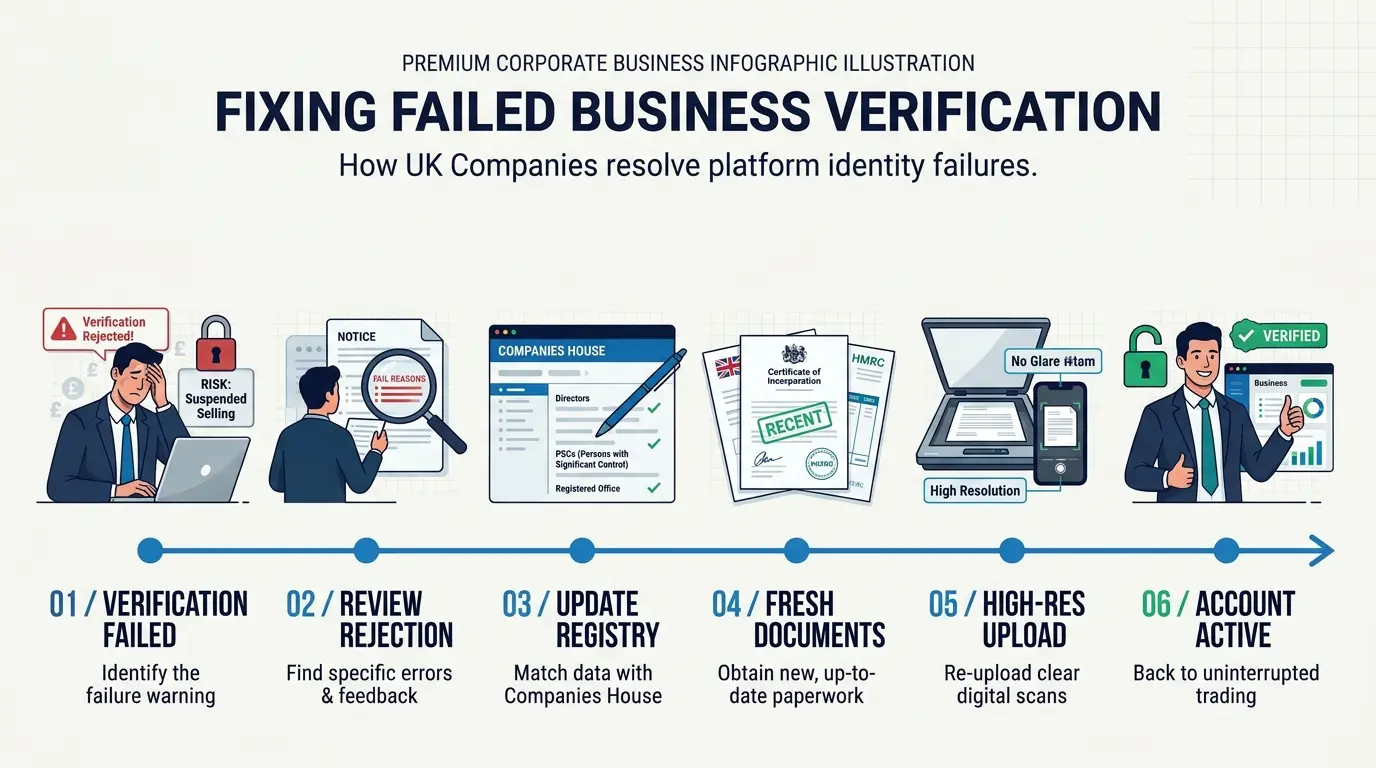
Receiving a verification rejection letter requires immediate, methodical action. Platforms state specific rejection reasons, such as document legibility, name mismatches, or expired director identification.
Review the rejection notice to pinpoint specific failing compliance criteria
Inspect Companies House records to identify data mismatches against submitted forms
Request updated certified corporate documents from official corporate registration specialists
Upload color PDF scans containing full document borders and visible security markers
Attempting repeated uploads with identical, flawed documents triggers permanent account bans. When technical system errors cause incorrect rejections, contacting specialized seller support channels with certified evidence resolves account blocks.
When experiencing persistent verification blocks, purchasing official marketplace verification documents from Form My Company provides verified corporate records designed to clear manual compliance audits. Freshly certified documents demonstrate current operational legitimacy directly to marketplace compliance teams.
How long does marketplace verification take for a UK limited company?
Marketplace verification takes between 24 hours and 10 business days for standard UK limited companies. Automated systems process clear applications quickly, while manual compliance reviews for complex ownership structures extend review timelines.
Processing speed depends on document accuracy and automated system availability. Applications featuring standard UK directors, matching addresses, and clear bank statements clear automated security pipelines within 24 to 48 hours.
Applications triggering manual compliance checks enter secondary review queues. Human compliance officers evaluate complex shareholding networks, recent director changes, or international corporate parents. Manual reviews typically take 5 to 10 working days depending on platform volume.
Submitting pre-verified, standardized corporate documentation prevents manual routing altogether. Maintaining clean corporate records ensures rapid verification when expanding onto additional digital selling channels.
Explore More Supplementary Company Documents Guide,
How to Prepare Company Documents for Commercial Insurance Cover
How to Combine Formation Documents and Registers to Prove Ownership
Frequently Asked Questions
What are supplementary company documents for a UK business?
Supplementary company documents are official legal filings and certified records that update or expand upon a UK firm’s initial certificate of incorporation. These include statutory registers, resolution minutes, share certificates, and Certificates of Good Standing required for corporate governance. Businesses can obtain certified Supplementary Company Documents through Form My Company to maintain regulatory compliance with Companies House.
Why do banks and online marketplaces require supplementary company documents?
Financial institutions and digital trading platforms mandate supplementary documentation to verify beneficial ownership structures, confirm active director credentials, and satisfy strict anti-money laundering (AML) compliance laws. Presenting certified extracts ensures that a company’s operational details match public registry filings in real time. Form My Company prepares verified document packs that satisfy third-party merchant and corporate banking due diligence checks.
Which specific records are included in a supplementary company document pack?
A complete supplementary pack typically contains the Register of Directors, Register of Shareholders, PSC (Persons with Significant Control) register, Articles of Association, and official share certificates. It may also incorporate Certificates of Good Standing or official change-of-name documents depending on specific operational requirements. Form My Company packages these corporate records into authenticated digital or physical formats ready for immediate presentation.
How do supplementary company documents differ from standard incorporation files?
Standard incorporation files—such as the initial Certificate of Incorporation—remain static post-registration and establish a business entity’s initial legal formation. Supplementary company documents provide real-time, updated extracts of current corporate structures, active directors, and post-incorporation statutory amendments. Ordering updated Supplementary Company Documents from Form My Company guarantees your company records accurately reflect your current legal standing.
How quickly can a UK business obtain certified supplementary company documents?
Certified supplementary records can be generated and delivered digitally within 24 hours, depending on Companies House processing schedules and certification levels. Standard requests provide immediate electronic access, while hard-copy apostilled or couriered versions require additional fulfillment time. Form My Company streamlines document retrieval to ensure corporate filings arrive promptly for urgent commercial transactions, loans, or marketplace seller verifications.