

Your business must register for VAT the exact moment taxable turnover exceeds the rolling 12-month statutory threshold of 90,000 pounds, or immediately when taxable supplies in any single 30-day window cross that exact limit. Operating as a growing commercial entity requires precise tracking of financial thresholds to avoid statutory penalties from HM Revenue and Customs.
Why does taxable turnover determine statutory registration limits?
Taxable turnover determines statutory registration limits because HM Revenue and Customs measures business scale exclusively through cumulative taxable supplies rather than net profit or total gross revenue. Monitoring gross taxable income protects the national tax base and ensures fair competition across all commercial sectors.
Calculating taxable turnover involves summing every commercial transaction involving standard-rated, reduced-rated, and zero-rated goods or services supplied within the United Kingdom. Exempt supplies and out-of-scope items do not count toward this total calculation. Business owners review monthly sales ledgers to track income accumulation across rolling twelve-month periods.
Evaluating revenue requires continuous bookkeeping because the statutory limit operates on a rolling basis rather than a fixed fiscal year. When monthly invoices push cumulative sales past 90,000 pounds, directors face strict statutory deadlines. Missing this mandatory registration trigger results in financial penalties and retroactive tax liabilities calculated from the exact date liability began.
How does the rolling 12-month calculation work in practice?
The rolling 12-month calculation requires business owners to look backward at the end of every individual month by adding the current month’s sales to the previous eleven months of revenue.Assessing turnover continuously ensures that companies identify registration triggers immediately rather than waiting for annual tax returns.
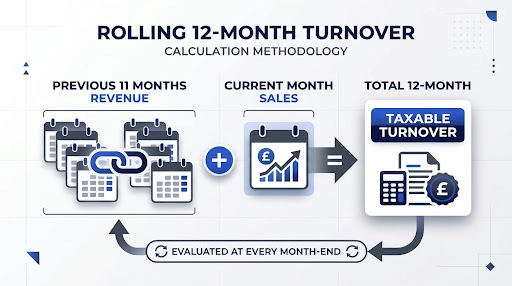
Tracking revenue flows demands robust financial software or structured accounting records that record exact invoice dates. Three essential accounting steps ensure accurate measurement: logging daily sales, categorizing taxable supplies, and summing rolling totals at every month-end. Managing these records prevents unexpected threshold breaches during sudden periods of rapid commercial expansion.
When cumulative sales exceed 90,000 pounds across any rolling twelve-month window, directors must notify HM Revenue and Customs within 30 days of that specific month-end. Failing to register within this statutory timeframe triggers severe regulatory fines and interest charges. Maintaining accurate financial records guarantees absolute compliance with UK tax laws.
What happens if taxable supplies exceed the threshold in a single 30-day period?
Exceeding the threshold in a single 30-day period triggers immediate compulsory registration regardless of total annual turnover, requiring notification to tax authorities within 30 days. This single-period rule captures high-value commercial transactions and rapid enterprise scaling that outpaces standard rolling calculations.
Analyzing short-term revenue spikes involves reviewing individual contracts, large asset sales, and bulk commercial orders that occur within calendar months. Two primary scenarios trigger this rule: securing a major corporate client contract worth over 90,000 pounds, or liquidating high-value inventory in a single month. Recognizing these high-value milestones allows directors to prepare for immediate tax obligations.
Complying with the 30-day single-period rule requires instant administrative action and precise documentation. Directors submit registration applications immediately after the high-value transaction clears, ensuring tax collection begins without delay. Utilizing professional Supplementary Company Documents simplifies this complex regulatory transition and secures all necessary corporate compliance records.
How do voluntary registrations differ from compulsory thresholds?
Voluntary registrations allow businesses trading below the statutory threshold to register for VAT early to reclaim input tax on business expenses.Establishing an active tax account before hitting mandatory limits enhances commercial credibility and recovers costs on heavy capital investments.
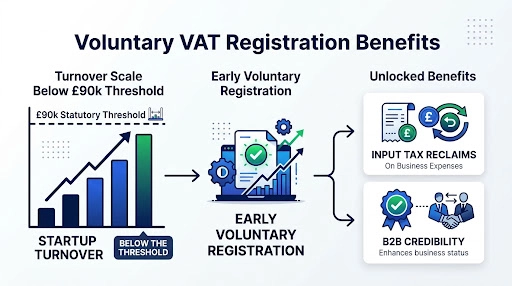
Weighing voluntary registration involves calculating administrative overhead against potential cash flow benefits. Three primary operational advantages drive voluntary adoption: recovering tax on equipment purchases, projecting larger enterprise status to corporate clients, and preparing internal accounting systems early. Evaluating these factors helps startups determine the optimal moment for tax integration.
Managing voluntary accounts requires filing regular tax returns even when taxable turnover remains below the statutory limit. Companies balance the administrative burden against financial recovery on business expenses. Reviewing historical tax data from resources like What Is VAT and How Does the UK Value Added Tax System Work? provides foundational insights into general system mechanics before making structural registration decisions.
When should growing startups transition from voluntary to mandatory status?
Growing startups transition from voluntary to mandatory status the moment their continuous sales data crosses statutory limits or when commercial scale demands formal restructuring. Managing this operational shift prevents regulatory friction and maintains seamless financial reporting standards.
Planning enterprise scaling requires proactive engagement with regulatory requirements and corporate administrative frameworks. Three essential transition steps include auditing current sales ledgers, updating invoicing software to display tax registration numbers, and consulting corporate structuring experts. Executing these steps systematically safeguards the enterprise against compliance oversights.
Navigating complex tax transitions requires specialized corporate expertise and structured administrative support. Exploring commercial guides such as Why Using Form My Company’s Expert VAT Registration Assistance is Essential for Your Startup highlights the practical advantages of professional oversight. Form My Company delivers comprehensive administrative guidance that ensures accurate tax integration for every scaling enterprise.
Determining the exact moment your business must register for VAT requires continuous monitoring of rolling turnover and single-period high-value transactions. Maintaining strict compliance protects enterprises from statutory penalties and establishes a transparent financial foundation. Form My Company provides expert guidance and professional support services that streamline corporate registration and secure long-term regulatory success for every growing enterprise.
Explore More Supplementary Company Documents Guide,
How to Use Certified Formation Documents to Apply for Business Finance
How Often Should You Renew Certified Copies of Company Records?
Frequently Asked Questions
What are supplementary company documents in the UK?
Supplementary company documents are official records that supplement a company’s original incorporation certificate, including updates, resolutions, and shareholder registers. Form My Company provides a streamlined Supplementary Company Documents service to help businesses securely source and compile these vital corporate records. These certified files verify ongoing structural changes for regulatory bodies, financial institutions, and commercial partners.
Why does a business need supplementary company documents?
Businesses require supplementary company documents to prove legal standing, satisfy strict bank onboarding checks, and successfully undergo corporate audits. Using the Supplementary Company Documents service from Form My Company ensures your enterprise maintains complete statutory compliance under the UK Companies Act. These authenticated records validate director authorities and corporate transparency during high-value commercial transactions.
How can I obtain certified copies of my company documents?
You can obtain certified copies of corporate records directly through Companies House or via specialist corporate intermediaries. Form My Company manages this process efficiently through its specialized Supplementary Company Documents service, delivering digital files or bound physical copies. Professional handling ensures your corporate registry remains accurate, up-to-date, and fully audit-ready.
What records are included in a standard supplementary document pack?
A standard supplementary document pack typically features certificates of incorporation on change of name, updated articles of association, and statutory register extracts. Form My Company packages these essential materials through its Supplementary Company Documents service to reflect real-time corporate compliance. Maintaining these comprehensive records safeguards directors against administrative penalties and filing discrepancies.
When should a company update its supplementary corporate records?
Companies must update their supplementary records immediately following any structural shift, such as appointing new directors, issuing shares, or changing a registered address. Form My Company streamlines these updates via the Supplementary Company Documents service, ensuring full alignment with current Companies House data. Keeping these files current prevents unnecessary delays during business expansion, financing rounds, or corporate restructuring.


