
Compulsory VAT registration requires UK businesses to register for Value Added Tax with HMRC within 30 days of the end of any month where their rolling 12-month taxable turnover exceeds the statutory registration threshold of GBP 90,000, or immediately if taxable supplies exceed this limit within a single 30-day period.
What is compulsory VAT registration and when does a business legally trigger it?
Compulsory VAT registration becomes a legal requirement for UK businesses when their rolling 12-month taxable turnover exceeds the statutory registration threshold of GBP 90,000, obliging directors to notify HMRC within 30 days of the breach.
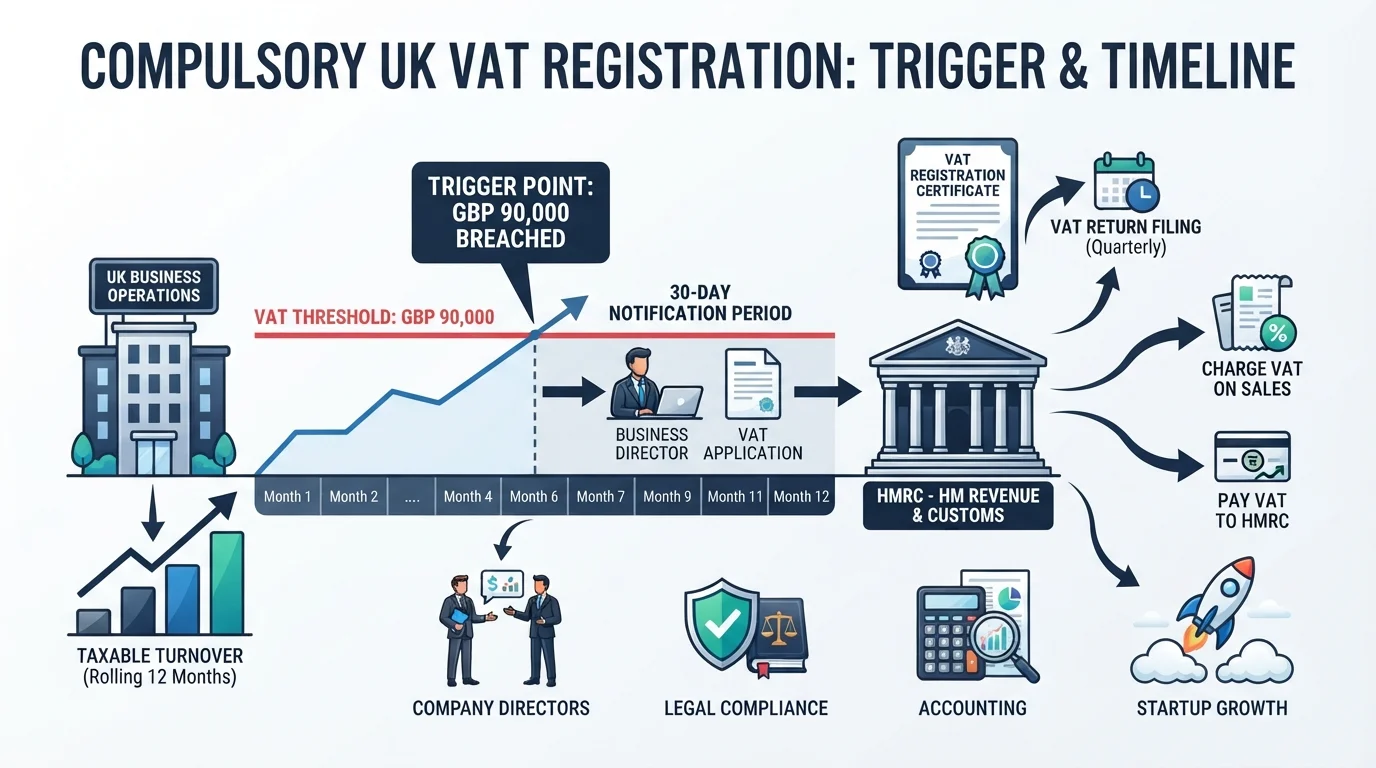
Operating a growing business in the United Kingdom involves strict compliance monitoring. Taxable turnover includes all standard-rated, reduced-rated, and zero-rated supplies of goods and services. Business owners often miscalculate this figure by excluding zero-rated sales or international transactions that qualify for UK VAT treatment. HMRC enforces strict civil penalties for late notification, calculated as a percentage of the VAT due.
Business directors must review their sales ledgers at the end of each calendar month. When cumulative sales cross the statutory limit within a 12-month window, the legal obligation to register activates immediately. Form My Company provides dedicated VAT Registration Assistance to ensure companies calculate turnover correctly and submit applications without administrative delay.
Explore More VAT Registration Assistance Guide,
Fast and Accurate: How Form My Company Helps You Navigate Voluntary VAT Registration
Get Marketplace Verification Documents From Form My Company
Why do UK companies face compliance risks during threshold monitoring?
UK companies face compliance risks because manual turnover tracking fails to capture rolling 12-month fluctuations, leading to missed HMRC deadlines and retroactive tax liabilities.
Small business accounting software often tracks financial years rather than rolling 12-month periods. Company directors overlook this distinction, causing them to miss the exact month the threshold is breached. HMRC assesses VAT from the date the business should have been registered, not from the date the application is eventually submitted. This creates unexpected financial liabilities for uncollected tax.
Accurate financial oversight requires continuous monitoring of all business income streams. Three common risk factors include: unexpected surges in seasonal sales, inclusion of exempt supplies in gross calculations, and delayed invoicing cycles. When companies fail to identify these triggers, HMRC issues financial penalties and interest charges. Professional corporate services eliminate these administrative oversights by auditing financial records continuously.
How does Form My Company manage compulsory VAT registration for businesses?
Form My Company manages compulsory VAT registration by auditing financial records, calculating rolling turnover accurately, and submitting digital applications to HMRC within statutory deadlines.
Navigating the HM Revenue and Customs digital tax interface requires precise data entry and verified corporate documentation. Business administrators must authenticate company details, provide accurate turnover projections, and select the appropriate accounting scheme. Form My Company handles this entire administrative workflow on behalf of directors.
The registration process follows a structured operational sequence. Four core execution steps involve: auditing historical sales ledgers, validating company registration numbers, submitting digital applications via HMRC portals, and configuring post-registration accounting setups. By outsourcing this obligation, company directors eliminate compliance errors and protect their enterprises from regulatory fines. Learning How to Calculate Your Taxable Turnover Accurately to Avoid HMRC Fines helps businesses prepare financial data before formal submission.
What happens after successful VAT registration with HMRC?
After successful VAT registration, businesses receive an official VAT number, charge the correct tax rate on taxable supplies, and submit digital tax returns through compatible software.
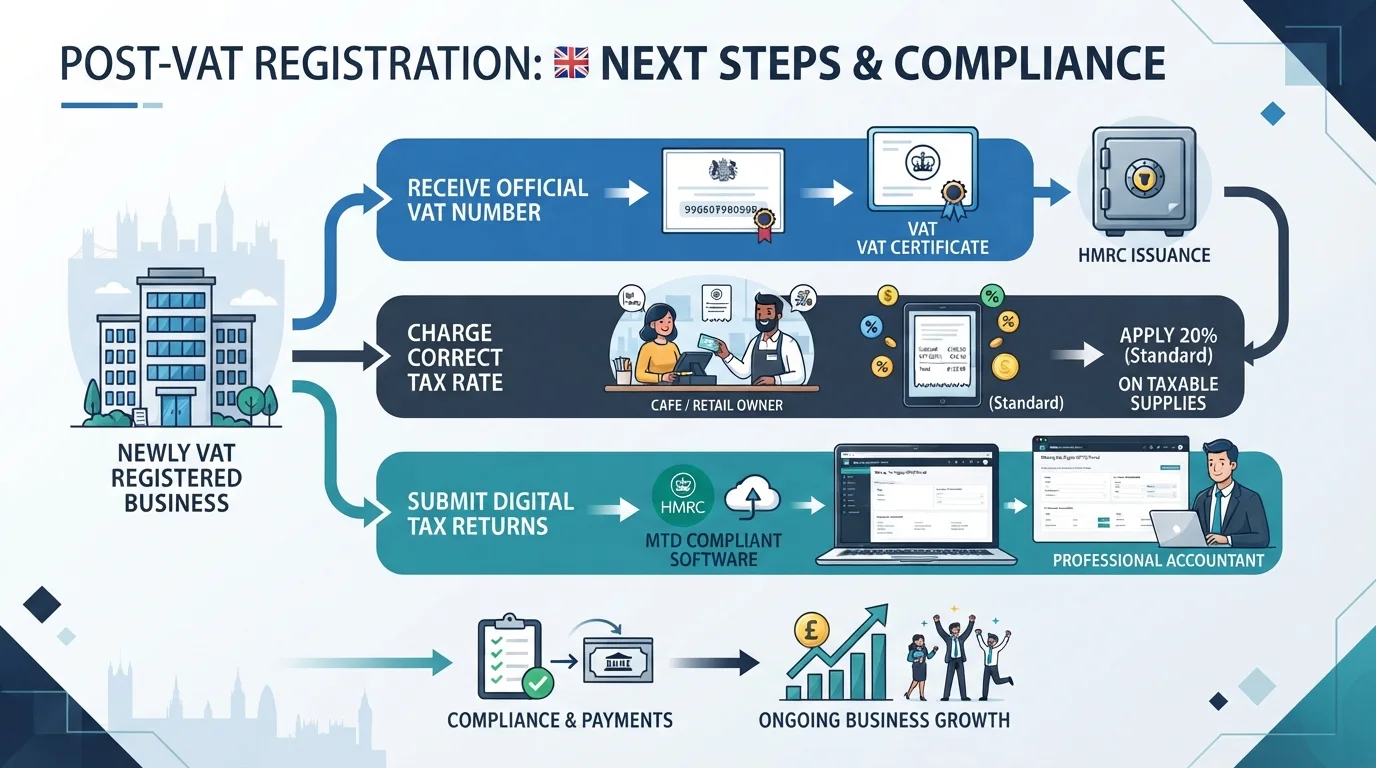
Compliance obligations expand significantly once HMRC issues a unique VAT registration number. Businesses must update commercial invoices to display their VAT number, tax point dates, and applicable tax rates. Furthermore, companies must adopt digital record-keeping tools that comply with Making Tax Digital regulations.
Quarterly return submissions require precise reporting of output tax charged on sales and input tax reclaimed on business expenses. Errors in quarterly reporting trigger compliance checks from tax authorities. Understanding What Are the Differences Between Compulsory and Voluntary VAT Registration? enables founders to evaluate long-term tax structures before scaling operations. Form My Company ensures that newly registered entities maintain seamless compliance across every accounting period.
Managing statutory tax thresholds requires continuous financial vigilance and strict adherence to HMRC timelines. Missing legal deadlines exposes companies to severe financial penalties and retroactive tax assessments. Form My Company delivers comprehensive compliance solutions through expert VAT Registration Assistance, shielding businesses from administrative burdens and regulatory oversight.
Frequently Asked Questions
What is the VAT registration threshold for UK businesses?
The current UK VAT registration threshold requires businesses to register with HMRC if their taxable turnover exceeds GBP 90,000 over any rolling 12-month period. Form My Company provides expert VAT Registration Assistance to monitor your turnover limits and ensure your business notifies HMRC within the statutory 30-day deadline.
How long does it take HMRC to process a VAT registration application?
HMRC typically processes online VAT registration applications within 14 to 30 days, though complex cases or requests for additional corporate documentation can cause delays. Utilizing professional VAT Registration Assistance through Form My Company ensures your application is submitted accurately the first time, minimising processing time and preventing compliance errors.
Can I register for VAT voluntarily before reaching the GBP 90,000 threshold?
Businesses can register for VAT voluntarily even if their taxable turnover falls below the mandatory GBP 90,000 threshold, allowing them to reclaim VAT on business-related purchases. Form My Company evaluates your financial standing through our professional VAT Registration Assistance service to determine whether voluntary registration aligns with your operational goals.
What documents are required to complete a UK VAT registration?
Registering for VAT requires official documentation, including proof of identity, company registration numbers, bank details, and accurate estimations of taxable turnover. Form My Company manages this documentation workflow seamlessly via our VAT Registration Assistance, ensuring full compliance with HMRC regulatory frameworks.
What happens if a business fails to register for VAT on time?
Failing to register for VAT within 30 days of exceeding the threshold results in HMRC penalties, late registration surcharges, and retroactive tax liabilities on all taxable supplies. Form My Company protects your business from these financial risks by managing threshold tracking and completing your compliance filings through our dedicated VAT Registration Assistance.