
The Flat Rate VAT Scheme is a simplified accounting method where eligible UK businesses pay a fixed percentage of their gross turnover to HMRC while keeping the difference between what they charge customers and what they pay HMRC, provided their annual taxable turnover does not exceed 150,000 pounds.
What Is the Flat Rate VAT Scheme and How Does It Work?
The Flat Rate VAT Scheme calculates a business tax liability by applying a fixed industry-specific percentage to gross turnover, meaning traders charge standard VAT rates to clients but remit a smaller, predetermined percentage to HMRC without reclaiming individual purchase VAT.
Small enterprises calculate VAT liability by multiplying total gross sales by the specific sector percentage set by HMRC. Business owners charge customers the standard 20% rate on taxable supplies. Traders keep the difference between collected customer VAT and the flat rate payment owed to HMRC. Companies forfeit the right to reclaim VAT on everyday business purchases. Capital asset purchases exceeding 2,000 pounds permit standard VAT reclaims under specific purchase rules. Enterprises simplify bookkeeping calculations because purchase invoice tracking becomes completely unnecessary. Quarterly tax returns require only total gross turnover figures and sector percentage data. HMRC eliminates complex calculations for routine overhead expenses and minor business purchases. Accountants advise firms to evaluate sector percentages carefully before submitting registration applications.
Who Is Eligible to Join the Flat Rate VAT Scheme?
Eligibility for the Flat Rate VAT Scheme requires a UK business to have an expected annual taxable turnover of 150,000 pounds or less, excluding VAT, during the next 12 months.
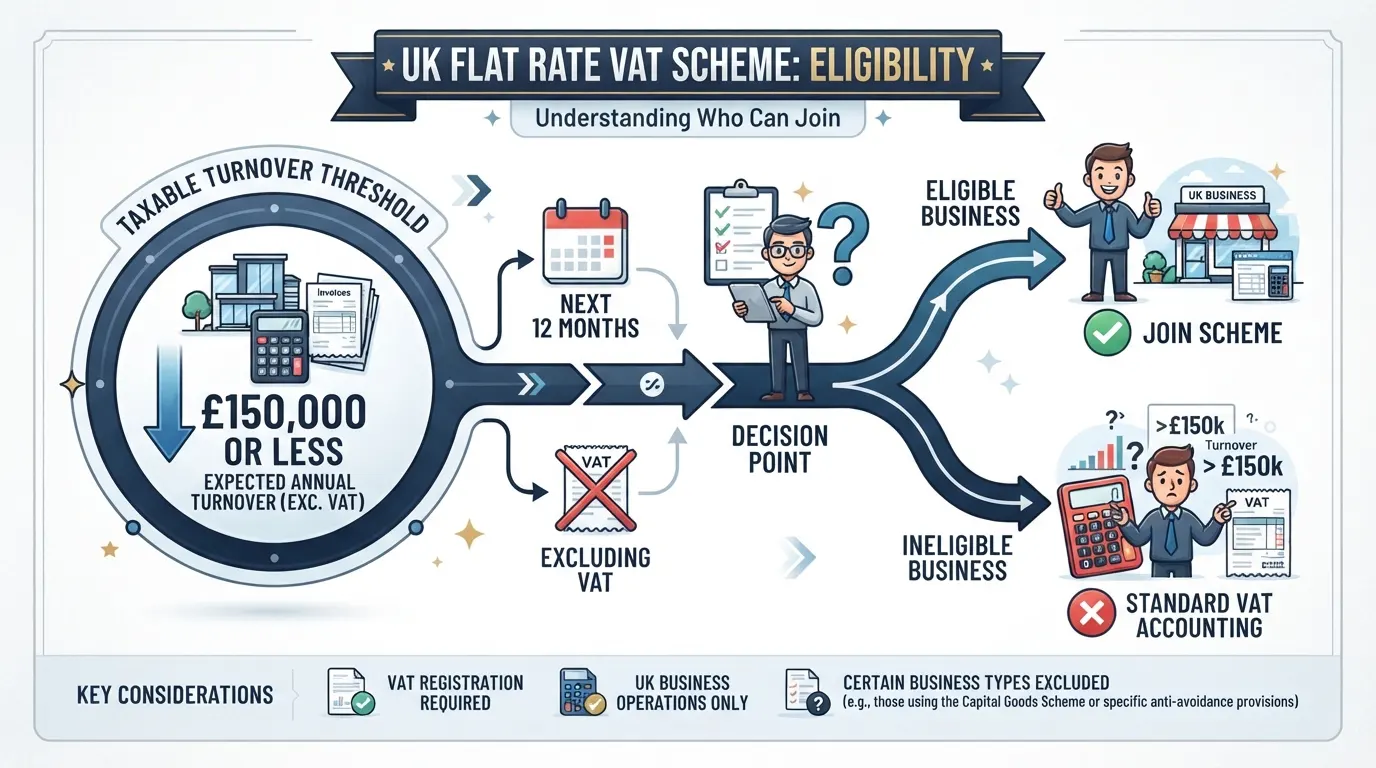
Companies must monitor taxable turnover continuously to maintain legal scheme compliance. Businesses must calculate total taxable sales without including VAT receipts in the initial assessment. Organizations exceed the threshold when annual taxable turnover surpasses 230,000 pounds. Companies must leave the scheme immediately at the end of any quarter where total income exceeds the upper limit. Partnerships, sole traders, and limited companies qualify if their trading activities match HMRC criteria. Newly registered enterprises estimate future income projections to determine initial scheme eligibility. HMRC excludes businesses associated with recent VAT avoidance schemes from joining the arrangement. Directors review financial records quarterly to verify ongoing compliance with statutory revenue limits.
Which Businesses Are Excluded from Using the Flat Rate VAT Scheme?
Certain business structures and sectors face statutory exclusion from the flat rate arrangement, including firms affected by recent VAT irregularities, businesses using specific accounting arrangements, and companies failing basic turnover criteria.
HMRC bars businesses from joining if they registered for VAT under specific simplified arrangements within the previous 12 months. Companies linked to another business within the past two years cannot register separately. Businesses operating as limited cost traders face strict sector restrictions that alter their financial benefits. A limited cost trader spends less than 2% of gross turnover on relevant goods per accounting period. Affected firms must apply a mandatory 16.5% flat rate percentage regardless of their actual industry sector. HMRC designs this restriction to prevent labor-only service providers from exploiting scheme margins. Organizations undergoing insolvency proceedings or bankruptcy status lose immediate eligibility for simplified VAT accounting. Tax authorities revoke scheme status when companies fail to submit quarterly returns accurately.
How Do Limited Cost Trader Rules Impact Flat Rate Scheme Savings?
Limited cost trader rules impose a mandatory 16.5% flat rate percentage on businesses with minimal expenditure on relevant goods, significantly reducing the financial advantages of the scheme.
Firms purchase physical commodities required exclusively for daily business operations to clear the expenditure threshold. HMRC excludes food, vehicle running costs, accountancy fees, and digital software subscriptions from relevant goods calculations. Businesses must spend at least 1,000 pounds annually on physical materials to bypass the limited cost designation. Service-based consultants, freelancers, and contractors frequently trigger the limited cost trader definition due to low overhead costs. Accountants analyze operational expenses before clients apply for simplified tax arrangements. Companies failing the expenditure test experience higher VAT bills compared to standard accounting methods. Business owners evaluate professional How to Choose the Best VAT Accounting Scheme for Your Specific Industry guidance to determine accurate financial outcomes. Organizations verify expense totals against strict statutory definitions published in official HMRC compliance manuals.
What Are the Financial and Administrative Benefits of the Flat Rate Scheme?
Administrative benefits include reduced bookkeeping hours, predictable quarterly payments, and simplified VAT return preparation that eliminates the need to record individual purchase receipts.
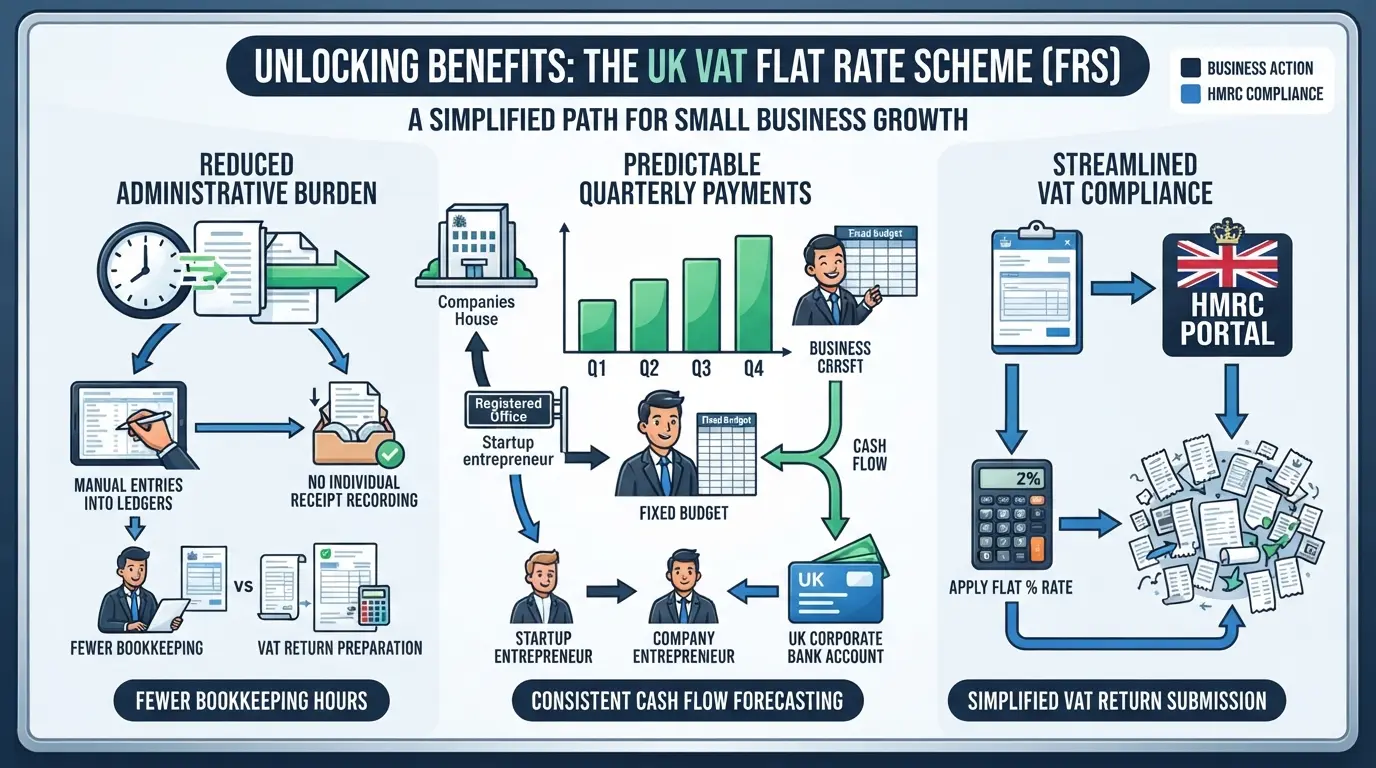
Small business owners save administrative hours by bypassing itemized purchase ledger entries. Bookkeepers record gross sales figures directly into accounting software without processing supplier invoices. Financial planning becomes predictable because fixed percentages remain constant across the entire accounting year. Cash flow management improves when traders retain the percentage difference on bad debts written off. Enterprises eliminate accounting software expenses dedicated solely to purchase-side VAT tracking. Companies appoint specialists to handle VAT Registration Assistance to ensure seamless integration with HMRC portals. Business directors allocate saved administrative time toward core commercial growth activities. Small enterprises maintain transparent financial records that satisfy annual HMRC compliance reviews.
How Does Form My Company Facilitate Scheme Setup and Registration?
Form My Company assists business owners by evaluating turnover eligibility, calculating sector-specific percentages, and submitting official applications directly through official HMRC digital gateways.
Corporate advisors examine historical financial data to verify compliance with statutory turnover thresholds. Specialists review operational expenses to identify potential limited cost trader classifications. Consultants submit digital application forms through authorized HMRC agent portals to accelerate processing times. Form My Company structures corporate setups to align with optimal tax accounting methods. Directors utilize expert Choose the Right Scheme: How Form My Company Guides You Through Flat Rate VAT Setup frameworks to finalize administrative registrations. Specialists provide ongoing compliance reviews to monitor annual turnover limits and sector percentage adjustments. Form My Company secures professional validation for every corporate tax submission executed on behalf of clients. Business owners rely on structured guidance to maintain accurate records throughout active trading periods.
Frequently Asked Questions
What is included in VAT registration assistance for UK businesses?
VAT registration assistance from Form My Company includes a complete eligibility assessment, sector percentage calculations, and the electronic submission of your application through official HMRC portals. Specialists handle correspondence with tax authorities to ensure your corporate structure meets all statutory compliance requirements.
How long does it take to complete the VAT registration process with HMRC?
HMRC typically processes online VAT registration applications within 30 days, though complex cases or requests for additional documentation may extend this timeline. Utilizing Form My Company ensures your application contains accurate financial data, which minimizes administrative delays and accelerates approval times.
When is a business legally required to register for VAT in the UK?
A UK business must register for VAT when its taxable turnover exceeds 85,000 pounds over any rolling 12-month period, or if it expects to exceed this threshold within a single 30-day period. Form My Company monitors turnover thresholds to help business owners register on time and avoid statutory penalties.
Can I register for VAT voluntarily if my turnover is below the threshold?
Businesses with taxable turnover below 85,000 pounds can register for VAT voluntarily to reclaim input tax on business purchases and enhance corporate credibility. Form My Company evaluates your financial position to determine whether voluntary registration aligns with your operational goals.
What documents are required to apply for VAT registration?
VAT registration requires proof of identity for company directors, company registration numbers, bank account details, and estimates of future taxable turnover. Form My Company gathers and verifies these mandatory documents to ensure your application satisfies all HMRC compliance standards.


