

To choose the best VAT accounting scheme for your specific industry, evaluate your annual turnover, customer base type, and expense structure. Businesses with low taxable expenses benefit from the Flat Rate Scheme, while high-inventory companies maintain better cash flow using the Standard or Annual Accounting Scheme.
Why Does Your Industry Determine Your Ideal VAT Accounting Scheme?
Your industry determines your ideal VAT accounting scheme because sector-specific profit margins, transactional volumes, and supply chain structures dictate your reclaimable input tax. Service-based sectors gain margins from fixed-rate billing, whereas retail and manufacturing businesses require precise input tax recovery to protect operational cash flow.
UK business sectors operate on vastly different cost structures and payment terms. Service-oriented industries, such as management consultancy or IT contracting, incur minimal taxable overheads. These companies pay very little VAT on purchases relative to the output VAT charged to clients.
Conversely, construction, manufacturing, and retail operations deal with continuous material acquisitions, raw inputs, and complex logistics. Reclaiming exact input tax amounts on these purchases is essential for maintaining liquidity.
Choosing an incompatible VAT mechanism creates administrative friction and reduces working capital. HM Revenue and Customs (HMRC) provides several accounting methods to accommodate these variations across commercial sectors.
How Does the Standard VAT Accounting Scheme Work for High-Expense Sectors?
The Standard VAT Accounting Scheme requires businesses to record and report VAT based on invoice dates rather than payment receipts. High-expense sectors select this method because it enables immediate recovery of input tax on large inventory purchases and machinery before customer invoices are settled.
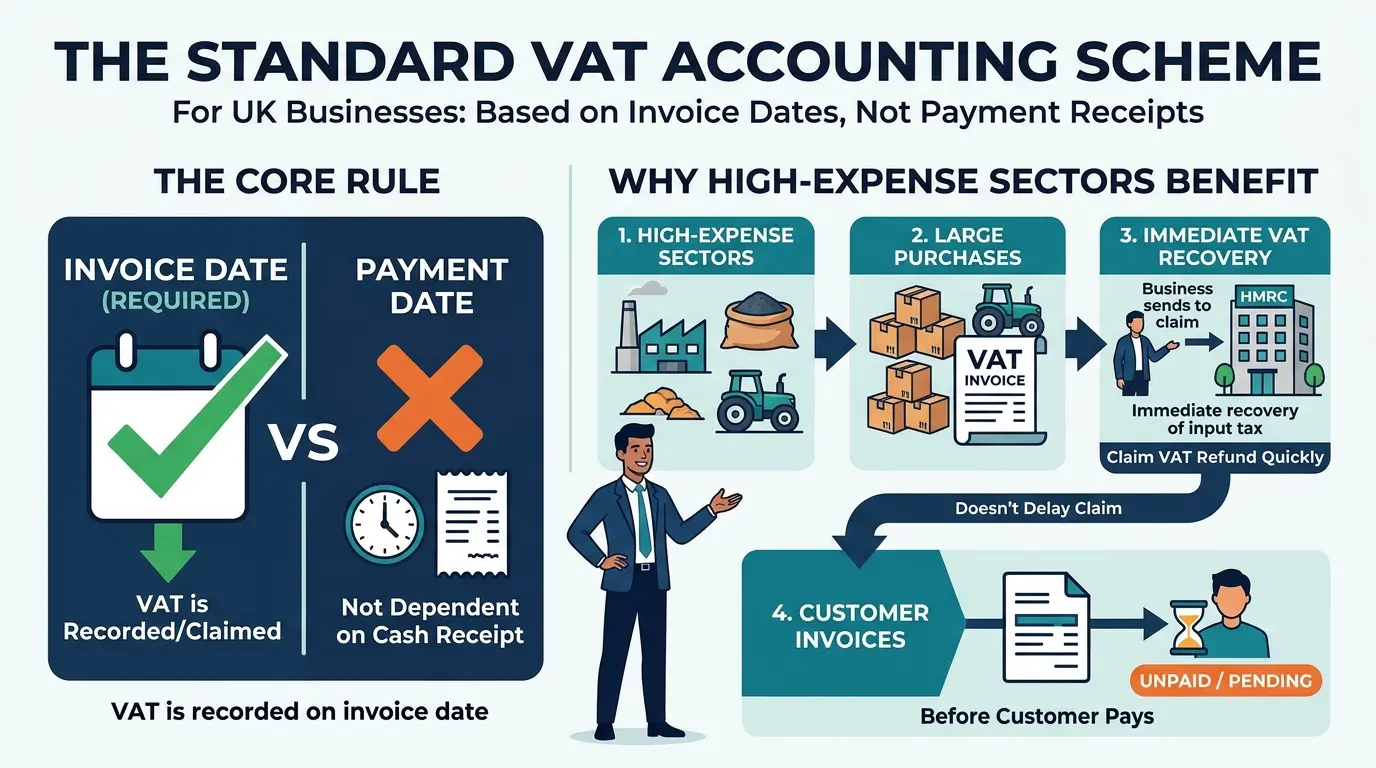
Under the standard accounting method, companies submit quarterly VAT returns reflecting the exact figures from sales and purchase invoices. When a business purchases equipment, stock, or raw materials, it reclaims the VAT incurred during that specific accounting quarter.
This model suits sectors such as wholesale distribution, heavy manufacturing, and primary retail. These industries handle thousands of line items and require precise input tax reconciliations to track thin operating margins.
Because accounting records follow invoice issuance dates, companies must manage cash flow carefully. Output VAT becomes payable to HMRC for the quarter an invoice is issued, even if the client delays payment beyond the due date.
When Should Service Businesses Select the Flat Rate VAT Scheme?
Service businesses should select the Flat Rate VAT Scheme when their annual taxable turnover remains below £150,000 and operating expenses consist mainly of labor rather than physical goods. This option simplifies quarterly reporting by applying a fixed sector percentage to gross turnover.
The Flat Rate Scheme allows eligible entities to calculate their VAT liability as a single percentage of total gross turnover. HMRC assigns specific percentage rates based on commercial sectors, ranging from 4% for food retailers to 14.5% for management consultants.
Businesses keep the difference between the standard 20% charged to customers and the lower flat rate paid to HMRC. However, participants cannot reclaim input VAT on everyday operational expenses, except for capital assets costing £2,000 or more including VAT.
If a company spends less than 2% of its turnover on relevant goods, HMRC classifies it as a limited cost business. Limited cost businesses must pay a higher flat rate of 16.5%, which eliminates financial advantages for pure service firms without inventory.
Evaluating turnover limits and expense profiles helps owners determine if this scheme improves profitability. For a detailed breakdown of eligibility rules and sector-specific percentage tiers, review our comprehensive guide on what is the Flat Rate VAT Scheme and who is eligible to join? to calculate your potential savings.
How Does Cash Accounting Protect Cash Flow for B2B Contractors?
Cash Accounting protects cash flow for B2B contractors by requiring VAT payments only after clients settle their invoices. This framework eliminates the risk of paying HMRC output tax on unpaid customer invoices, making it ideal for industries with extended payment terms.
Businesses with an annual VAT turnover of £1.35 million or less qualify for the Cash Accounting Scheme. Under standard rules, issuing a large invoice forces a business to pay the associated VAT at the end of the quarter, regardless of customer payment status.
Cash Accounting shifts the tax point to the date funds clear in the bank account. If a client delays payment for 90 days, the corresponding VAT liability moves to the subsequent reporting period.
This approach benefits tradespeople, B2B agencies, and logistics providers operating on credit terms. Input VAT recovery also follows payment execution, meaning suppliers must be paid before input tax reclaims are processed.
When Is the Annual Accounting Scheme Suitable for Low-Admin Operations?
The Annual Accounting Scheme is suitable for low-admin operations that prefer predictable monthly or quarterly interim tax installments. Businesses submit just one annual VAT return instead of four, reducing reporting deadlines while stabilizing recurring cash management.
Companies with taxable turnover under £1.35 million can apply to use the Annual Accounting Scheme. Participants make nine monthly installments or three quarterly payments based on an estimated annual VAT calculation.
At the end of the accounting year, the business files a single balancing return alongside the final payment or refund claim. This setup benefits seasonal enterprises, estate managers, and stable service providers seeking consistent monthly outgoings.
Because interim payments rely on historical data, rapid growth can generate a large balancing payment at year-end. Conversely, a sudden downturn requires formal notification to HMRC to adjust payment amounts downwards.
What Special VAT Rules Apply to Retail, Margin, and Construction Sectors?
Special VAT rules apply to retail, margin, and construction sectors to handle high transaction volumes, second-hand goods, and supply chain tax evasion. Retail Schemes simplify point-of-sale calculations, Margin Schemes tax gross profit, and Reverse Charge shifts liability to main contractors.
Retailers handling thousands of daily consumer transactions cannot track individual VAT amounts for every single sale. Retail Schemes calculate total output VAT by applying sector formulas to gross daily takings.
Resellers of second-hand goods, antiques, and vehicles utilize the Margin Scheme. This mechanism levies 20% VAT solely on the profit margin between buying and selling prices, rather than the full resale value.
The Domestic Reverse Charge governs the UK construction sector to prevent missing trader fraud across subcontractor chains. Under this system, sub-contractors do not charge output VAT on qualifying building services provided to VAT-registered main contractors.
Instead, the main contractor accounts for the VAT as both output and input tax on their own return. Construction firms must verify contractor status and apply precise invoice notations to remain fully compliant with HMRC frameworks.
How Do You Transition Between VAT Schemes as Your Business Grows?
You transition between VAT schemes as your business grows by notifying HMRC, auditing turnover thresholds, and aligning scheme choices with changing expense structures. Exceeding threshold limits requires immediate scheme exits to avoid non-compliance penalties and back-dated tax liabilities.
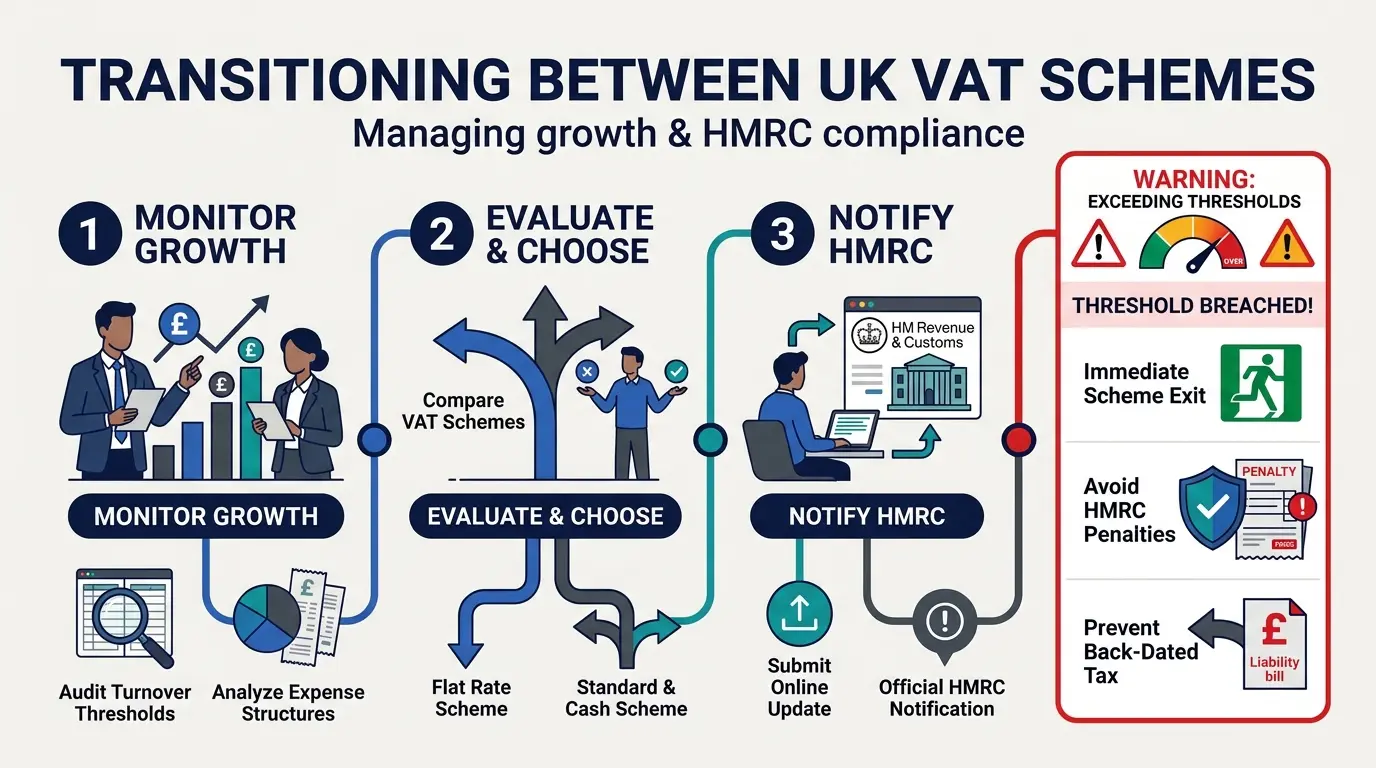
Business expansion alters an entity’s optimal VAT structure over time. A startup consultancy using the Flat Rate Scheme may outgrow the £230,000 exit threshold or increase capital expenditure on office equipment and sub-contractors.
Transitioning to Standard or Cash Accounting requires careful timing to prevent double-counting or omitting invoices during the cutoff period. Companies must reconcile outstanding debtor ledgers, vendor liabilities, and asset registers before altering their reporting methods with HMRC.
Executing a smooth changeover requires clear adjustments to invoicing software and accounting schedules. Businesses seeking expert guidance can leverage professional VAT registration assistance to ensure seamless transitions without interrupting trading activity.
Choosing incorrect effective dates or miscalculating adjustment figures causes administrative delays and triggers HMRC compliance queries. Professional registration services validate historic accounting records, verify scheme eligibility, and file formal change requests on behalf of company directors.
Evaluating your industry’s trajectory every 12 months ensures your VAT accounting method continues to protect operational margins. To establish an optimized tax structure from day one, explore how Form My Company guides you through Flat Rate VAT setup and long-term accounting compliance.
Explore More VAT Registration Assistance Guide,
How to Calculate Your Taxable Turnover Accurately to Avoid HMRC Fines
How to Determine the Exact Moment Your Business Must Register for VAT
Frequently Asked Questions
How long does it take to complete UK VAT registration?
UK VAT registration typically takes between two to thirty working days, depending on HM Revenue and Customs (HMRC) processing times and identity verification checks. Using VAT Registration Assistance from Form My Company ensures all business documentation and application details are submitted accurately to minimize delays.
Do small businesses have to register for VAT in the UK?
Small businesses must register for VAT if their taxable turnover exceeds the mandatory threshold of £90,000 within any rolling 12-month period. Companies below this threshold can complete voluntary registration through Form My Company to reclaim input tax on business expenses and strengthen commercial credibility.
What documents are required for VAT registration?
Registering a UK business for VAT requires official company details, government-issued director identification, bank account information, and proof of trading activity. Expert VAT Registration Assistance verifies these credentials prior to submission to maintain strict compliance with HMRC registration protocols.
What is the difference between standard and Flat Rate VAT registration?
Standard VAT accounting requires businesses to calculate and report the exact difference between output tax collected on sales and input tax paid on purchases. The Flat Rate VAT scheme allows eligible small businesses to pay a fixed sector-specific percentage on total gross turnover, which simplifies quarterly returns when arranged during setup by Form My Company.
Can a UK business register for VAT before generating revenue?
Yes, a UK company can complete voluntary VAT registration prior to making sales if it can demonstrate intent to trade through contracts, purchase orders, or operational expenses. Obtaining VAT Registration Assistance helps early-stage businesses properly evidence pre-trading expenditure to reclaim eligible VAT from HMRC.


