

The Standard VAT Accounting Scheme requires businesses to calculate Value Added Tax based on invoice dates rather than payment receipt dates. Companies report output tax on sales and reclaim input tax on purchases quarterly through official HMRC submissions, paying or reclaiming the net variance.
What Is the Standard VAT Accounting Scheme?
The Standard VAT Accounting Scheme is the default UK tax framework where businesses record VAT liability on the date an invoice is issued. Companies calculate tax obligations regardless of whether customer payments have cleared or supplier invoices have been settled.
UK businesses operating under this framework record Value Added Tax (VAT) using accrual accounting principles. When an enterprise issues a sales invoice, the output tax becomes an immediate liability due to HM Revenue & Customs (HMRC). Similarly, input tax on supplier invoices becomes eligible for reclaim on the tax point date printed on the bill. This method aligns tax reporting directly with commercial invoicing cycles rather than cash flow movements.
Businesses automatically enter this scheme upon completing their registration unless they formally apply for alternative arrangements. Registration becomes compulsory when taxable turnover exceeds £90,000 within any rolling 12-month period. Companies must monitor turnover continuously to avoid late registration penalties. Understanding how to navigate the HMRC VAT Registration Process Step-by-Step Without Delays ensures compliance with statutory deadlines and prevents unexpected tax assessments.
The accrual basis provides clear operational visibility for commercial entity management. Finance departments track tax liabilities instantly upon transaction booking. However, this system requires diligent cash flow management. A company must remit output tax to HMRC even if a client delays payment past the quarterly tax deadline.
How Does Output Tax Differ From Input Tax Under Standard Accounting?
Output tax is the 20% standard rate VAT added to customer invoices on sales of goods and services. Input tax represents the VAT charged on business purchases, which registered entities subtract from output tax to calculate their net HMRC payment.
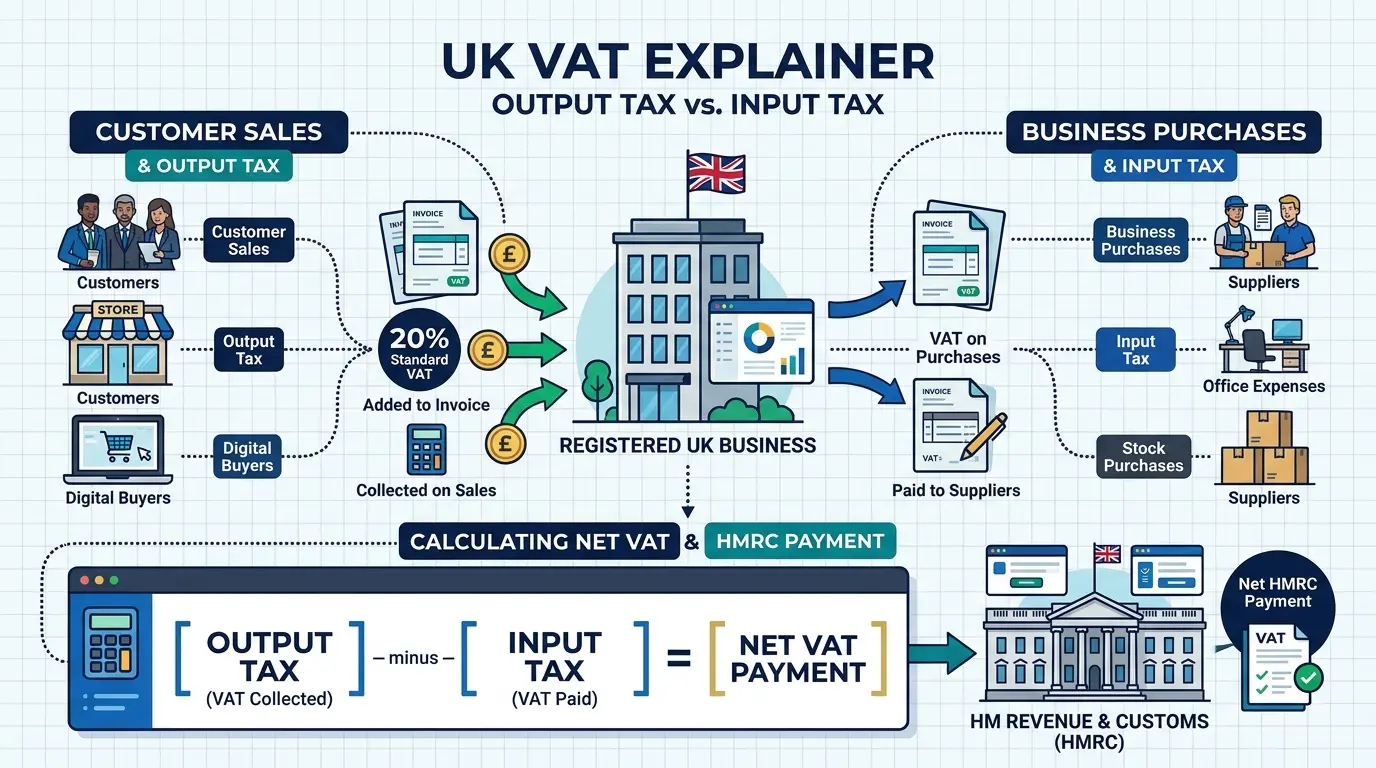
Output tax applies to all taxable supplies delivered by a registered business in the UK. Enterprises charge the standard rate of 20%, the reduced rate of 5%, or the zero rate of 0% based on item classification. Every issued invoice must detail the taxable amount, the applied rate, and the final tax sum. Businesses collect this money on behalf of HMRC during standard trading operations.
Input tax includes VAT incurred on raw materials, stock, utility bills, professional services, and equipment purchases. Registered entities retain valid VAT invoices from VAT-registered suppliers to validate these claims. HMRC rejects claims that lack valid tax receipts or proper business justification. Proper record-keeping ensures entities successfully offset valid input tax against their output tax obligations.
The mechanical calculation determines the final quarterly liability or refund status. If output tax exceeds input tax, the business remits the difference directly to HMRC. When input tax exceeds output tax during capital-intensive quarters, HMRC issues a repayment refund. Entities maintain precise audit trails to defend these calculations during standard compliance reviews.
How Do Businesses Calculate and Submit Standard VAT Returns?
Businesses submit Standard VAT Returns quarterly via Making Tax Digital compliant software by calculating total output tax minus total allowable input tax. Submissions and electronic tax payments are strictly due one calendar month and seven days after the period ends.
Quarterly reporting cycles structure the operational timeline for tax management. A standard tax year divides into four distinct accounting periods assigned by HMRC. Software integration automatically tracks every transaction logged in the general ledger across the three-month period. Accounting teams tally total sales, total purchases, output tax collected, and input tax incurred.
Digital record-keeping mandatory rules require software to link directly to HMRC systems. UK law forbids manual copy-and-paste data transfers under Making Tax Digital (MTD) enforcement guidelines. Accounting platforms compile nine specific box figures summarizing taxable sales, total purchases, and net tax due. Authorized staff verify these totals before transmitting the secure electronic payload.
Payment execution follows strict calendar deadlines to prevent automatic financial surcharges. Entities settle outstanding balances using Direct Debit, faster payments, or online bank transfers. If a return shows an input tax credit, HMRC deposits the refund into the designated corporate bank account. Consistent adherence to these digital submissions protects corporate credit standing.
Who Is Eligible to Use the Standard VAT Scheme in the UK?
Any UK sole trader, limited company, or partnership registered for VAT can use the Standard Accounting Scheme without turnover restrictions. It remains mandatory for corporate entities whose annual taxable turnover exceeds £1.35 million.
Eligibility for the standard accounting framework begins immediately upon tax registration. Small startups and growing enterprises can adopt this method voluntarily below the statutory threshold. There is no upper limit on annual turnover for remaining in the standard scheme. Larger commercial organisations with multi-million-pound revenues must operate under these accrual rules.
Corporate structure does not restrict access to standard accrual reporting. Limited liability companies, general partnerships, designated LLPs, and individual sole traders use identical operational mechanisms. Overseas businesses registering for UK VAT must also report under standard rules unless granted specific scheme authorizations. Compliance requirements apply equally across all commercial legal structures.
Certain business models benefit significantly from standard reporting setups. Enterprises that receive immediate cash or point-of-sale payments while purchasing stock on 60-day supplier credit generate positive cash floats. Because input tax is claimed on invoice receipt before paying suppliers, cash flow improves. Conversely, businesses offering extended client credit terms may experience temporary cash strain under this mechanism.
What Are the Key Advantages and Disadvantages of Standard VAT Accounting?
Standard VAT accounting offers unlimited turnover scaling and instant input tax reclaims on credit purchases. However, it creates cash flow risks by requiring output tax payments to HMRC before receiving payments from slow-paying clients.
Unrestricted scalability represents a primary advantage for expanding commercial enterprises. Growing businesses never outgrow the standard scheme, eliminating the need to transition accounting frameworks during high-growth phases. Furthermore, businesses buying capital assets on supplier credit reclaim input tax immediately. This mechanism provides immediate liquidity support during major equipment upgrades or inventory expansion phases.
| Feature / Metric | Standard VAT Accounting Scheme | Alternative Cash Accounting Scheme |
| Tax Point Basis | Invoice date (Accrual) | Payment receipt/settlement date (Cash) |
| Turnover Ceiling | Unlimited | Must leave if turnover exceeds £1.6 million |
| Bad Debt Relief | Claimed separately after 6 months unpaid | Automatic (Tax not paid until cash received) |
| Best For | Immediate point-of-sale receipts & credit purchases | Extended customer credit terms & slow payers |
Cash flow exposure forms the primary disadvantage of standard accrual tax reporting. When clients delay invoice settlement past the quarterly deadline, the business must fund the tax liability using cash reserves. If a customer defaults entirely, the enterprise must wait six months to claim bad debt relief. Managing this risk requires strict credit control and systematic invoice collection procedures.
Administrative complexity also increases under accrual record management systems. Teams must match credit notes, partial payments, and supplier adjustments back to original invoice dates. Errors in invoice dating distort quarterly tax totals and trigger compliance inquiries. Systematic bookkeeping processes prevent these administrative bottlenecks.
How Does Standard Accounting Compare to Cash Accounting and Flat Rate Schemes?
Standard accounting calculates tax on invoice dates without turnover caps, whereas Cash Accounting calculates tax strictly when payments clear. The Flat Rate Scheme applies a fixed percentage to gross turnover for small businesses under £150,000.
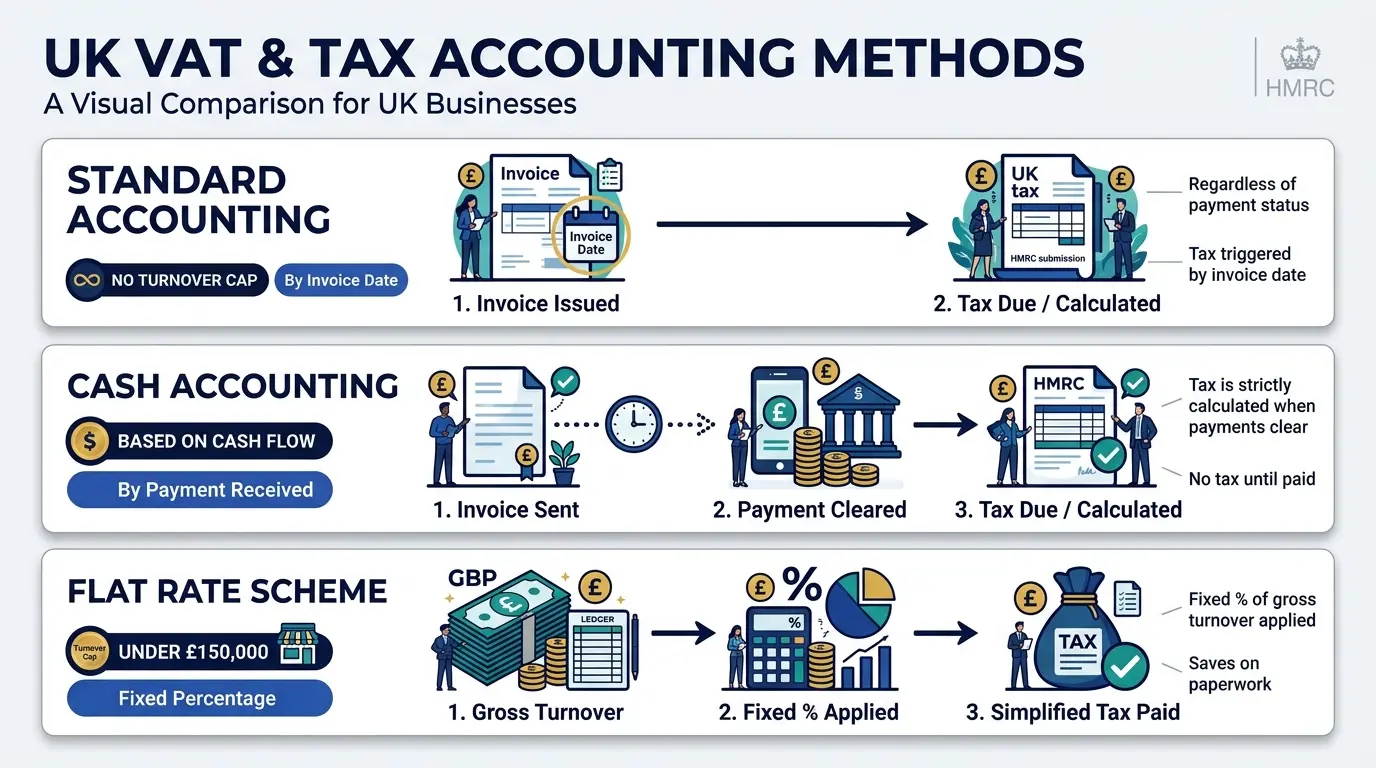
Cash Accounting offers an alternative framework designed to protect small business liquidity. Under cash rules, output tax is due only when the customer pays the invoice. Similarly, input tax is reclaimed only after settling supplier bills. This eliminates the risk of paying HMRC tax on uncollected invoices. However, cash accounting is restricted to businesses with annual taxable turnover below £1.35 million.
The Flat Rate Scheme simplifies reporting for small enterprises earning under £150,000 annually. Instead of calculating exact input and output tax per invoice, businesses pay a lower fixed percentage on total gross turnover. Participants keep the difference between the VAT charged to clients and the flat rate paid to HMRC. However, flat-rate businesses cannot reclaim input tax on routine day-to-day operational purchases.
Selecting the optimal framework depends entirely on business trading patterns and client payment terms. Companies with low overheads and business-to-business clients often prefer standard reporting. Organizations seeking seamless corporate setup rely on professional VAT Registration Assistance to evaluate accounting options before submitting initial HMRC filings. Strategic selection minimizes administrative burdens while optimizing cash retention.
How Can UK Businesses Switch to or From the Standard VAT Scheme?
Businesses can switch from standard accounting to alternative schemes at the start of any quarterly VAT period if they meet eligibility rules. Leaving the standard scheme requires adjusting accounts to ensure zero double-counting or missed tax liabilities.
Transitioning between tax schemes requires careful alignment with quarterly accounting start dates. An enterprise moving to Cash Accounting must verify that its turnover falls below the £1.35 million threshold. The business notifies HMRC by updating its accounting software settings at the start of the new tax period. Formal written approval is usually unnecessary, but clear audit records must document the transition date.
Reconciling outstanding invoices prevents compliance errors during a scheme change. Invoices issued under the standard scheme must not be taxed again when cash arrives under the cash scheme. Finance teams create transition schedules isolating unpaid sales and purchase invoices. Accurately categorizing these transactions ensures smooth transitions without triggering HMRC compliance audits.
Businesses growing rapidly must leave simplified schemes and rejoin standard accounting automatically. If turnover crosses the £1.6 million cash accounting exit threshold, the entity must return to standard accrual rules immediately. Founder-led enterprises choosing Stress-Free HMRC Setup: Why UK Founders Trust Form My Company for VAT Registration ensure their corporate tax structures scale smoothly alongside revenue growth.
Summary of VAT Accounting Compliance
The Standard VAT Accounting Scheme provides a structured, scalable method for UK enterprises to manage corporate tax compliance. By recording tax liabilities on invoice dates, businesses maintain precise operational visibility while fulfilling statutory obligations through Making Tax Digital software. Form My Company assists UK entrepreneurs and expanding enterprises with professional VAT registration, scheme selection, and HMRC setup to ensure full regulatory compliance from day one.
Explore More VAT Registration Assistance Guide,
What Is the Flat Rate VAT Scheme and Who Is Eligible to Join?
What Are the Differences Between Compulsory and Voluntary VAT Registration?
Frequently Asked Questions
Do I need VAT Registration Assistance if my business turnover is under £90,000?
Voluntary registration allows businesses below the compulsory £90,000 threshold to reclaim input tax on startup expenses and enhance corporate credibility with business clients. Professional VAT Registration Assistance from Form My Company helps sole traders and limited companies evaluate threshold obligations, select the optimal tax scheme, and submit compliant applications to HMRC without administrative delays.
How long does the HMRC VAT registration process take?
Standard HMRC VAT registration processing typically takes between 5 and 30 working days depending on identity verification requirements and application accuracy. Utilizing VAT Registration Assistance through Form My Company ensures all supporting documentation, corporate details, and bank information are correctly formatted to prevent delays or rejections during official compliance reviews.
What documents are required to register for UK VAT with HMRC?
Applicants must provide a government-issued photo ID, proof of UK business address, incorporation details for limited companies, and national insurance numbers or UTRs for directors. Expert VAT Registration Assistance guides business owners through gathering approved compliance documentation, verifying that all financial records align with current Making Tax Digital (MTD) statutory standards.
Can non-UK residents use Form My Company for UK VAT registration?
Yes, non-resident business owners and overseas corporate entities selling goods or services in the UK can register for UK VAT regardless of turnover. Form My Company provides specialized VAT Registration Assistance for foreign directors, handling distance selling requirements, non-established taxable person (NETP) filings, and direct communication with HMRC.
What happens after completing VAT registration with HMRC?
Once HMRC approves the application, the business receives a 9-digit VAT registration number, a official certificate, and an assigned effective date of registration. Form My Company delivers ongoing support alongside its VAT Registration Assistance, helping new taxpayers set up their HMRC online portal access and integrate Making Tax Digital compliant software for quarterly returns.


