Yes, you can apostille a UK Certificate of Incorporation for official use abroad by submitting the official company document to the UK Foreign, Commonwealth and Development Office. This official legalisation process validates corporate identity, verifies registrar signatures, and ensures international compliance.
What is an apostille for a Certificate of Incorporation?
An apostille is an official government certificate issued by the Foreign, Commonwealth and Development Office that validates the authenticity of a UK corporate document. This specific legalisation mechanism confirms that the signature, seal, or stamp on the Certificate of Incorporation belongs to an authorised official at Companies House. Overseas authorities, foreign banks, and international regulators require this validation step because domestic documents lack automatic legal standing abroad. Global commerce relies on secure verification standards to prevent fraud, establish corporate legitimacy, and streamline cross-border trade operations.
International expansion requires businesses to prove their legal existence across foreign jurisdictions. Foreign institutions cannot independently verify UK company registers without official certification channels. The apostille process bridges this gap by attaching an internationally recognized certificate to the original document. Three primary entities handle this verification workflow: Companies House, the Foreign, Commonwealth and Development Office, and foreign embassies. Each institution performs a specific validation check before the document travels overseas.
Compliance frameworks dictate that foreign banks demand apostilled incorporation papers before opening corporate accounts. Overseas tax authorities require identical verification when foreign subsidiaries register for local value-added tax. Legal departments utilize these authenticated certificates during cross-border mergers, international litigation, and asset acquisitions. International trade agreements depend on these standardized legalisation procedures to maintain regulatory transparency.
Why do international authorities require apostilled company documents?
International authorities require apostilled company documents to confirm legal existence, verify corporate governance, and prevent cross-border commercial fraud. Foreign jurisdictions operate under distinct legal frameworks that do not automatically recognize foreign public documents. An apostille eliminates the need for consular legalisation across member states of the 1961 Hague Convention. Global regulatory bodies mandate this authentication step to protect domestic markets from shell companies and illicit financial operations.
Cross-border transactions expose foreign entities to financial risks if corporate identities remain unverified. Official authentication proves that a company maintains active status on the official public register. Two primary risk factors drive this requirement: financial transparency and beneficial ownership verification. Overseas regulators audit these documents to ensure foreign investors comply with local commercial laws.
International business partners examine apostilled certificates to validate corporate solvency before signing high-value contracts. Foreign courts accept apostilled incorporation papers as admissible evidence during international legal proceedings. Global supply chain partners verify company legitimacy to satisfy strict international compliance mandates.
How does the UK legalisation process work for corporate documents?
The UK legalisation process requires submitting the physical Certificate of Incorporation to the Foreign, Commonwealth and Development Office for official authentication.
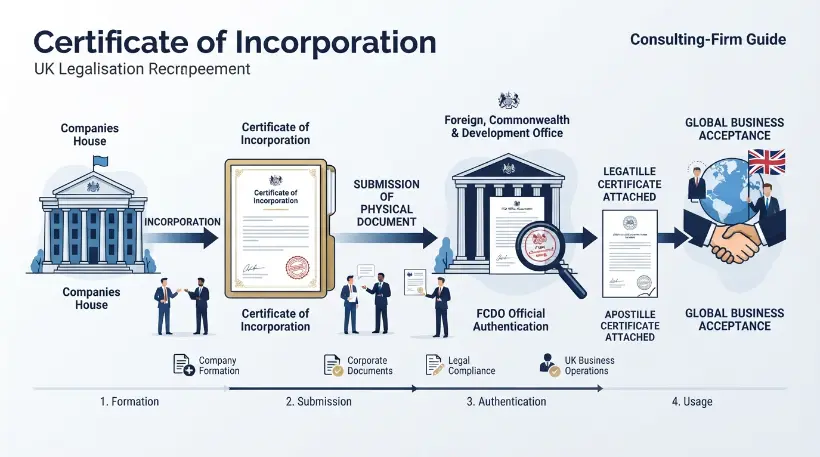
Official government officials examine the document, verify the registrar’s signature, and attach the secure apostille certificate. This procedural workflow ensures that corporate paperwork meets strict international diplomatic standards.
Businesses complete this procedure through specific operational steps. First, companies prepare the original paper Certificate of Incorporation or obtain an official certified copy from the registrar. Second, applicants submit the paperwork to the government legalisation office via standard or premium processing channels. Third, officials authenticate the registrar’s credentials and attach the physical apostille certificate. Fourth, the finalized document ships to the international destination for foreign deployment.
Processing times vary depending on the chosen submission channel and government backlogs. Standard postal submissions take approximately five working days, while premium counter services process documents within hours. Companies utilizing professional corporate services streamline this workflow to accelerate international expansion. Accurate preparation prevents costly delays during time-sensitive global trade negotiations.
Which countries accept UK apostilled corporate documents?
Countries that signed the 1961 Hague Convention accept UK apostilled corporate documents without requiring additional embassy legalisation. Over 120 nations participate in this international treaty, simplifying cross-border document recognition for global enterprises. Non-member countries require an additional layer of consular legalisation through their respective London-based embassies.
International trade routes dictate where businesses deploy their apostilled company papers. Major commercial hubs across Europe, North America, and parts of Asia participate in the Hague Convention framework. Three common destination regions include the European Union, the United States, and British Overseas Territories. Each region enforces specific acceptance criteria for foreign corporate filings.
Businesses operating in non-Hague jurisdictions must complete a multi-step authentication process. First, the Foreign, Commonwealth and Development Office attaches the initial apostille. Second, the foreign embassy representing the destination country validates the document. Third, local authorities in the destination state accept the fully legalised paperwork.
How can businesses ensure seamless cross-border document authentication?
Businesses ensure seamless cross-border document authentication by verifying company register details, utilizing expedited submission channels, and partnering with specialists. Accurate paperwork preparation prevents administrative rejection by government legalisation offices. Companies must verify that their Certificate of Incorporation reflects current registered office addresses and director details before submission.
Strategic document preparation involves specific operational controls. First, audit company registers to confirm active status at Companies House. Second, request official certified copies if original documents are unavailable or damaged. Third, secure professional assistance through Form My Company apostilled documents to handle official government submissions. Fourth, track delivery logistics to ensure secure international transit.
Corporate service providers manage the complexities of international document legalisation for growing enterprises. These specialists coordinate directly with government departments to reduce administrative friction and prevent compliance errors. Companies expanding into global markets leverage these optimized workflows to focus on core commercial activities. Proper document preparation guarantees that international expansion initiatives proceed without regulatory obstruction.
Businesses navigating international trade benefit from structured document preparation strategies outlined in our guide on what documents do different countries require to be apostilled. When leadership teams finalize overseas operations, they review how can you order apostilled company documents for overseas trade from Form My Company to secure reliable administrative support.
Explore our Apostilled Documents guide,
What Is a Paperless Conference and Why Does It Matter?
What Information Should Appear on a Company Stamp?
Frequently Asked Questions
Can a Certificate of Incorporation be apostilled for use outside the UK?
Yes, a UK Certificate of Incorporation can be officially authenticated for international use through the UK Foreign, Commonwealth and Development Office. Form My Company processes these official documents to ensure they meet global legalisation standards for overseas authorities.
How long does it take to get an apostille for corporate documents?
Standard government processing for corporate apostilles typically takes approximately five working days, excluding courier delivery times. Form My Company also provides expedited processing options to secure authenticated documents within hours for time-sensitive international trade.
Do all countries require an apostille for UK company papers?
Countries that signed the 1961 Hague Convention accept UK corporate documents bearing an official government apostille without further authentication. Non-Hague jurisdictions require an additional layer of consular legalisation through their respective London-based embassies before accepting foreign paperwork.
What is the difference between notarisation and apostille for business documents?
Notarisation involves a practicing notary public verifying the authenticity of a signature or document content before submission. An apostille is the subsequent government-issued certificate that validates the notary or registrar’s signature for international legal recognition.
Why do overseas banks require apostilled incorporation documents?
Overseas financial institutions mandate apostilled corporate papers to verify company legitimacy, comply with anti-money laundering regulations, and confirm active register status. Form My Company supplies properly legalised documents to help businesses satisfy these strict international banking requirements.