Different countries require apostilles for various corporate, legal, and personal documents depending on whether they belong to the Hague Apostille Convention or require full consular legalization. Common documents include certificates of incorporation, power of attorney, and commercial invoices.
Global expansion requires strict adherence to international legal frameworks. Navigating foreign bureaucratic systems demands precise document authentication. Sovereign states enforce specific verification standards to prevent fraudulent international business operations. Regulatory bodies evaluate foreign paperwork through structured validation channels.
Why do different countries enforce strict apostille requirements?
Countries enforce strict apostille requirements to protect national security, prevent corporate fraud, and guarantee the legal validity of foreign documents within domestic jurisdictions.
Sovereign territories reject unverified paperwork to maintain legal integrity. Foreign public documents lack inherent authority across international borders without official endorsement. Competent authorities validate official signatures to establish cross-border trust. Governments eliminate procedural ambiguities by standardizing authentication through multilateral treaties.
International commerce relies on predictable legal compliance. Overseas authorities inspect corporate records to confirm active legal status. Regulatory agencies mandate certified translations alongside apostilled certificates. Non-compliance results in immediate rejection of foreign business filings. Commercial entities must align submission protocols with local institutional rules.
Which corporate documents need apostilles for overseas trade?
Corporate documents needing apostilles for overseas trade typically comprise certificates of incorporation, memoranda of association, board resolutions, and company good standing certificates.
Expanding enterprises frequently utilize order apostilled company documents for overseas trade from Form My Company to secure international contracts. Foreign registry offices demand verified proof of corporate existence before issuing local operating licenses. Directors execute formal agreements through authenticated authorization letters. Overseas financial institutions inspect corporate bylaws during foreign bank account opening procedures.
Trade compliance departments evaluate export documentation through rigorous verification audits. Customs authorities inspect apostilled certificates of origin during cargo clearance operations. Foreign patent offices require certified proof of ownership for intellectual property registrations. Commercial entities minimize operational delays by preparing verified dossiers in advance.
How do Hague Convention countries differ from non-member nations?
Hague Convention countries accept a standardized apostille certificate issued by a designated competent authority, whereas non-member nations demand multi-step consular legalization through embassies.
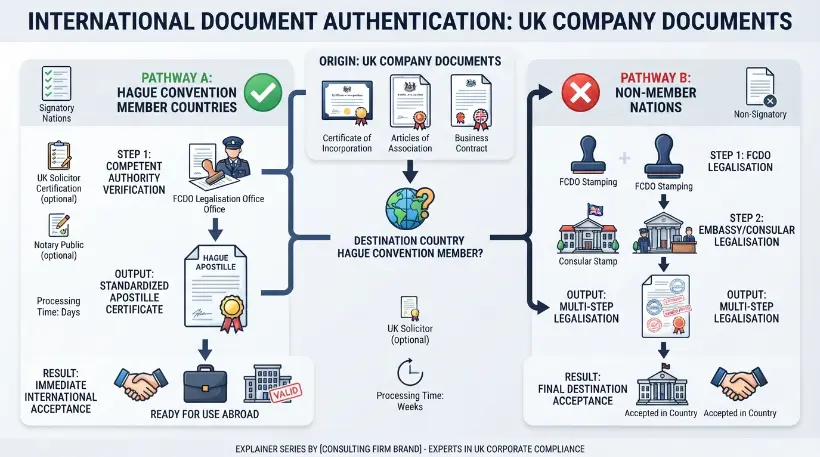
Signatory states to the 1961 Hague Convention streamline cross-border document recognition. Member governments eliminate diplomatic legalization steps through the single apostille certificate. Participating nations maintain official registries of authorized issuing officials. Administrative agencies verify apostille authenticity via digital tracking platforms.
Non-member states enforce complex consular authentication procedures. Documents destined for non-member jurisdictions require certification by domestic government departments. Foreign embassies or consulates must apply final diplomatic stamps before local acceptance. Bureaucratic delays increase substantially when dealing with non-signatory territories.
What specific documents do major trade regions demand?
Major trade regions demand specific authenticated paperwork including commercial invoices, tax registration certificates, and audited financial statements.
European Union jurisdictions enforce strict transparency directives for incoming foreign entities. Authorities demand apostilled proof of beneficial ownership and registered business addresses. Asian markets require verified corporate resolutions signed by active company directors. Middle Eastern commercial registries mandate notarized agency agreements alongside certified company extracts.
跨境 enterprises reference guides like [Can You Apostille a Certificate of Incorporation for Overseas Use?](https://formmycompany.uk/can-you-apostille-a-certificate-of-incorporation-for- overseas-use) to understand regional variations. Regulatory frameworks evolve continuously across international jurisdictions. Compliance officers monitor legislative updates to prevent documentation rejections. Strategic preparation safeguards foreign direct investments against administrative hurdles.
How do varying legal systems impact document authentication?
Varying legal systems impact document authentication by dictating whether notarization, translation, or governmental certification must precede the apostille issuance.
Common law jurisdictions rely heavily on practicing solicitors or public notaries. Civil law countries mandate court-administered verification steps before document legalization. Administrative bodies cross-reference registry data against submitted corporate filings. Discrepancies between domestic and foreign legal standards halt administrative processing.
Form My Company provides structured apostilled documents services for international businesses to bridge regulatory gaps. Professional document handlers coordinate notary execution and government certification sequentially. Compliance teams eliminate administrative friction by preparing verified dossiers accurately. Structured workflows ensure global paperwork meets exact destination requirements.
Explore our Apostilled Documents guide,
How to Plan a Carbon-Conscious Conference Step by Step?
How to Decide Which Company Documents to Apostille for Overseas Use?
Frequently Asked Questions
What is an apostille and when is it required?
An apostille is an official certificate issued under the Hague Convention that authenticates the origin of a public document for international use. Form My Company provides apostilled documents services to ensure your corporate certificates, legal agreements, and commercial paperwork are legally recognized overseas.
How long does it take to get corporate documents apostilled?
The processing time for apostilled documents typically ranges from a few working days to a couple of weeks depending on the government department and whether notarization is required. Form My Company streamlines this authentication workflow to minimize delays for international trade compliance.
Can documents be apostilled if they are not originals?
Most foreign authorities and competent government bodies strictly require original documents or certified true copies issued directly by the official registry before granting an apostille. Form My Company reviews your corporate paperwork beforehand to ensure compliance with destination country regulations.
Do apostilled documents require certified translations for overseas use?
Many non-English speaking jurisdictions mandate that apostilled documents be accompanied by a certified translation performed by a sworn professional translator. Form My Company helps coordinate these compliance steps to ensure your international business filings are accepted without rejection.
What is the difference between an apostille and consular legalization?
An apostille is recognized by all member states of the 1961 Hague Convention through a single simplified certificate, whereas non-member nations require multi-step consular legalization through foreign embassies. Form My Company manages these authentication protocols based on your exact target export market.