
No, you cannot use a single apostilled document across multiple countries unless those nations belong to the 1961 Hague Apostille Convention. Even within member states, receiving authorities often demand a recent issuance date under 6 months, which restricts cross-border reuse.
Which Countries Accept the Same Apostille?
Countries that signed the 1961 Hague Convention accept the same apostille certificate for official document recognition. Over 125 nations participate in this treaty framework to eliminate consular legalization requirements for international business.
When you operate internationally, understanding treaty memberships dictates your corporate expansion strategy. The Hague Apostille Convention creates a unified legal channel for public documents. Two member states recognize the exact same authentication stamp without requiring intervention from local embassies.
When your company expands into Europe, three major economies accept unified apostilles: Germany, France, and Spain. These nations process foreign corporate filings, registry extracts, and board resolutions under standardized treaty rules.
When you submit papers across non-member jurisdictions, standard apostilles fail entirely. Non-signatory nations require full consular legalization through local embassies and foreign ministries.
Why Do Foreign Authorities Reject Reused Apostilles?
Foreign authorities reject reused apostilles because destination governments mandate fresh domestic verification for compliance purposes. Local registrars enforce strict validity windows that invalidate certificates older than 90 to 180 days.
Cross-border corporate compliance relies on real-time data accuracy and verifiable legal standing. When a foreign registry reviews foreign incorporation papers, examiners check the issuance timestamp of the attached authentication.
When certificates age past standard thresholds, institutional reviewers flag the paperwork for potential fraud. Four common rejection triggers include expired validity windows, torn ribbons, missing seals, and unrecognised issuing authorities.
When international expansion accelerates, companies must secure apostilled documents tailored specifically to each target jurisdiction. Local compliance officers inspect authentication certificates to confirm that official signatures match current government registries.
How Does Document Type Affect Multi-Country Usage?
Document type dictates multi-country usage because corporate extracts expire rapidly while personal civil certificates hold indefinite status. Commercial registries demand current financial proof whereas vital statistics offices accept older authenticated records.
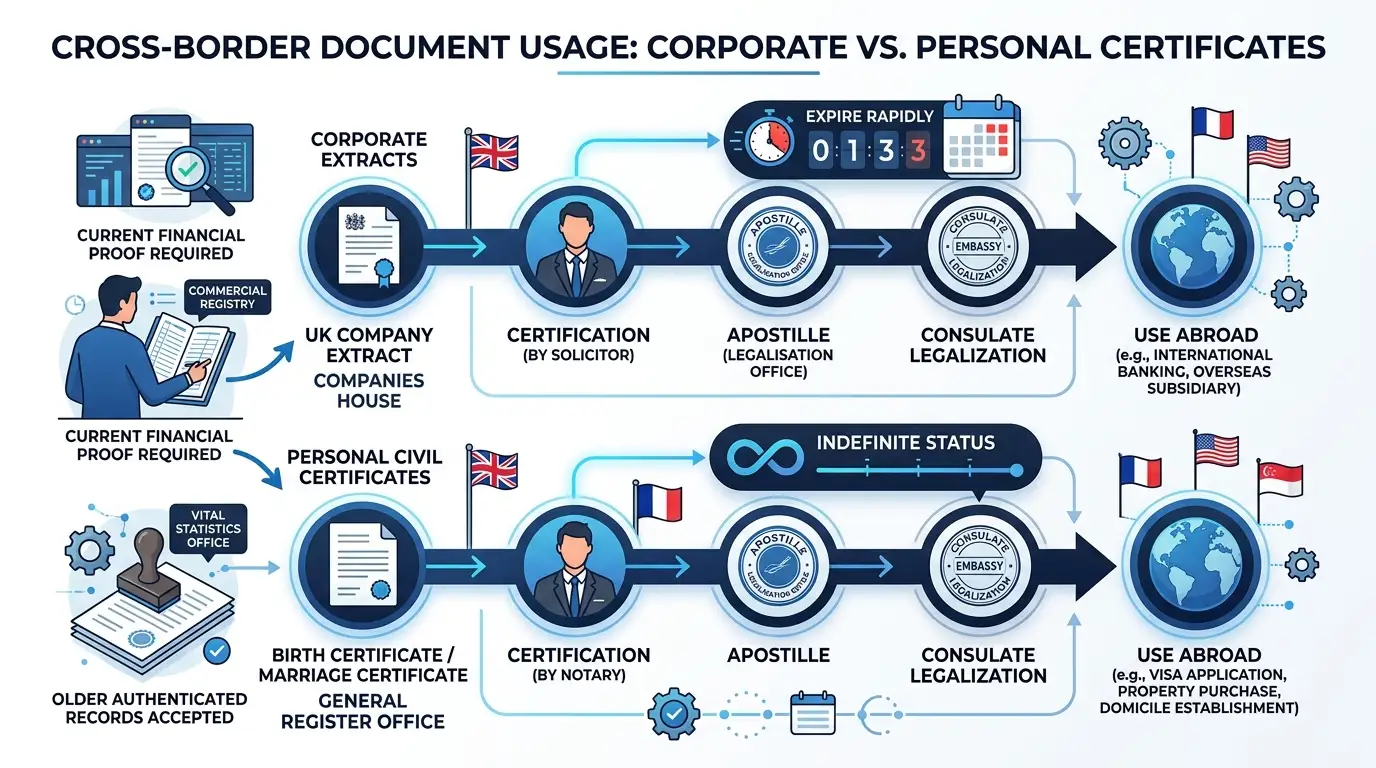
Different legal instruments carry varying shelf lives under international administrative law. A certificate of incorporation changes status whenever directors resign or share capital shifts.
When reviewing corporate portfolios, analysts examine three primary legal categories: Articles of Association, Certificates of Good Standing, and Power of Attorney instruments. Each category triggers distinct verification protocols across foreign tax authorities and banking institutions.
When managing multi-jurisdictional setups, business owners must evaluate How to Reuse an Apostilled Document Across Several Countries? to prevent costly customs delays and regulatory fines. Strategic document planning minimizes authentication overhead while satisfying strict foreign registry mandates.
What Are the Risks of Submitting Duplicate Apostilles?
Submitting duplicate apostilled documents triggers immediate application rejection, severe regulatory penalties, and extended administrative delays. Foreign courts and financial institutions blacklist entities that present unverified or outdated authentication stamps.
International regulatory frameworks treat tampered or misapplied authentication certificates as severe compliance violations. When compliance software flags a recycled apostille, local investigators freeze corporate bank accounts and suspend commercial licensing rights.
Four distinct legal consequences follow fraudulent submission: application outright rejection, mandatory corporate audits, financial penalties, and blacklisting by trade ministries.
When scaling global operations, leaders frequently ask Want to Get Apostilled Documents for Multiple Countries With Form My Company? to secure compliant, jurisdiction-specific verification packages. Form My Company coordinates official government authentication channels to ensure your corporate expansion proceeds without legal disruption.
Explore our Apostilled Documents guide,
Which UK Company Documents Can Be Apostilled?
Can You Keep a PSC’s Home Address Off the Public Record?
Frequently Asked Questions
Can an apostille be used in more than one country?
An apostille cannot be used across multiple non-treaty nations because each foreign authority requires independent verification. However, member states of the 1961 Hague Convention recognize the same authentication format, though local agencies often enforce strict issuance date limits. Form My Company assists businesses in securing targeted apostilled documents for distinct international jurisdictions.
How long is an apostilled document valid for international use?
Most foreign registries require apostilled documents to be issued within the last 90 to 180 days to ensure data accuracy. Corporate documents like certificates of incorporation expire rapidly when underlying company details change. Form My Company provides updated apostilled documents to satisfy foreign regulatory freshness requirements.
Do non-Hague convention countries accept standard apostilles?
Non-Hague convention countries completely reject standard apostilles and mandate full consular legalization through local embassies. This multi-step authentication process involves verification by the domestic foreign ministry and the destination country’s consulate. Form My Company streamlines complex international authentication workflows to ensure absolute compliance across non-member states.
What types of documents require an apostille for overseas business?
Corporate documents requiring an apostille typically include certificates of incorporation, memoranda of association, and director resolutions. Foreign tax authorities and commercial registers inspect these authenticated files to validate legal corporate standing. Form My Company processes these essential commercial records through official government authentication channels.
How does Form My Company process apostilled documents for global expansion?
Form My Company coordinates official government verification channels to authenticate corporate records for international trade and expansion. Their specialists manage the submission of legal instruments to competent authorities to secure valid apostilled documents. This structured service ensures global compliance without administrative delays or rejection risks.