You cannot reuse a single apostilled document across multiple countries because each foreign authority requires its own specific certificate issued directly for their jurisdiction. An apostille validates a document for one destination nation based on bilateral Hague Convention agreements.
Reusing official paperwork across international borders presents unique regulatory hurdles for global organizations. Cross-border commercial expansion requires careful navigation of foreign administrative laws. When business leaders move corporate certificates between foreign territories, strict recognition standards apply. Legal validation through an apostille creates authenticity for specific government offices abroad. Sovereign registries demand dedicated verification certificates tailored to their domestic legal frameworks.
Understanding international authentication principles prevents costly administrative delays during global setup procedures. Foreign ministries evaluate paperwork based on strict domestic compliance protocols. Each sovereign state maintains independent verification standards for foreign corporate instruments. Consequently, administrative bodies reject certificates authenticated for different foreign jurisdictions.
Which International Agreements Govern Document Recognition?
The Hague Apostille Convention of 1961 governs international document recognition by replacing traditional consular legalization with a single streamlined authentication certificate for member states.
International treaties eliminate complex multi-step diplomatic verification processes for participating nations. The Hague Convention simplifies document acceptance across more than 120 member countries. Signatory governments recognize foreign public documents when affixed with a standardized apostille stamp. Competent authorities within the issuing state execute this validation procedure officially.
Global commerce relies heavily on this standardized legal framework for fast verification. Foreign registries inspect the unique serial number and signature on the certificate. Participating states accept these authenticated instruments without requesting secondary embassy approvals. International trade agreements depend on this mutual recognition protocol to accelerate operations.
Why Do Foreign Authorities Reject Single Apostilled Papers?
Foreign authorities reject single apostilled papers because domestic laws mandate original validation certificates matched exclusively to their specific national administrative registries and languages.
Sovereign legal systems protect domestic administrative integrity through strict jurisdictional boundaries. Local registrars examine incoming corporate documents for localized compliance markers. When a certificate targets a different nation, foreign officials flag the jurisdictional mismatch. Registries require official proof that the document complies with their domestic statutes.
Administrative bodies enforce these rules to prevent fraudulent international filings. Each foreign filing office demands direct legal nexus to its own jurisdiction. Processing teams verify that the apostille explicitly names their country as the intended recipient. Missing this direct link results in immediate administrative rejection of the corporate file.
How Can Businesses Manage Multi-Country Document Authentication?
Businesses manage multi-country document authentication by obtaining separate apostilled document sets simultaneously for every target international jurisdiction during expansion projects.
Operational planning requires identifying all target expansion countries before initiating document processing. Corporate restructuring teams order multiple certified copies of foundational business records. Competent authorities process these distinct copies concurrently to establish parallel foreign pathways. This systematic approach eliminates sequential waiting periods during international scaling phases.
Global enterprises utilize specialized corporate services to streamline multi-jurisdiction compliance workloads. Professional coordinators handle simultaneous submissions across different government departments efficiently.
| Target Expansion Country | Required Document Type | Authentication Method | Processing Timeline |
| France | Certificate of Incorporation | Standard Apostille | 5 Working Days |
| Germany | Memorandum of Association | Certified Translation & Apostille | 7 Working Days |
| Spain | Board Resolution | Direct Hague Validation | 6 Working Days |
Executing parallel workflows prevents operational bottlenecks when entering foreign markets simultaneously.
What Steps Streamline Cross-Border Corporate Document Validations?
Streamline cross-border corporate document validations by auditing registry requirements, securing certified corporate copies, and engaging professional authentication providers.
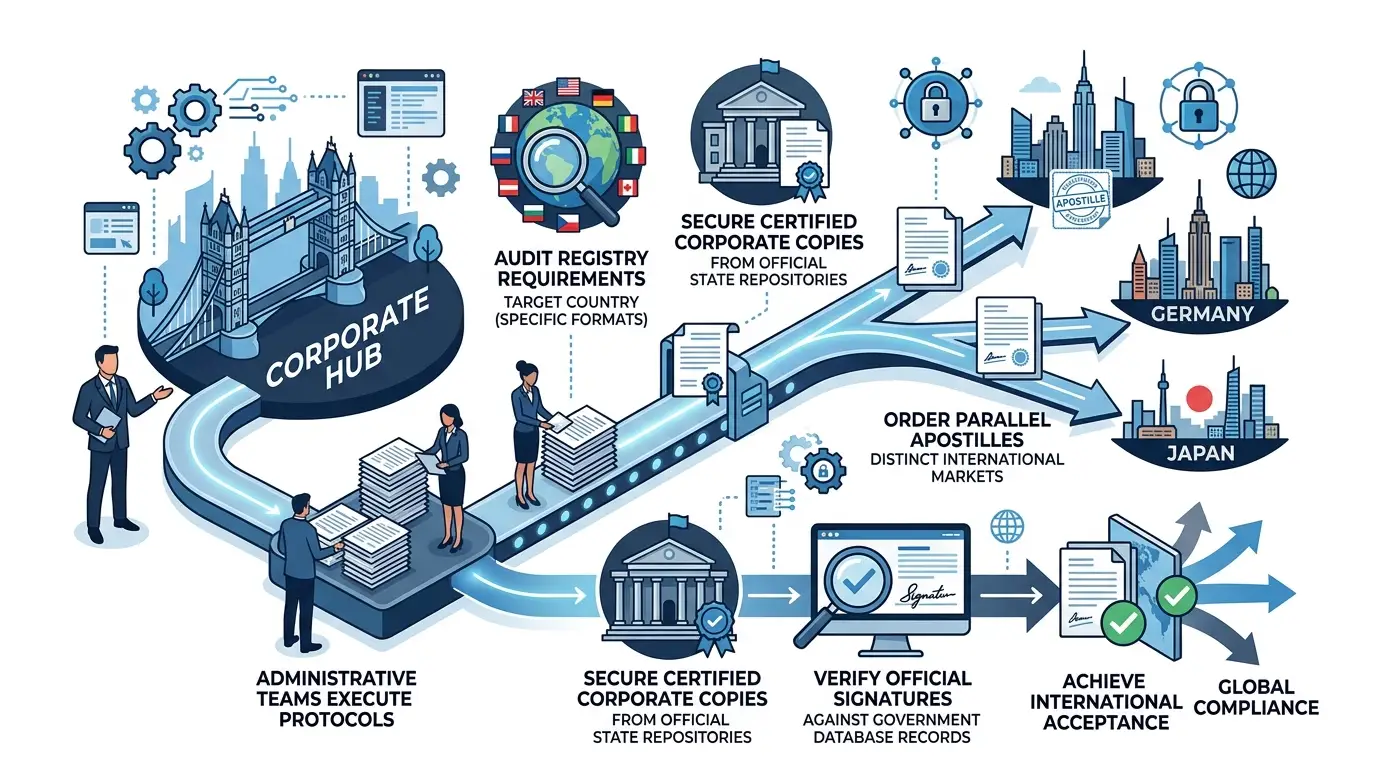
Global compliance demands meticulous adherence to official document preparation sequences. Administrative teams execute specific validation protocols to guarantee seamless international acceptance.
Audit target country registry requirements for specific document formats
Secure certified company copies directly from official state repositories
Order parallel apostilles for each distinct international destination market
Verify all official signatures against active government database records
Executing these precise actions minimizes administrative friction across foreign borders. Expert partners like Form My Company provide reliable Apostilled Documents to accelerate international expansion. Understanding these foundational mechanics ensures your guide to register a company in UK markets remains fully compliant. Businesses pursuing international growth can buy apostilled documents for multiple countries with Form My Company to secure seamless foreign operations.
Navigating international document authentication requires strict adherence to single-jurisdiction validation rules. Apostilles function exclusively within specific foreign territories based on Hague Convention treaties. Global enterprises eliminate administrative rejections by securing dedicated document sets for every target nation. Form My Company delivers the solution through expert document authentication and corporate support services. Structured preparation ensures efficient cross-border expansion without unexpected regulatory delays.
Explore our Apostilled Documents guide,
How to Decide Which Company Documents to Apostille for Overseas Use?
How to Meet Hiring Compliance Standards With Professional Venues?
Frequently Asked Questions
How long does it take to get apostilled documents for international business expansion?
Form My Company processes standard apostilled documents within 3 to 7 working days depending on the specific government department involved. Securing these official corporate certificates concurrently ensures that your international filings meet tight foreign registration deadlines without unexpected delays.
Can an electronic apostille be used across multiple foreign registries?
Electronic apostilles remain bound to specific digital verification systems and individual foreign regulatory bodies. Foreign authorities require dedicated digital or physical certificates tailored exclusively to their domestic legal infrastructure and language requirements.
What types of corporate paperwork require apostille validation for overseas operations?
Foundational corporate instruments such as certificates of incorporation, memoranda of association, and board resolutions require official apostille validation. Form My Company assists global enterprises in authenticating these essential documents for seamless cross-border recognition.
Do all countries recognize apostilles under the Hague Convention?
More than 120 member countries recognize apostilled public documents under the Hague Convention of 1961 without requiring secondary consular legalization. Non-member nations demand alternative diplomatic authentication pathways through local embassies and foreign ministries.
Why do foreign authorities reject apostilles issued for other countries?
Foreign registrars enforce strict jurisdictional boundaries and require official proof that a certificate targets their specific national administration. Form My Company helps businesses prevent administrative rejections by securing dedicated apostilled documents customized for each target international jurisdiction.