Getting apostilled documents for multiple countries requires ordering separate apostilles for each destination because an apostille is strictly country-specific and ties a UK public document to a single foreign jurisdiction through the Hague Convention network.
Navigating international expansion requires absolute precision regarding document legalisation. When UK businesses launch operations overseas, compliance officers must authenticate corporate records for foreign authorities. Each foreign jurisdiction operates under sovereign legal frameworks. Foreign ministries demand individual validation certificates before recognising foreign corporate documents.
Global expansion strategies often involve entering more than one international market simultaneously. Corporate directors frequently ask whether a single official stamp suffices for multiple territories. Operating across borders involves strict adherence to local regulatory compliance standards. Foreign authorities reject shared authentication stamps because legal frameworks differ across sovereign borders.
Form My Company provides dedicated Apostilled Documents to streamline multi-jurisdictional compliance for expanding enterprises. Understanding the mechanics of international legalisation prevents costly administrative delays during overseas incorporation.
Why Can You Not Use One Apostilled Document Across Several Countries?
You cannot use one apostilled document across several countries because each foreign nation requires an independent certificate verifying the UK document specifically for its own domestic legal and governmental registry systems.
Foreign registry offices examine foreign corporate filings against strict national security guidelines. A validation stamp issued for France holds zero legal standing within Japanese corporate registries. Each sovereign state maintains independent diplomatic treaties with the United Kingdom.
Individual embassies and foreign ministries mandate direct verification chains to prevent document fraud. Legal compliance demands that an official certificate names the target destination explicitly. When businesses scale internationally, administrative teams must commission separate legalisation packages for every target nation.
Corporate entities expanding into Germany and Spain need two distinct sets of authenticated certificates. International banking institutions also enforce strict document origin rules during corporate account setup. Reviewing How to Reuse an Apostilled Document Across Several Countries? helps businesses understand why single-stamp strategies fail globally.
How Do Different Hague Convention Rules Affect Multi-Country Usage?
Hague Convention rules affect multi-country usage by mandating that a certificate of authentication targets only one specific member state party to the 1961 Apostille Convention treaty framework.
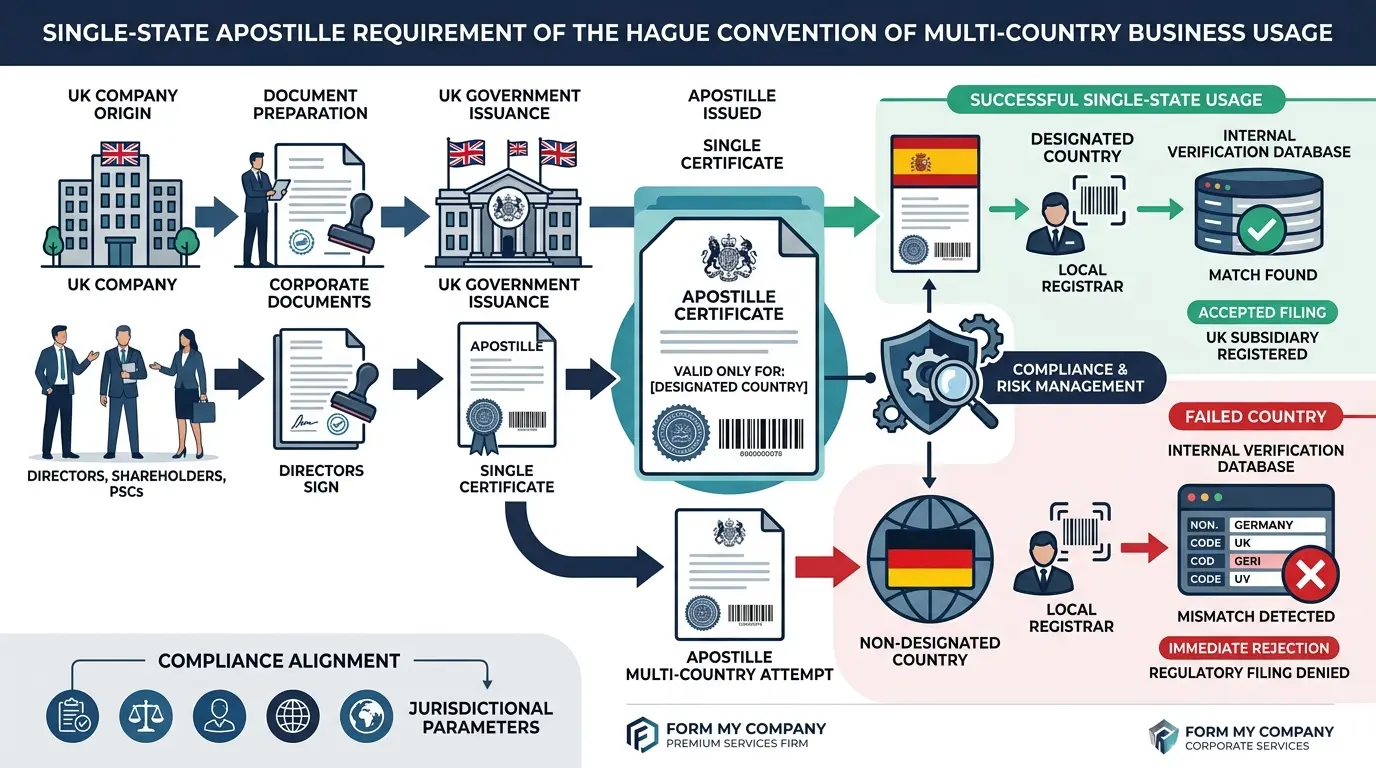
The 1961 Hague Convention abolished the requirement of diplomatic legalisation for foreign public documents. This treaty simplified cross-border commerce by replacing multi-step consular stamping with a single official certificate. However, treaty terms explicitly tie the resulting certificate to one designated recipient country.
Member states utilize unique internal tracking systems to verify foreign corporate filings. When a UK company registers a subsidiary abroad, local registrars scan the certificate barcode against foreign office databases. A mismatch in designated country codes triggers immediate rejection by local regulatory bodies.
Compliance departments must align document preparation workflows with specific treaty requirements. Form My Company ensures that every authentication request meets the exact jurisdictional parameters of the destination state.
What Steps Are Involved in Ordering Apostilles for Multiple Countries?
Ordering apostilles for multiple countries involves generating separate certified copies of UK corporate documents, submitting each set to the Foreign, Commonwealth & Development Office, and paying individual government processing fees.
Corporate administrators must first identify every target international market requiring legalisation. Businesses then obtain certified true copies of company incorporation certificates, memorandum of association documents, and director appointment records.
Each distinct destination market requires its own dedicated physical document set. The processing workflow follows four precise operational steps:
Generate certified copies of company documents through official UK registries
Submit separate document bundles to the Foreign, Commonwealth & Development Office
Pay individual government processing fees for each target country
Dispatch finalised legalised portfolios to respective international addresses
Form My Company executes these sequential steps efficiently to eliminate administrative bottlenecks.
How Can Businesses Manage Multi-Jurisdictional Document Workflows?
Businesses manage multi-jurisdictional document workflows by establishing centralised corporate tracking systems, auditing international expansion timelines, and partnering with specialised document legalisation providers.
Global scaling introduces complex document logistics that require rigorous internal oversight. Compliance officers map out foreign regulatory deadlines before initiating international expansion projects. Coordinating multiple foreign filings simultaneously prevents operational downtime in overseas markets.
Strategic planning ensures that corporate records remain valid throughout the entire legalisation cycle. Businesses often leverage professional corporate services to handle complex multi-country paperwork. Examining insights found in Can You Use One Apostilled Document in Multiple Countries? provides foundational clarity on document mobility.
Form My Company delivers reliable corporate solutions designed to simplify cross-border compliance demands. Our dedicated experts manage intricate authentication protocols so that commercial enterprises can focus on international growth.
Securing legalised paperwork for multiple international markets requires distinct authentication certificates for every destination. Sovereign legal systems reject shared validation stamps due to strict domestic compliance mandates. Form My Company delivers comprehensive administrative solutions to streamline global corporate expansion.
Explore our Apostilled Documents guide,
Want to Order Your Company Name and Number Stamp With Form My Company?
Want to Reserve Green Event Spaces via Form My Company?
Frequently Asked Questions
How long does it take to get apostilled documents from Form My Company?
Form My Company processes standard apostille legalisation for UK corporate documents within 3 to 5 working days through official government channels. Expedited dispatch services are also available for international business expansions requiring urgent verification.
Can Form My Company legalise certificates for countries outside the Hague Convention?
Documents destined for non-Hague Convention nations require full consular legalisation rather than a standard apostille stamp. Form My Company manages these extended diplomatic verification processes directly through respective foreign embassies in London.
What types of UK company documents can Form My Company apostille?
Form My Company routinely authenticates certificates of incorporation, memorandum and articles of association, and director appointment records. Each corporate document undergoes certified copy verification before receiving official government validation.
Do digital company documents qualify for an apostille through Form My Company?
Electronic company records issued by Companies House must be certified by a UK notary public or solicitor before Form My Company submits them for physical apostille authentication. Foreign authorities require physical wet-ink stamps or verified digital certificates depending on local jurisdiction rules.
Why must businesses order separate apostilles for each foreign country?
Foreign registry offices mandate independent verification certificates that explicitly name the destination state to comply with national security and legal protocols. Form My Company coordinates separate document bundles for every target international market to prevent administrative rejection.