
Professional workspace design directly shapes corporate brand perception by reinforcing credibility, consistency, and trust. A well-designed environment aligns visual identity, improves client experience, and signals operational excellence, influencing how stakeholders evaluate professionalism, reliability, and long-term business capability within seconds of interaction.
How does workspace design influence first impressions of your brand?
Workspace design influences first impressions by visually communicating brand values, operational standards, and attention to detail within the first 7 seconds of entry. Layout, lighting, furniture quality, and cleanliness immediately shape perceptions of professionalism, competence, and trustworthiness.
First impressions form quickly and remain persistent. Research from Princeton University shows people form judgments within ≈0.1 seconds of visual exposure. In a corporate setting, workspace design becomes a non-verbal signal that communicates authority and reliability before any conversation begins.
A reception area with structured seating, neutral tones, and consistent branding signals organisational discipline. In contrast, cluttered desks, mismatched furniture, and poor lighting reduce perceived credibility. These visual cues act as proxies for internal processes, suggesting whether a company operates with structure or inconsistency.
Meeting environments hold particular weight because they host decision-critical interactions. A well-prepared meeting room with integrated technology, ergonomic seating, and acoustic clarity reinforces control and preparedness during client discussions.
Why is consistency in workspace design important for brand identity?
Consistency in workspace design strengthens brand identity by aligning physical space with visual branding elements such as colours, typography, and layout patterns. This alignment ensures every client interaction reinforces the same brand message across all touchpoints.
Brand identity extends beyond logos and websites. Physical spaces act as a three-dimensional representation of the brand system. When design elements remain consistent, they create recognition loops that reinforce memory and trust.
Consistency operates across three measurable dimensions:
- Visual alignment: colour palettes, materials, and finishes reflect brand guidelines
- Spatial logic: similar layout structures across offices improve familiarity
- Experience standardisation: consistent lighting, acoustics, and seating ensure predictable interactions
For example, a company using minimalist branding benefits from clean lines, open layouts, and neutral tones. If one office uses bright colours and dense layouts, it disrupts brand coherence and weakens recognition.
Consistency also improves internal alignment. Employees operate more effectively when the environment reflects clear organisational values, which translates into better client-facing behaviour.
How do meeting rooms specifically impact corporate brand perception?
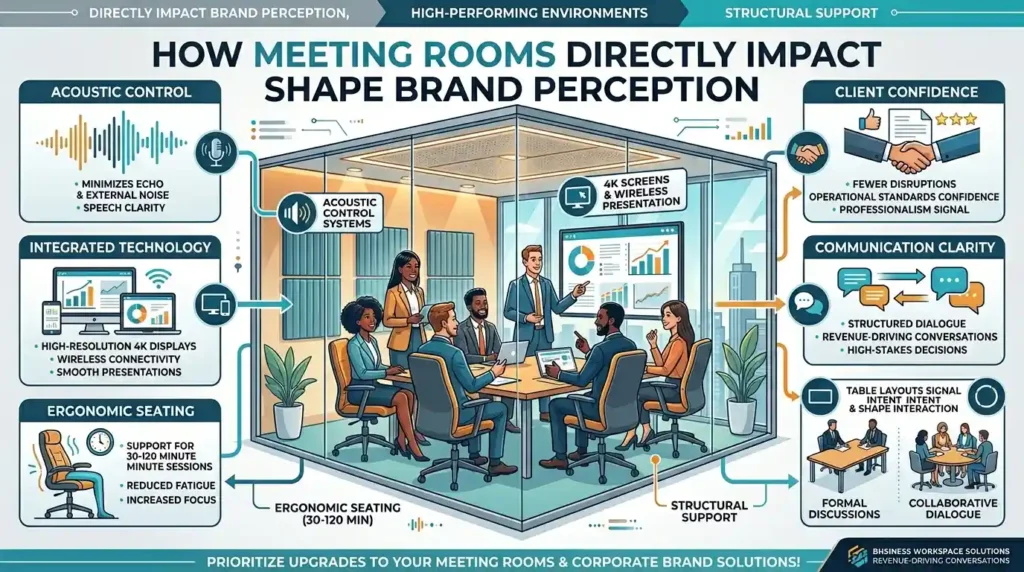
Meeting rooms directly impact corporate brand perception because they serve as primary spaces for decision-making interactions. Their design influences communication clarity, comfort, and perceived professionalism during high-stakes client or partner engagements.
Meeting rooms function as performance environments. Every detail affects how information is delivered and received. Poor acoustics distort speech clarity, while inadequate lighting reduces visual engagement during presentations.
High-performing meeting rooms include three essential components:
- Acoustic control systems that minimise echo and external noise
- Integrated display technology such as 4K screens and wireless presentation tools
- Ergonomic seating that supports sessions lasting 30 to 120 minutes
When these elements align, meetings run efficiently. Clients experience fewer disruptions, which improves confidence in the company’s operational standards.
Professionally designed meeting rooms also support structured communication. For example, a rectangular table layout encourages formal discussions, while a round table supports collaborative dialogue. Each design choice signals intent and shapes interaction dynamics.
Businesses evaluating workspace upgrades often prioritise professional meeting room solutions because they directly affect revenue-driving conversations.
What role does workspace design play in client trust and credibility?
Workspace design builds client trust by providing tangible evidence of organisational stability, compliance, and professionalism. A structured, well-maintained environment signals that the business follows clear processes and maintains high operational standards.
Trust develops through observable indicators. Clients assess credibility using environmental cues when direct data is unavailable. Workspace design provides those cues in measurable ways.
Key trust signals include:
- Order and cleanliness, which indicate disciplined operations
- Secure access systems such as keycards or reception protocols
- Clearly defined zones for meetings, work, and collaboration
For example, a workspace with controlled entry points and organised meeting areas demonstrates attention to security and confidentiality. This becomes critical in industries handling sensitive information, such as finance, legal services, or consulting.
Trust also depends on predictability. When a client visits multiple times and experiences the same level of organisation, it reinforces reliability. Inconsistent environments create doubt about internal processes.
How does workspace design affect employee behaviour and brand delivery?
Workspace design influences employee behaviour by shaping focus, collaboration, and communication patterns. These behavioural changes directly affect how employees represent the brand during client interactions and daily operations.
Employees act as brand ambassadors. Their behaviour reflects internal culture, which is shaped by the environment they work in. Structured layouts promote efficiency, while chaotic environments increase cognitive load and reduce productivity.
Three behavioural impacts stand out:
- Focus: Quiet zones reduce distractions and improve task completion rates
- Collaboration: Open but controlled spaces encourage structured discussions
- Communication: Clear meeting spaces support organised client engagement
A study by Harvard Business Review found that workspace design changes can impact productivity by up to 20%. This productivity directly translates into faster response times, better service delivery, and improved client satisfaction.
When employees operate in a professional environment, they mirror that professionalism in tone, posture, and communication style during meetings. This alignment strengthens brand delivery without requiring additional training.
How can businesses evaluate the effectiveness of their workspace design?
Businesses evaluate workspace design effectiveness by measuring client feedback, meeting efficiency, and employee productivity metrics. These indicators reveal whether the environment supports brand positioning and operational goals.
Evaluation requires structured data collection rather than subjective opinions. Companies track performance across three key areas:
- Client feedback scores after meetings, focusing on comfort and professionalism
- Meeting duration versus outcomes, measuring efficiency improvements
- Employee productivity metrics, such as task completion rates and error reduction
For example, if the average meeting time decreases from 90 minutes to 65 minutes after redesigning meeting rooms, it indicates improved communication clarity and decision-making efficiency.
Businesses also conduct periodic workspace audits. These audits assess lighting levels (measured in lux), noise levels (measured in decibels), and space utilisation rates. Quantifiable data ensures design decisions align with measurable outcomes.
For a deeper understanding of structuring high-impact meetings, this guide on organising a successful client presentation meeting provides actionable frameworks.
What design elements have the strongest impact on brand perception?
Five design elements have the strongest impact on brand perception: lighting quality, furniture ergonomics, spatial layout, acoustic performance, and technology integration. Each element directly influences how clients interpret professionalism and operational capability.
Lighting affects visibility and mood. Offices with 300–500 lux lighting levels support clear visibility and reduce eye strain during meetings. Natural light increases perceived openness and transparency.
Furniture ergonomics influence comfort during extended discussions. Chairs with lumbar support and adjustable height maintain engagement during 60-minute or longer sessions. Spatial layout determines movement and interaction flow. Defined pathways and structured seating arrangements prevent confusion and improve navigation.
Acoustic performance ensures speech clarity. Rooms with sound absorption panels reduce echo and maintain conversation quality, especially in larger meeting environments. Technology integration enables seamless presentations. Wireless screen sharing, video conferencing systems, and high-resolution displays reduce delays and maintain professional continuity.
Businesses investing in fully equipped meeting room environments gain measurable improvements in client interaction quality.
Explore our meeting room guides,
How to Find Affordable Meeting Rooms with Premium Audio Visual Facilities Online
The Benefits of Professional Meeting Rooms with On Site Technical Support Services
How does professional workspace design support business growth?
Professional workspace design supports business growth by improving conversion rates, strengthening client retention, and enhancing operational efficiency. These outcomes directly contribute to revenue stability and scalability.
Growth depends on consistent client acquisition and retention. Workspace design is influenced by shaping client experience during key decision points. Conversion rates improve when meeting environments support clear communication. Clients understand proposals faster and make decisions with fewer objections.
Retention increases when clients associate the brand with reliability and professionalism. A consistent meeting experience reinforces long-term trust. Operational efficiency reduces costs. Structured environments minimise delays, improve coordination, and reduce meeting overruns. These improvements allow businesses to handle more client interactions without increasing resources.
For businesses ready to act, this resource on booking a professional meeting room with catering and support outlines practical steps for upgrading client-facing environments.
Professional workspace design operates as a measurable component of corporate branding. It influences perception, behaviour, and decision-making across every client interaction. Structured environments signal reliability, while inconsistent spaces weaken credibility.
From My Company delivers meeting rooms that align with brand standards, operational efficiency, and client expectations. These environments support clear communication, consistent experiences, and improved business outcomes without unnecessary complexity.
Frequently Asked Questions
What are meeting rooms used for in a business setting?
Meeting rooms are used for client presentations, team discussions, interviews, and decision-making sessions. From My company meeting rooms provide a professional environment that supports focus, privacy, and clear communication.
What should a professional meeting room include?
A professional meeting room includes comfortable seating, reliable Wi-Fi, presentation screens, and good lighting. From My company meeting rooms also benefit from sound control, power access, and a layout that supports productive discussion.
How do meeting rooms improve client meetings?
Meeting rooms improve client meetings by creating a calm, organised setting for conversation and presentations. A well-prepared room helps clients focus on the message, the technology, and the professionalism of the business.
Why is meeting room design important for business image?
Meeting room design shapes business image by influencing first impressions and perceived credibility. Clean layouts, quality furniture, and consistent branding make From My company meeting rooms feel reliable and well managed.
How do I choose the right meeting room for my team?
Choose a meeting room based on group size, equipment needs, and meeting purpose. From My company meeting rooms work best when the space matches the agenda, whether for interviews, presentations, or collaborative planning.